
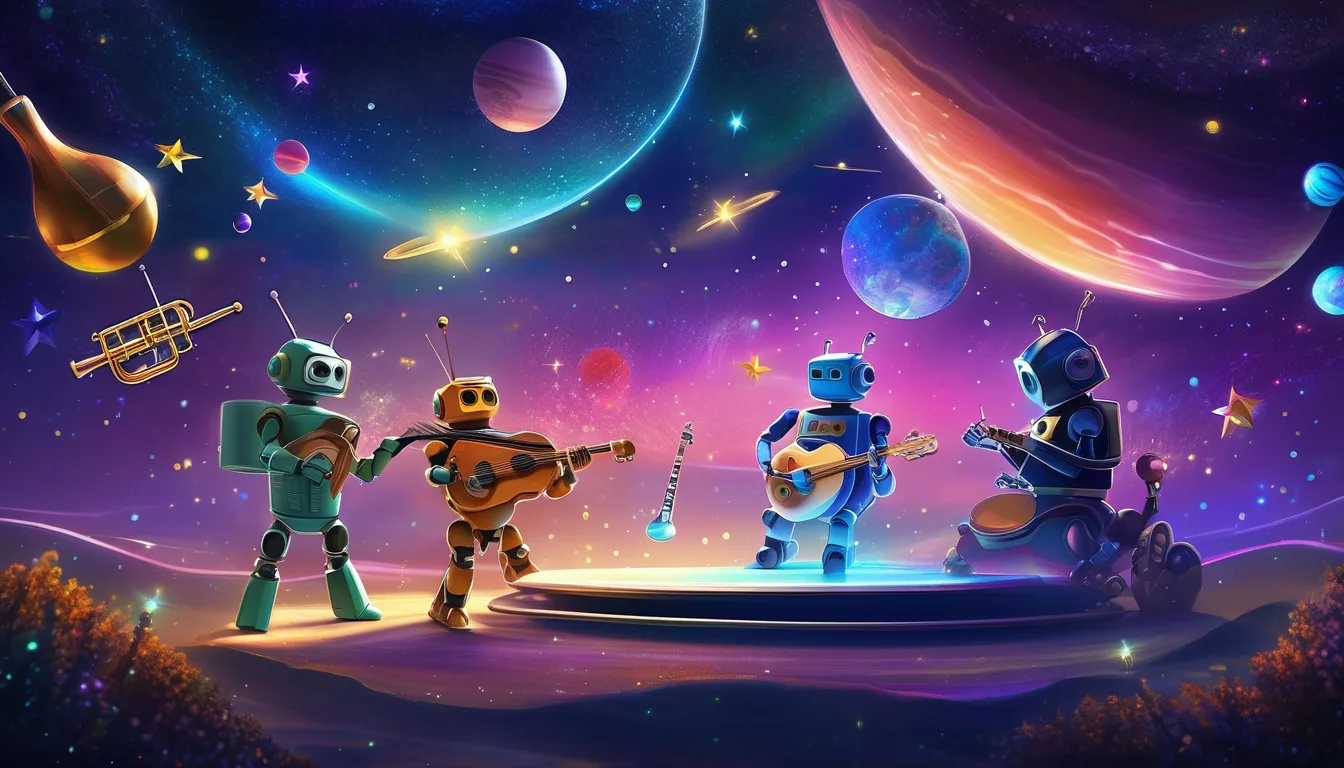
Once upon a time, in a cozy corner of the universe where the darkness sparkled with tiny diamonds, there lived a band of robots who loved to play music. They didn’t live in a city or a town, but on a tiny floating stage that drifted gently among the stars. Every night, when the planets spun quietly and the constellations began to sing their silent songs, the robots would prepare for their magical midnight concerts.
The band was made up of four special robots. There was Lulo, who played the twinkling xylophone made from shimmering moon rocks. Next to Lulo stood Pip, a round and jolly robot whose favorite instrument was a silver trumpet with tiny bells dangling from its sides. Then came Vee, the gentle robot who strummed on a harp strung with comet tails, so soft that even the sleepiest stars would sigh and sway. Last but never least, there was Tiki, bold and bright, who played a drum set built from space pebbles and old satellite dishes.
Each evening, as the sun tucked itself behind a distant planet, the robots polished their instruments with stardust and adjusted their shiny hats. They didn’t dress in ordinary clothes. Instead, they wore jackets sewn from nebula clouds and scarves patterned with swirling galaxies. Their boots glowed with soft lights, leaving sparkly footprints wherever they marched.
Lulo was always the first to start. He would tap gently on his moon rock keys, making a sound so light that it fluttered through space like a whisper. Pip would purse his lips and press his trumpet to his face, blowing a cheerful tune that made the little stars quiver with excitement. Vee would close his eyes, pluck a comet string, and let the silvery notes rise like bubbles. Tiki would count quietly under his breath, then begin to tap the pebbly drums, sending a steady heartbeat through the galaxy.
Every night, their audience appeared like magic. Stars brightened and spun, forming sparkly spirals around the floating stage. The planets leaned closer, their rings shimmering with anticipation. Even the sleepy comets paused in their journeys to listen. A handful of curious space mice perched on asteroid seats, nibbling on bits of cosmic cheese, while a family of shooting stars zipped in, trailing glittery tails.
As the music filled the sky, the stars began to dance. They would twirl and spin, sometimes alone and sometimes with a partner. If there was a particularly fast song, the stars would bounce in time, making the whole sky look like it was laughing. When the robots played a slow, dreamy tune, the stars would sway gently, humming along with soft, glowing voices.
One night, as the robot band played a song called “Lunar Lullaby,” something magical happened. A tiny blue star, just hatched from a cosmic egg, floated closer than ever before. It flickered nervously, blinking with every note. The robots noticed the little star and played softer, hoping not to scare it away. Pip gave a gentle toot on his trumpet, Vee strummed a lullaby, and Tiki played a soft beat with just his fingertips.
The little star began to glow brighter and brighter, its colors swirling like a rainbow. It spun in a circle, then zipped in and out between the robot band members, leaving trails of blue light. The audience cheered, and the robots grinned. After the show, the blue star whispered thank you in a tiny, tinkling voice. Lulo beamed and invited the star to return anytime.
From that night on, the blue star came to every concert. It brought friends too. Soon, pink and green stars joined, each taking a turn to dance or sing along. The robot band was delighted and started learning new songs just for their starry friends. They wrote “Starlight Samba” for the dancing stars, and “Meteorite Melody” for the comets that zipped by so quickly they nearly missed the music.
One evening, as the band tuned their instruments, a great silence fell over the universe. The planets didn’t twinkle, and the comets held very still. Lulo looked around and realized that the biggest, oldest star, called Grandfather Star, had drifted into view. He was so ancient and wise that his light shined softly gold and silver. The robots bowed politely, and Grandfather Star nodded, his beard trailing glitter behind him.
“We have come to listen to your song,” boomed Grandfather Star in a voice like rolling thunder. The whole sky waited. Lulo took a deep breath and began to play. The other robots followed, and together they played “Celestial Sonata,” the most beautiful song they knew. The music wound through the sky, curling around planets, brushing the tails of comets, and weaving between the arms of the Milky Way.
As the last note faded, Grandfather Star’s light grew brighter than ever. He smiled, filling the universe with warmth. “Thank you, dear robots. You have given us a gift of joy.” The stars clapped, and the space mice whistled, their tiny paws held high. Grandfather Star drifted away, still humming the melody.
After that, the robot band became famous across the galaxy. Their concerts grew even more whimsical. Sometimes, the robots invited their friends onstage to play along. Pip taught the comets how to play his silver trumpet, while Lulo handed out tiny moon rock maracas made just for little stars. Vee would gather the planets and teach them to sing in harmony, each planet humming a different note.
Tiki threw the wildest parties. On special nights, he set up extra drums, inviting any passing asteroid to join in. The sound of space pebbles drumming made the whole sky giggle. Once, a group of giggly space jellyfish floated in, their tentacles jingling with bells. They chimed along with the music, making the concert shimmer with extra sparkles.
The robot band loved to share their music-making secrets. They told the stars about rhythm and melody, about how to listen for the softest notes and how to play with their whole hearts. Even the shyest star learned to tap its light in time with Tiki’s drums or hum quietly with Vee’s harp.
Sometimes, the robots played a game called “Guess That Noise!” Lulo would play a single note, and the audience would guess what it sounded like. Was it a shooting star? A rocket zooming? The laughter that filled the sky could be heard as far as the edge of the universe.
One night, a group of tired astronauts floated by in their spaceship. They had been traveling a long way and looked very sleepy. The robots played “Sleepy Stardust Waltz,” a slow, gentle tune just for them. The astronauts smiled, tucked themselves into their cozy beds, and drifted off to sleep, dreaming of twinkling lights and dancing stars.
Time passed, but the robot band never grew tired of performing. They loved their audience and loved making music together. Every concert was different. Sometimes it was loud and exciting, with shooting stars racing around the stage. Other times it was soft and sweet, with comets drifting and planets curling up to listen.
One evening, a solar wind swept through, bringing with it a cloud of cosmic dust. The robots sneezed and shook off their jackets, laughing as the dust made them sparkle even more. Pip used the dust to polish his trumpet, and Vee wove bits of it into his harp strings, giving every note a golden shimmer.
The band liked to try new things. They once built a music machine out of old rocket parts and sang into it, making their voices echo across the stars. Another time, they performed a silent concert, using only gentle lights and colors to tell their story. The audience watched, mesmerized, as blue and purple lights danced and swirled, painting pictures in the night.
One night, the robot band noticed that the little blue star looked sad. Its light was dim, and it floated at the back of the crowd. Lulo went over and asked what was wrong. The blue star said it missed its home, a tiny patch of sky far away. The robots huddled together and played a special song, “Homeward Hymn,” full of warm, comforting notes. The blue star smiled, its light growing bright again, and promised to come back whenever it felt lonely.
The robots knew that music could heal and comfort. They often played for lost comets or lonely planets, sending love through every note. No matter how far their songs traveled, the music always found its way to someone who needed a smile.
As the years rolled by, the robot band welcomed new members. A tiny robot named Dot joined, playing a flute carved from a meteorite. She was shy at first but soon found her place, filling the sky with sweet, fluttering notes. The stars cheered when Dot played a solo, and even the grumpiest asteroid couldn’t help but grin.
The robot band’s friendship grew stronger with every concert. They helped each other tune their instruments and took turns choosing which songs to play. On their birthdays, the whole galaxy joined in singing, and the stars showered the stage with sparkling confetti.
The band sometimes traveled to faraway corners of the universe. They played on Saturn’s rings, letting the music bounce and echo. They visited tiny blue moons and swirling red storms, always bringing a little bit of magic wherever they went. The robots loved to collect small souvenirs a shiny pebble here, a feather from a comet there and added them to their music stage.
When it was time to rest, the robots would curl up together beneath a blanket of starlight. They whispered stories about their adventures and dreamed up new songs. The stars kept watch, glowing softly to keep them safe until morning.
The universe was full of surprises. One night, a friendly alien floated by on a bubble. It wore a hat made from a folded map and carried a backpack filled with strange instruments. The robot band invited the alien to join them. Together, they played a wild, wonderful tune that made the stars spin and the planets laugh so hard that their rings wobbled.
After the concert, the alien taught the robots how to play its favorite instrument, a bubbly bell that sang when you squeezed it. The robots gave the alien a pair of galaxy-patterned socks to keep its toes warm while it traveled. They promised to meet again under the same sky.
The robot band always ended their concerts with a special song. They called it “Goodnight Galaxy.” It was soft and slow, with gentle xylophone notes, a sleepy trumpet lullaby, dreamy harp music, and a soothing drumbeat. The stars would yawn and snuggle closer together, and even the comets would curl up for a little rest.
As the last note faded, the robots would wave goodnight to their friends. The space mice would tiptoe back to their cheese-shaped homes. The planets would close their sleepy eyes. The audience of stars would send one last twinkle, just for the band.
Each night, just as the robots drifted off to sleep, the universe grew a little brighter. The stars would remember the music and hum it quietly, carrying the songs to every corner of space. And somewhere, far away, a lonely traveler or a tiny star would hear that gentle melody and know that they were not alone.
So, if you ever look up at the night sky and see the stars sparkling a little more than usual, you’ll know that the robot band is playing. Their music drifts through the darkness, weaving dreams for everyone who listens. And as you snuggle into your bed, you might just hear the softest note of Lulo’s xylophone or the faint toot of Pip’s trumpet, wishing you sweet dreams and a sky full of magic.
And in that twinkling universe, the robot band will always be there, playing concerts for the stars at night, filling the sky with laughter, friendship, and the most whimsical music the cosmos has ever heard. Goodnight, little dreamer. Goodnight, shining stars. Goodnight, robot band, wherever you are.
Leave a Reply