
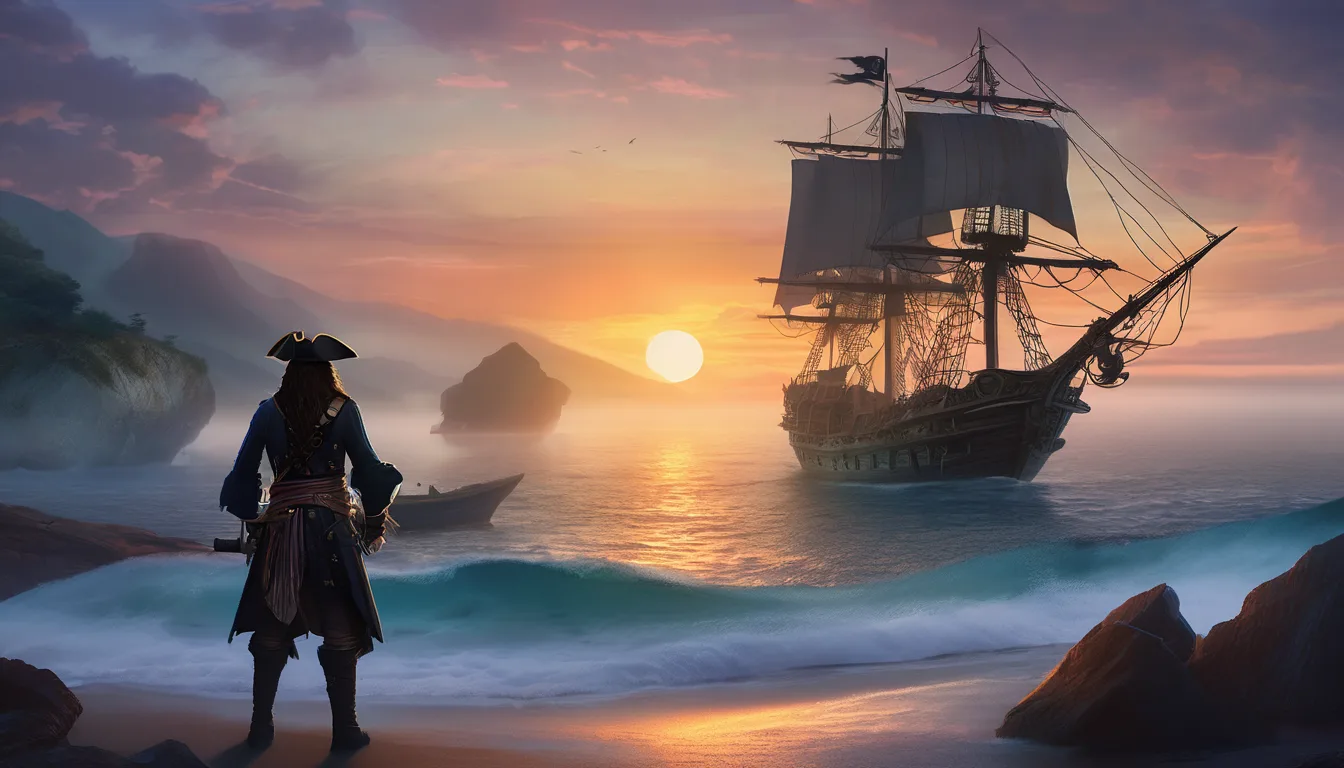
Far out on a silver-blue ocean, where the moon liked to paint a glowing path on the water each night, there sailed a small but sturdy pirate ship named The Whispering Gull. Its sails were patched with many colors, and its flag showed a laughing seagull carrying a golden shell. The ship belonged to a pirate named Captain Milo, who had hair the color of wet sand and eyes as bright as sea glass.
Captain Milo was not like the other pirates who shouted and argued and bragged about treasure. He liked quiet nights and listening to the sea. While his crew slept, he often stood alone at the rail, letting the breeze ruffle his hair, wondering what secrets hid in the deep water below. The ocean always sounded like it was trying to say something, but he could never quite understand.
One evening, after a long day of sailing with no wind and too much sun, The Whispering Gull finally glided into a wide, gentle bay. The sunset poured pink and gold across the sky, and the first stars blinked awake. The crew was tired, and even the parrot, a bright green bird named Zuzu, was too sleepy to squawk. Everyone drifted off to sleep, one by one, until only Captain Milo remained on deck.
Milo leaned over the side of the ship and watched the tiny waves tap against the hull. The water glowed faintly with little specks of light, like stars that had fallen into the sea. He dipped his fingers in, and the waves whispered against his skin. They almost sounded like words. Milo closed his eyes and listened harder.
Suddenly a small wave rose higher than the rest and brushed his ear. He heard it clearly this time. A soft sound, almost like a voice, said, “Milo.” The captain jumped back, his heart thumping. He spun around, but no one stood beside him. The crew snored below deck. Zuzu muttered sleepily into her feathers. The night was still.
Very slowly, Milo leaned over the rail again. Another wave rolled in, gentle and shy. It curled around a piece of driftwood and carried it close to the ship. As it reached the hull, it spoke again, just for him. “Milo. Listen.”
Milo’s eyes widened. “Waves do not talk,” he whispered. “Not really.” But the wave only shimmered and faded away, leaving behind the driftwood, which bumped softly against the side of the ship. Curious, Milo reached down with a boat hook and lifted it out of the water.
The driftwood was smooth and worn, shaped like a flattened oval. On one side, someone had carved a small symbol. It looked like a spiral with tiny lines reaching out, like a sun or a shell. Milo traced it with his thumb. It felt warm, as if it had been sitting in the sun all day, even though night had already fallen.
He took the driftwood to the lantern and studied it. The spiral seemed to twist and turn as he stared, as if the shape itself was moving. Milo felt a strange flutter in his chest, like tiny fish swimming in his heart. He carried the driftwood to his cabin, set it on his desk, and sat down. The ship rocked gently, and the sound of the waves outside became slower and softer, like breathing.
Something inside him said, Ask. So, in a quiet voice, he said, “What are you?”
The ship creaked. The candle flickered. The night outside hummed with the low song of the sea. Then, from the driftwood, he heard the faintest reply, like a whisper caught in a shell. “I am a message. For you, Captain Milo.”
Milo’s eyes grew as round as silver coins. “A message for me? From who?” His voice came out squeaky and surprised. He cleared his throat and tried again, a bit braver this time. “From who?”
The driftwood shimmered, and a tiny droplet of seawater formed on its surface, then slid down like a tear. The whisper drifted up again. “From the waves. From the paths of the wind. From someone who waits.” The voice was not a man’s voice or a woman’s voice. It sounded like foam and wind and sand all mixed together.
Milo’s heart pounded. He had always believed the sea was alive in some secret way, but he had never expected it to speak directly to him. “Why me?” he asked. “There are many ships, many captains. Why send a message to a small pirate like Milo?”
Outside, a soft wind rose, and the ship gently turned. Far off, a low swell rolled toward the bay. The driftwood pulsed with a faint glow. “Because you listen,” the whisper said. “You hear our sighs against the hull. You watch the color of the waves. You do not shout over our song. So we chose you.”
The words wrapped around Milo like a warm blanket, but they also made him feel very small. “What do you want me to do?” he asked, his voice barely louder than the whisper itself.
The driftwood brightened, then dimmed, like a slow heartbeat. “Follow the path we draw. We will carry messages in our waves, just for you. There is something lost that must be found. Someone waiting who must be reached. Trust us, Captain Milo. Read the sea.”
Milo frowned thoughtfully. A pirate liked treasure, of course, but this sounded like a different kind of treasure. Something important and secret. He took a deep breath. “All right,” he said at last. “I will follow your path. But how do I read the sea?”
That night, sleep slipped away from him like a fish. He lay in his hammock, listening to the water tap and murmur against the hull. Every now and then, he thought he heard his name, or a soft word, but it faded before he could understand. Finally, just before dawn, he drifted into a shallow, dream-filled sleep.
In his dream, Milo floated on his back in the open ocean. The sky was deep purple, and the stars hung low, almost close enough to touch. Each star dropped a thin silver thread down into the water. The threads turned into lines of waves, stretching across the sea like secret writing. Milo watched them form words he could not quite read. When he reached out to touch one, he woke up with a gasp.
Morning came golden and bright. The crew bustled about, not knowing anything was different. There was a cook named Rania, who made the best coconut porridge, a tall sailor named Tomasz who could climb the rigging faster than anyone, and a quiet navigator named Mei who always knew where they were by looking at the stars. They all greeted Captain Milo, but he only nodded, his mind still swimming with whispers and silver threads.
He went to the rail and looked down. The sea sparkled in the morning sun, cheerful and ordinary. But Milo knew it was not ordinary at all. Somewhere in the waves, messages waited. He had to learn how to see them, to feel them. He had to trust that the sea really had chosen him.
“Captain,” called Mei, her dark hair tied back neatly. “There is a gentle wind from the south. Where should we sail today?”
Milo hesitated. Before, he would have checked his maps and chosen a good place to search for treasure or trade. Now he looked at the water instead. Tiny ripples moved in one direction, then curved another way, as if drawing a path. He felt a tug in his chest, like a soft hand pointing.
“We will follow the waves,” he said slowly. “Where they lean, we go.”
The crew exchanged puzzled glances, but they trusted their captain. Tomasz raised the sails. Rania tied the lines. Mei adjusted the compass and charted their path. The Whispering Gull turned and slipped out of the bay, following the faint, curving lines of the water.
As the day went on, the wind grew steady and kind. The ship sailed over swells that rose and fell like the backs of sleeping whales. Milo watched every pattern, every glimmer, every tiny curl of foam. He began to notice things he had never cared about before. One wave would lift the bow a little higher, as if nodding. Another would tap the side twice, like a knock on a door.
At midday, when the sun blazed bright white above, a pattern finally appeared. A line of darker blue water stretched ahead, different from the rest. The waves along that line moved in a neat row, almost like writing on a page. Milo leaned forward, his breath caught in his throat.
The line of waves curved left, then right, then left again, forming a shape that looked like the spiral on the piece of driftwood. Milo ran to his cabin, grabbed the driftwood, and held it up. The spiral on the wood glowed faintly, and the waves ahead seemed to answer, their pattern growing clearer.
“Mei,” he called. “Turn the ship to follow that dark line of water.”
Mei shaded her eyes and peered ahead. “It is only a change of current, Captain,” she said. “It might lead us into a storm. Are you sure?”
Milo looked from the waves to the driftwood and back again. His heart said yes. The whisper of the sea brushed his ears, though he could not hear the words. “I am sure,” he replied. “Follow it.”
So The Whispering Gull turned, its colorful sails billowing as it slipped onto the dark blue path. The crew felt the ship move differently at once. It was as if they had stepped from a crowded road onto a secret, hidden lane. The water grew smoother. The wind hummed softly in the rigging, like a quiet song.
For three days and three nights, they followed the dark blue path. Sometimes it was clear as ink on paper. Sometimes it faded, and Milo had to stand at the rail for hours, watching and listening, until it appeared again. The crew grew curious but did not complain. Rania brought him cups of sweet tea. Tomasz told jokes to keep everyone cheerful. Mei watched the stars each night and frowned at her maps.
“According to the stars, we are heading toward the Sea of Forgotten Names,” Mei said on the third evening, as the sun sank into a band of purple clouds. “No one sails there. The maps are empty. There are stories of lost ships and wandering islands.”
“Stories are often born from something true,” Milo said quietly. “But so are new paths. The waves chose us. We must keep going.”
That night, the sea changed. The waves grew taller and slower, their tops tipped with pale green foam that glowed faintly in the dark. A mist drifted over the water, soft and cool, wrapping the ship in a silver veil. The crew huddled close, their voices low. Even Zuzu tucked her head under her wing and said nothing.
Milo stood alone at the bow, the driftwood in his hands. The spiral gleamed brighter than ever, casting a soft light on his face. The waves around the ship rose and fell in a careful rhythm, like a heart beating. Then, all at once, he heard it again. His name, carried by the sea.
“Milo,” the waves whispered. “Milo.”
He knelt at the very front of the ship and reached down, his fingers almost touching the glowing foam. “I am here,” he said. “I am listening.”
The waves lapped at the hull, and the mist swirled, gathering itself into shapes. For a moment it looked like a doorway of fog, tall and arched. Then it drifted apart and formed something else. A face. Not a clear face, not like a person standing right in front of him, but a soft, shimmering shape with eyes like moonlit water and hair like seaweed.
Milo’s breath caught. “Who are you?” he whispered.
The watery face smiled, a slow, gentle smile. “I am part of the sea. Part of its memory. You may call me Neris. Long ago, when the world was younger, we spoke with sailors often. But people stopped listening, and our voices grew thin. Only a few still hear us. You are one of them, Milo.”
Milo swallowed, his throat tight. “Why did you call me? What is lost that must be found?”
The mist shifted, and the waves below deepened to a darker blue, almost black. The face of Neris grew sad. “There is an island that does not remember its own name,” the voice said softly. “Once it was bright and full of music. Children laughed on its shores. Birds nested in its trees. But a great storm came, a storm of forgetting. The island’s name was washed away, and with it, the way home for those who loved it.”
Milo listened, his heart aching for a place he had never seen. “Where are those who loved it?” he asked.
“Scattered,” Neris replied. “Some on distant coasts, some on other islands, some on ships that never found land again. They dream at night of a shore they cannot name, of a song they cannot hum. The island waits, half asleep, wrapped in fog. It needs someone who can hear the sea, someone brave enough to follow waves that carry messages, to find its true name once more.”
Milo felt the weight of the words settle on his shoulders, light and heavy all at once. “You want me to find the island and its name,” he said.
“Yes,” Neris replied. “You must listen to the waves, for they remember. Each wave that touches that island carries a piece of its story. Follow those pieces. Gather them. When you know the name, speak it aloud upon its shore. Then those who are lost may find their way back.”
Milo looked back at his sleeping crew, then at the endless, misty water ahead. Fear prickled at the back of his neck. What if he failed? What if he never found the island? What if they all became lost in the Sea of Forgotten Names?
As if hearing his thoughts, Neris’s face grew kinder. “You are not alone, Milo,” the voice said. “Your crew is strong. Your heart is steady. And we, the waves, will guide you. Whenever you doubt, put your hand in the water and listen. The sea will answer.”
Milo nodded slowly. “All right,” he whispered. “I will go.”
The mist swirled, and Neris’s face faded, sinking back into the waves. The glowing foam dimmed. The night grew quiet again, but the air still felt full of something important and unseen. The ship rocked gently, like a cradle on the water.
The next morning, the Sea of Forgotten Names lived up to its strange title. Everywhere Milo looked, there was only water and mist. No land. No birds. No other ships. The sky was pale, and the air smelled like old rain. The crew grew restless. Rania tapped her spoon against a pot. Tomasz paced. Mei stared at her empty maps and frowned.
“Captain,” Mei said at last, “we are far beyond any chart I know. We cannot sail in circles forever.”
Milo rested his hands on the rail. “We are not sailing in circles,” he said. “We are following stories. The waves remember an island that forgot itself. We must listen to them.”
Rania crossed her arms. “Listen to waves?” she repeated. “I listen to bubbling stew, not splashing water.”
Zuzu, perched on the rigging, fluffed her feathers and squawked, “Listen, listen, pirate pigeon!”
The crew chuckled a little, and the tight knot of fear loosened. Milo smiled. “Come,” he said. “I will show you.”
He led them all to the side of the ship. The water below looked gray and still, but Milo knew better now. He knelt and dipped his hand in. For a moment, nothing happened. Then a faint warmth curled around his fingers, like a tiny fish brushing past. He closed his eyes and listened.
At first, he heard only the soft slap of waves, the creak of wood, the sigh of the wind. He breathed slowly and tried to quiet his thoughts. Then, like a hidden tune rising from far away, he heard something else. A sound like many voices, far and faint, singing a word he could not quite catch.
He frowned and leaned closer. The word slipped away whenever he tried to grab it with his mind. It reminded him of the dream with the silver threads and the unreadable writing. The island’s name was there, in pieces, scattered across the sea.
Milo opened his eyes. “The waves are singing,” he said softly. “They are singing a name, but it is broken. We must follow the parts of the song until it becomes whole.”
Tomasz scratched his head. “How do we follow a song in the water, Captain?”
Milo thought. The driftwood in his pocket warmed. He pulled it out, and the spiral glowed faintly. “Where the song is louder, the waves will look different,” he said slowly. “Like the dark blue line we followed before. Mei, keep your eyes on the water. Look for any change in color or pattern. Tomasz, climb up to the crow’s nest. You may see from higher up what we cannot see from here.”
So Mei watched the surface with sharp, careful eyes, and Tomasz climbed into the swaying nest at the top of the mast. The ship moved forward slowly, its sails half full, gliding over gentle swells. The mist thinned and thickened, like curtains opening and closing.
Hours passed. Rania hummed as she cooked, trying to keep everyone’s spirits up. Zuzu hopped from rope to rope, muttering bits of sailor songs. Milo stayed at the rail, hand in the water whenever he could, listening to the broken, faraway singing.
Then Tomasz shouted from above. “Captain! I see something different ahead. A line of waves, darker and brighter all at once.”
Milo’s heart leaped. “Point the way,” he called.
Tomasz pointed, and Mei turned the wheel. The Whispering Gull slid toward the line Tomasz had seen. As they drew near, Milo felt the song in the water grow a little stronger. Still not clear, still broken, but closer now. Like a word on the tip of his tongue.
For many days, they repeated this strange work. Tomasz watched from above, Mei watched from the deck, Milo listened with his hands and his heart. They followed dark lines of water, patches of glowing foam, ripples that moved in a different rhythm. Each time, the song of the waves grew a tiny bit clearer. They heard little pieces of the island’s name, like “Na” and “Lo” and “Re,” but never the whole thing.
Sometimes the crew grew tired and grumpy. The days blurred together. The sky and sea looked the same. Rania missed the smell of land and fresh fruit. Mei missed her maps. Tomasz missed the feeling of knowing exactly where he was.
One evening, when the sky was a soft blue-gray and the sun was hidden behind clouds, Rania stomped up to Milo. “Captain,” she said, her hands on her hips, “we are chasing a song in the water. What if this island does not want to be found? What if we are all just lost in a story?”
Milo looked at her, then at his crew, gathered nearby. They were brave, but their courage was wearing thin. He reached into his pocket and held up the driftwood. The spiral glowed, casting a warm light on their faces.
“I do not know every answer,” he admitted. “But I know that the sea chose us. I know that there are people who dream of a home they cannot name. I know there is an island waiting. If we turn back now, we will always wonder. If we go on, we might be afraid, we might be tired, but we might also bring back something beautiful that was lost. I would rather be tired and brave than rested and wondering.”
The crew fell silent. Rania’s face softened. Tomasz nodded slowly. Mei looked out at the water, and for the first time, she seemed to see it not as empty space, but as a page covered with invisible writing.
“All right, Captain,” Rania said. “We will follow the story with you.”
That night, the sea rewarded their patience. The wind shifted, bringing with it a smell none of them had noticed before. It was faint, but it was there. A hint of flowers, of warm sand, of ripe fruit. Land, somewhere ahead.
Milo stood at the bow, the smell filling his lungs. His heart raced. He dipped his hand in the water again, and this time the song of the waves was stronger. The broken pieces of the name twined together, almost making sense. He could feel it just out of reach, like a word drifting just beyond his memory.
The mist thinned, then parted like a curtain. Ahead, far in the distance, they saw a shape. At first it looked like a cloud sitting on the water. Then it grew clearer. A sloping hill. A line of trees. A beach. An island.
The crew cheered, their voices bright and relieved. Zuzu whirled in the air, squawking, “Land ho, land ho, pirate mango!” Milo’s eyes stung with tears he did not quite understand. The island looked lonely and quiet, as if it had been waiting a very long time.
As they sailed closer, Milo felt a strange hush fall over the ship. The island’s shores were wrapped in a soft, silver fog that curled around the rocks and trees. The water near the beach was very still, as if holding its breath. No birds flew overhead. No waves crashed. It was beautiful, but it felt half asleep.
The Whispering Gull dropped anchor in the shallow bay. The crew lowered a small boat. Milo climbed in, clutching the driftwood in one hand. Mei, Tomasz, and Rania joined him, their faces serious and curious. They rowed toward the shore, the oars dipping into the silent water with soft, careful splashes.
When the boat scraped gently against the sand, Milo stepped out and felt the island beneath his boots. The sand was cool and fine, like powdered shells. The air smelled of flowers and something he could not name. The fog swirled around his ankles.
“Hello,” Milo said softly, feeling a little foolish, talking to an island. “We have come to find your name.”
For a moment, nothing happened. Then a tiny breeze stirred, lifting a few grains of sand. The fog shifted. From somewhere deep in the trees, a faint sound drifted out. It might have been a note of music. It might have been a sigh.
Milo walked slowly up the beach, the others behind him. The driftwood in his hand grew warmer, its spiral glowing steadily now. The sand gave way to soft grass. Strange flowers bloomed in colors he had never seen before, petals shaped like tiny stars. The trees were tall, their leaves wide and glossy, but there were no birds in their branches.
“The island feels lonely,” Mei whispered.
Milo nodded. “It has forgotten its name,” he said. “Imagine if you forgot your own. How would you call yourself? How would others call you home?”
They reached a small clearing where a single tree stood, taller than the rest. Its trunk was wide and twisted, its roots curling out of the ground like gentle waves frozen in wood. At its base lay a smooth, flat stone, half covered in moss.
Milo knelt and brushed the moss away. On the stone, worn and faded, he saw carved lines and curls. Words, once clear, now washed almost away. He traced them with his fingers, but he could not read them. The letters were broken, just like the pieces of the song in the sea.
He closed his eyes and placed the driftwood on the stone. The spiral flashed brightly, then sank into a soft, steady glow. The air around them grew warmer. The faint sound from the trees grew louder, like a distant choir humming a tune.
Milo put his hand flat on the stone and listened. He listened with his ears, with his skin, with his heart. He listened the way he had listened to the waves at night, to the dreams of silver threads. Slowly, the broken bits of sound began to join.
“Na,” whispered the wind. “Lo,” sighed the trees. “Re,” hummed the ground. “Si,” sang the distant waves. “A,” breathed the fog around them.
The sounds swirled together, growing clearer, stronger. “Na lo re si a,” they sang. “Naloresia.”
Milo’s eyes flew open. The name hung in the air, bright and shining. Naloresia. It tasted like sunlight and salt and something sweet on his tongue. He looked at the tree, at the stone, at the island that seemed to lean closer, listening.
He stood, his knees trembling a little, and took a deep breath. Then, in a strong, clear voice, he called out, “Naloresia. Your name is Naloresia.”
The word rang through the clearing like a bell. It flew up into the branches, slipped into the grass, dove into the soil, and rushed down to the shore. The island shivered, as if waking from a long sleep.
The fog around them lifted, swirling up into the sky and vanishing like breath on a mirror. Sunlight poured down, bright and golden, lighting every leaf and flower. Suddenly, birds burst from the trees, their feathers flashing blue and red and yellow, singing loud, joyful songs.
On the beach, waves began to move again, rolling in with happy splashes. They laughed against the rocks. They ran up the sand and back again, as if dancing. The water glittered with tiny points of light, brighter than before.
Milo felt the ground under his feet pulse gently, like a heartbeat. The island whispered its own name back to him, over and over. “Naloresia. Naloresia.” It sounded joyful and proud and relieved.
Rania laughed, her eyes shining. “We did it,” she said. “We really did it.”
Mei turned slowly, taking in the now-lively forest, the chattering birds, the colorful flowers. “The island remembers itself,” she murmured. “It is awake.”
Tomasz pointed toward the sea. “Look,” he said softly.
Out on the water, shapes appeared in the distance. Sailboats, small fishing vessels, even a few larger ships. They came from all directions, their sails full, their bows cutting through the waves with purpose. As they drew closer, Milo saw the faces of the people on them.
Some were old, with weathered skin and white hair, tears already streaming down their cheeks. Some were young, eyes wide and shining. Some looked tired, as if they had been searching for a very long time. All of them stared at the island with a look Milo understood in his bones. Recognition. Home.
One small boat glided into the bay, carrying a family. A dark-haired woman with a baby tied to her back, a man with kind eyes, and a little boy with curls that bounced when he moved. The boy stood up in the boat and pointed at the shore, shouting, “Mama, that is it! That is the place from my dreams!”
The woman’s lips trembled. “I dreamed of it too, when I was small,” she whispered. “But no one knew its name. No one believed me.”
Milo’s heart swelled. More boats arrived, more people stepping onto the sand, looking around with wonder and relief. They walked as if the ground was greeting them, as if the trees were old friends. Some knelt and kissed the earth. Some laughed. Some cried. The island seemed to hum with happiness.
A tall, gray-bearded man approached Milo, his eyes bright with tears. “You found it,” he said hoarsely. “I thought it was gone forever. I thought I was foolish to remember it. But you found Naloresia.”
“It was the waves,” Milo replied quietly. “They carried the messages. They remembered the name, even when the island forgot. I only listened.”
The man nodded slowly. “Then you listened well, Captain.” He placed a hand over his heart. “I was born here. I left as a young man, and when I tried to return, the sea was empty. The name slipped from my mind like water through my fingers. But now” he looked around, smiling through his tears “now it is all coming back.”
The day passed in a soft, happy blur. The people who had dreamed of Naloresia began to settle once more on its shores. They sang songs that had nearly vanished from their memories. They told stories of a time before the great storm of forgetting. Children ran along the beach, their laughter bright and free.
Milo and his crew helped where they could, carrying supplies from the ships, building small shelters, sharing food. Zuzu flew from shoulder to shoulder, copying bits of songs and making everyone laugh with her silly words. The Whispering Gull bobbed gently in the bay, its sails fluttering in the warm breeze.
As the sun dipped low, painting the sky with pink and orange, Milo walked alone to a small hill that overlooked the sea. He sat and watched the waves roll in and out. They seemed calmer now, content. The song in the water was different. No longer broken and searching. Now it was a lullaby.
He took out the driftwood and turned it in his hands. The spiral had faded a little, its glow softer, but he could still feel a quiet power in it. He knew the sea would always hold more secrets, more messages, more stories. But this one, for now, was done.
A gentle splash sounded behind him. He turned and saw a small wave rise up the hill, which should have been impossible. It curled around his boots and then stilled, holding its shape like a liquid hand. In its surface, for just a moment, he saw the face of Neris.
“You have done well, Milo,” Neris said, the voice as soft as foam. “Naloresia remembers its name. Those who were lost have a path home. The sea is grateful.”
Milo smiled, his eyes warm. “Thank you for trusting me,” he replied. “I am only a small pirate, with a small ship.”
“You are not small to us,” Neris answered. “You are one who listens. That is rarer than gold. Remember, the waves will always carry messages. Not always as clear as this one, not always for you, but whenever you place your hand in the water and quiet your heart, you may hear us.”
Milo nodded. “Will there be other islands that forget? Other names that are lost?”
“Perhaps,” Neris said. “The world is wide, and storms still come. But now there is a pirate who knows how to read the sea. If the time comes, we will call you again. For now, rest. Let your ship dream in this gentle bay.”
The wave slipped back down the hill and melted into the sea. The surface smoothed, then sparkled in the last light of the sun. Milo sat for a while longer, feeling the steady beat of Naloresia beneath him, like a sleeping giant’s slow, peaceful breath.
When the stars began to appear one by one, he returned to the beach. The crew had built a small fire. People from the island sat around it, sharing food and stories. Someone was playing a simple tune on a flute, and others hummed along. The air was soft and warm. It smelled of wood smoke and sweet fruit and sea salt.
Rania handed Milo a wooden bowl filled with ripe, golden slices of a fruit he did not know. “From Naloresia,” she said with a grin. “The taste of a remembered island.”
Milo took a bite. The flavor burst on his tongue, sweet and tangy, like sunshine and rain together. He laughed softly. “We must come back,” he said. “Not as rescuers next time, just as visitors.”
Mei stretched her legs toward the fire. “I will need to make new maps,” she said. “Maps with Naloresia on them. So it is never forgotten again.”
Tomasz leaned back on his elbows, looking up at the stars. “And I will tell sailors in every port,” he added. “About the captain who listens to waves, and the island that remembered its name.”
Zuzu hopped onto Milo’s shoulder and whispered in his ear, “Captain sea-ears, captain sea-ears.” Milo chuckled and scratched the parrot’s neck.
That night, Milo lay on the deck of The Whispering Gull instead of in his cabin. The ship rocked gently on the calm water. Above him, the stars shone bright and friendly. Below, the waves hummed a soft, steady song. Naloresia glowed quietly in the distance, its trees swaying in the night breeze, its shores peaceful at last.
Milo rested one hand over the side, letting his fingers trail in the cool water. He listened. The waves brushed against his skin and whispered, not words this time, but feelings. Gratitude. Peace. A promise that they would always remember him, just as he would remember them.
His eyes grew heavy. The sounds of the sea and the soft creaks of the ship wrapped around him like a blanket. He thought of all the stories still waiting in the world, hidden in ripples and tides and forgotten places. He thought of the day the waves had first spoken his name.
As sleep gently pulled him close, the waves seemed to murmur one last clear, quiet sentence, meant only for him. “Good night, Captain Milo. Dream of silver paths and names that shine.”
And Captain Milo, the pirate who had learned that waves can carry messages meant only for him, smiled in his sleep as The Whispering Gull floated on the softly singing sea, under a sky full of listening stars.






Leave a Reply