
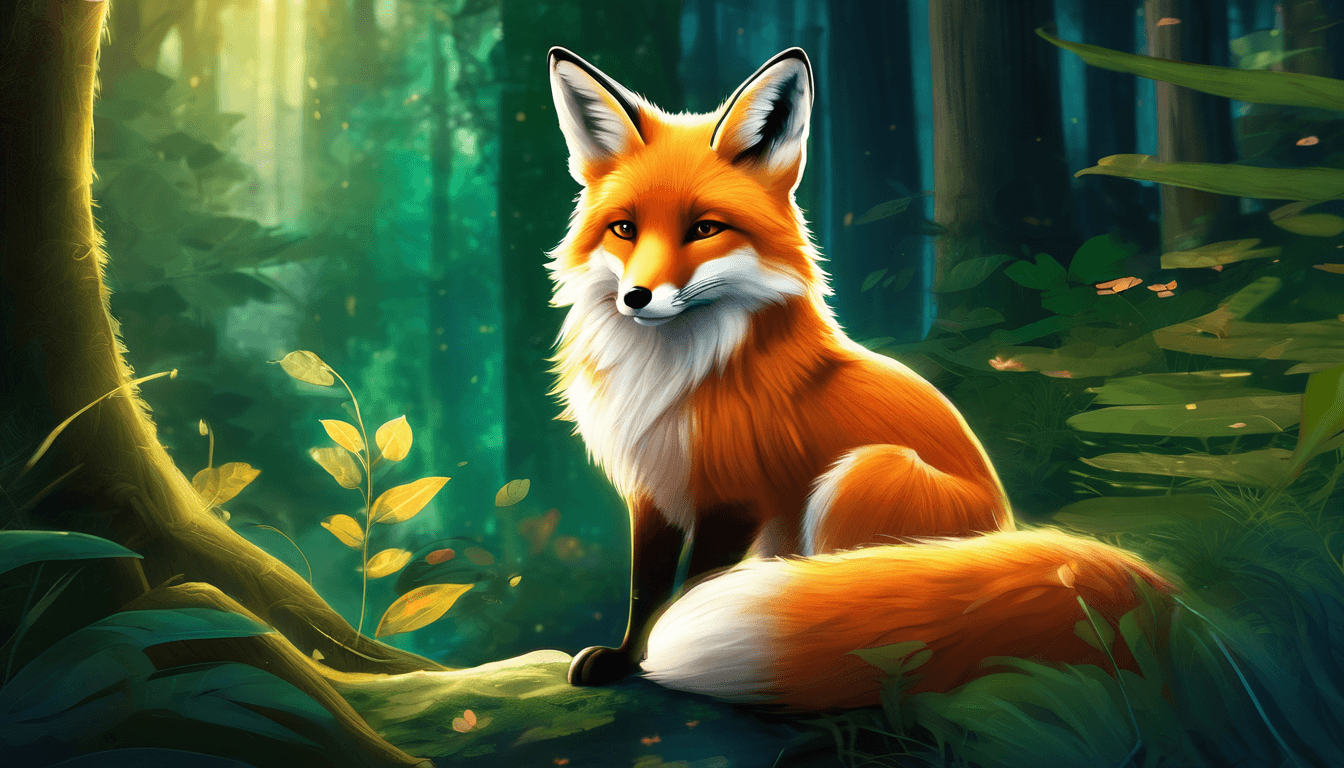
In a quiet valley, where the hills curled like sleeping cats, there was a forest that most maps forgot to draw. The trees there grew tall and kind, with trunks as wide as three bears hugging and leaves that whispered secrets whenever the wind walked past.
In that forest lived a young fox named Milo. Milo had bright amber eyes, a tail tipped with snowy white, and paws that made barely a sound on the forest floor. He was clever, as foxes often are, but he was also something else. Milo talked. He talked a lot.
Every morning, as the sun climbed over the hills, Milo trotted out of his den and began to speak to the world around him.
“Good morning, sky,” he would say.
“Good morning, trees.”
“Good morning, moss and mushrooms and sleepy little stones.”
The sky never answered. The trees never spoke. The moss and mushrooms only sat and listened, or so it seemed. Milo did not mind. He liked the sound of his own voice. It kept him company when the forest felt big and quiet.
One soft spring morning, when the dew still clung to spiderwebs like tiny glass beads, Milo padded along his favorite path. The path twisted between ferns and under low branches, over roots and around a fallen log that smelled of rain and time.
“I had the strangest dream last night,” Milo told the forest. “I dreamed I could jump so high I landed on the moon. The moon was cold and tasted like old ice. I did not like it very much.”
He laughed at his own story. A bird flitted overhead, a blue speck among green leaves. The bird gave a tiny chirp that sounded almost like a giggle, but Milo did not notice. He was already telling the next part of his dream, the part where he slid down a moonbeam like it was a silver slide.
Later that day, Milo sat by the small stream that cut through the forest. The water made a gentle shushing sound as it slipped over smooth stones.
“You always sound like you are telling me to be quiet,” Milo said to the stream. “But I do not want to be quiet. I want to tell you all the things in my head.”
He told the stream about the time he tried to chase his own tail and bumped into a bush. He told it about the owl who lived two trees away and stared at him with round, serious eyes.
“I think the owl thinks I am silly,” Milo said. “But I am not silly. I am just full of stories, and if I keep them inside, I feel like a balloon that might pop.”
The stream did not answer. It only kept on shushing. Milo sighed and dipped his paw into the cold water, drawing circles.
That night, when the sky turned indigo and the first stars peeked through, Milo curled up in his den. It was a cozy place under a tangle of roots, lined with soft leaves and bits of moss he had collected. A single firefly blinked at the entrance like a tiny lamp.
Milo yawned. “Goodnight, forest,” he murmured. “Thank you for listening, even if you never say anything back.”
Outside, the trees rustled. A branch creaked. A leaf fell with a sound so soft it was almost nothing. Milo’s eyes grew heavy, and soon he was asleep.
The next morning, Milo woke to a strange feeling. The air in his den felt thicker, as if it were holding its breath. When he stepped outside, the forest seemed to be waiting. The birds were quiet. Even the stream sounded shy.
“That is odd,” Milo said. “Why is everyone so quiet today?”
He shook himself, sending drops of dew flying from his fur, and started down his usual path. As he walked, he talked, because that was what he always did.
“I had another dream,” he said. “This time I dreamed I was very small, as small as an ant, and I walked under a mushroom that felt as big as a house.”
He passed a tall beech tree he liked to lean against. Its bark was smooth and gray, and its branches spread like gentle arms.
“You would make a good house,” Milo told the beech tree. “If I were a bird, I would build my nest right there, in that crook where the branches meet.”
He moved on, not seeing the tiny shimmer that ran up the trunk, like a shiver of excitement.
By midday, the sun poured warm gold through the leaves. Milo reached the old stump where he liked to rest. It was soft with moss and smelled like wet earth.
Sitting there, he told the forest his worries, the ones he never said aloud to anyone else.
“Sometimes I am scared,” he confessed. “The forest is so big, and I am so small. What if I get lost? What if winter comes early and I cannot find enough food? What if no one remembers me when I am gone?”
The wind gave a low sigh. A fern brushed against his paw. A squirrel, halfway up a tree, paused and looked at him with bright, shiny eyes.
“I am just talking to myself,” Milo muttered, suddenly embarrassed. “No one is really listening.”
He hopped off the stump and trotted toward the stream again. The water seemed louder today, splashing and chattering as it ran over the rocks.
“You are in a good mood,” Milo said. “Did something fun happen to you?”
The stream burbled, and a little wave slapped gently against his paw, as if in greeting. Milo blinked.
“That felt like a hello,” he said slowly.
A leaf dropped from a nearby birch tree and landed on his head, soft and papery. Milo sneezed, and the leaf slid down his nose. From somewhere above came a faint rustling that sounded almost like a chuckle.
Milo’s ears twitched. He turned in a slow circle, looking at the trees, the ferns, the moss, the stones. For the first time, he felt that the forest was not just around him. It was around him and close to him, like a crowd of people leaning in to hear a story.
“Is someone there?” he asked.
A breeze answered, warm and gentle. It curled around his tail and lifted the fur along his back. It carried the smell of pine and damp bark and something else. Something like attention.
Milo swallowed. “If you can hear me, rustle your leaves,” he whispered.
For a heartbeat, nothing happened. Then, as if a secret signal had passed from root to root, the trees shivered. Leaves trembled, branches shifted, and a soft, leafy murmur rolled through the forest like a quiet applause.
Milo’s eyes went wide. His tail fluffed up so much it looked like a dandelion.
“You heard me,” he breathed. “You have been hearing me all this time.”
A tall oak tree to his left gave a long groan, the kind that old wood makes when it stretches. Its branches dipped low, almost like a bow. A twig fell, landing right at Milo’s paws.
He stared at the twig. Then he looked up at the oak.
“Can you talk?” he asked.
The oak did not answer with words. But a soft tapping began inside its trunk, like a slow drum. Tap tap tap. Tap tap. The rhythm matched the beating of Milo’s heart. It felt like a greeting.
Milo backed up a step. The forest seemed to lean closer. Vines hung down like listening ears. Mushrooms glowed a little brighter in the dim places. Even the shadows felt alive.
“You have been listening to me,” Milo said. His voice shook a little. “All my dreams and fears and silly stories. You heard everything.”
The wind rose, swirling leaves into a tiny dance. They spun around Milo’s paws, tickling his fur, then settled in a neat circle, as if the forest were saying, Yes. We heard.
Milo did not know what to say. His mouth opened and closed like a fish. At last, words tumbled out.
“Why did you not tell me before? Why did you never speak?”
A tall pine tree near the stream sighed. Its needles shivered, making a sound like rain on a roof. The sound grew and changed, turning into something like a voice, though it was not made of words. It was made of rustles and creaks and small, soft snaps.
Milo listened hard. He tilted his head, ears pointed, eyes half closed. Slowly, the sounds began to make sense.
“We are slow,” the pine seemed to say. “We are old. It takes time for us to answer.”
Milo sat down, his legs suddenly wobbly. “How long have you been listening to me?”
The pine gave a low hum. The ferns swayed. The moss at Milo’s feet felt warmer, as if it were blushing.
“Since you first spoke to the morning,” the sounds said together. “Since you first said hello to the sky. Since you first wished us goodnight.”
Milo thought back. That had been a long time ago. He had been a smaller fox then, with shorter legs and a tail that dragged in the dirt when he ran.
“You listened when I was scared?” he asked quietly.
A cluster of birch trees nodded their thin white trunks. Their leaves flickered like green coins.
“We listened,” they whispered.
“You listened when I talked about the moon and mushrooms and my own tail?” Milo added.
The stream splashed with a playful little leap.
“We listened,” it sang.
Milo’s chest felt very full, as if someone had poured warm tea into it. “Why?” he asked. “Why listen to me? I am just one fox.”
A great beech tree, the same one Milo had once called a good house, let its branches droop low until the leaves brushed his ears. Its bark carried the scent of rain and years and patience.
“Because you talk,” the leaves rustled. “Because you share. Because you say the things that other animals only think.”
Milo’s ears went hot. “Do the other animals know you listen to them too?”
The forest’s answer came slowly, like roots growing.
“Some feel it,” the wind said. “Some do not. But you, Milo, you speak to us as if we are already awake.”
Milo lay down right there on the forest floor. He pressed his cheek against the moss. It was soft and slightly damp, like a pillow that had just been fluffed.
“I did not know I had an audience,” he whispered.
The moss tickled his nose. “You have always had an audience,” it murmured. “You have never been alone.”
For a while, Milo did not speak. He listened instead. He heard the tiny crackle of bark, the slow stretch of roots deep underground, the secret sighs of stones as they warmed in the sun. He heard the quiet chatter of beetles in the dirt and the faint hum of sap moving inside branches.
The forest was not silent at all. It was full of voices, all of them talking in their own slow, leafy way.
After a long time, Milo lifted his head. “If you have been listening to me,” he said, “then you know all my stories.”
The trees nodded. A shower of leaves fell like soft applause.
“Then maybe,” Milo went on, “it is your turn to tell me a story.”
The forest grew very still. Even the birds seemed to hold their breath. The air thickened with waiting.
At last, from deep within the earth, a sound rose. It was low and deep, like a drum made of stone. It thrummed through Milo’s paws, climbed up his legs, and settled in his chest.
“We will tell you a story,” the forest said. “But it will not be like your stories. It will be slow. It will be long. It will be made of growing and falling and growing again.”
“I will listen,” Milo said firmly. “I promise.”
The nearest tree, a young maple with bright green leaves, began. Its branches swayed gently, even though the wind was quiet.
“Once,” the leaves whispered, “before you were born, before your mother’s mother walked these paths, there was a tiny seed.”
Milo curled his tail around his paws and listened as the forest told him about the seed, how it slept in the dark earth, wrapped in cold and silence, until one spring day a drop of rain woke it up. He heard how the first root pushed down, and the first shoot reached up, and how the baby tree shivered with surprise when its leaves first met the sun.
The story moved slowly, like the growth of a branch. There were no sudden chases or quick escapes. Instead there were storms that bent trunks but did not break them, winters that froze every leaf and summers that painted berries bright red.
Milo listened as the forest’s story wandered from the seed to the tree, then to a bird that built a nest in its branches, then to a squirrel that hid nuts at its roots.
He learned that when a tree fell, it did not mean the story ended. It meant the story changed. The fallen trunk became a home for mushrooms and beetles and tiny green plants that liked the shade. The story went on and on, like a song with many verses.
As the forest spoke, the sun moved across the sky. The light shifted from bright gold to pale yellow to soft orange. Shadows grew long and thin, like fingers stretching.
Milo did not notice time passing. He was too busy listening.
At one point, a robin hopped close and tilted its head at him.
“You are very still for a fox,” the robin chirped.
“I am listening to the forest,” Milo whispered back.
The robin fluffed its chest. “The forest talks to me too,” it said. “But only in pieces. Today it told me where the fattest worms are.”
Milo smiled. “Today it is telling me a very old story.”
The robin nodded, as if that made perfect sense, and flew away.
As evening came, the forest’s voice grew softer. The trees whispered about the first time the stars had shone on their leaves, about nights when the wind howled and nights when it barely breathed.
Finally, the story slowed, like a stream in late summer. The last words rustled through the branches above Milo’s head.
“And now you are here,” the forest finished. “You walk our paths. You drink from our stream. You speak your thoughts into our shade. You are part of our story now.”
Milo felt a lump in his throat. “I am part of your story,” he repeated. “And you are part of mine.”
The trees nodded. The moss hugged his paws. The stream gave a little splash of agreement.
Night slid gently into the forest. The sky turned deep blue, then darker still. The first stars came out, sharp and bright. Fireflies began to blink in the shadows, writing tiny green words in the air.
Milo stood and stretched. His legs tingled from lying still so long.
“Thank you for your story,” he said. “I liked it very much. Even the slow parts.”
The nearest birch tree shook its leaves. “Our stories are always slow,” it replied. “We have all the time in the world.”
Milo smiled, a soft, sleepy smile. “I do not have all the time in the world,” he said. “But I have tonight. And I have tomorrow. And the day after that. I think that is enough.”
He walked back toward his den, but now the path felt different. The roots he stepped over seemed to lift a little, helping his paws. The branches that once brushed his back now bent out of the way, as if they were holding a door open just for him.
At the entrance to his den, Milo paused. The forest around him hummed quietly, like a big animal purring.
“Do you ever get tired of listening to me?” he asked.
The wind rustled through the leaves in a gentle laugh. “You change,” it said. “Your stories change. The way you feel changes. We never hear the same thing twice.”
Milo ducked into his den and curled up on his bed of leaves. The earth above him felt solid and safe. Roots wove together like strong fingers, keeping him dry and warm.
Outside, the forest settled into its night sounds. Crickets sang. An owl hooted from somewhere high and far. Leaves whispered lullabies to one another.
Milo closed his eyes. “Tomorrow,” he murmured, “I will tell you a new story. I will tell you about a fox who learned that the forest has ears.”
A soft tap came from the root above his head, like a knuckle gently knocking.
“We will listen,” the forest replied.
Milo’s breathing slowed. His tail relaxed. His paws twitched once, as if he were already chasing something in his dreams.
As he drifted toward sleep, he felt something he had never quite felt before. It was not just tiredness, not just comfort. It was a deep, quiet knowing that every word he spoke had a place to land, like a leaf falling into a river that would carry it along.
In his dream, he stood in the middle of the forest on a carpet of soft needles and moss. The trees bent low, their branches forming a circle above his head. The stream wound around him like a silver ribbon. The stones glowed faintly, as if they were holding bits of starlight.
“Milo,” the forest said in his dream, its voice all the sounds of leaves and water and wind together. “Tell us a story.”
Milo looked around at the listening trunks and the watching leaves. He did not feel small anymore. He felt exactly the right size.
“This is a story about you,” he began. “About how you watched over a little fox who thought he was alone.”
He told the story of his first hello to the morning, of his quiet worries by the stream, of the day he finally heard the answer in the rustling leaves. As he spoke, the trees leaned closer, and the moss grew softer under his paws. The forest listened, and in its listening, it wrapped around him like a blanket.
When he woke, the real forest was there, the same and yet not the same. The sun peeked over the hills. Birds chirped. The stream whispered its shush shush song.
Milo stepped out into the morning light.
“Good morning, forest,” he said.
All around him, leaves trembled, branches swayed, and one tiny flower at his feet opened its petals just a little wider, as if smiling.
“Good morning, Milo,” the forest answered, in a hundred quiet ways.
From that day on, Milo’s talking changed. He still told his dreams and his worries and his silly thoughts, but he also paused more often, leaving spaces in between his words.
In those spaces, the forest spoke.
Sometimes it gave him hints, like the way the wind pushed him gently toward the ripest berries or the softest patches of grass. Sometimes it told him when rain was coming, with a deep, leafy sigh that rolled through the canopy.
Sometimes it only hummed, a low sound that said, We are here. We are listening.
One afternoon, Milo met a hedgehog named Liora, who was huffing and puffing as she tried to roll a big apple up a small hill.
“That looks heavy,” Milo said.
“It is,” Liora grunted. “But I want to save it for later.”
Milo tilted his head. The hill was steep. The apple kept trying to roll back down.
“You could eat some now,” he suggested.
“I want to save it,” she repeated stubbornly.
Milo heard a quiet chuckle in the leaves above his head. A nearby sapling bent its thin trunk, letting a low branch brush against the apple. Gently, it stopped the apple from rolling back.
“Did you see that?” Milo whispered.
Liora blinked. “See what?”
“The tree helped you,” Milo said.
Liora sniffed. “Trees do not help hedgehogs,” she snorted. “Trees just stand there.”
Milo thought about explaining. He thought about telling her how the forest listened and spoke, slow and soft. Then he remembered how long it had taken him to hear it.
“Maybe,” he said instead, “you could say thank you, just in case.”
Liora looked at the tree, then at Milo. Finally she muttered, “Thank you, I suppose,” to the branch.
The leaves above her rustled in a pleased little shiver. A single acorn dropped at Liora’s feet.
She stared at it, then at Milo.
“That was odd,” she said. “Very odd.”
Milo smiled. “Sometimes odd is just something you have not noticed before.”
As the seasons turned, Milo changed too. His coat grew thick and fluffy in winter, then thin and sleek in summer. His steps grew surer on the paths he once tiptoed down. He learned the secret spots where snow melted first and where the earliest flowers dared to peek out.
All the while, he talked, and all the while, the forest listened.
On windy days, when branches clacked together and leaves flew like birds, Milo told the forest about his wildest ideas. He told it that one day he wanted to climb the highest hill and see what lay beyond the valley. He told it that he wondered if other forests listened too, far away where he could not see.
On still days, when the air was heavy and hot, he spoke more quietly. He told the forest about small things, like the way a ladybug had crawled across his nose or how a cloud had looked exactly like a rabbit for a whole long minute.
Sometimes, when he did not know what to say, he simply lay down and breathed. The forest listened to that too, to the in and out of his lungs, to the soft thump of his heart.
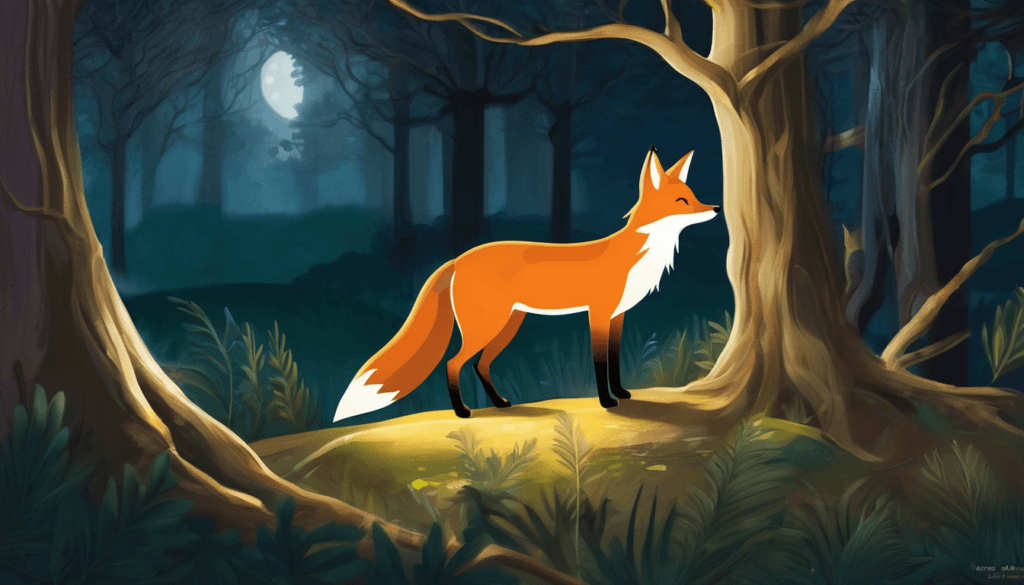
One clear night, when the moon was big and round and white, Milo climbed a small rise and looked up at the sky. Stars scattered across the dark like spilled sugar.
“Do you think the sky listens too?” he asked.
The forest around him rustled thoughtfully.
“Perhaps,” the wind said. “Perhaps it listens in its own sky way.”
Milo watched a shooting star streak across the darkness.
“If the sky is listening,” he called softly, “then I hope it likes my stories too.”
A cool breeze slid down from the high places and brushed his ears. It felt like a quiet yes.
Milo lay there for a long time, his back against the warm ground, his eyes full of stars. Behind him, the trees stood watch, their branches black against the bright moon. Beneath him, roots reached deep, deep down, holding the earth like gentle hands.
He thought about the first day he had realized the forest was listening. He remembered how surprised and shy he had felt. Now, the thought made him feel peaceful.
“I used to talk because I was afraid of being alone,” he whispered. “Now I talk because I know I am not.”
The nearest tree let one leaf fall. It landed right on his chest, over his heart. Milo placed a paw on it, as if he were holding a tiny hand.
“I will keep telling you my stories,” he promised. “And I will keep listening to yours.”
The forest did not answer in words. It answered in stillness, in the way the air felt safe and deep around him, in the way the ground cradled his body like a nest.
Milo’s eyes grew heavy. The stars blurred into a soft white cloud. His breathing slowed.
All around him, the forest kept listening, the way it had listened since the first seed woke in the dark earth, the way it would keep listening long after Milo’s paws no longer walked its paths.
If you had walked by just then, you might have seen only a sleeping fox on a hill under a bright round moon. You might have heard only the faint rustle of leaves and the distant murmur of a stream.
But if you had listened very carefully, the way Milo had learned to listen, you might have heard something else too.
You might have heard the quiet, patient heartbeat of the forest, keeping time with the small, steady heartbeat of the fox, as together they dreamed their long, slow, listening dream.


Leave a Reply