
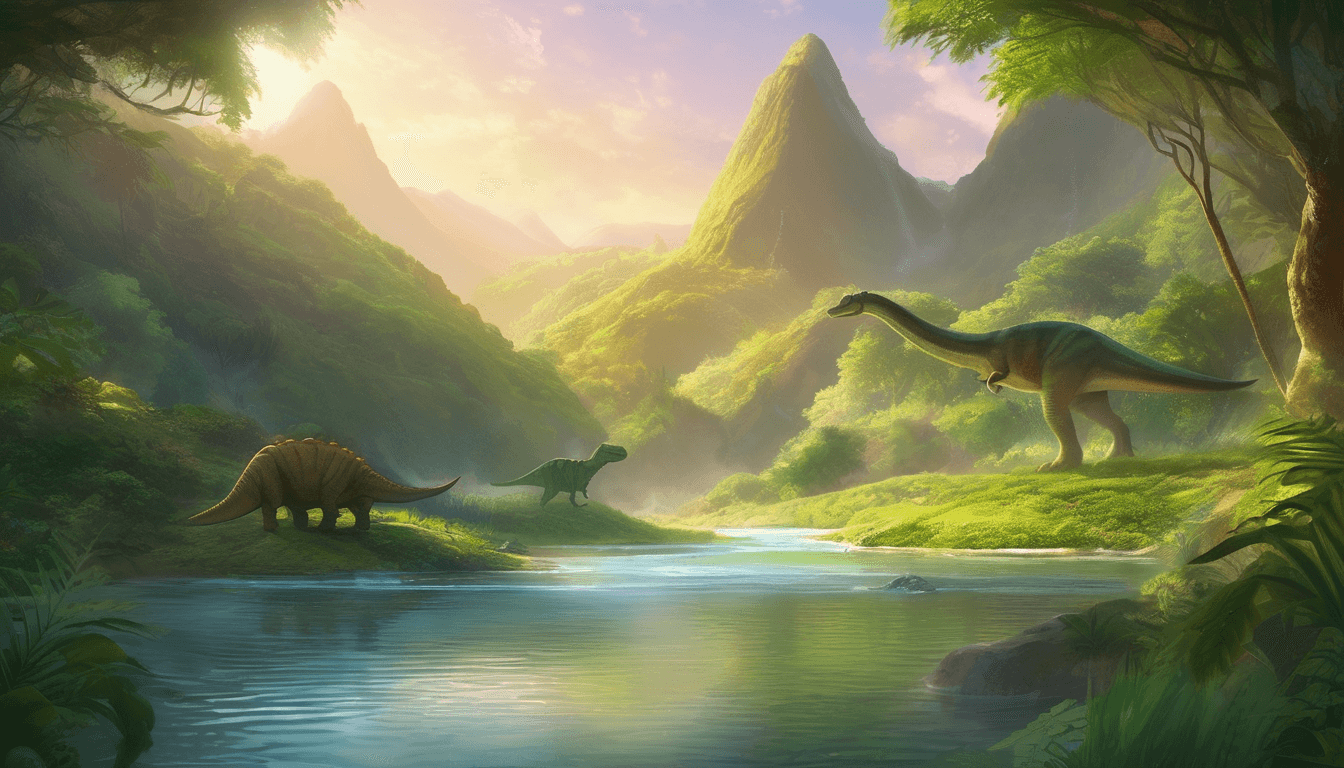
Far beyond the hills where the clouds liked to nap in the afternoon sky, there was a wide green valley filled with ferns, tall trees, and tiny sparkling ponds. In that valley lived a young dinosaur named Liora. Liora was a small apatosaurus with a long neck, a bluish green back, and a tail that swished like a lazy river. She loved to explore more than anything in the world.
Every morning, when the pink light of sunrise touched the tops of the trees, Liora would stretch her neck, blink the sleep from her big brown eyes, and whisper to herself, “What will I discover today?” Then she would set off, her heavy feet making soft thumps in the mossy ground.
Liora’s friends liked to explore too, but only a little. There was Hugo the triceratops, who liked to look for crunchy leaves near the safe cliffs. There was Aya the tiny compsognathus, who darted in and out of the bushes, but never too far from home. And there was Milo the stegosaurus, who preferred to stay close to the warm rocks where the sun felt nice on his plates.
Liora, though, always felt a gentle pull in her chest, as if the world were quietly calling her name. She wanted to see what was behind the next hill, and the next, and the next after that. Sometimes, at night, she would lie on her side and stare up at the stars, her tail curled around her, and wonder what secrets the valley still kept hidden.
One evening, when the sky turned a soft purple and the first star winked above, Liora’s grandmother, Abuela Mira, told a story. All the young dinosaurs gathered in a circle, their eyes shining in the firefly light, while Abuela Mira’s voice floated through the warm air.
“Long ago,” Abuela Mira said, “before you were hatched, before your parents were hatched, there was a river that could sing. Its water hummed and whispered and sometimes even laughed. At night, it sang lullabies so sweet that every creature who heard them slept peacefully until morning.”
The little dinosaurs leaned closer. Hugo’s frill quivered, Aya’s eyes grew huge, and Milo’s tail clinked softly against the stones as he shifted.
“But,” Abuela Mira continued, “the singing river was shy. One day it slipped away, hiding itself deep in the valley where no one could find it. Some say it vanished forever. Others say it is still here, waiting for someone with a brave heart and a gentle ear to discover it.”
Liora felt her heart flutter. A river that could sing. A hidden river that sang lullabies. It sounded like something from a dream, yet Abuela Mira’s eyes were serious and full of memories.
“Abuela,” Liora asked softly, “did you ever hear the river yourself?”
Abuela Mira smiled, a slow and secret smile. “I heard something once,” she said. “A faraway song that made the stars seem closer. But I was very young, and it was only for a moment. Then it was gone. Perhaps it was the wind. Perhaps it was the river. Some mysteries are like that.”
That night, as the others yawned and curled up to sleep, Liora lay awake longer than usual. The air was cool on her back, and the grass smelled sweet. Somewhere a night insect chirped. She listened hard, hoping to hear a faint song carried on the breeze, but all she heard was the gentle rustle of leaves.
Inside her, curiosity grew like a tiny spark. She imagined a river hidden under hanging vines, its surface silver in the moonlight, humming a sleepy tune. She imagined water that knew how to comfort every creature, even the smallest, even the loneliest.
“I will find you,” Liora whispered to the dark. “If you are real, I will find you.”
The next morning, the sun climbed into the sky like a slow, golden balloon. Liora woke with a quiet excitement that made her steps feel lighter. She ate a quick breakfast of tender leaves and fresh berries, then went to find her friends.
She found Hugo near the cliffs, chewing on a patch of crunchy ferns. “Hugo,” Liora said, her eyes bright, “come exploring with me today. I want to look for the hidden singing river from Abuela’s story.”
Hugo paused mid chew. “A river that sings?” he asked, sounding unsure. “Rivers splash and gurgle. They do not sing.”
“Maybe this one does,” Liora said. “Will you come?”
Hugo looked toward the safe cliffs and the familiar bushes. Then he looked at Liora’s hopeful face. “I will come a little way,” he decided. “But not too far.”
Next they found Aya chasing a shimmering blue beetle. “Aya,” Liora called, “we are going to look for a hidden river. A river that sings lullabies. Do you want to join us?”
Aya stopped at once. “A river that sings?” she squeaked. “That sounds magical. And also a tiny bit scary.” She thought for a moment, then bounced on her feet. “I will come. My legs are fast. If I get scared, I can always run home.”
They found Milo last, standing near his favorite warm rocks, his eyes half closed in comfort. “Milo,” Liora said gently, “we are going to explore deeper into the valley. We are searching for a secret river.”
Milo opened one eye. “Is it far?” he asked in a sleepy voice.
“Maybe,” Liora admitted. “But if we find it, it might sing us to sleep every night. Imagine that.”
Milo thought about not having to toss and turn on restless evenings. He thought about a soft song that could wrap around him like a warm blanket. Slowly, he nodded. “All right,” he agreed. “I will come. But if my feet get too tired, I will stop.”
Together, the four friends set off. The air was fresh, and the morning light made the leaves glow a bright green. Birds that no one had ever named yet fluttered from branch to branch, their feathers flashing red and gold. Somewhere in the distance, a waterfall roared like a giant breathing.
Liora led the way, her long neck stretching forward. She listened for anything unusual. She knew what regular rivers sounded like. They splashed and burbled and sometimes rushed loudly over rocks. But she was listening for something else, something that sounded like a song.
They followed a small stream first, its water clear and cold. “Maybe this is it,” Hugo suggested, dipping a horn into the water and flicking drops at Aya, who squealed and laughed.
Liora listened closely. The stream chuckled as it rolled over pebbles. It made a friendly sound, but it did not sing. “This is a nice stream,” she said, “but it is not the one from Abuela’s story.”
They walked farther, past a grove of tall trees with trunks so wide that it would take ten dinosaurs holding hands to wrap around them. The ground grew softer, and their feet sank into patches of damp moss that felt like green clouds.
Aya hopped from rock to rock, humming to herself. “What if the river does not want to be found?” she asked.
“Then we will be very polite,” Liora answered. “We will tell the river that we are gentle explorers. We only want to listen. We will not ask it to sing if it does not feel like singing.”
Hugo looked relieved at that. “I would not want anyone to force me to sing,” he muttered. “I only sing when I am alone and sure no one can hear.”
The friends came to a fork in the path. To the left, the land sloped up toward bright sunlit hills. To the right, the way dipped into a shaded hollow where vines hung like curtains and strange flowers glowed softly in the dim light.
“Which way?” Milo asked, swishing his tail.
Liora closed her eyes for a moment and listened. She heard the usual sounds of the valley. Wind in the leaves. Insects buzzing. Distant calls of other dinosaurs. Then, very faintly, from the shaded hollow, she thought she heard a tiny hum, like the first note of a song.
“Right,” she said quietly. “Let us go right.”
They stepped into the hollow. The air was cooler here, and it smelled mossy and rich, like the inside of a hidden cave. The light turned gentle and green as it passed through the layers of leaves above. Their footsteps were almost silent on the thick carpet of plants.
As they walked, the faint hum grew a little stronger. It rose and fell so softly that Hugo wondered if he was imagining it. Aya’s eyes darted around, trying to find the source of the sound. Milo’s plates gave a small shiver, as if they could feel music even more than his ears could hear it.
Suddenly, a flock of tiny feathered dinosaurs burst out of a bush in front of them, chirping loudly. Aya squeaked and jumped backward onto Hugo’s foot. Hugo yelped, and Milo bumped into Liora, who almost slipped on a patch of wet stones.
They all froze, breathing hard. Then they started to laugh, quietly at first, then louder. The hollow echoed with their giggles, and for a moment the strange hum disappeared under the sound of their voices.
When their laughter faded, the hollow grew quiet again. Liora took a slow breath and tilted her head, listening. There it was. The hum returned, sweeter now, like a faraway lullaby sung through cupped hands.
“Do you hear it?” she whispered.
Hugo’s frill trembled. “I think so.”
Aya nodded very fast. “It is like someone humming to themselves while they fall asleep.”
Milo’s eyes grew soft. “It is very gentle,” he murmured.
They followed the sound deeper into the hollow. The path narrowed, and vines brushed against Liora’s sides. Aya slipped ahead, darting between roots and stones. Hugo and Milo walked behind, careful not to crush the glowing flowers under their feet.
The hum grew into a soft song. There were no words, only notes that rose and fell like waves. It wrapped around them like a silk scarf, so light and kind that Liora’s eyes began to feel heavy. She blinked hard and kept walking.
At last, the hollow opened into a hidden clearing that none of them had ever seen before. In the middle of the clearing, shining softly under the filtered light, flowed a river.
It was not a wide river, nor a loud one. It slipped between smooth, dark stones, curving gently like a sleeping snake. Its water was so clear that they could see tiny golden fish swimming near the bottom. Along the banks, pale flowers with silver petals opened their faces, even though it was still daytime.
The river was singing.
Its song was quiet but strong, like the voice of someone who has been singing forever and never grows tired. It hummed and sighed, sometimes high, sometimes low, threading through the air and into their hearts.
Liora stepped closer, her breath caught in her chest. “The hidden river,” she whispered. “Abuela was right.”
Hugo’s eyes were wide. “I did not know water could sing like that.”
Aya crept to the very edge, peering at her reflection. “Hello, river,” she said softly. “We will be very polite. May we listen to your song?”
The river’s song did not change, but a little wave rose up and kissed the shore near Aya’s feet, as if it were saying hello in its own language.
Milo lay down slowly on the soft grass. “I could sleep right here,” he murmured. “This song feels like a pillow for my ears.”
Liora felt something warm and happy spread through her chest. She stretched out her long neck until her nose almost touched the water. The song tickled her nostrils and made her think of every kind thing that had ever happened to her. Her first sunny day. Her mother’s voice. Abuela Mira’s stories.
“River,” Liora whispered, “thank you for letting us find you.”
For a moment, the song grew just a little louder, swirling gently around Liora’s head. It sounded almost like laughter, soft and delighted.
They stayed there for a long time, listening. The river’s lullaby changed as the sun moved across the sky. At first it was bright and curious, like a morning tune. Then it settled into something slower and deeper, like the way shadows grow longer in the afternoon.
Hugo dipped his front feet into the water and sighed. “This feels like standing in a dream,” he said.
Aya chased a tiny silver dragonfly that hovered over the surface. Each time she leaped, the river’s song rose playfully, as if encouraging her.
Milo dozed with his head resting on his front legs, his breath steady. The plates along his back glowed faintly in the soft light, and every now and then a low snore puffed from his nose.
Liora walked slowly along the bank, memorizing every curve and stone. She watched how the water slipped around obstacles instead of fighting them. She noticed how it never stopped singing, even when it grew very quiet.
After a while, she spoke again. “River,” she said, “how did you learn to sing?”
Of course, the river did not answer with words. It answered with a small change in its song. For a moment, the tune sounded like wind passing through tall grass. Then it sounded like rain on a roof. Then like the soft heartbeat heard when you press your ear against someone you love.
Liora listened carefully. “You learned from everything around you,” she said slowly. “From the wind and the rain and the hearts of all the creatures who came here.”
A tiny swirl appeared on the surface of the water, shining like a smile.
Hugo, who had been quiet for a while, spoke up. “River,” he asked, “why did you hide?”
The song dipped low, then rose again, gentle and calm. Aya tilted her head, trying to understand. Milo blinked sleepily and listened too.
“It is shy,” Liora guessed. “Maybe too many creatures wanted to drink and splash and be noisy. Maybe it could not sing its lullabies anymore.”
Hugo’s face grew serious. “We should keep its secret,” he said. “We should not tell everyone. Only those who can listen gently.”
Aya nodded. “Only the ones who promise not to shout or jump in with big splashes.”
Milo yawned. “Or step on the flowers,” he added.
Liora agreed. “We will protect the river’s quiet,” she told the water. “We will not bring crowds. Only friends who understand lullabies.”
The river’s song warmed, like sunlight sliding across closed eyelids. A small, clear drop of water leaped up and landed on Liora’s nose. It felt cool and kind.
As the day drifted toward evening, the light in the clearing turned golden. Shadows stretched and reached for each other across the grass. The silver flowers along the riverbank opened wider, and their petals caught the last rays of the sun, glowing softly as if holding tiny lanterns.
“We should go home before it gets too dark,” Hugo said, though his voice sounded reluctant.
Aya pouted a little. “I want to stay and listen all night.”
Milo shook his head slowly. “If we do that, our families will worry. And Abuela Mira will wonder where we are.”
Liora looked at the river. “We will come back,” she promised. “Will you sing for us again?”
The river answered with a new melody, one that rose up like a greeting and then settled back into the gentle lullaby. It felt like a yes.
They turned to leave, but Liora paused. She looked at the path they had taken and realized it was not very clear. Vines had hidden most of it. Someone else might pass by and never see the way into the clearing.
She searched the ground and found a smooth, flat stone. Carefully, she pushed it with her nose to the edge of the path. Then she found another stone with a streak of bright white running through it and placed it next to the first.
“What are you doing?” Aya asked.
“Making a quiet sign,” Liora said. “If we ever forget the way, we can look for these stones. They will show us the secret path.”
Hugo nodded in approval. “A secret that is not lost. I like that.”
They followed their own footprints back through the hollow, the river’s song growing fainter behind them. By the time they reached the fork in the path, the hum was only a memory in their ears, like the last note of a song that still lives in the heart.
As they climbed out of the dip and into the open valley, the sky had turned a deep orange, fading into purple at the edges. The first stars were peeking out, shy and twinkling.
When they reached their home, the other dinosaurs were gathering for the evening. Fires of glowing mushrooms lit the ground with a soft blue light. Abuela Mira sat in her usual place, her tail curled around her feet, her eyes watching the sky.
Liora ran to her. “Abuela,” she said, breathing a little fast, “we found it. We found the hidden river.”
Abuela Mira looked at her for a long moment. Then her wrinkled face softened into a smile that seemed to come from a very deep place. “Tell me,” she said.
So Liora told her everything. Hugo added details about the glowing flowers. Aya described the dragonfly and how the river seemed to play with her. Milo spoke slowly about how the song had wrapped around his dreams even while he was awake.
Abuela Mira listened with her eyes half closed, as if she could see the clearing through their words. When they finished, she nodded. “I knew it was still here,” she murmured. “I could feel it in my bones.”
“Why did you not look for it again?” Liora asked.
Abuela Mira chuckled softly. “When I was your age, I tried. But the valley is big, and I did not have friends as brave and curious as you. After a while, I decided that if the river wanted to be found, it would show itself to someone who needed it.”
Liora thought about that. “Maybe the river needed us too,” she said. “Maybe it was lonely.”
“Maybe,” Abuela Mira agreed. “Music likes to be heard. Even shy music.”
That night, as the dinosaurs settled into their nests and resting places, the usual sounds of the valley floated up. Crickets chirped. Leaves rustled. Somewhere, a distant waterfall rumbled its steady song.
Liora curled up, her tail wrapped around her body. She closed her eyes, and in the darkness behind her eyelids, she could see the river again. She could hear its lullaby, gentle and kind. The memory of the song was so clear that, for a moment, she was not sure if it was only in her mind or if the river’s voice was somehow reaching all the way across the valley.
Her breathing slowed. Her thoughts drifted like leaves on water. Sleep came softly, as if it had been waiting at the edge of the clearing with the river, ready to walk home with her.
In her dreams, Liora stood beside the singing river once more. This time, the stars were reflected in the water like hundreds of tiny lamps. The river’s lullaby blended with a new sound. She looked up and saw that the stars were humming too, their light pulsing gently with each note.
The river seemed to say, without words, “You found me. Now I will help you find your own songs.”
Liora listened. Inside her, she heard something she had never noticed before. It was the sound of her own heart, beating in a steady rhythm. She began to hum along with the river, softly at first, then a little louder. Her voice wobbled, but the river’s song held it, guiding it like a hand.
When she woke with the pale light of dawn, the dream still sat in her chest like a warm pebble. She knew that the river was real. She also knew that its lullaby had changed something inside her.
Over the next days, Liora and her friends returned to the hidden clearing many times. They always walked quietly, always spoke in soft voices. Each visit, the river welcomed them with its gentle song.
Sometimes they brought gifts. Hugo brought a smooth shell he had found near another stream. Aya brought a feather from a bright yellow bird. Milo brought a round stone that looked like a tiny moon. Liora brought stories, which she told in a low voice as the river sang beneath her words.
The river never took the gifts away, but it let them rest along its banks. Over time, the edge of the water became a small museum of kindness, filled with things chosen with care.
On one visit, a new friend came with them, a shy little pterosaur named Kumi. At first, Kumi was afraid of the hollow and its shadows, but when she heard the river’s lullaby, her wings relaxed, and she settled onto a branch that leaned over the water.
“I have trouble sleeping at night,” Kumi admitted quietly. “My wings twitch, and my thoughts flap around like bats. But this song makes me feel calm.”
The river’s melody wrapped gently around her, and her eyelids drooped. Before long, she was fast asleep, her head tucked under her wing, her body rocking slightly in time with the music.
Liora watched her and felt a soft joy. The river was not just a secret to keep. It was a friend who knew how to help.
One afternoon, dark clouds rolled over the valley. The wind picked up, tugging at leaves and bending tall grasses. Thunder grumbled in the distance like a sleepy giant.
“We should not go to the river today,” Hugo said, watching the sky nervously. “It might not be safe in the storm.”
Liora looked up at the heavy clouds, then toward the hidden hollow. She felt a tug inside her again, the same tug that had led her there the first time. “I want to hear what the river sings when it rains,” she said. “I think it might be beautiful.”
Aya glanced at the swaying trees. “I will come,” she said. “But if the thunder gets too loud, I am flying right into Milo’s plates to hide.”
Milo nodded. “I will be a moving shelter,” he promised.
They hurried along the path, their steps quicker than usual. The first raindrops began to fall, fat and cool, dotting their backs and tails. By the time they reached the hollow, the rain had turned into a curtain of silver strings.
Inside the hollow, everything looked different. The glowing flowers shone brighter against the gray sky. Raindrops slid down the vines and dripped from the leaves in steady beats. The air smelled sharp and clean.
As they stepped into the clearing, they saw that the river had changed its song. It was still a lullaby, but now it carried the sound of rain, a thousand soft taps on the surface of the water. The river’s voice rose and fell with the storm, weaving the patter of the raindrops into its melody.
Liora stood in the rain, feeling it roll down her neck and along her back. The river’s rainy lullaby filled her ears. It was not a sleepy song now. It was a brave song, one that said, “Storms come and storms go, but the river still flows, and you are still here.”
Hugo’s fear melted a little as he listened. Aya forgot about hiding in Milo’s plates. Milo tilted his head back and let the rain wash over him, his plates shining like wet stones.
For a moment, Liora closed her eyes. She felt the water from the sky and the water in the river and the water inside her own body, all connected in one great, quiet song. She realized that the river’s lullaby was not just for nighttime. It was for every time a heart needed comfort.
Eventually, the storm moved on. The rain softened to a mist, then stopped completely. Droplets clung to every leaf and petal, turning the clearing into a place made of tiny mirrors. The river’s song shifted once more, becoming lighter, as if it were sighing in relief.
“We should go home,” Milo said gently. “Our families will be worried again.”
They said goodbye to the river, each in their own way. Hugo bowed his head. Aya blew a tiny kiss. Milo patted the ground near the bank. Liora whispered, “Thank you, brave river.”
As they walked back through the valley, the world sparkled. Puddles reflected bits of sky. The air felt fresh and new, as if everything had been washed and hung up to dry.
That night, when Liora lay down to sleep, she did not need to wait for the river’s song to reach her. It was already inside her, humming softly. She thought of the first time she had heard it, the day she had seen the silver flowers, the stormy lullaby, and Kumi sleeping peacefully on the branch.
She thought of how the river had hidden itself, and how it had slowly, carefully, allowed itself to be found again.
Discovery, Liora realized, was not just about finding new places. It was also about finding new sounds, new feelings, and new parts of yourself that you did not know were there.
She closed her eyes and imagined the hidden clearing, the gentle curve of the water, and the way the lullaby rose up under the stars. Her breathing matched the rhythm of the song in her memory. Her tail curled around her legs, and her head rested lightly on the ground.
Outside, the valley settled into its own nighttime music. Crickets played their tiny violins. Leaves whispered secrets to each other. Far away, a waterfall droned like a giant’s snore.
And somewhere, in a hidden hollow, a shy river kept singing its lullaby, sending its quiet song into the roots of trees, into the stones beneath the soil, and into the dreams of a young dinosaur named Liora, who had discovered it and, in doing so, had discovered a new kind of peace inside herself.
As the stars wheeled slowly overhead and the moon climbed softly into the sky, Liora slept, wrapped in the memory of that gentle river song, knowing that tomorrow and the next day and the day after that, there would always be more to explore, more to understand, and more secret songs waiting patiently to be heard.

Leave a Reply