
In a small town where the rooftops looked like folded paper boats and the streets curled like sleepy cats, there lived a child named Liora. Liora had hair the color of toasted bread and eyes that always seemed to be listening, even when everything around her was quiet. She lived with her parents in a skinny blue house at the edge of town, right where the cobblestones stopped and the fields began.
Every night, Liora’s mother or father would tell her stories. They were stories about dragons who collected teacups, about clouds that forgot how to float, and about rivers that sang songs only ducks could hear. Liora loved those stories. When she was younger, she was sure that the world was full of glittering secrets hiding in every cupboard and crack in the sidewalk.
But one autumn, when the leaves started to crumble into orange and brown confetti, something began to change. Liora started school. Her days filled up with numbers and letters and rules, and there was less time for staring at the way dust sparkled in the sunlight. There was less time for lying in the grass and listening to the earth hum beneath her.
One evening, after a long day of spelling tests and sitting still, Liora lay in bed and stared at the ceiling. The moonlight painted a pale square on her blanket. Her bookshelf was quiet. The toys in the corner were quiet. Even her own thoughts felt like tired footsteps instead of dancing shoes.
She whispered into the dark, almost too softly for herself to hear.
“I think my wonder is going away.”
The word wonder felt like a bubble in her chest. It used to float and bounce and shine. Now it felt heavy, like a marble that had rolled under the bed and gathered dust. Liora squeezed her eyes shut and tried to imagine dragons and singing rivers, but the pictures in her mind were faint and thin, like drawings left out in the rain.
The next morning, Liora woke feeling older than she was. Not taller, not stronger, just older, like a story that had been read too many times. She dressed slowly, pulling on her favorite green sweater with the one loose button shaped like a star. She hoped the star button would make her feel a little magical again. It did not.
On the way to school, she walked with her father along the narrow path that cut through the fields. Dew clung to the grass, and spiderwebs hung between the stems like silver ladders. Her father pointed at a spiderweb that had caught a drop of water, and it sparkled like a tiny crystal lantern.
“Look at that, Liora,” he said. “Isn’t it beautiful?”
Liora glanced at it. She knew it was beautiful. She knew she should feel a little jump in her chest, the way she used to. But there was only a small, tired nod.
“Yes,” she said quietly. “It is.”
Her father watched her for a moment, then squeezed her hand.
“Sometimes beauty hides when we are tired,” he said. “It waits for us to rest.”
Liora did not answer. She was not just tired. She was worried. She wondered if beauty and wonder had decided to move away from her, like birds flying to another country when the weather changed.
At school, the day marched along. There were numbers to add and words to read and a map of the world pinned to the wall. The teacher, Miss Calista, had kind eyes and a voice that could sound like a bell or like a blanket, depending on what she was saying. That day it mostly sounded like a bell, sharp and clear, counting and spelling and explaining.
During art time, the other children drew rockets and castles and unicorns. Liora stared at her blank paper. Her pencil felt heavy. She remembered when paper felt like a door, and pencils felt like keys. Now they felt like chores.
She finally drew a small gray cloud in the corner of the page. It did not even look like a good cloud. Just a smudge with a pout.
Miss Calista walked by and stopped.
“Tell me about your drawing, Liora,” she said.
Liora shrugged. “It is just a cloud.”
“Clouds are never just clouds,” Miss Calista replied softly. “They are ships or mountains or giant sleeping animals, depending on who is looking.” She tilted her head. “What kind of cloud is this one?”
Liora wanted to say it was a lost cloud, a cloud that had forgotten how to be fluffy and bright. But the words got tangled in her throat. She shrugged again.
Miss Calista did not push. She only smiled a little and said, “Sometimes our drawings know more than we do. Keep it. Maybe it will tell you its story later.”
When school finally ended, the sky outside had turned a pale peach color, and the first evening star waited patiently for its friends. Liora walked home alone, her backpack bumping against her shoulders.
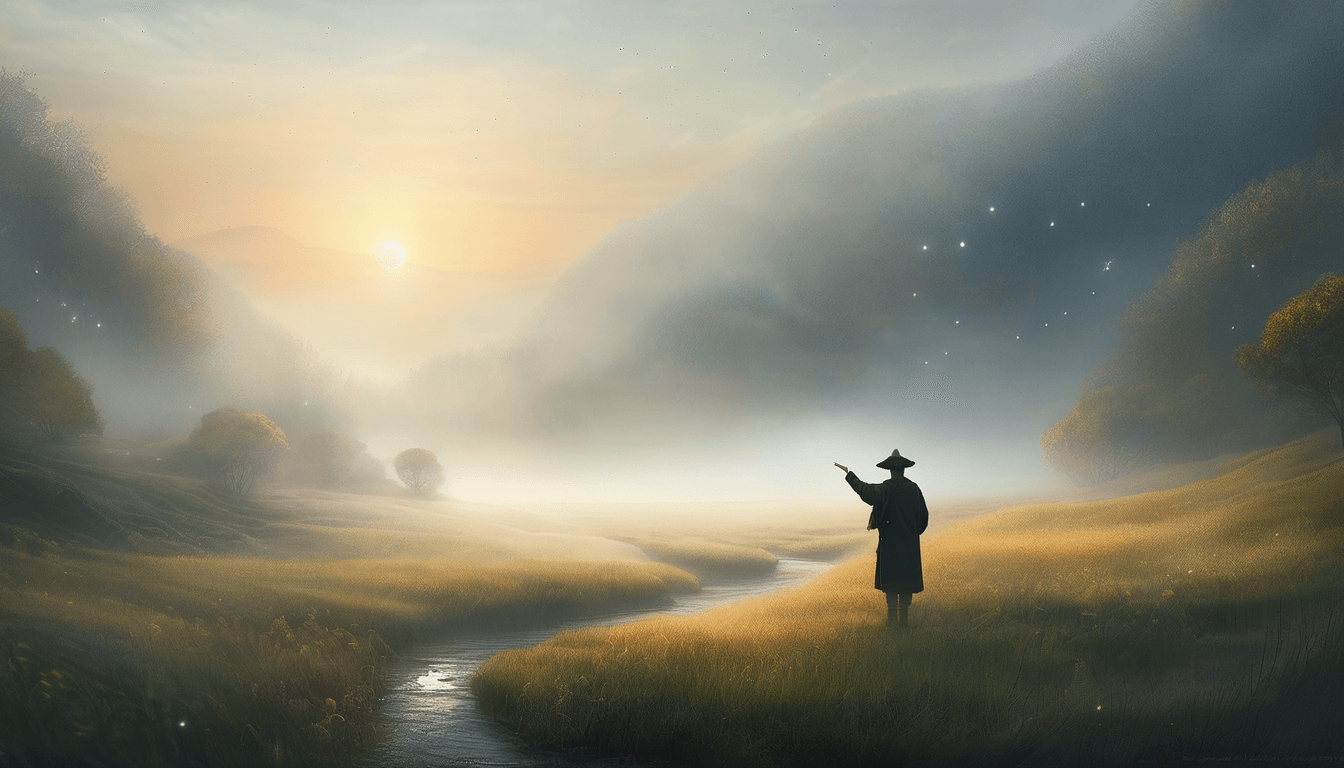
As she reached the edge of the fields, she noticed the air felt different. It was cooler and smelled like wet earth and leaves. A thin fog had begun to crawl along the ground, wrapping itself around the grass and stones like a soft scarf.
Liora paused. The path ahead looked almost unfamiliar, like it belonged to another town. The fog curled around her shoes. The world felt quiet, but not the usual kind of quiet. This quiet was full of something, like a held breath.
She stepped off the main path, just a little, to see how the fog felt between the taller grasses. It was cool against her legs, and tiny drops of water clung to her socks. A cricket somewhere nearby started to sing, slow and steady.
Liora listened.
The sound of the cricket grew louder, as if it had moved closer, though she could not see it. Another cricket joined in, then another. The fog shimmered slightly, and for a moment Liora thought she saw small lights deep in the mist, like tiny lanterns bobbing up and down.
She blinked and rubbed her eyes. The lights were gone. Or maybe they had never been there. Maybe her eyes were just tired.
“I used to see things all the time,” she muttered to herself. “Why is it so hard now?”
Just then, a voice spoke. It was not loud, but it was very clear.
“Perhaps you are looking with the wrong part of you.”
Liora spun around. There was no one behind her. Only the fog, the grass, and a crooked fence post with a broken top.
“Who said that?” she called.
“I did,” the voice replied. It seemed to come from everywhere at once, but also from the fence post. “Down here.”
Liora stared at the fence post. Sitting on the very top of the broken wood, where a bird might have perched, was a creature she had never seen before.
It was about the size of her hand. Its body was shaped a little like a squirrel’s, but its fur shone with the faintest hints of blue and silver, like the sky just before dawn. Its eyes were round and bright, and inside them tiny stars seemed to blink. Around its neck it wore a collar made of dried flower petals and dewdrops that did not fall.
Liora forgot to be afraid. She stepped closer.
“What are you?” she whispered.
The creature lifted its chin proudly.
“My name is Neru,” it said. “I am a Keeper of Wonder.”
Liora’s heart skipped. “A Keeper of Wonder? Is that a real thing?”
Neru sniffed. “Of course I am a real thing. I am sitting right here, am I not?” It flicked its tail, and a few drops of fog scattered like pearls. “The question is, are you a real thing? You look a bit faded around the edges.”
Liora frowned. “I am real. I am just… tired. I think my wonder is leaving me.”
Neru’s bright eyes softened. “Ah. That is different. Wonder does not leave. It only moves around. Sometimes it hides in your elbow or behind your knees or deep in your chest. Sometimes it goes very quiet, like a cat under a bed. But it never leaves.”
Liora shook her head. “I do not feel it.”
“Feeling is not the same as having,” Neru replied. “You, Liora, have plenty of wonder. You are simply not noticing where it has gone.” The little creature tilted its head. “Would you like to go looking for it?”
Liora hesitated. The path home was behind her. Her parents would be waiting. Dinner would be warm on the table. But the fog wrapped around her like a question, and Neru’s starry eyes were kind.
“Yes,” she said. “I want to find it.”
“Good,” said Neru. “Close your eyes.”
Liora obeyed. The fog’s cool breath brushed her cheeks. For a moment she felt silly, standing there with her eyes shut, talking to a creature that might have been a dream.
“Now,” Neru said gently, “remember the last time you felt a jump in your chest, like you had swallowed a little comet. The last time something made you say oh without thinking.”
Liora thought hard. She remembered being very small and seeing the ocean for the first time, how the waves had roared and laughed all at once. She remembered watching a thunderstorm from the safety of her window, counting the seconds between the lightning and the thunder. She remembered the day a bird had landed on her outstretched finger by accident.
But those memories felt far away, like pictures in someone else’s book.
Then she remembered something smaller. Just last week, a tiny seedling had pushed its head up through the soil in the flowerpot on the kitchen windowsill. She had watched it for a long time, amazed that something so green could come from something so plain and brown.
“I remember a little plant,” she said quietly. “It made me feel… awake.”
“Good,” Neru said. “Hold on to that feeling. Wrap it around you like a scarf. Do not try to make it bigger. Just let it be what it is.”
Liora breathed in and imagined the seedling in the pot, its two little leaves opening like hands. Something inside her chest flickered, very softly.
“Now open your eyes,” Neru said.
Liora opened them. The world had not changed, not really. The fog still hugged the ground. The fence post still leaned. The sky was still a pale peach, deepening slowly into lavender. But the colors looked a little thicker, as if someone had turned up the paint.
“There,” Neru said. “You see?”
“I do not… know,” Liora answered.
Neru hopped lightly from the fence post onto her shoulder. It was lighter than she expected, like a whisper.
“Come,” it said. “Let us walk a different way home.”
They stepped off the narrow path completely, moving into the taller grass. At first, Liora worried about getting lost, but the town’s rooftops still peeked over the horizon, and Neru’s tail glowed just enough to guide her.
As they walked, Neru pointed with its tiny paw.
“Look there.”
A line of ants marched along a stone, each carrying a crumb or a leaf piece many times its own size. Liora had seen ants before, of course. But now she knelt to watch. One ant stumbled, its crumb slipping. Two others stopped and helped it lift the crumb again. Together they carried it forward.
“They help each other,” Liora murmured.
“Of course,” Neru replied. “They are very small. Together, they are not so small.”
They walked on. A cluster of mushrooms huddled under a fallen branch, their caps spotted and smooth. A tiny snail traced a silver line across a leaf. A blackbird on a nearby fence post tilted its head, watching them carefully with one bright eye.
“Everything is busy,” Liora said. “I never noticed how busy it all is.”
“Wonder likes busy,” Neru said. “It hides in the tiny jobs of the world.”
The sky grew darker, and the first stars began to appear, not all at once, but one by one, like children arriving late to a party. Liora tilted her head back.
“Do stars get tired?” she asked.
“Sometimes,” Neru answered. “Then they rest in people’s eyes for a while. I see a few in yours already.”
Liora almost laughed. “You are just saying that.”
Neru shook its head. “No. When you watched that little plant grow, a star came closer to see what you were seeing. It liked staying. So it did.”
They reached a small hill Liora had never noticed before. It was not tall, but it rose just high enough to see the town clearly. The skinny blue house, the crooked chimneys, the soft yellow lights starting to bloom in the windows.
“Let us sit,” Neru suggested.
They sat on the damp grass. The night grew deeper around them, but it did not feel scary. The sounds of the town drifted up softly. A door closing. Someone laughing. A dog barking once, then twice.
“Do you remember when you were very little,” Neru asked, “and you thought the moon followed you?”
Liora nodded. “I used to wave at it from the car window.”
“You were never wrong,” Neru said. “The moon does follow you. It follows everyone. It looks different from every place, and it collects all the wishes people whisper to it. That is a lot of following.”
Liora hugged her knees. “But I do not feel the same anymore,” she said. “When I was small, everything was big and bright. Now school is big. Homework is big. The world feels… thinner.”
Neru was quiet for a while. Fireflies rose from the grass around them, their lights blinking on and off. One landed on Liora’s sleeve, its tiny body shining like a living bead.
“You are growing,” Neru said at last. “When you grow, the world does not get smaller. It gets bigger in a different way. You start to see more of it. Some of it is heavy. Some of it is confusing. But wonder does not belong only to small things. It belongs to all of it.”
“What if I am too busy?” Liora asked. “What if I forget to look?”
“Then wonder will tap you on the shoulder,” Neru replied. “It is very patient. It will wait in the shape of a cloud or the smell of rain or the sound of your own heartbeat until you are ready again.”
Liora listened to her heartbeat, thump thump, steady and warm inside her.
“Can wonder live there?” she asked, touching her chest.
“It lives there most of all,” said Neru.
They sat together as the sky turned deep blue and then almost black. The stars above were steady now, no longer shy. Liora felt something inside her slowly stretch and uncurl, like a cat waking from a long nap.
“I think,” she said carefully, “I can feel a little piece of it. Not as big as before. But it is there.”
“That is enough,” Neru replied. “Wonder does not need to be loud to be real. A whisper can be as true as a shout.”
Far below, in the skinny blue house, a porch light blinked on. Liora’s mother stepped outside and shaded her eyes, looking for her.
“I have to go,” Liora said.
“Of course,” said Neru. “You are expected. But before you go, I want to show you one last thing.”
It lifted its tiny paw and brushed the air. The fog around the hill swirled, then thinned. In the space between two swaying grasses, a small shape appeared, made of faint blue light. It looked like a doorway.
“What is that?” Liora whispered.
“A memory,” Neru said. “Not from the past. From the future. Step closer.”
Liora approached the glowing shape. Inside it, like a picture in a window, she saw herself, older, maybe twelve or thirteen. She was sitting under a tree with a notebook on her knees, writing, her brow furrowed in concentration. Around her, children much smaller than her sat in a circle, leaning in, listening. Their eyes were wide.
Liora saw her older self lift her head and smile as she spoke. Though the words were silent in the glowing image, she could see the way the younger children leaned even closer.
“Am I telling them a story?” Liora asked.
“You are,” Neru said. “You are giving them your wonder, and they are giving you theirs back.”
The picture faded gently, like a lantern going out. The doorway of light closed until it was only the night again.
“You mean I still have it then?” Liora asked. “My wonder?”
“Of course,” Neru answered. “Wonder never leaves. It changes shape. It lives in how you listen, how you notice, how you care. It may feel different, but it is still there.”
Liora felt a warmth spread through her chest, like a candle being lit in a dark room. It did not chase all the shadows away, but it made them softer.
“Will I see you again?” she asked.
“Maybe,” Neru said. “Maybe not. Keepers of Wonder are not very good at schedules. But you do not need me to find your wonder. You only need to stop sometimes and say, ‘I am here. Are you there too?’ And it will answer.”
Liora stood up. She brushed the grass from her sweater and touched the star-shaped button gently.
“Thank you, Neru,” she said.
Neru bowed, very formally for such a small creature.
“Walk home slowly,” it advised. “Let the night tell you at least one secret on the way.”
Liora climbed down the hill, back toward the town. The fog had thinned, and the path was clearer now. As she walked, she listened. She heard the soft creak of tree branches. She heard the rustle of a hedgehog in the leaves. She heard her own footsteps, each one a small promise that she was still moving, still growing, still here.
Halfway home, she stopped. The moon had risen, round and bright, hanging just above the rooftops like a lantern that belonged to everyone and no one.
“Hello, Moon,” she whispered. “I know you are following me.”
The moon did not answer, but somehow she felt as if it had heard.
When she reached the skinny blue house, her mother was waiting at the door, worry and relief mixed together on her face.
“There you are,” her mother said, kneeling to hug her. “You were gone longer than usual. I was starting to wonder where you were.”
Liora hugged her back, feeling the solid warmth of arms and sweater and home.
“I was discovering something,” she said.
Her mother drew back a little, looking into her eyes. “And what did you discover?”
Liora thought of Neru, of the ants, of the fireflies, of the glowing doorway with her older self inside. She thought of the tiny plant on the windowsill.
“I discovered that wonder does not leave,” she answered. “It only hides sometimes. But it is still there, even when I forget to look.”
Her mother smiled, slow and soft. “That sounds like a very important discovery.”
They went inside. The house smelled like soup and fresh bread. The kitchen light made everything look golden. On the windowsill, the little plant had grown another leaf.
After dinner, Liora went to her room. She climbed into bed and pulled the blanket up to her chin. Her father came in and sat on the edge of the mattress.
“Do you want a story?” he asked.
Liora hesitated. Then she nodded. “Yes. But can I tell you one first?”
Her father raised his eyebrows. “I would like that very much.”
So Liora told him about walking through the fog, about the creature named Neru, about the ants and the fireflies and the hill. She did not tell him about the future doorway. That part felt like a seed still tucked in the soil, not ready to come out yet.
When she finished, her father was quiet for a long moment.
“That is a beautiful story,” he said at last. “Where did you hear it?”
Liora placed her hand over her chest.
“From here,” she said.
Her father smiled. “Then your inside is a very special place.”
After he left, turning out the light and leaving only a small lamp glowing in the corner, Liora lay on her side and watched the shadows on the wall. They were soft and wobbly, like gentle waves. She listened to the house breathing around her, the faint creaks and sighs of wood and wind.
“Wonder,” she whispered into her pillow, “if you are there, you can stay. I know you might hide. But I will try to remember to look for you.”
A warmth answered her from inside, not in words, but in a feeling, like a small hand slipping into hers.
Outside, the moon climbed a little higher. A cat walked along a fence, tail held high. Somewhere in the fields, a tiny creature with silver-blue fur and starry eyes curled up inside a hollow log and closed its eyes, pleased.
In her dreams that night, Liora walked through a forest where every leaf had a different story written on it in tiny letters. Some of the stories were about things that had already happened. Some were about things that might happen someday. She could not read all of them, of course. There were too many. But she did not feel sad about that.
She knew now that wonder was not a thing you finished, like a book with a last page. It was a road that kept going, even when you had to stop and rest. It was the space between what you knew and what you did not know yet.
In the morning, when the first light slipped through her curtains and the birds began their noisy, cheerful songs, Liora opened her eyes and felt for that warm flicker inside her.
It was there. Quiet, but steady.
She got out of bed, went to the window, and looked at the little plant on the sill. It had grown even more in the night. A tiny bud was forming at the top, tightly closed, keeping its color a secret a little longer.
Liora smiled.
“Good morning,” she said to the plant. “I cannot wait to see what you become.”
Inside her, something answered, like a small bell ringing once, clear and bright.
She dressed and went downstairs, ready for another day of numbers and letters and paths and fog and ants and stars and quiet secrets. Some days, she knew, her wonder would feel loud and sparkling. Other days it would be hard to find, hiding in the corners of ordinary things.
But now she understood that it never truly left. It was stitched into her, like the star-shaped button on her sweater, fastened tightly, holding strong.
And as she stepped out of the skinny blue house, into the wide, waiting world, the world seemed to lean toward her just a little, as if it too was full of wonder, and very glad that she had noticed.

Leave a Reply