
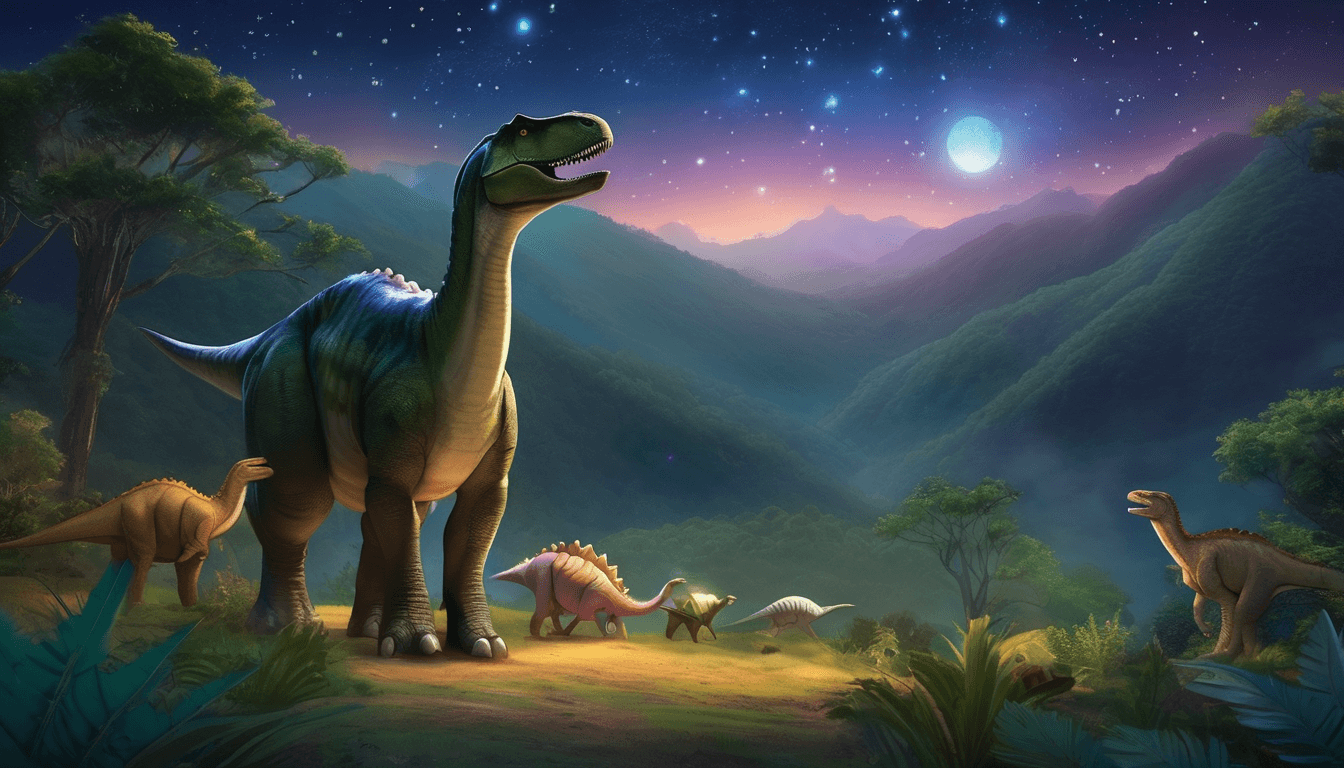
In a quiet valley where the grass grew tall and soft, there lived a young dinosaur named Taro. Taro was a small apatosaurus with a long neck, a long tail, and gentle gray-green scales that shone like wet pebbles after rain. He loved the whisper of the wind and the glow of the stars, but there was one thing he did not love at all. He did not love his own voice.
When Taro spoke, the air seemed to shake. His voice rolled across the valley like thunder over hills. Birds fluttered from the trees, rabbits hurried into their burrows, and even the leaves trembled on their branches. Taro never meant to scare anyone. He only wanted to say hello, or ask if someone wanted to play. But his voice was so big that everyone thought he was angry.
Because of this, Taro tried not to speak. He walked softly, with careful steps, and kept his mouth almost always closed. When he needed to say something, he said it very quickly and very quietly, like a tiny puff of sound. Still, his voice rumbled. It was not as loud as before, but it was still deeper and stronger than almost anyone else’s.
Taro lived with his family at the edge of the valley, near a forest of tall, twisty trees. His mother, Laleh, was wise and calm. His father, Roko, was strong and kind. Taro had a little sister named Ines who chattered all day like a stream running over stones. Ines loved her voice. She sang and hummed and made little songs about everything she saw.
“Come sing with me, Taro,” Ines would say as they walked by the river. “We can make a song about the water, and the sky, and those funny turtles on the rocks.”
Taro would lower his head and answer, “Maybe later,” in his softest, quickest rumble. The turtles would slide into the water at the sound, and Ines would sigh.
One warm evening, when the sky was painted peach and gold, Taro and Ines walked together among the tall grasses. Fireflies had just begun to blink on and off, like tiny lanterns learning how to shine. Ines skipped ahead, making up a song about fireflies that forgot their bedtime.
Suddenly, a flock of little pterosaurs flew overhead. At Taro’s quiet humming, they squeaked in surprise and swerved away. One bumped into another, and they tumbled a short distance before catching the air again. Their wings flapped wildly as they hurried off toward the cliffs.
Ines stopped and looked at her brother. “They think you roar at them,” she said softly. “But you were only humming.”
“I know,” Taro answered, gazing at the ground. “I do not like my voice, Ines. It frightens everyone. It is too big. Too heavy. I wish it would go away.”
Ines tilted her head. “Voices cannot go away,” she said. “They can change. They can grow. Maybe yours has not learned how to be gentle yet.”
Taro snorted a tiny, sad snort. “How can a mountain learn to float? How can thunder learn to whisper? My voice is like that. Too strong.”
Ines did not know what to say. She took his big front foot in her small one and patted it, as if his foot were a shy animal. “Maybe one day,” she whispered, “you will see it differently.”
As the sun slid behind the hills, their mother called them home. “Night is coming, little ones,” Laleh called from the trees. “The stars are waking. Time to eat and rest.”
They walked back together, the sky darkening from peach to purple. Taro watched a flock of tiny glowing moths drift like slow snow over the river. He wanted to tell them how beautiful they were. He wanted to say, “Do not worry, I will not hurt you.” But he stayed silent, afraid that even a whisper would send them scattering.
That night, after dinner, Taro lay on his mossy bed looking up at the open patch of sky above their home. The stars were bright and patient. He listened to the soft breathing of his family. Ines had already fallen asleep, her nose tucked under her tail. Their parents murmured to each other in low, soothing tones.
Taro thought about his voice. He thought about the pterosaurs, the rabbits, the turtles, the moths. He thought about the way the earth seemed to answer him when he spoke, how his words felt like stones rolling down a hill. He wished he could trade his voice for one like Ines’s, light and bright, like water bouncing over rocks.
Far away in the dark forest, an owl hooted. The sound floated through the trees, clear and sure, but not frightening. Taro listened closely. The owl’s call was strong, yet somehow kind. It did not make the leaves shake. It did not make the earth tremble. It simply said, “I am here. Where are you?” in the language of owls.
Taro closed his eyes and imagined having a voice like that. A voice that could be heard, yet did not scare anyone. A voice that could say, “I am here,” and make others feel safe.
The next morning, Taro woke before the sun. The sky was a pale, sleepy blue. Mist floated along the ground like low clouds that had forgotten how to fly. Taro’s parents still slept, and Ines snored very softly, making tiny whistling sounds.
Taro stepped outside, careful not to wake anyone. The air was cool and smelled of wet leaves and river stones. Dew clung to his scales and made them sparkle. He walked toward a quiet hill on the far side of the valley, a place where he liked to be alone.
On the way, he passed by a small burrow where a family of little mammals lived. They were fluffy and round, with tiny paws and bright eyes. Taro had often tried to say hello to them. They always ran inside and closed their door of woven grass.
He paused and looked at their burrow. The door was open. A small nose poked out, twitched, then vanished when it saw Taro’s huge shadow. Taro’s heart sank.
“I will not speak,” he thought. “If I do not speak, I cannot frighten anyone.”
He walked on in silence, his long tail swaying behind him like a slow-moving branch. The mist parted around his legs. Birds began to wake in the trees, chirping and peeping, calling to each other as the sky brightened.
When Taro reached the top of the hill, he lay down and rested his head on his front feet. From here, he could see almost the whole valley. The river curved through it like a silver ribbon. The forest stood dark and deep at one edge. Beyond the forest, low mountains rose, their tops still wrapped in clouds.
He listened to the sounds of morning. Insects buzzed. Frogs croaked. A faraway dinosaur called to its herd. All their voices blended together into a soft, busy song of life. Taro listened and listened, and then something new reached his ears.
It was very faint at first, like the echo of a sigh. It came from the forest. It did not sound like a bird or a frog or a dinosaur. It sounded like a tiny cry, shaky and high, like a note from a flute that did not know which way to go.
Taro raised his head. The sound came again. It was clearer this time. It sounded like someone calling for help.
He stood up slowly. His heart thumped. “Maybe I imagined it,” he thought. “Maybe it was just the wind.” But then he heard it once more, and there was no mistaking it.
“Hello?” the tiny voice called. “Is anyone there? I cannot see. I am lost.”
Taro’s feet moved before his thoughts caught up. He started down the hill toward the forest. The grass brushed his legs as he walked. The mist swirled and faded. The cry came again, a little louder.
“Please. I am afraid.”
Taro had never liked the forest much. It was dark and confusing. Paths twisted and turned. Shadows stacked on top of shadows, and strange sounds lived under the roots. But someone needed help. Someone was afraid. Taro could feel their fear like a small, cold pebble in his own chest.
He reached the edge of the trees. The light grew dim. Birdsong softened. The air smelled of earth and bark and mushrooms. The tiny voice came again, from somewhere deeper inside.
“I am here,” Taro thought, but he did not speak out loud. His big, rumbling voice might make things worse. He stepped carefully between the trunks, pushing aside ferns with his tail. The forest floor was soft and uneven.
As he walked, he heard scurrying above him. A troop of little tree lizards scrambled along branches, watching him with bright, curious eyes. One of them, a green one with a yellow stripe, called out.
“Why are you here, Long Neck?” it chirped. “You do not like the forest.”
Taro looked up but did not answer. If he spoke, even softly, the lizards might scatter in fear. So he kept walking, his silence thick and heavy around him.
The little lizard frowned. “Rude,” it muttered to its friends. “He will not answer.” They darted away through the leaves.
The tiny lost voice called again, this time from somewhere to Taro’s left. He turned, pushing through a tangle of bushes. Twigs scratched his legs, but he did not slow down.
Soon he came to a small clearing, lit by a thin finger of sunlight. In the center of the clearing stood a baby triceratops, no bigger than Taro’s head. She was a soft brown color with darker spots, and her three little horns were still short and round. Her name, though Taro did not know it yet, was Amira.
Amira’s eyes were wide and shiny with tears. Her legs shook. She turned in a small circle, looking at the trees that all seemed the same. When she heard Taro’s heavy steps, she froze. Her eyes grew even wider.
Taro stopped at the edge of the clearing. He saw how tiny she was, how alone. His heart squeezed. He wanted to say, “Do not be afraid. I will help you.” But he remembered the pterosaurs tumbling away, the turtles sliding into the water, the little mammals closing their door.
He opened his mouth, then shut it again.
Amira stared up at him. “You are very big,” she whispered. “Are you going to roar at me?”
Taro shook his head quickly. “No,” he thought. “No, no, no.” But the words stayed inside him, like birds trapped in a cave.
Amira took a small step backward. “I got lost,” she said in a trembling voice. “I chased a blue butterfly, and then the trees moved, and the light changed, and now I do not know how to go home.”
Taro’s thoughts raced. He knew the way back to the valley. He knew the paths, the rocks, the old fallen tree that pointed toward the river. He could guide her home easily. But how could he tell her that without scaring her?
He lowered his long neck slowly, trying to make himself seem smaller. He lay down, so his head was closer to the ground and not so high above her. The earth was cool under his belly.
Amira watched him, still shaking. “You are not roaring,” she said, surprised.
Taro took a deep breath. He remembered the owl’s call from the night before, strong but kind. He remembered Ines saying that voices can change, can grow. Maybe, he thought, he could teach his voice to walk more softly.
He closed his eyes for a moment and felt his breath move in and out. His chest rose and fell like a quiet wave. Then, very carefully, he let out one word.
“Hello.”
The sound was still deep. It still rolled through the air like a low drum. But Taro had wrapped it in softness. He had thought of moss and feathers and the way mist touched the ground. The word came out slow and careful, not hard and sharp.
Amira flinched, but she did not run. Her ears twitched. “You sound like thunder far away,” she said. “Not like thunder right on top of me.”
Taro felt a tiny spark of hope. He tried again.
“I can help,” he said, each word floating out on a gentle breath. “I know the way home.”
Amira’s trembling slowed. She listened to the shape of his words. They were big, yes, but they were not angry. They did not crash. They rolled and rested.
“Really?” she asked. “You will not shout?”
Taro shook his head. “No shout,” he said, even more softly. “Only guide.”
The baby triceratops took a hesitant step forward. Then another. She came close enough to touch Taro’s nose with her small, bumpy horn. “My name is Amira,” she said. “My family lives near the river, where the ground is a little muddy.”
Taro nodded. “Taro,” he answered. His name came out like a stone gently placed on the ground, not dropped. “I live by the forest edge.”
Amira sniffed and wiped her eyes with the back of her front foot. “I could not find the river anymore,” she said. “The trees were all in the wrong places.”
Taro slowly stood, careful not to move too fast. “Walk by me,” he said, his voice a low murmur. “I will talk, and you can follow my voice if you cannot see the path.”
Amira frowned. “Follow your voice?” she asked. “How?”
Taro thought for a moment. Then he turned so his long neck stretched ahead. “Close your eyes,” he suggested. “Take one step. Listen. Then take another step. My voice will be like a lantern made of sound.”
Amira hesitated, but she trusted his calm tone. She squeezed her eyes shut and took a small step forward. The forest seemed darker without her sight. She felt the ground under her feet, but she did not know which way to go.
“Here,” Taro said softly. “I am here. One step more.”
His words brushed her ears like a soft wind. She turned toward the sound and took another step. Her foot did not land in a hole. It did not trip on a root. It found solid ground.
“Good,” Taro murmured. “You are doing well. Listen again. I am in front of you.”
They began to move through the forest, one slow step at a time. Taro walked carefully, looking ahead for roots and rocks and low branches. When he saw a bump in the path, he warned Amira.
“Small root,” he said gently. “Lift your foot a little higher.”
Amira did as he said. Her foot cleared the root. She kept her eyes closed, trusting the deep, careful sound of his voice. Each word was like a stone placed on a path, one after another, making a trail she could follow.
As they walked, the forest began to change. The trees grew a little farther apart. More light reached the ground. Birdsong came back, soft at first, then brighter.
In the branches above, the little green lizard with the yellow stripe watched in surprise. “Listen,” it whispered to its friends. “The Long Neck is using his rumble to guide the tiny horn-face. He is not roaring. He is lighting the way with sound.”
The other lizards tilted their heads, listening. Taro’s voice drifted up to them, low and kind.
“Step over,” he said, as Amira neared a fallen branch. “Good. Just like that. You are safe.”
One by one, the lizards began to follow along the branches, curious. They had never heard such a big voice used so gently.
Soon, the trees thinned more. Taro could see the silver glimmer of the river through the leaves. He could smell the damp, muddy banks and the sweet scent of water plants.
“You may open your eyes now,” he told Amira in his soft rumble. “We are almost there.”
Amira blinked against the sudden light. The darkness of the forest fell away behind them. In front of them, the valley opened wide, green and welcoming. The river sang its bright, splashing song.
“There!” Amira cried, her eyes lighting up. “That bend in the river. That rock that looks like a sleeping turtle. That is where my family is.”
From across the water, a worried call rose. “Amira! Amira, where are you?”
A large triceratops with strong horns and kind eyes ran along the bank, searching. Her name was Sana, and she had been looking for her daughter since the first light of dawn.
“Mother!” Amira shouted, racing forward. She splashed through the shallow water and bumped her head lovingly against Sana’s chest. “I got lost in the forest, but Taro found me. He used his voice to show me the way home.”
Sana’s eyes moved from her daughter to the big apatosaurus standing a little distance away, half hidden by reeds. Taro lowered his head, suddenly shy. He felt very large and very clumsy.
“You guided her?” Sana asked.
Taro nodded. “I did not mean to frighten her,” he said, his voice a careful murmur. “I tried to make my words soft. Like moss. Like mist.”
Sana listened to the sound of his voice. It was deep, yes, but it held no sharp edges. It wrapped around the space between them like a warm blanket.
“You did not frighten her,” Sana said. “You brought her back. Your voice is strong, Taro, but it is also gentle. Thank you.”
Amira splashed back across the water and stood by Taro’s front foot. “He made a sound path,” she explained. “I closed my eyes and followed his words. Each one was a step that did not let me fall.”
Taro felt something strange happen inside his chest. It was as if a door opened in his heart, letting in a kind of light he had never known. His voice, the very thing he had wished would go away, had helped someone. It had not scared them. It had kept them safe.
He walked home slowly along the river, thinking and thinking. The water flowed beside him, steady and sure. Birds flew overhead. The world seemed a little different, as if someone had turned it just a tiny bit and now he could see a new side.
When he reached his family’s home, Ines ran to meet him. “Where did you go?” she asked. “I woke up and you were gone. Mother said you went to think.”
Taro told her, in his new, careful voice, about the tiny cry in the forest, the clearing, the baby triceratops. He told her how he had lowered himself to the ground, how he had practiced wrapping his words in softness. He told her about guiding Amira with his voice.
Ines listened, eyes wide. “You used your voice like a lantern,” she said. “You shone a path in the dark.”
Taro nodded slowly. “I did,” he answered. “I thought my voice was only for roaring. But it can be for guiding too.”
That evening, as the sun began to sink and the sky turned the color of ripe peaches again, Taro climbed his favorite hill. Ines walked beside him. They reached the top and looked out over the valley.
The river glowed in the fading light. The forest was a dark, peaceful wall at the edge of the world. Little lights began to appear as fireflies woke up. The air felt soft and sleepy.
“Do you think there are other creatures who get lost?” Taro asked quietly. “In the forest, in the tall grass, by the cliffs?”
Ines nodded. “Of course,” she said. “Everyone gets lost sometimes. Even grown-ups. Even birds. Even the wind forgets which way to blow now and then.”
Taro lay down, his long body curving along the top of the hill. He looked at the shadows stretching across the valley.
“If they are lost,” he said slowly, “and if they are afraid, maybe they will not see a path. But they might hear one.”
That night, Taro could not sleep. Not because he was worried, but because he was thinking. The stars shone above him. The owl hooted again in the forest, calling out, “I am here. Where are you?”
Taro listened to that voice, strong and calm. Then he took a deep breath and spoke to the night.
“I am here too,” he said softly. The words rose into the air and drifted across the valley. “If you are lost, listen.”
Far away, a tiny rustle answered. Somewhere in the tall grass, a small creature paused. It had been wandering in circles, trying to find its burrow. It heard Taro’s voice, low and warm, like a distant drum that knew the way home.
Taro did not know exactly who had heard him. But he felt the night shift, as if a new thread had been woven into it.
The next day, he decided to practice. Not roaring, not shouting, but guiding. He walked along the river, speaking gently whenever he saw someone unsure of their path.
A young duckling had fallen behind its family and was quacking in panic at a fork in the stream. Taro stood on the bank, far enough not to scare it, and said, “Your family went left.” His voice rolled along the water, and the duckling followed the sound, paddling hard until it found its brothers and sisters again.
A tiny lizard had climbed too high in a tree and was afraid to climb back down. Taro stood below and said, “One step. There is a branch. Another step. You are almost there.” The lizard listened to his words like rungs on a ladder and soon felt the ground under its feet.
News began to spread quietly through the valley. “If you are lost,” the animals whispered, “listen for the low, gentle voice. It belongs to Taro, the dinosaur with the guiding words.”
At first, some creatures did not believe it. “A big voice like that can only roar,” said a nervous rabbit. But then the rabbit’s cousin got turned around in a maze of rocks and found the way out by following a deep, calm sound that said, “Turn right. Now straight. Almost home.”
One evening, as the sky grew darker and a silver moon rose, clouds began to gather over the valley. They were thick and heavy, like great gray blankets piled on top of each other. The air grew still and heavy.
Taro watched from his hill. The wind stopped. The birds grew quiet. A hush fell over the land.
Then the first flash of lightning tore across the sky. A moment later, thunder boomed. It was loud and sharp, much louder than Taro’s voice had ever been. The sound bounced off the mountains and rolled through the valley.
Rain began to fall in thick, heavy drops. It beat on the leaves, splashed on the river, and soaked the ground in moments. The soft paths turned slick and muddy. Little streams formed where there had been none.
Creatures hurried for shelter. Birds hid under thick branches. Mammals darted into burrows. Dinosaurs gathered under stone overhangs and in the hollows of hills.
Taro’s family huddled near their home. Ines shivered. “The storm is loud,” she said. “Louder than you, Taro.”
Taro felt the thunder in his chest. It was a wild, shaking sound, nothing like the gentle rumble he had learned to make. He looked out into the rain and thought of all the small creatures who might be caught in the open, unable to see the path home.
Somewhere in the storm, a voice cried out. It was almost lost in the roar of the rain and the crash of thunder.
“Help!” it called. “I cannot find my way!”
Taro stepped forward. “Stay here,” he told his family in his soft voice. “I will listen.”
He walked out into the storm. Rain pelted his scales and ran in rivers down his sides. The sky flashed again and again. Thunder shouted and rolled and shouted again.
Taro climbed his hill, each step heavy in the mud. At the top, the wind tore at him, but he braced himself and listened. The valley was a blur of gray and silver. Shapes of trees and rocks and rivers melted together.
“Help!” The cry came again, from somewhere near the cliffs by the far side of the valley. It was small and scared and thin as a thread in a hurricane.
Taro knew the cliffs. They were steep and tricky, with sudden drops and loose stones. Getting lost there during a storm could be very dangerous.
He took a deep breath. The thunder cracked above him, trying to swallow all other sounds. But Taro had learned something important. He had learned that his voice could be big and still be gentle. Now he wondered if it could also be big enough to be heard through a storm, without turning into a roar of fear.
He lifted his head toward the cliffs and called out, louder than he had ever dared to speak since he was a hatchling.
“I am here!” he cried. “Listen to me! Stay where you are. Do not move!”
His words rolled across the valley like the thunder, but they were different. They were not wild or angry. They were strong and steady, like a giant hand held out in the dark.
On the rocky ledges near the cliffs, a young pterosaur huddled, her wings wrapped tight around her body. Her name was Lian, and she had been practicing loops in the sky when the storm surprised her. The wind had thrown her against the cliff, and she had landed on a narrow ledge. Now she was too afraid to open her wings again.
Rain blurred her eyes. The world was a storm of noise. She could not see the valley below. She could not see the way back to her nest. She could only hear the crash of thunder and the hiss of rain.
Then, through all that wild sound, she heard something else. A deep, steady voice, like the ground itself speaking.
“I am here,” it said. “Listen to me. Stay where you are. Do not move.”
Lian froze. The voice was huge, but it did not sound like the storm. It sounded like safety. It sounded like someone who knew where the ground was.
“I am on a ledge,” she called back, her voice shaking. “I cannot see. I am afraid to fly.”
Taro heard her faint answer. He narrowed his eyes, trying to see through the rain. A flash of lightning lit the cliffs for a heartbeat. In that brief white light, he saw her, small and clinging to the rock.
“I see you,” Taro called, his voice deep and clear. “Do not try to fly yet. The wind is too wild. Listen for my voice. I will speak again and again so you know I am here.”
He began to talk, not with fancy words, but with steady ones. He talked about where she was. He described the valley below, the river that curved like a silver snake, the hill where he stood. He told her which way the wind was blowing and how the storm would move.
His words echoed up to the cliffs, each one a stone in a bridge made of sound. Lian pressed her cheek to the rock and listened. The storm still crashed and boomed, but Taro’s voice was like a low song running underneath it all, a song that did not stop.
“I am afraid,” she admitted.
“It is all right to be afraid,” Taro answered gently. “Fear tells you to be careful. You are already careful. Now let my voice be your map.”
Slowly, the storm began to change. The thunder grew farther apart. The lightning flashed less often. The rain softened from heavy sheets to steady drops.
Taro watched the sky. When the wind calmed just a little, he spoke again to Lian.
“Soon,” he said, “you will open your wings. Not yet. When I say now, you will glide, not flap hard. The air will hold you. I will keep talking, and you will follow my voice to the soft ground by the river.”
Lian’s legs shook. Her claws ached from holding the rock. But she trusted the calm weight of his words. She waited.
At last, the storm moved farther over the mountains. The rain became a light curtain. The wind turned from a shout to a whisper.
“Now,” Taro called, his voice strong and sure. “Open your wings. Step off. The air will take you. I am below. Follow my voice.”
Lian closed her eyes and did the bravest thing she had ever done. She uncurled her wings, feeling the damp air catch on her feathers. She took one tiny step forward and let go of the rock.
For a heartbeat, she dropped. The ground rushed up. Her heart pounded. Then the wind slid under her wings and lifted her. She was flying, not in wild loops, but in a smooth, steady glide.
“Good,” Taro’s voice boomed gently up to her. “You are flying. Tilt a little to your left. That is it. Now straight. You are above the river. I am ahead of you.”
Lian followed the sound of his voice, turning when he told her, gliding lower and lower. The earth rose to meet her, but it did not crash into her. It reached up like a soft hand.
She landed on the grassy bank near Taro’s hill, her legs wobbling, but safe. The storm clouds drifted away, leaving a clean, washed sky behind them.
Taro came down from his hill and stood a little way off, giving her space. “You did very well,” he said, his voice warm and low.
Lian looked up at him. “You were louder than the storm,” she said, “but you did not sound like the storm. You sounded like home.”
Taro felt rainwater drip from his chin. He smiled, just a little. “My voice is big,” he said. “I cannot change that. But I can choose how to use it.”
Word of what had happened spread quickly after the storm. Creatures who had once hidden from Taro’s rumble began to look at him with new eyes. They saw not just a large dinosaur with a shaking voice, but a gentle guide whose words could reach through darkness and rain and fear.
The little mammals by the burrow started leaving their door open when Taro walked by. One day, their smallest child, a tiny creature named Milo, wandered too far chasing a bright red beetle. When he realized he was lost among tall ferns, he began to cry.
Taro heard him and came close, careful not to step on any burrows. “Milo,” he said softly, “I am here. Your home is to your right, just a few steps. Listen to my voice and walk toward it.”
Milo sniffed and wiped his nose. The ferns were taller than he was. He could not see his burrow. But he could hear Taro. He turned toward the sound and took a step. Then another. Soon his little paws touched the familiar woven grass of his doorway.
From then on, Taro became something special in the valley. Not a monster to hide from, not a giant to fear, but a friend whose voice could be trusted. He did not talk all the time. He still liked quiet. But when someone needed help, when someone felt lost or frightened, he let his voice grow large and gentle, like a lantern of sound in the dark.
Sometimes, on calm nights, he would climb his hill and speak softly to the stars.
“I am here,” he would say. “If anyone is lost, listen.”
Far away, in the forest, in the grass, by the cliffs, in the river reeds, tiny ears would twitch. Small hearts would feel a little braver. They knew that if they ever lost their way, there would be a deep, kind voice waiting to guide them.
Ines would often join him on the hill. She would sing in her light, bright voice, and Taro would hum along in his low one. Together they made a song that carried across the valley, a song that said, “You are not alone. You can find your way.”
One night, as the moon rose full and round, Ines leaned against her brother’s side. “Do you still wish your voice would go away?” she asked.
Taro thought of Amira in the forest, Lian on the cliff, Milo in the ferns, and all the others who had followed his words home. He listened to the slow, steady beat of his own heart.
“No,” he answered, his voice deep and soft and sure. “I do not wish it away. My voice is how I shine in the dark. It is how I discover where others are, and how they discover the way back.”
The stars above them twinkled like many small eyes, listening. The valley lay quiet below, safe and peaceful.
Taro closed his eyes and let his breath slow. His last thought before sleep was a simple one, wrapped around his heart like a warm blanket.
“Everyone gets lost sometimes,” he thought. “But as long as I am here, no one has to stay lost. They can follow my voice, and I will guide them safely home.”
And in the gentle hush of the night, as crickets sang and the river whispered, the valley slept, comforted by the presence of a dinosaur whose great, tender voice knew how to light the way.


Leave a Reply