
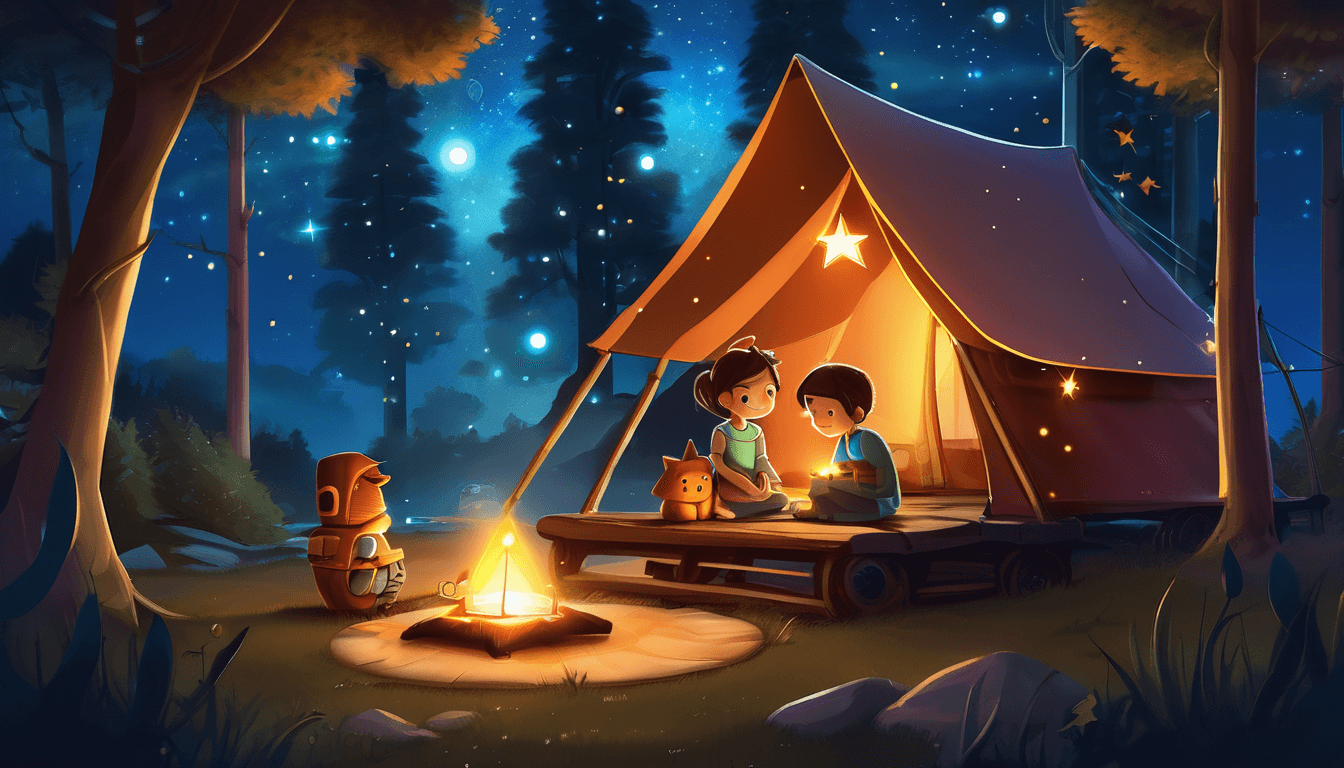
Miro had a silver face, round copper ears, and a small blue light in the middle of his chest that glowed whenever he was curious.
And Miro was curious almost all the time.
He lived with his family in a busy apartment above a bakery in the city of Bellavita. Every morning, delivery bicycles rang their bells below the windows. Every afternoon, the bakery ovens hummed warmly. Every evening, the streets shone with bright signs, glowing buses, shining shop windows, and screens everywhere.
There were screens in the elevator.
Screens in the train station.
Screens on the bakery counter, showing pictures of swirly cakes.
Miro liked screens very much. He liked their neat, bright colors. He liked how they could show maps, weather, music, pictures of dolphins, and instructions for fixing a wobbly chair.
So when his family announced they were going camping for the weekend, Miro’s chest light blinked a puzzled purple.
“Camping?” he asked.
“Yes!” said his older sister, Sanaa, tossing socks into a bag. “We’re going to Pineglass Valley.”
“We will sleep in a tent,” said Papa.
“And cook soup over a little fire,” said Mama.
“And there are no screens,” added Sanaa.
Miro’s blue chest light went dim.
“No screens?” he repeated.
“Not even one tiny screen?” asked Miro.
“Not even a tiny one,” said Mama, smiling.
Miro looked toward the window. Across the street, a giant screen flashed an advertisement for sparkling juice. It was bright enough to turn the rainy pavement pink and gold.
“But why?” Miro asked. “Screens help people see.”
Papa knelt beside Miro’s travel bag. “Sometimes people like to see different things.”
“What things?”
Papa’s eyes twinkled. “That is exactly what we are going to discover.”
The next morning, the family rode a small green train out of Bellavita. At first, Miro watched buildings slide by. Then the buildings became houses. The houses became fields. The fields became rolling hills with sheep that looked like white buttons sewn onto green blankets.
Miro pressed his silver nose against the train window.
“There are so many shades of green,” he said.
Sanaa laughed. “You have only just noticed?”
“I usually look at maps on the train,” Miro said.
When they arrived at Pineglass Valley, the air smelled of pine needles, cool rocks, and something sweet growing near the river. Their campsite rested between tall trees. Beyond it, a wide meadow stretched toward blue-gray mountains.
There were no glowing signs.
No buzzing traffic lights.
No bakery screens.
Only trees whispering to one another high above.
Mama and Papa put up the tent while Sanaa collected smooth stones from the riverbank. Miro read the tent instructions three times, then helped by holding the poles very straight.
At dinner, they ate tomato soup with beans and soft bread wrapped in foil. Miro did not need food the same way his family did, but he loved the warm smell of it. He sat near the fire and listened to the logs crackle.
As evening came, the forest changed.
The bright green leaves turned dark green.
The mountains turned deep blue.
The river became a long silver ribbon.
Then, little by little, darkness began to fill the spaces between the trees.
Miro’s chest light brightened automatically.
“Warning,” he said. “Visibility decreasing.”
Sanaa pointed at the sky. “That is the good part.”
“The good part?” Miro asked.
“Wait.”
The sun slipped away behind the mountains, leaving a stripe of peach-colored light. Then that faded too. The first star appeared, very small and clear.
Miro looked up.
Then another star appeared.
And another.
Soon the sky was sprinkled with thousands of them.
Miro made a tiny clicking sound of surprise.
“There are more stars than I expected,” he whispered.
“They were always there,” said Mama. “In the city, we just cannot see many of them because of all the lights.”
Miro tipped his head back farther. Above him was a huge dark sky, wider than all the streets of Bellavita put together. A pale, cloudy band crossed it from one side to the other.
“What is that?” he asked.
“The Milky Way,” said Papa.
Miro searched his memory. “A galaxy. A vast group of stars, dust, and planets.”
“Yes,” said Papa. “And we are inside it.”
Miro’s copper ears gave a soft whirr. He was inside it?
He imagined Bellavita, the bakery, their small apartment, the train tracks, the sleeping sheep, the little tent in the valley. Then he imagined all of it floating among enormous stars.
His chest light changed from bright blue to a gentle, thoughtful violet.
Later, Mama said, “Time to settle down.”
They crawled into their sleeping bags inside the tent. Sanaa fell asleep quickly. Papa’s breathing became slow and steady. Mama whispered goodnight.
But Miro could not sleep.
The darkness pressed softly against the tent walls.
There was no small green light from the microwave clock.
No passing headlights.
No elevator chime.
No screen making its quiet, electric hum.
Miro sat up.
“Are you all right?” Mama whispered.
“I do not understand the darkness,” said Miro. “It removes information.”
Mama opened the tent flap a little. Moonlight slipped in, pale as milk.
“Come outside for a moment,” she said.
They sat together on a flat rock near the tent. The fire had gone out, but its ashes glowed faintly red beneath a blanket of gray.
“Listen,” Mama said.
Miro listened.
At first, he heard almost nothing.
“This is silence,” he said.
“Is it?” Mama asked.
Miro listened more carefully.
He heard the river moving over stones.
He heard leaves brushing against leaves.
He heard an owl call from somewhere deep in the trees.
He heard a small animal rustle in the grass.
He even heard Mama’s coat make a soft crinkle when she breathed.
“This silence has sounds in it,” Miro said.
Mama nodded. “At home, there are so many loud things that these quiet sounds get hidden.”
Miro stayed very still.
A cricket chirped near his foot.
Then another cricket answered from farther away.
The two chirps bounced gently through the dark, like a tiny conversation.
“What are they saying?” Miro asked.
“Perhaps they are saying, ‘I am here,’” Mama replied.
Miro thought about that.
The crickets did not have screens.
They did not need bright signs.
Still, they could tell one another they were there.
The next day brought a new discovery.
After breakfast, the family followed a trail into the woods. Miro wore a little red backpack filled with a raincoat, a magnifying glass, and three emergency batteries, though Mama reminded him he would not need them.
The trail curved past ferns as big as umbrellas. It crossed a wooden bridge over a stream. It climbed between boulders covered in soft green moss.
Miro noticed things he had never seen on a screen.
A beetle with a shiny blue back climbing a twig.
A spider web holding round drops of water.
A feather striped black and gold.
A tiny mushroom shaped like a cup.
At lunchtime, they rested in a meadow. Sanaa lay on her back in the grass.
“Look,” she said.
Miro lay beside her. Above them, white clouds traveled slowly across the sky.
“That one looks like a whale,” Sanaa said.
“That one resembles a kettle,” said Miro.
“That one looks like a dancing potato,” said Sanaa.
Miro considered it. “Agreed.”
They watched clouds for a long time. No one rushed them. No one asked them to swipe, click, charge, or choose a password.
Miro found that he liked the slow clouds.
They did not give answers.
They gave room for wondering.
That evening, as the second night came, Miro did something surprising.
Before the stars appeared, he pressed the small button beneath his collarbone.
His chest light dimmed.
“Miro?” Papa said.
“I am testing a discovery,” Miro explained.
His family sat around the fire, quiet and warm. The darkness gathered again, but this time Miro did not think of it as empty.
Darkness made the fire seem brighter.
Darkness made the stars come out.
Darkness made the owl’s call travel farther.
Darkness made the family’s faces glow close together, like a secret circle in the enormous valley.
Miro leaned against Papa’s shoulder. Papa was warm, and Miro’s metal head made a small clink against his jacket zipper.
“Why do people enjoy darkness?” Miro asked.
Papa looked toward the sky.
“Maybe because darkness helps us notice what light can hide.”
“And silence?” Miro asked.
“Silence helps us notice what noise can hide.”
“And skies without screens?”
Mama smiled. “Those remind us that the world is much bigger than the things we make.”
Miro looked up at the Milky Way. He listened to the river. He smelled the pine trees and the sleepy ashes of the fire.
Then he understood something, though it was not the sort of understanding that fit neatly into a file.
People did not come camping because there was nothing to see.
They came because there was so much to see, once they stopped looking only at bright things.
On the train home, Miro watched the city return through the window. The screens came back. The signs flashed. The buses glowed. Bellavita buzzed and glittered as it always had.
Miro still liked screens.
He still liked maps and dolphin pictures and instructions for wobbly chairs.
But that night, from his bedroom window above the bakery, he spotted one small star between the tall buildings.
He turned off his lamp.
He sat quietly.
And beneath the soft city sounds, Miro listened for the tiny hidden silence that was still there, waiting for him to notice.
Leave a Reply