
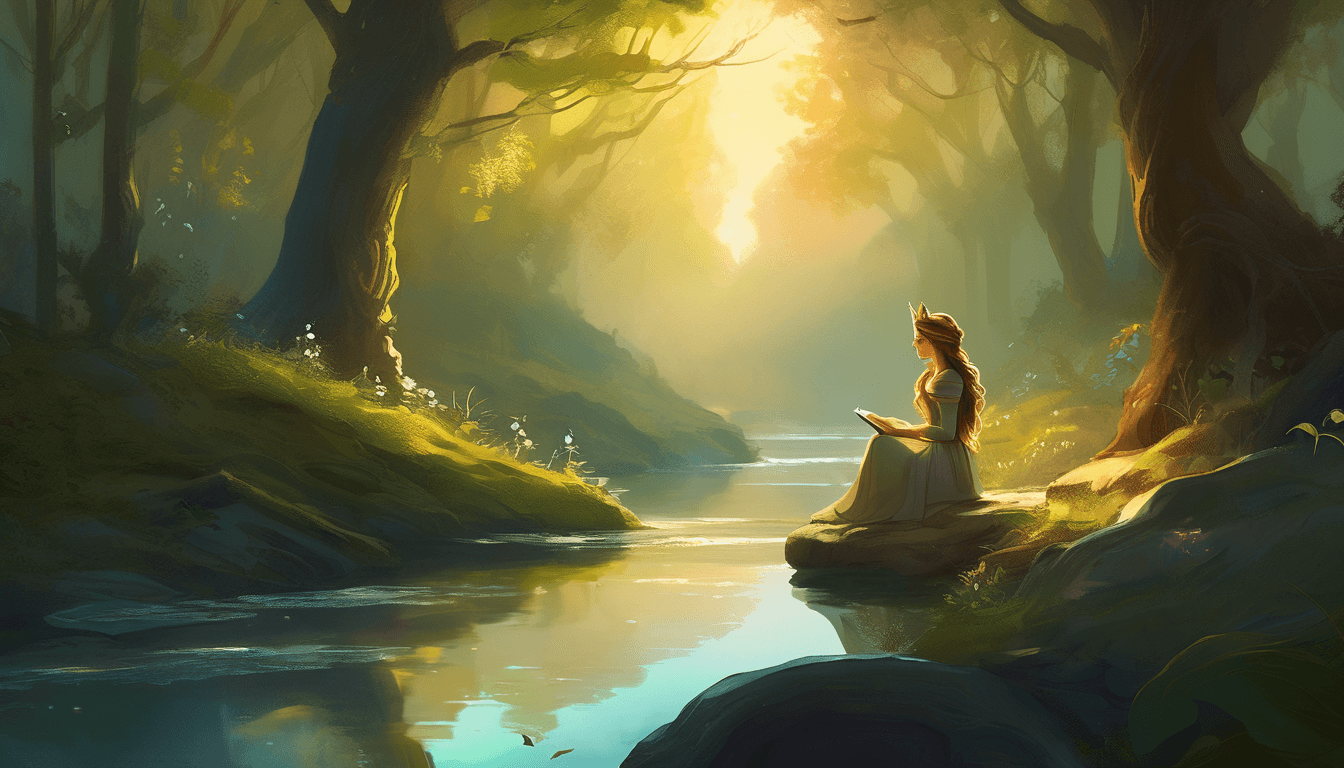
In the kingdom of Veloria, where the rivers shone blue at noon and silver at night, there stood a palace with seven round towers.
At the very top of the tallest tower slept Princess Samira.
Samira had warm brown eyes, quick feet, and a mind that moved faster than a flock of swallows. She loved maps, secret staircases, sugared plums, and deciding things. She decided which flowers should be planted in the palace gardens. She decided what songs the bell ringers should play on feast days. She even decided that the royal geese should wear little blue ribbons around their necks.
Most of the time, Samira’s decisions were quite good.
But there was one thing Samira did not enjoy.
She did not enjoy being disagreed with.
If someone said, “Perhaps there is another way,” Samira’s shoulders would stiffen.
If someone said, “I see it differently,” Samira would tap her slipper against the floor.
And if someone said, “Your Highness, I am not sure that is wise,” Samira would lift her chin and say, “I have already decided.”
On the morning of her twelfth birthday, the whole kingdom gathered in the Great Hall. Musicians played flutes made of pale river reeds. Bakers carried in cakes iced with tiny golden stars. The royal tailor brought a velvet cloak the color of ripe cherries.
Then Queen Nasrin, Samira’s mother, carried forward a small wooden box.
It was made from the wood of a moon pear tree, and it had a silver latch shaped like an ear.
Samira blinked. “An ear?”
“A reminder,” said the queen.
She opened the box.
Inside lay a crown unlike any crown Samira had ever seen. It was braided from gold as fine as sunlight. Along its rim sat seven little jewels: a ruby, an emerald, a sapphire, an amber stone, a pearl, an amethyst, and a round piece of milky moonstone.
The crown was lovely.
It was also very, very heavy.
When the queen placed it on Samira’s head, Samira’s knees bent.
“Oof!” she gasped.
The guests murmured kindly.
“It will become lighter,” said Queen Nasrin.
“When?” Samira asked.
“Whenever you listen carefully to someone who disagrees with you.”
Samira frowned. “Listen carefully?”
“Not merely waiting for them to stop talking,” said the queen. “Not pretending to listen while planning your answer. You must truly hear what they mean.”
Samira was not sure she liked this rule at all.
Still, a princess must stand tall at her birthday celebration, even when her crown feels like a sleepy dragon has curled up on her head.
So Samira stood tall.
For the first few days, she carefully avoided anyone who might disagree with her.
When the royal gardener suggested planting white lilies near the fountain instead of red poppies, Samira said, “Oh, look at that cloud,” and hurried away.
When the palace cook said the kitchen needed a new oven, Samira said, “I must go polish my crown,” though she did not polish it.
When her little cousin, Miro, said, “I think blue ribbons make the geese grumpy,” Samira gave him a lemon tart and changed the subject.
But the crown remained heavy.
Heavier, perhaps.
By the end of the week, it pressed her curls flat. It made her neck ache during lessons. It made her walk slowly down stairs. One afternoon, it even slid over her eyebrows while she was trying to read a book about griffins.
Then, one bright morning, a problem came to Veloria.
The Cloudwood Forest had grown thirsty.
The forest lay beyond the city walls, where tall trees held little villages in their branches. The people of Cloudwood collected rainwater in shining bowls made from giant leaves. They traded honey, mushrooms, carved toys, and soft wool with Veloria.
But for many weeks, no rain had fallen.
The leaf bowls were dry.
The woodland wells were low.
And the forest folk came to the palace seeking help.
In the Great Hall stood Elder Olek, who had a beard as white as thistle fluff. Beside him stood a young forest keeper named Tavi, wearing a green cap and muddy boots.
“The river should be turned toward Cloudwood,” said Elder Olek. “A channel can be dug from the River Sel to the forest roots.”
Samira sat on her golden chair beneath a painted ceiling of stars. Her crown felt particularly enormous that day.
“Yes,” she said at once. “We shall send workers this afternoon. They will dig a river channel through the eastern meadow.”
Tavi stepped forward. “Your Highness, I disagree.”
Samira’s fingers curled around the arms of her chair.
The room went quiet.
“The eastern meadow is where the meadow ponies foal,” Tavi continued. “And beneath it, there are sleeping burrows of the blue-nosed marmots. If we dig there, we may ruin their homes.”
Samira wanted to say, We cannot wait. We need water.
She wanted to say, It is only a meadow.
Instead, she remembered the silver ear on the wooden box.
She took a slow breath.
“What do you think we should do?” she asked.
Tavi looked surprised.
Then he unrolled a map. “There is an old stone canal near the western hills. It was built long ago, before my grandmother’s grandmother was born. It may still lead to Cloudwood. It is blocked by thorn vines and fallen rocks, but it would not harm the meadow.”
Samira leaned closer.
The map showed a twisty line that passed through the Whispering Hills, under a bridge, and around a lake shaped like a sleeping cat.
“It is much longer,” she said.
“Yes,” said Tavi. “But it may be kinder.”
Samira sat quietly.
She thought of thirsty trees. She thought of tiny marmots sleeping underground. She thought of newborn meadow ponies wobbling on long legs.
Then she nodded. “We will go and see the old canal.”
At once, the crown gave a small, musical hum.
The ruby glowed like a berry in sunlight.
And suddenly, Samira’s head lifted.
The crown was still there, but it no longer felt like a dragon. It felt like a large, sleepy cat.
Everyone in the hall noticed.
Queen Nasrin smiled, but said nothing.
Samira, Tavi, Elder Olek, and a small group of helpers set out toward the western hills. There were stone masons, rope makers, gardeners, and two cheerful donkeys named Basha and Nuri.
The path was long. It wound through fields where yellow butterflies floated over clover. It crossed a bridge where fish flashed beneath the water. It climbed into hills that whispered whenever the wind moved through the grass.
“Whispering Hills,” said Miro, who had begged to come along. “Do they tell secrets?”
“Only to people who can listen,” said Elder Olek.
Miro put his ear to the ground.
“What do they say?” Samira asked.
“They say I should have brought more biscuits.”
Everyone laughed.
At last, they found the old canal.
It was almost hidden beneath tangles of thorn vines. Great gray stones had tumbled into it. Moss grew on the old walls, and in one place, a family of red-tailed lizards had made a home between the cracks.
Samira studied it.
“We can clear it,” she said. “The workers can pull up every vine and move every stone.”
“I disagree,” said a quiet voice.
It was Mara, the oldest stone mason. Her hair was braided in a thick gray rope down her back, and she carried a hammer tucked into her belt.
Samira sighed inside herself.
But this time, she did not feel angry. Not quite.
“What do you see?” she asked.
Mara pointed to the canal wall. “These stones are old. If we pull too hard, the wall may collapse. The water could flood the valley instead of flowing to Cloudwood.”
Tavi crouched beside the canal. “And the thorn vines are holding some of the loose stones together.”
Samira looked at the vines. They were prickly and wild, with little purple flowers hidden among their leaves.
“So what should we do?” she asked.
Mara smiled. “Slowly. We clear only one small part at a time. We build supports. We move the lizards before we shift the stones. It will take longer.”
Samira looked toward the faraway forest. She imagined the dry leaf bowls and thirsty roots.
Longer felt difficult.
But flooding the valley would be worse.
“Slowly, then,” she said.
The crown hummed again.
This time, the emerald shone green as spring.
The crown became lighter still.
It felt like a basket of apples now. Not weightless, but possible.
For three days, everyone worked carefully.
The rope makers tied strong cords around stones. The gardeners gently moved the flowering thorn vines into baskets so they could be replanted. Miro and Tavi carried the red-tailed lizards to sunny rocks nearby.
Princess Samira worked too.
She wore plain boots and a blue work dress. Her hands became dusty. A thorn snagged her sleeve. Once, she slipped in mud and sat down with a surprised plop.
Basha the donkey looked at her as if this were very funny.
On the fourth morning, a dark cloud appeared in the sky.
Everyone cheered.
“Rain!” cried Miro.
But the cloud did not bring rain.
It was a smoke cloud.
Far beyond the hills, near the old canal’s ending, a small fire had begun in the dry grass. It crackled along the forest edge, frightening birds from the trees.
“We must open the canal now!” said Elder Olek.
“We must break the final stone wall,” said one of the workers.
Samira ran to the end of the canal. There stood an ancient stone gate, sealed with roots and mud. Behind it waited the river water, held back in a small reservoir.
“If we open it quickly,” said Tavi, “the water can travel to the fire.”
“But the channel is not finished,” said Mara. “The last bend is weak. Too much water at once could break it.”
“We do not have time,” said Elder Olek.
The three of them looked at Samira.
Samira’s crown suddenly felt heavy again.
Not as heavy as before, but heavy enough to remind her that a decision was waiting.
Elder Olek said, “Open the gate now. The forest needs water.”
Mara said, “Wait and strengthen the bend. The valley needs safety.”
Tavi said nothing. He was watching the smoke.
Samira wanted someone to tell her the right answer.
But no one did.
Then she saw Miro beside the canal, holding a little red-tailed lizard in his palms. The lizard’s tiny chest moved quickly. It was frightened.
Samira knelt beside him.
“Where would it be safest for the water to go?” she asked.
Miro looked at the lizard, then at the canal. “Not all at once,” he said. “Like when you pour tea into a cup. If you pour too fast, it spills.”
Samira looked at the stone gate.
There was a small opening near the bottom, covered by a round plug of rock.
“Mara,” she said, “can we open only that small part first?”
Mara’s eyes widened. “Yes. A narrow stream could wet the grass near the fire while we reinforce the bend.”
“Tavi,” said Samira, “can the forest keepers guide the water with earth banks?”
“Yes!” he said. “We can make little paths for it.”
“Then we do both,” said Samira. “We send a little water now. We make the canal safe as we go.”
Everyone sprang into action.
Mara and her helpers carefully loosened the round stone plug. At first, only a trickle slipped through, clear and bright. Then a narrow stream rushed along the canal, curling around the bends.
Tavi and the forest keepers shaped small banks of earth with shovels and their hands. The water hurried across the dry ground toward the edge of the fire.
Steam rose.
The flames hissed.
Not all at once, but little by little, the thirsty grass darkened. The fire shrank from a roaring orange creature into a few glowing red patches, then into smoke, then into nothing but wet earth.
By sunset, the forest was safe.
And the old canal, strengthened with care, carried a shining ribbon of water all the way toward Cloudwood.
The trees drank.
Their leaves lifted in the evening breeze.
Drops began to gather at the tips of branches, and then, as though the sky had been waiting for everyone to finish, soft rain began to fall.
It tapped on Samira’s hair.
It made silver dots on the canal stones.
It drummed gently on the donkeys’ backs.
Samira looked up, laughing.
Then the crown on her head sang.
All seven jewels glowed.
The ruby, emerald, sapphire, amber, pearl, amethyst, and moonstone shone together.
The crown lifted so lightly that Samira almost forgot she was wearing it.
It felt like a circle of warm sunlight.
Queen Nasrin had come up the path with a small group from the palace. She stood beneath a rain cloak, watching her daughter.
Samira walked to her.
“Mother,” she said, “I still do not always like it when people disagree with me.”
The queen nodded. “That is all right.”
“But sometimes,” said Samira, touching the light crown, “they can see a piece of the path that I cannot.”
Queen Nasrin smiled. “That is why a wise ruler has ears as well as a crown.”
That night, everyone returned to the palace.
There was warm soup with tiny star-shaped noodles. There were honey cakes for the workers and extra oats for Basha and Nuri. The royal geese received new ribbons, though Samira chose soft green ones this time.
Miro inspected them very seriously.
“They do seem less grumpy,” he admitted.
Before bed, Princess Samira climbed the seven winding staircases to her room in the tallest tower.
She placed her crown on the moon pear box beside her bed.
It was so light now that one small finger could lift it.
Outside her window, the kingdom of Veloria gleamed under the rain-washed moon. In the distance, beyond the western hills, the Cloudwood Forest shimmered with drops of water on every leaf.
Samira climbed beneath her blankets.
As she began to drift toward sleep, she thought she heard the Whispering Hills far away.
They were not telling secrets.
They were simply saying, over and over, in soft grassy voices:
Listen.
Listen.
Listen.
And because the room was warm, and the kingdom was safe, and her crown was resting quietly beside her, Princess Samira listened.
Then she dreamed of rivers, moon pears, silver rain, and all the many paths that could lead home.



Leave a Reply