
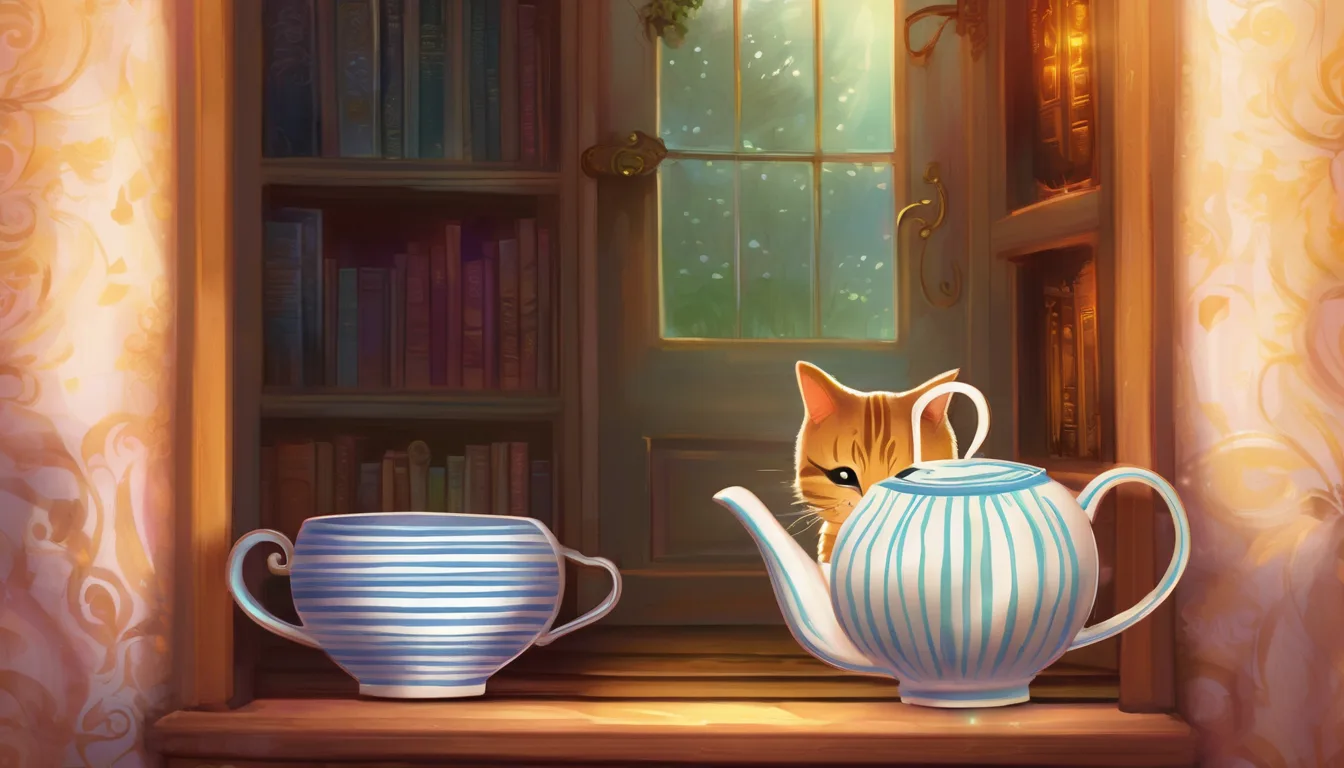
In a quiet little town where the cobblestones remembered every footstep, there was a crooked blue house at the end of a lane. In that crooked blue house lived a striped cat named Milo, who loved three things more than anything in the world: warm blankets, soft music, and cups of peppermint tea.
Milo was not like other cats in the town. He did not chase birds or climb roofs just to show off. Milo preferred to sit on the wide windowsill and watch the clouds drift by, wondering where they were going and if they ever got tired. He liked to tap his tail in time with the ticking of the clock and imagine that the clock and his tail were having a quiet little dance.
Milo’s human was an old woman named Signora Rosa, who wore long skirts that whispered as she walked and earrings that chimed like tiny bells. Signora Rosa collected teacups. She had teacups with flowers, teacups with golden rims, teacups shaped like seashells, and even one that looked like a plump tomato.
Every evening, just as the sky turned lavender and the first stars peeked out, Signora Rosa made herself a pot of tea. The steam would curl up like soft ghosts, and Milo would follow it with his eyes until it disappeared. Then he would curl at her feet and purr while she read stories out loud from her old, crackly books.
One rainy night, when the wind was grumbling and the raindrops were racing each other down the window, Signora Rosa fell asleep in her rocking chair before she could finish her tea. The book slid from her hands and landed with a soft thump on the rug. Her glasses slipped down her nose, and her snores began to sound like a sleepy harmonica.
Milo sat up and stretched, his back arching like a question mark. The house felt different when Signora Rosa slept. The ticking of the clock grew louder, the shadows grew longer, and the teacups on the shelves seemed to lean forward as if they were listening for something.
On the little table beside the rocking chair, Signora Rosa’s favorite teacup waited. It was a pale green cup with tiny white dots and a handle shaped like a leaf. Tonight the cup was only half full, and the tea had grown cool and still. The lamplight shivered in the surface, making it look like a small, quiet pond.
Milo hopped onto the table with the careful grace of a cat who had done this many times. He sniffed at the tea. Peppermint and honey. Sweet and sharp. He dipped one paw in and then shook it, making raindrop shapes on the table. He watched the ripples glide across the surface of the tea.
As the ripples spread, something unusual happened. Very unusual. In the center of the teacup, where the lamplight should have been the brightest, a tiny dot of light appeared. It was no bigger than a grain of rice at first, but it glowed with a steady, gentle shine, like a star that had lost its way and fallen into the tea.
Milo leaned closer, his whiskers twitching. The dot grew into a circle. Then it stretched taller and taller until it became a tiny glowing door, no higher than Milo’s nose. The door had a little round knob and the faintest outline of a keyhole that sparkled like a silver tear.
The door stood there, floating right above the tea, glowing softly. Milo blinked several times. He looked back at Signora Rosa to see if she had noticed. She only snored a little louder and mumbled something about cinnamon.
Milo’s heart began to beat faster. His tail puffed up, not with fear, but with excitement. He had always wondered if the world was bigger than the rooms he knew and the garden he visited. Now, a door had appeared inside a teacup. The world, it seemed, was ready to answer him.
He stretched his neck and sniffed at the glowing door. It smelled like warm sugar and rain on stone and the crisp edge of a page in a new book. It smelled like something that was waiting to be discovered. Slowly, the tiny knob turned all by itself with the softest click.
The little door opened inward, and a breath of cool, shimmering air slipped out. It brushed Milo’s whiskers and sent a shiver all the way down to the tip of his tail. The air hummed, just a little, like a faraway song played on a glass violin.
Inside the door, instead of the dark inside of a teacup, Milo saw a hallway no wider than his paws. The hallway was lit by hundreds of firefly lamps that floated gently along the walls. The floor looked soft, like moss, but it glimmered as if someone had sprinkled it with tiny bits of moon.
Milo knew, deep inside his brave little cat heart, that this was a moment that would not come again. He glanced once more at Signora Rosa and at the quiet room. Then, as carefully as a cat can, he placed one paw into the glowing doorway.
The world wobbled. The teacup tilted, though it did not spill. Milo felt himself being pulled, not down and not up, but sideways into a place that tasted like peppermint and starlight. His whiskers tingled, his ears filled with a gentle ringing sound, and his fur stood on end as if he were a dandelion puff caught in a breeze.
Then, just as suddenly, the wobbling stopped. Milo opened his eyes. He was standing in the tiny hallway he had seen through the door. Except now it did not seem tiny at all. It stretched ahead of him, long and winding, with the firefly lamps bobbing politely as he passed.
The walls of the hallway were not made of stone or wood. They were made of stacked saucers and cups and little porcelain plates, all glued together in swirls and patterns. Some cups still had painted roses, others had stripes or stars. Milo could see the ghost of old tea stains like pale brown clouds.
As he walked, his paws made almost no sound on the soft, moon speckled floor. The only noise was the gentle clink of the teacup walls as they settled and the quiet buzzing of the firefly lamps. The air was warm and smelled faintly of lemon peel and toasted sugar.
After a while, or perhaps only a short time, Milo turned a corner and found himself in a vast, round room. The ceiling was a high dome made of crystal teapots, each one hanging upside down like a bell. Inside every teapot, a tiny candle burned with a colored flame. Blue, pink, green, gold. The lights painted soft rainbows on Milo’s whiskers.
In the center of the room stood a tall, elegant figure about as high as a human chair. It was not a person, not exactly. It was a teapot. A teapot with slender silver arms, a polished round body, and a long curved spout. The teapot wore a little crown made from a sugar tong and three sugar cubes that glittered like ice.
“Welcome, Milo of the Crooked Blue House,” said the teapot, bowing with a gentle clink. Its voice was like tea being poured into fine china, warm and smooth. “I am Lord Samovar, Keeper of the Teacup Ways.”
Milo’s ears tilted forward. “You know my name,” he said, a little surprised. His own voice sounded small in the big crystal room.
“Of course,” replied Lord Samovar. “The teacups in your house talk about you all the time. They say you are careful with your paws and kind to the saucers. They say you listen to stories even when you pretend to be asleep.”
Milo felt his cheeks grow warm under his fur. He had not known that cups could talk, but he liked that they had noticed his care. “Where am I?” he asked softly. “And why was there a door in Signora Rosa’s teacup?”
“You are in the Hall of Hidden Sips,” said Lord Samovar. “This is the first chamber of the Whimsy Way, where all forgotten drops of tea and lost sugar grains come to dream. As for the door, it appears only when a heart in the waking world is ready to walk through it.”
Milo thought about his quiet evenings, his wondering eyes, his curiosity that tickled at him like a feather. Perhaps his heart had indeed been ready for a very long time. “What happens in the Whimsy Way?” he asked.
Lord Samovar’s spout curved into something like a smile. “Ah, many things. Teaspoons learn to dance. Sugar cubes practice their jumps. Lost saucers find their matching cups. And sometimes, on the rarest of nights, a cat comes to help us when we are in a bit of a steep.”
Milo tilted his head. “In a steep?”
“Trouble,” said Lord Samovar gently. “We are in trouble, Milo. The Glow that lights our doors has begun to flicker. If it goes out, no more doors will appear in teacups, and the Whimsy Way will be forgotten.”
Milo looked up at the colorful flames shining inside the crystal teapots. Some of them did seem dimmer, as if a fog had crept into the glass. “Why is the Glow fading?” he asked.
“Because the Teacup Moon has gone missing,” said Lord Samovar. His voice trembled just a little. “Without the Teacup Moon, the Glow has nothing to drink. It grows weaker every night.”
Milo had never heard of the Teacup Moon, but he understood the feeling of something missing. Once, Signora Rosa had lost her favorite spoon and had searched for half a day, her face full of worry. The house had felt wrong until the spoon was found.
“What can I do?” Milo asked. “I am only a cat.”
“Exactly,” replied Lord Samovar. “Only a cat can fit through some of our smaller passages. Only a cat can walk silently enough not to wake the sleeping Saucers of Doubt. And only a heart that still believes in wonder can see the Teacup Moon when it hides.”
Milo’s tail twitched thoughtfully. He looked down at his paws. They were not big paws, but they were sure and steady. He had used them to climb curtains, to pat Signora Rosa’s cheeks when she was sad, and to bat at dust motes dancing in the sun. Perhaps they could also help find a missing moon.
“I will go,” he said. “Tell me where to start.”
Lord Samovar’s crown of sugar cubes chimed together in relief. “You must follow the Saucer Path through three rooms. First, the Pantry of Echoes. Then, the Library of Steam. Finally, the Garden of Almost. Somewhere in the Garden, the Teacup Moon is hiding. But be careful. The Garden is watched by the Sleepless Teaspoon.”
“The Sleepless Teaspoon?” Milo repeated, his ears flattening just a bit.
“A guardian,” said Lord Samovar. “Very loyal, very shiny, and very stubborn. You must not anger it. You must listen to it. Only then will the Garden open its deepest corner.”
Milo took a slow breath. His whiskers quivered, but his eyes were bright. “I will remember,” he promised.
Lord Samovar clapped his silver hands, and a small door opened in the wall of stacked saucers. A path of tiny plates lit up one by one, stretching into the distance like a trail of little moons. “Walk this way to the Pantry of Echoes,” he said. “And Milo, thank you.”
Milo dipped his head politely. Then he stepped onto the first plate. It did not wobble under his weight. The next plate glowed as his paw touched it, and the next, and the next, until he was walking on a chain of soft white lights. The round room faded behind him, and the air grew cooler.
The Pantry of Echoes was not like any pantry Milo had ever seen. It was as tall as a cathedral and three times as long. The shelves climbed up and up, disappearing into mist. On every shelf sat jars and tins and boxes, all neatly labeled in careful curling letters.
Milo read some of the labels as he walked. “Leftover Laughter. Unused Whispers. Half Remembered Songs. Crumbs of Courage.” Each jar glowed faintly, and every sound he made was repeated back to him in soft, playful echoes.
His claws clicked once on the floor. Click, said the pantry. Click, click, click, click, like a row of tiny cats following behind him. When he cleared his throat, the sound echoed back as a dozen polite little coughs. Milo could not help it. He giggled.
His giggle bounced off the jars and came back bigger, rounder, and sillier. The Pantry of Echoes filled with a chorus of laughing Milos. The jars of Leftover Laughter shook on their shelves, and a few even popped open, letting bubbles of giggles float out and burst like soap.
“Careful,” said a soft voice near his paws. “Too much laughter and the shelves get ticklish.”
Milo looked down. At his feet stood a small, round cookie tin with painted daisies on its lid. The tin had two little metal eyes and a shy, dented smile. It rolled from side to side as it spoke.
“Hello,” Milo said. “I did not mean to tickle the shelves. I am looking for the way to the Library of Steam.”
“The Library of Steam,” the tin repeated thoughtfully. “That is beyond the Far Shelf. You will need to cross the Floor of Forgotten Crumbs. Many paws get stuck there.”
Milo flexed his toes. “Stuck how?”
“In memories of dropped biscuits and spilled sugar,” said the tin. “They cling if you are not careful. But you are a cat. You know how to walk lightly. Just remember: do not look back at the crumbs that call your name.”
Milo nodded. “Thank you. What is your name?”
The tin’s dented smile grew a little wider. “I am Dalia. I used to hold lemon cookies. Now I hold the sound of their crunch. It is a good sound.”
“It sounds lovely,” said Milo. “Will you be all right if I go on?”
“Oh yes,” Dalia replied. “I like to listen. I will listen to your steps and cheer for you quietly.” She rolled herself back against a jar of Saved Surprises and settled there.
Milo continued down the long aisle until the shelves ended. The floor ahead changed color, from smooth gray to a patchwork of browns and golds. Crumbs of every size and shape covered the ground. Some were as fine as sand, others as big as pebbles. They glittered with sugar and memory.
As soon as Milo touched the Floor of Forgotten Crumbs, he heard them whisper.
“Milo,” sighed a crumb that smelled of cinnamon. “Remember when you almost tasted me when I fell from Signora Rosa’s plate?”
“Milo,” hummed a sugar grain. “Remember the time you knocked over the sugar bowl and she laughed instead of scolding you?”
“Milo,” crooned a soft cake crumb. “Remember the birthday when there were too many candles and you chased the smoke?”
The crumbs were not scary. Their voices were gentle and full of warmth. Milo felt his heart tug toward them. Each memory was like a soft paw on his shoulder, asking him to stop, to sit, to stay.
He remembered Dalia’s warning. Do not look back at the crumbs that call your name. He lifted his paws higher, placing them carefully between the thicker patches of crumbs. He focused on the far end of the floor, where he saw a faint swirl of steam rising like a silver ribbon.
The whispers grew sweeter. “Just a quick rest,” begged a honey crumb. “Just one little step back,” coaxed a sugar crystal. Milo’s tail twitched. His paws felt heavy, as if the crumbs had turned into tiny hands, holding him in place.
He closed his eyes and pictured Signora Rosa asleep in her rocking chair, the unfinished story resting on her lap. He pictured the glowing door in the teacup, the fading lights in the crystal hall, and Lord Samovar’s worried eyes. He remembered why he was walking at all.
“I will come back in my thoughts,” he whispered to the crumbs. “I will remember you without stopping.” Then he took a breath and stepped forward, and forward again, and again.
With each step, his paws grew lighter. The crumbs’ voices faded into a soft murmur, like the sound of rain in another room. At last, his front paw touched smooth stone again. He opened his eyes. The Floor of Forgotten Crumbs lay behind him, shining softly like a field of tiny stars.
Before him stood a tall archway made of stacked teacups, all of them chipped in just the right way so they fit together. From somewhere beyond the archway came the sound of pages turning and a gentle, steady hiss.
Milo passed through the archway into the Library of Steam. It was dim and cozy, filled with shelves that curved in slow spirals and ladders that climbed up into shadows. Instead of books, the shelves held glass jars full of steam. Each jar was sealed with a cork and labeled with the name of a story.
Milo read a few as he walked past. “The Night the Kettle Sang Too Loud. The Tale of the Lost Saucer. The Cat Who Learned to Whistle. The Day All the Sugar Turned Blue.” Inside each jar, the steam swirled in little shapes, like scenes from the story trapped in a cloud.
A plump, copper kettle sat on a low table in the center of the room. It wore round spectacles on its spout and a knitted cozy in stripes of green and yellow. As Milo approached, the kettle let out a small puff of steam that smelled like old paper and lemon peel.
“Ah, visitor,” said the kettle. “It has been a long time since anyone new came to read the steam.” Its voice was rough and kind, like someone who had told many stories and liked them all.
“I am Milo,” the cat said. “I am trying to find the Garden of Almost. They told me I must pass through the Library of Steam.”
“Indeed you must,” replied the kettle. “I am Professor Hervé, keeper of the Condensed Tales. To reach the Garden, you must answer a question. All who pass through here must answer one.”
Milo sat down politely, wrapping his tail around his paws. “What is the question?” he asked.
Professor Hervé’s lid rattled thoughtfully. “The question is different for everyone. For you, Milo, the question is this. What is the quietest sound you know?”
Milo blinked. He thought of the clock at home, of raindrops on glass, of Signora Rosa’s breathing as she slept. He thought of pages turning and the soft thump of his own paws on the rug.
He closed his eyes. In his mind, he walked through a day in the crooked blue house. Morning light, afternoon nap, evening tea. Somewhere between all these sounds, he found it. A sound that was not quite a sound at all.
“The quietest sound I know,” Milo said slowly, “is when Signora Rosa smiles without laughing. Her lips do not make a noise, but the room feels different. It is like a hush made of happiness.”
The library seemed to hold its breath. The jars of steam glowed a little brighter. Professor Hervé let out a long, pleased hiss of steam that curled into the shape of a heart before it faded.
“A very good answer,” he said. “Quiet is not always empty. Sometimes it is full of things that do not need to be loud. You may pass, Milo. The Garden of Almost awaits you through the back door, behind the shelf of Unfinished Wishes.”
Milo stood and bowed his head. “Thank you, Professor,” he said.
“Take a story with you,” the kettle added kindly. “You never know when you might need an extra one.”
One of the jars on the nearest shelf popped its cork and floated down into Milo’s paws. Its label read, “The Cat Who Danced With His Shadow.” Milo tucked the jar carefully under his chin for a moment, feeling its warmth, then let it drift back. The jar returned to its place, but a faint wisp of steam stayed with him, curling around his ears like a promise.
At the far end of the library, Milo found the shelf of Unfinished Wishes. The jars here were only half full. Their labels read, “Learn to whistle,” “Find a missing sock,” “Say hello to the moon,” and many more. Behind this shelf, just as Professor Hervé had said, was a small wooden door with a round brass handle.
Milo pushed it open. A breeze slipped through the crack, carrying the smell of mint, soil, and something not yet decided. He stepped through and found himself in the Garden of Almost.
The garden stretched as far as he could see, but nothing in it was quite complete. Trees stood with half their leaves painted green and the other half still sketched in soft pencil. Flowers had petals that shimmered at the edges, as if they could not decide what color to be. Paths began and then faded into mist, as if the idea of them had only just been born.
Above the garden hung a pale sky with faint stars that blinked on and off like sleepy eyes. Milo searched for the Teacup Moon, but he saw no moon at all, not even a sliver.
He walked along a path made of almost stones that felt warm but did not quite touch his paws. As he walked, he heard voices all around him. Little sighs and half sentences.
“Almost finished,” murmured a vine that had not reached its trellis. “Almost ready,” hummed a bud that had not yet opened. “Almost brave,” whispered a tiny, shivering leaf.
Milo’s heart felt a small ache. The garden was beautiful in its not quite way, but it also felt a little lonely, like a song that stops before the last note. Somewhere in this place, the Teacup Moon was hiding, and he would have to find it.
He remembered Lord Samovar’s warning. The Garden was watched by the Sleepless Teaspoon. Milo’s ears twitched, listening. At first, he heard only the soft rustle of unfinished things. Then, from behind a cluster of half grown teacup roses, he heard a clear, bright clink.
A teaspoon stepped out from the shadows. It was tall for a spoon, almost reaching Milo’s shoulder. Its silver surface shone like a drop of liquid light. Its handle was carved with tiny stars, and its bowl was polished to a perfect mirror.
The Sleepless Teaspoon had no eyes, yet Milo felt it looking at him. It tapped its bowl gently against a stone, making a ringing sound that hung in the air like a question.
“Who walks in the Garden of Almost?” asked the spoon. Its voice was high and clear, like a bell.
“I am Milo,” the cat replied. “I came through the glowing door in a teacup. Lord Samovar sent me to find the Teacup Moon.”
The spoon tilted, reflecting Milo’s face back at him, small and a little nervous. “Many have wanted to find the moon,” said the Sleepless Teaspoon. “Why should you be the one?”
Milo thought about saying that Lord Samovar had chosen him, that he was small and quiet and could walk lightly. But the spoon had asked why he should be the one, not who had sent him.
“Because I am already here,” Milo said after a moment. “And because I promised to try.”
The spoon was silent. The reflection in its bowl shimmered. “Promises are heavy,” it said at last. “Even for a cat. Do you know what the moon is, Milo?”
“A light,” he answered. “A round light in the sky.”
“Sometimes,” the spoon agreed. “Sometimes the moon is also a mirror. Sometimes it is a question. Sometimes it is a cup. The Teacup Moon is all of these. It shows what is almost true and waits for someone to see what is really there.”
Milo’s whiskers quivered. “How can I find it?” he asked.
The Sleepless Teaspoon stepped closer. Milo could see his own eyes in its shining bowl, wide and a little uncertain. “First you must answer me this. What is the bravest thing you have ever done?”
Milo opened his mouth, then closed it. He thought of chasing shadows, of climbing high shelves, of walking across the Floor of Forgotten Crumbs. But none of those felt like the bravest thing. They felt more like games.
He remembered a night when thunder had boomed over the crooked blue house. Signora Rosa had been alone then. The storm had made the windows rattle and the lights flicker. She had sat in her chair, hands folded tightly, eyes far away.
Milo had been afraid. The thunder had made his bones shake. He had wanted to hide under the bed. Instead, he had climbed into her lap and pressed his warm body against her. His heart had thudded fast, but he had stayed there, purring as loudly as he could, until her hands relaxed and her eyes softened.
“The bravest thing I have ever done,” Milo said softly, “was stay in Signora Rosa’s lap when I was very scared, because she was scared too and I did not want her to be alone.”
The garden grew very still. Even the almost leaves paused in their half rustle. The Sleepless Teaspoon’s silver surface dimmed a little, as if it were thinking very hard.
“Bravery that holds another’s fear,” the spoon said at last. “That is a kind of light. You may pass, Milo. But know this. The Teacup Moon will not look like a moon, not at first. You must use the same heart that stayed in the storm to see it.”
The spoon lifted itself high and tapped the ground three times. Each tap made a ring of silver light spread across the path. When the third ring faded, a new path appeared, leading deeper into the Garden of Almost. This path was made of reflections, like puddles of water that did not wet Milo’s paws.
He followed the path. Around him, the unfinished trees leaned closer. The flowers turned their almost faces toward him. The sky grew darker, but not with night. It darkened like a curtain being drawn before a show.
At the end of the path stood a wide, still pool. It had no rim, no stones, no reeds. It was simply a circle of perfect, unbroken water in the middle of the garden. The pool did not reflect the half sky or the almost trees. It reflected only one thing.
It reflected Milo.
He saw himself as if he were sitting on the other side of a window. His striped fur, his long whiskers, the little notch in his left ear from a kitten adventure. But there was something else in the reflection. Floating above his reflected head was a small, soft light, round and pale.
Milo looked up. There was nothing above him but the strange, unfinished sky. He looked down again. In the pool, the little light hovered, steady and clear. It was not big. It was no larger than the glowing door had been. But it shone with a calm brightness that made his chest feel warm.
“The Teacup Moon,” Milo whispered.
The light in the reflection flickered, as if it had heard its name. The pool rippled once, and the light seemed to grow a tiny bit brighter.
Milo remembered what the Sleepless Teaspoon had said. The moon could be a mirror, a question, a cup. This moon was all of those, resting in the reflection of his own face.
He leaned closer to the pool. “We need you,” he said. His voice shook just a little. “The Glow is fading. The doors are dim. Lord Samovar is worried. Without you, the Whimsy Way will be forgotten.”
The reflected moon trembled. Milo saw his own eyes in the water, wide and honest. He did not try to look braver than he felt. He did not pretend he was not afraid of getting lost or of not being able to go home. All of that was in his reflection.
“I am small,” he went on. “And sometimes I am scared. But I came anyway. Because I did not want the stories to end. I did not want the doors to close. I did not want to leave Lord Samovar and the others in the dark.”
A single drop of water rose from the pool. It floated in the air like a clear pearl. Inside the drop, the soft moonlight swirled, growing stronger, rounder, surer.
The drop drifted toward Milo and hovered just above his nose. He held very, very still. The light in the drop pulsed once, twice, three times, like a slow, steady heartbeat. Then the drop sank into his fur without making him wet.
Warmth spread across Milo’s face, down his whiskers, into his chest and paws. The world around him shimmered. The unfinished trees filled in their missing leaves. The flowers chose their colors and bloomed. The sky smoothed itself out and deepened into a rich, velvety blue.
High above the garden, where there had been only emptiness before, a new moon appeared. It was small at first, like a pearl in a dark sea. Then it grew, bright and round, until its gentle light washed over everything.
Milo looked back at the pool. His reflection smiled at him. Above his reflected head, the Teacup Moon shone calmly, no longer hiding. It had not been lost, he realized. It had been waiting for someone to see it in themselves.
“You came back,” said a soft voice behind him.
Milo turned. The Sleepless Teaspoon stood at the edge of the path. Its silver surface glowed with moonlight.
“I did not know I had gone,” Milo replied.
“You went into the part of yourself that is not afraid of being small,” said the spoon. “You brought that part out, and the moon followed. The Whimsy Way will shine again.”
Milo felt very tired and very light at the same time. “Can I go home now?” he asked. “Signora Rosa will wake soon. I do not want her to worry.”
The spoon dipped its bowl in a slow nod. “Of course. Close your eyes, Milo of the Crooked Blue House. Remember the taste of peppermint tea and the sound of pages turning. When you open your eyes, you will be where you began. But you will carry a little moonlight with you, whether you know it or not.”
Milo obeyed. He closed his eyes. He thought of the warm kitchen, the soft rug, the lamplight on Signora Rosa’s face. He heard the faint clink of teacups, the whisper of Dalia the cookie tin, the hiss of Professor Hervé’s stories, and the soft, strong ring of the Sleepless Teaspoon.
The garden’s scents faded. The mossy floor under his paws melted into something smooth. The air cooled and grew familiar. Milo’s whiskers twitched.
He opened his eyes.
He was back on the little table beside the rocking chair. The pale green teacup with white dots sat in front of him, its peppermint tea now only a shallow pool at the bottom. There was no glowing door, no hallway of cups, no firefly lamps. Only the quiet room, the ticking clock, and the soft, slow breathing of Signora Rosa.
For a moment, Milo wondered if he had dreamed it all. Then he noticed something. The surface of the tea in the cup was shining just a little, even though the lamp was not pointed at it. In the very center, for just a heartbeat, he saw a tiny round reflection. A pale, steady light.
The Teacup Moon winked at him, then faded into the ordinary shine.
Milo’s heart filled with a hush made of happiness. He stepped carefully around the cup and hopped down to the rug. Signora Rosa stirred in her sleep and let out a tiny, content sigh.
Milo climbed into her lap, just as he had on the stormy night. He curled up, pressing his warm body against her. His fur still held a faint, secret warmth, like moonlight that had forgotten to leave.
Signora Rosa’s hand moved in her sleep and came to rest gently on his back. Her fingers sank into his fur, and her whole body relaxed. Outside, the rain slowed to a soft patter. Inside, the room felt full, but very quiet.
Up on the shelf, the other teacups seemed to lean a little closer to one another. If anyone had been listening very closely, they might have heard a tiny clink of relief, like a sigh made of porcelain.
Far away, in the Hall of Hidden Sips, the crystal teapots burned brighter. Lord Samovar lifted his sugar cube crown and looked up at the restored Teacup Moon hanging in the high, shimmering ceiling. The Glow flowed through the Whimsy Way, lighting doors in teacups wherever hearts were ready.
In the Pantry of Echoes, Dalia the cookie tin rolled in a happy little circle, making her daisies blur. On the Floor of Forgotten Crumbs, the memories hummed a sleepy song of a cat who had walked past without forgetting them. In the Library of Steam, Professor Hervé puffed a new jar into being, labeled, “The Cat Who Found the Moon In His Own Reflection.”
In the Garden of Almost, now a Garden of Nearly and Sometimes and Just Enough, the Sleepless Teaspoon at last felt a little drowsy. It watched the bright, round Teacup Moon for a while, then planted its handle gently in the soft earth and rested, keeping one ear open for new footsteps.
Back in the crooked blue house, Milo’s purr began, low and steady. It filled the room like a secret song. Signora Rosa’s dreams shifted into something softer, something with warm fur and glowing doors and a moon the size of a teacup.
The night folded itself around the house. Stars blinked in the sky, sharing their light with any teacup that wished for a door. And in the circle of Signora Rosa’s arms, Milo the cat slept, his whiskers twitching from time to time, as if he were walking along a path of saucers in a place where every forgotten drop of tea had a story to tell.
If you had looked very closely at his sleeping face, you might have seen it. Just at the edge of his closed eyes, a tiny, gentle shine, like a bit of moonlight that had decided to stay.



Leave a Reply