
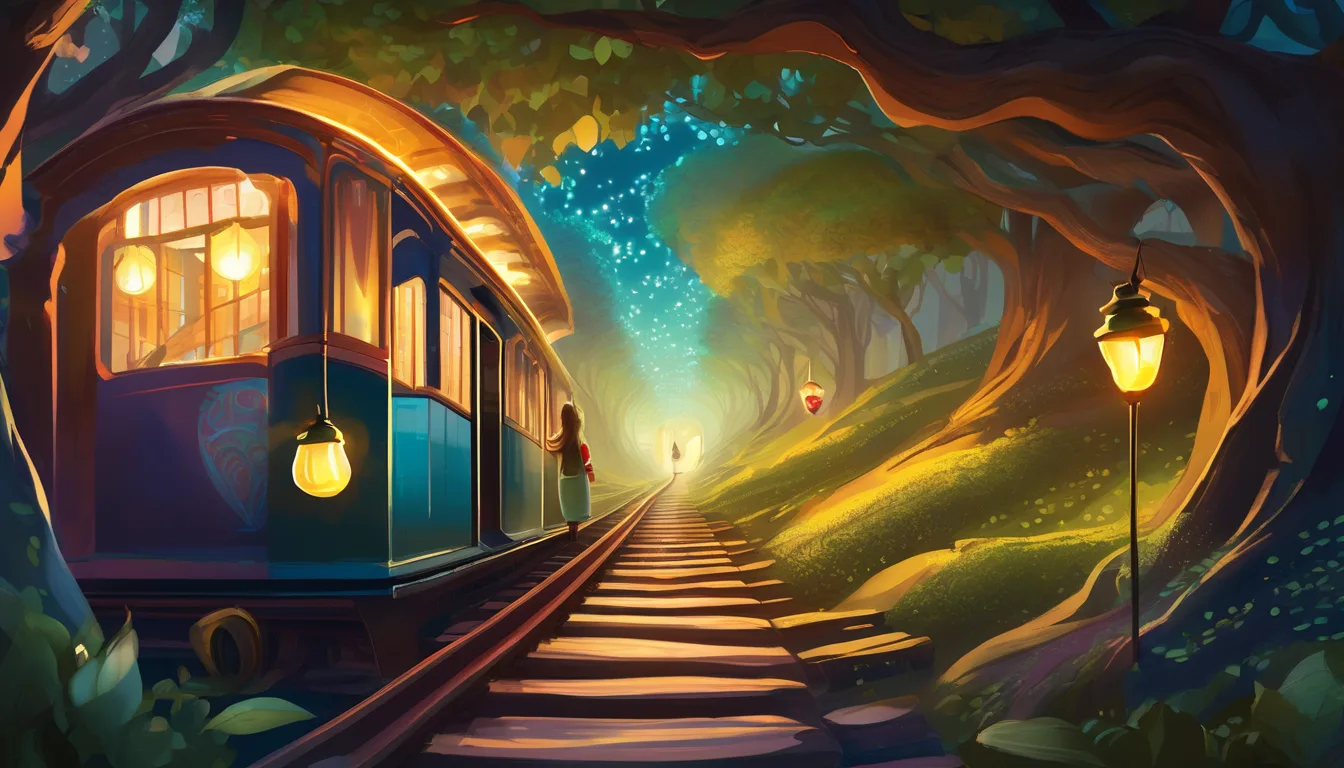
Mara lived at the edge of a town where the streets stopped suddenly and turned into fields.
Beyond her bedroom window grew a hill covered in foxgloves, wild thyme, and long grass that whispered whenever the wind went by. At the top of the hill stood an old pear tree with a crooked trunk. Everyone in town knew the tree. Children climbed it in summer, sheep rested beneath it in spring, and in autumn the pears dropped so softly into the grass that they sounded like tiny footsteps.
But Mara was the only one who knew that, underneath the pear tree, there was a door.
She found it on a rainy afternoon while searching for a lost blue button from her cardigan. The button had rolled through the grass, slipped between two roots, and disappeared beneath a flat stone.
Mara tugged at the stone.
It did not move.
She pushed it.
Still nothing.
Then she noticed a round brass handle, muddy and green with age.
Mara took a breath and pulled.
The stone lifted with a low, rumbling sound.
Below was a staircase.
Not a dark, dusty staircase like one leading to a cellar. This staircase was bright with little lamps hung along the walls. Each lamp was made from a polished walnut shell and held a golden glow-worm inside. The steps went down and down, spiraling beneath the hill.
From far below came an unexpected sound.
A bell rang.
Then a whistle blew.
Then someone called, “Mind your paws! The 4:15 to Sunflower Rise is arriving!”
Mara put one foot onto the first step.
Then another.
The stone door swung quietly shut above her.
At the bottom of the staircase, Mara found herself standing on a railway platform.
It was enormous.
The ceiling was held up by pillars made of smooth tree roots. The walls shimmered with mica, so that they looked sprinkled with stars. Red-and-cream signs pointed in different directions.
ACORN JUNCTION.
MUSHROOM MEADOW.
THE OLD BOOT.
SUNFLOWER RISE.
At the platform edge stood a tiny train, just the right size for moles, hedgehogs, field mice, beetles, shrews, and one sleepy-looking toad in a woolen scarf.
The train had six little carriages and a shiny black engine at the front. It puffed pale clouds that smelled faintly of cinnamon and damp earth.
Standing beside the engine was a mole in a navy-blue cap. His whiskers were silver, and he carried a pocket watch as big as a biscuit.
He stared at Mara.
Mara stared at him.
“Well,” said the mole at last. “You are rather taller than our usual passengers.”
“I’m sorry,” said Mara. “I didn’t mean to interrupt. I found the door under the pear tree.”
The mole adjusted his cap. “A surface entrance! We have not used that one in ages. I am Conductor Baku, of the Underhill Railway. You may be lost.”
“I’m not exactly lost,” Mara said. “But I am very curious.”
Conductor Baku’s whiskers twitched. “Curiosity is often how trouble begins. Also how it ends, if one is fortunate.”
Just then, the station lights flickered.
The train gave a worried little squeak.
All around the platform, signs began to spin.
SUNFLOWER RISE became THE OLD BOOT.
THE OLD BOOT became PUDDLE END.
PUDDLE END became somewhere called TUESDAY.
A hedgehog wearing a yellow raincoat gasped. “Tuesday is not a station!”
“No,” said Baku grimly. “It most certainly is not.”
A rumble passed through the floor.
The walls sighed.
Then, from the tunnel beyond the platform, a deep, dreamy voice whispered:
“Turn left at the raincloud. Arrive at the grandmother’s teacup. This way to the moonlit sandwich.”
The passengers began to chatter nervously.
“What is happening?” Mara asked.
Conductor Baku looked toward the dark tunnel.
“The tunnels are remembering,” he said.
“Remembering what?”
“The wrong things.”
He led Mara into a small office beneath a sign that read STATIONMASTER, although inside there was no stationmaster, only stacks of maps, shelves of acorns, and a red kettle steaming on a stove.
Baku spread a map across the desk.
“Our railway was built many years ago by moles,” he explained. “Moles are excellent diggers, of course, but we are also excellent rememberers. Every tunnel was made with a destination in mind. To Mushroom Meadow. To the old water pump. To the roots beneath the library. The tunnels remembered where they went, and so did we.”
“But now they’re mixed up?” Mara asked.
Baku nodded. “Yesterday, a new tunnel was dug to connect the railway to a big compost heap. Very useful for worms. Very popular with beetles. But while digging, the workers opened a passage into the Deep Archive.”
“The Deep Archive?” Mara repeated.
“The oldest part of the underground. It holds all the places the tunnels have ever remembered. Old rabbit burrows. Dry riverbeds. Lost kitchens. Places that disappeared long ago.” Baku tapped the map. “The memories have leaked into the railway. Now a tunnel that should lead to Sunflower Rise might lead to a sock drawer from thirty years ago.”
Mara imagined a train full of passengers arriving inside somebody’s sock drawer.
“That sounds difficult,” she said.
“It is worse than difficult,” said Baku. “Many passengers need to reach the surface before nightfall. The bees must return to their hive. The field mice have babies waiting in a stone wall. Mrs. Nadi, the toad, has an appointment with a pond.”
From the waiting room came a firm voice.
“I do not like being late for water,” said Mrs. Nadi.
Baku folded the map. “We need to find the Deep Archive and settle the tunnels’ memories. But only someone from the surface can do it.”
“Why?”
“Because the tunnels have forgotten which way is up.”
Mara looked at the maps. She looked at the worried passengers. She looked at the little train with its round windows glowing warmly.
“I know where up is,” she said.
Conductor Baku’s eyes widened.
Then he smiled.
“Then welcome aboard, Mara.”
The train set off with a cheerful chuff.
Mara sat in the front carriage beside Baku, while the passengers squeezed into the others. The hedgehog in the yellow raincoat sat near a family of mice. Mrs. Nadi the toad sat in a velvet seat with her feet in a small puddle she had brought along in a jar.
At first, the journey was smooth.
The train rattled through a tunnel lined with shining roots. Little white mushrooms glowed along the walls. The air smelled of wet stones and mint.
Then the tunnel split into three.
A sign above the tracks read:
THIS WAY TO SUNFLOWER RISE.
Except the letters kept changing.
THIS WAY TO A WARM HAT.
THIS WAY TO LAST WINTER.
THIS WAY TO A PLACE YOU FORGOT.
The engine slowed.
“Which one?” asked Baku.
Mara closed her eyes.
Above the ground, she remembered, the sun was beginning to set. The hill would be turning gold. The pear tree would be bending its branches in the breeze. Birds would be flying home.
She listened carefully.
Beneath the clatter of the train, beneath the whispering tunnels, she heard something else.
A faint sound.
Bee wings.
Not the bees in the carriage. These were far away.
“Take the middle track,” Mara said.
Baku blinked. “Why?”
“I can hear bees. They must be near the sunflower field.”
Baku pulled a brass lever.
The train turned onto the middle track.
For a few moments, nothing happened.
Then the tunnel opened into a wide chamber full of roots dangling like curtains. A thousand bees hummed above them, circling around a crack in the ceiling where a narrow stripe of evening light shone through.
“Sunflower Rise!” cried the bees.
The train stopped, and the bee passengers flew out at once, following the light upward through the crack.
“Thank you!” buzzed their queen. “We will tell the flowers!”
The tunnel gave a happy little hum.
One of its walls brightened.
On it appeared neat words carved into the earth.
SUNFLOWER RISE.
“It remembered correctly,” said Baku.
Mara smiled. “Maybe it needs reminders.”
They traveled on.
The next tunnel tried to lead them into a memory of a pirate ship. The train puffed straight into a cavern where wooden floorboards creaked beneath underground waves, and a ghostly parrot shouted, “Turnips ahoy!”
The passengers squealed.
Mara spotted a tiny door in the cavern wall. Above it was a rusty spoon nailed like a sign.
“The Old Boot station is near the garden shed,” she said. “And the garden shed has old tools. There might be a spoon from a picnic buried nearby.”
“Splendid reasoning,” said Baku.
He sounded impressed.
Mara followed the smell of old leather and rain. They found the real tunnel hidden behind the pirate ship memory, and soon the hedgehog in the yellow raincoat stepped off at the Old Boot station, where a huge cracked boot lay half-buried in soil.
“My house is just beyond those daisies,” he said. “You’ve saved my supper. I was meant to have mushroom stew.”
The tunnel hummed again.
THE OLD BOOT appeared on the wall in bright, steady letters.
At last, after many twisting tracks, they reached a place where the rails ended.
Before them stood an enormous round door made of packed clay. It had no handle, no keyhole, and no sign.
Only hundreds of words pressed into its surface.
HOME.
LOST.
UNDER.
BEFORE.
LATER.
UP.
DOWN.
Mara stepped closer.
“The Deep Archive,” whispered Baku.
The door opened by itself.
Inside was a cavern so huge that Mara could not see its ceiling. It was filled with floating pictures made of dust and light.
There was a picture of a little rabbit burrow that had been washed away in a flood.
A picture of a child’s marble lost beneath a floorboard.
A picture of an apple orchard that had once grown above the hill.
A picture of a bright blue button.
“My button!” Mara exclaimed.
The picture drifted past her, shining softly.
In the center of the cavern was a great mound of earth, shaped almost like a sleeping animal. Tunnels curled around it in every direction, whispering and murmuring.
“We remember,” they sighed.
“We remember everywhere.”
“We remember the river before it moved.”
“We remember the house with the green door.”
“We remember a breakfast that happened on a Thursday.”
“But,” Mara said gently, “you don’t remember where your passengers need to go now.”
The murmuring stopped.
A tunnel near her feet sniffled.
“We have too many memories,” it said. “We do not know which ones matter.”
Mara thought of her own room. She had many things in it. Books, shells, drawings, a feather, a smooth red stone, three socks without partners. She could not carry everything at once. But she knew which things belonged in which places.
“Maybe,” she said, “you don’t have to forget the old memories. You just need to put them somewhere safe.”
Conductor Baku slowly lifted his pocket watch.
“The timetable,” he breathed.
Mara nodded. “A timetable tells you what happens when. And maps tell you where. Perhaps the old memories need their own map, so they don’t get mixed into the railway.”
The tunnels rustled.
“But who will make it?” they asked.
Mara looked at Baku.
Baku looked at Mara.
Then every passenger who had not yet gone home began to help.
The mice brought threads from their nests. Mrs. Nadi offered the blank pages of her pond appointment book. A beetle gave a drop of black ink. Baku fetched colored chalk from the engine cupboard.
Mara sat on the floor of the Deep Archive and began to draw.
She drew the pear tree.
She drew the sunflower field.
She drew the old boot near the garden shed.
She drew the pond, the stone wall, the library roots, and the compost heap.
Then, around the edges, she drew little pictures for the old memories.
A rabbit burrow for the flood tunnel.
A marble for the floorboard passage.
A pirate ship for the silly ghost cavern.
A blue button for the staircase beneath the pear tree.
Each time Mara placed a memory on the map, it floated down from the cavern air and settled gently onto the paper.
The Deep Archive grew quieter.
The tunnels sighed, but this time their sighs sounded peaceful.
“We remember,” they whispered.
“And now we know where to keep it.”
All at once, the railway tracks gleamed.
Far away, stations lit up one by one.
MUSHROOM MEADOW.
THE OLD BOOT.
SUNFLOWER RISE.
POND GATE.
PEAR TREE SURFACE ENTRANCE.
The little train whistled so loudly that dust puffed from the ceiling.
The journey home was easy.
Mrs. Nadi arrived at her pond just as the first stars appeared above it. The mice reached their stone wall, where tiny babies peeked out with round eyes. The hedgehog got his mushroom stew after all.
Finally, the train returned to the platform beneath the pear tree.
Conductor Baku handed Mara her blue button.
“I believe this belongs to you,” he said.
“And this,” he added, placing a small brass ticket in her palm, “is for whenever the railway needs someone who knows which way is up.”
The ticket read:
MARA
SURFACE NAVIGATOR
ANYTIME, ANYWHERE
Mara climbed the glowing staircase.
When she pushed open the stone door, the rain had stopped. The sky was deep blue, and the pear tree leaves glittered with drops of water.
Her bedroom window shone warmly across the field.
Before Mara closed the hidden door, she heard the tiny train pull away beneath the hill.
Chuff-chuff.
Chuff-chuff.
And, very faintly, a cheerful voice called:
“All aboard for the right destination!”
Mara smiled, tucked the brass ticket beneath her pillow, and went inside.
That night, as she fell asleep, she dreamed of warm little train windows shining under the earth, of moles in navy caps checking maps, and of tunnels that remembered exactly where everyone belonged.
Leave a Reply