
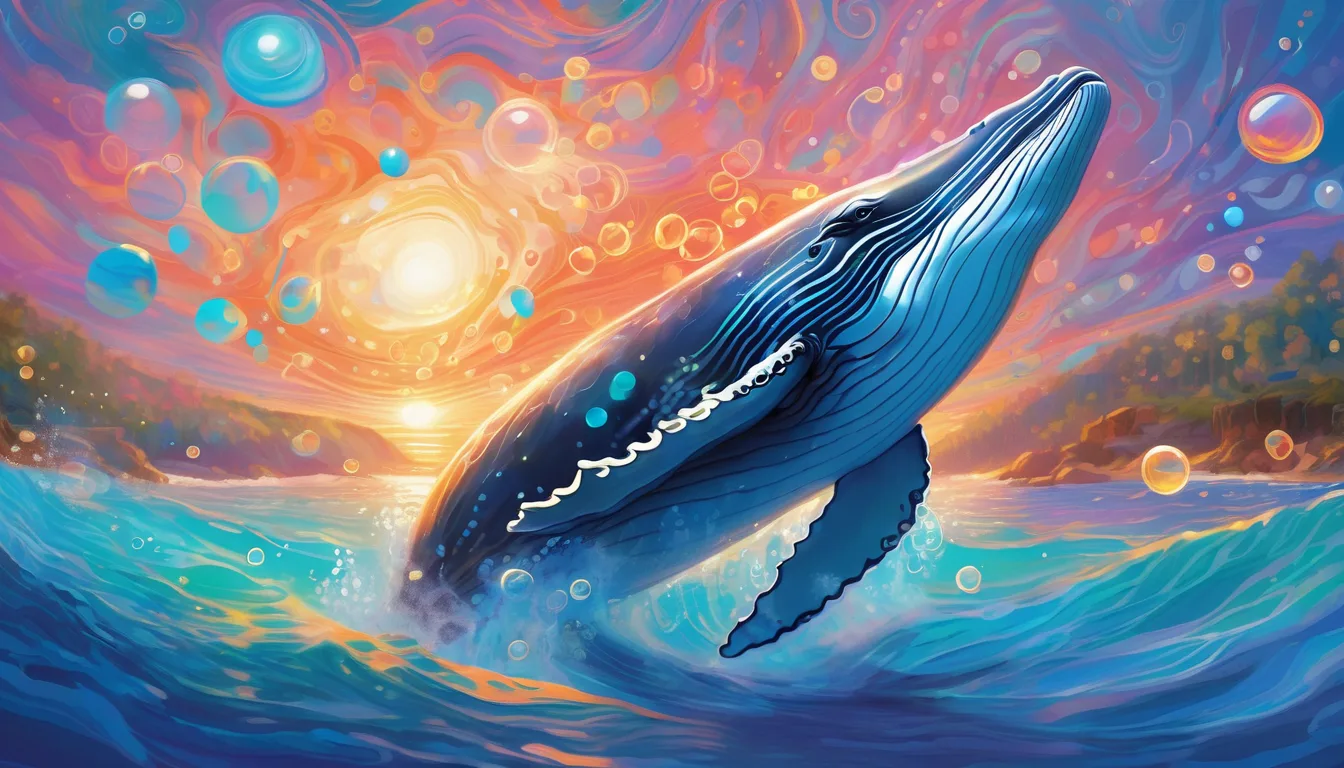
Far below the shining skin of the sea, where sunlight turned into green ribbons and then into quiet blue shadow, lived a young whale named Mako.
Mako was a humpback whale with a wide silver-gray belly, barnacles like tiny pale buttons on his fins, and a tail so strong that he could leap nearly all the way into the sky. He loved the ocean very much.
He loved the sleepy forests of swaying kelp.
He loved the bright orange fish that darted between coral rocks.
He loved the way moonlight made a glittering road upon the water at night.
Most of all, Mako loved whale songs.
Every year, when the waters grew warm near the island of Tonga, whales came from far away to sing together. Their songs rolled through the deep like drums, flutes, thunder, and soft humming all at once.
Mako’s mother could sing a song that began low and round, like a giant shell being gently blown. His uncle sang high notes that wobbled and twirled through the water. Even little calves, no bigger than fishing boats, could make small squeaky calls.
But whenever Mako tried to sing, nothing came out the usual way.
He would take in a great breath.
He would lift his head.
He would open his mouth and say, “Oooooooh…”
And then his sound would come out as:
“Blup.”
Just one little bubble.
Sometimes it was, “Blurp-blurp!”
Sometimes it was, “Pffffft!”
Once, while the whales were singing beneath a full moon, Mako tried very hard to join the final grand note.
His mother sang, “Oooooooommmmmmm!”
His uncle sang, “Wooooo-oooo-oooo!”
Mako puffed his cheeks and called, “Ploop!”
A sleepy sea turtle nearby woke up and said, “Was that a question?”
Mako sank slowly beneath the others, feeling as heavy as an anchor.
“I cannot sing,” he whispered.
His mother swam beside him. “You can make sounds.”
“Not whale sounds.”
“Perhaps not yet,” she said kindly.
But Mako did not feel better. For days, he stayed near the quietest part of the reef. He watched crabs tiptoe sideways through the sand. He watched tiny shrimp clean the teeth of a sleepy grouper. He listened to the songs of the other whales drifting around him, beautiful and far away.
One evening, a storm passed over the sea.
The waves slapped and flashed under a gray sky. Rain tapped the surface so hard that it sounded as if a million tiny feet were running above Mako’s head.
Mako swam down deep, down to where the storm could not reach him.
There, the water was still.
Or almost still.
Mako felt something brush against his side.
Not a fish.
Not seaweed.
It was a current.
The current slid past his fin in a long, cool ribbon. It moved from left to right, then curled around behind him. Mako turned and followed it.
He swam through a narrow valley between two underwater cliffs. The current changed. Here it was warmer, and it rose in a gentle spiral. Mako drifted with it, turning slowly and slowly, until he felt as though the sea itself were giving him a secret dance lesson.
“Oh,” Mako murmured.
He swished his tail once.
The current answered by curling around a rock.
He flicked his fin twice.
The current carried a cloud of glittering sand forward, then upward.
Mako watched closely.
He swished his tail again, this time making a strong push of water. A school of little glassfish flashed apart, then gathered into a shining silver ball.
The sea was moving.
And when it moved, it made shapes.
Mako spent the whole night practicing. With one sweep of his fin, he could make a soft swirl that meant hello. With three slow circles of his tail, he could make a twirling stream that meant come closer. By swimming quickly upward, then gliding down, he could make a cool little wave that meant look!
It was not singing.
But it felt like speaking.
The next morning, Mako found his friend Nuru, an octopus who lived in a purple-shell cave.
“Nuru,” said Mako. “Watch this.”
Nuru blinked with all three of his calm, golden eyes on each side of his head.
Mako made a small circle with his tail. The water curled toward Nuru, carrying a few pink petals from a drifting sea flower.
Nuru’s skin turned bright yellow with surprise.
“What does that mean?” asked Nuru.
“It means good morning,” Mako said.
Nuru considered this. Then he lifted one tentacle and puffed out a small cloud of ink that floated upward in the shape of a wiggly comma.
“That means I am hungry,” Nuru said.
Mako laughed, which made bubbles rise from his blowhole.
“Can I add bubbles too?” he asked.
“Of course,” said Nuru. “Bubbles are very good for important things.”
So Mako began to practice bubbles.
One large bubble meant danger.
Two tiny bubbles meant thank you.
A whole string of bubbles rising quickly meant hurry!
And a slow, round bubble that popped softly against someone’s nose meant I missed you.
Soon, Mako had currents and bubbles.
But one night, as he swam farther from home than he had ever gone before, he discovered one more kind of sound.
It came from above.
Mako floated near the surface and heard a deep, steady hum.
Hmmm-mm. Hmmm-mm. Hmmm-mm.
A great ship was passing far away. Its lights were golden dots on the dark water. It did not sing like a whale. It did not splash like a dolphin. It hummed and groaned and rang with faint metal clinks.
Mako listened.
The ship’s sound traveled through the sea for miles. It was slow and low, and sometimes its horn called out over the waves.
Bwooooooo!
Mako felt the note in his ribs.
He answered with a stream of bubbles.
Bwooooooo!
“Blup-blup-blup-blup!”
The ship kept going, and its song grew fainter.
But Mako remembered it.
After that, he listened to every distant ship. There were ferries carrying people home. There were fishing boats with rattling engines. There were cargo ships, slow and enormous, with humming bellies. Some made rhythms like tap-tap-tap. Some groaned like sleepy giants. Some rang a bright little bell.
Mako learned their faraway songs.
He mixed them with currents and bubbles.
Then, one night, the whales gathered again.
The moon was round and pale. The water was warm. Mako’s mother, uncle, cousins, and grandparents floated together in a great peaceful circle.
It was time for the whale songs.
Mako hung back.
His heart beat quickly.
His mother touched her fin to his. “Would you like to try?”
“I still cannot sing the usual way,” Mako said.
“You do not have to do things the usual way,” his mother told him.
Mako looked around. The old whales waited. The young calves bobbed near their mothers. Even a curious turtle had come to listen.
Mako took a breath.
He did not try to make a long whale note.
Instead, he swept his tail through the water.
A warm current moved through the whale circle, curling around each whale like a gentle greeting.
Hello, it said.
Then Mako made three slow loops. The current rose, carrying silver sand that sparkled in the moonlight from above.
Listen, it said.
Mako blew a stream of tiny bubbles, one after another.
Blup. Blup. Blup.
They floated up in a shining path.
Then he made a low sound in his chest, not quite a song, but a soft echo of the distant ships.
Hmmm-mm.
His uncle answered with a deep whale note.
“Oooooom.”
Mako replied with a swirl of current.
His mother added a smooth, rising song.
“Wooooo-ahhhh.”
Mako sent bubbles dancing around her.
Soon every whale was joining in. Some sang long, rolling notes. Some clicked and squeaked. Mako’s currents curled among them. His bubbles flashed like little pearls. The memories of distant ships hummed underneath it all.
The song became something no whale had ever heard before.
It was a song of deep water and faraway harbors.
A song of storms passing overhead.
A song of sea turtles waking up confused.
A song of bubbles, moonlight, warm currents, and homes that could be found by listening carefully.
The whales sang until the moon tipped toward morning.
When it was over, nobody spoke for a little while.
Then Mako’s grandmother, who had traveled through many oceans and seen icebergs taller than castles, said, “That was a beautiful language.”
Mako felt a warm, light feeling spread through him.
“A language?” he asked.
“Yes,” she said. “Your own.”
From then on, Mako became known across the sea as the whale who spoke in currents. Whales came from distant waters to learn his bubble words. Dolphins learned the hurry bubbles, though they used them far too often. Octopuses added ink swirls. Turtles made slow fin-signs to go with the currents.
And every now and then, when a ship passed far beyond the horizon and gave its low, lonely hum, Mako would listen.
Then he would answer with a curl of water, a bright trail of bubbles, and a happy little sound.
“Ploop.”
It meant, in Mako’s language:
I hear you.
The ocean is wide.
You are not alone.
And under the soft, shining moon, the sea carried those words gently onward, all the way into dreams.
Leave a Reply