
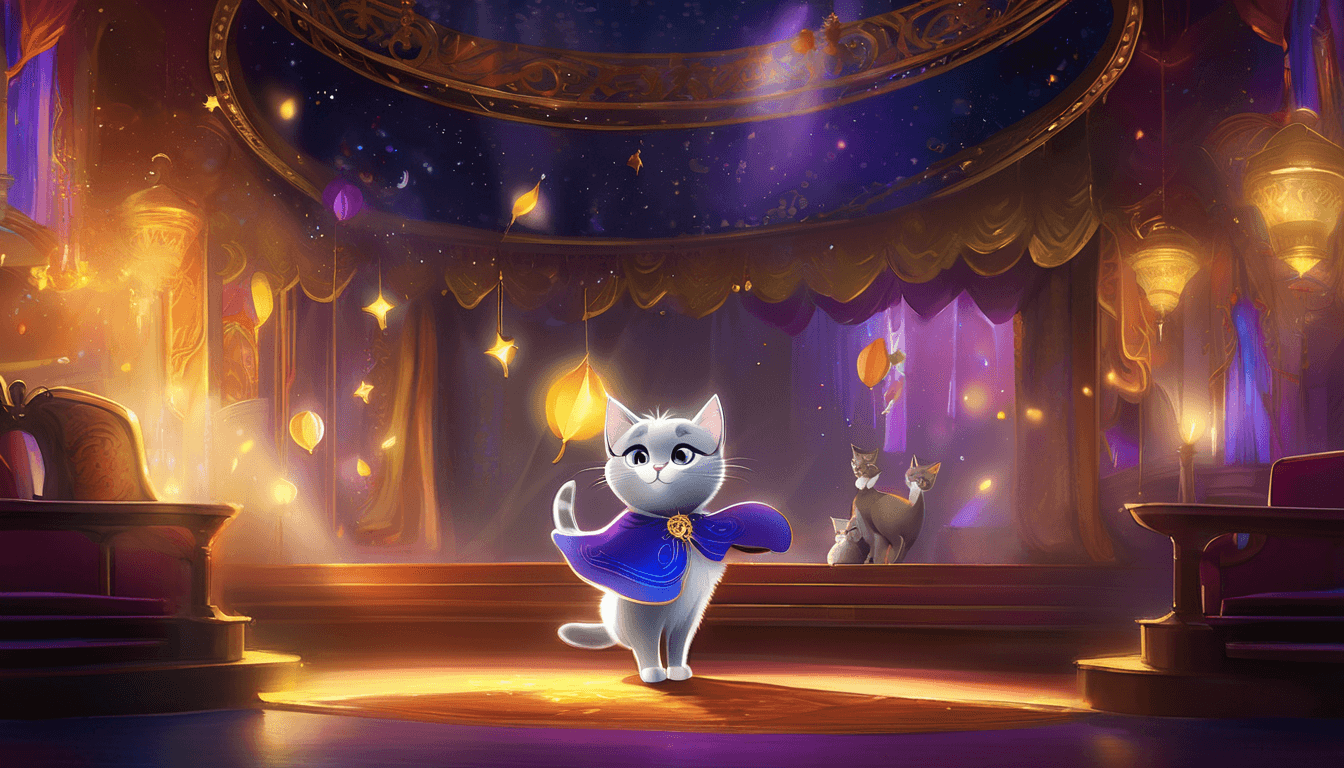
On a narrow street in the old city of Valparaíso, where the houses were painted like bright little boxes and stairways climbed up hills toward the stars, stood the Moonbeam Theatre.
By day, the Moonbeam Theatre was full of bustle.
Actors hurried through the doors holding cups of tea. Musicians carried shiny instruments. Painters climbed ladders to paint forests, palaces, clouds, and even one enormous purple dragon. Children came with their grandparents to watch comedies, puppet shows, and stories about brave sailors.
But at night, after the audience had clapped their last claps and the ushers had swept up biscuit crumbs, the theatre became very quiet.
Or at least, that was what people thought.
One rainy evening, a silver-gray cat named Miro slipped through the theatre’s side door.
Miro had soft paws, a white star-shaped patch beneath his chin, and a tail that curved at the end like a question mark. He had been living under the bakery awning across the street, where the baker sometimes gave him warm pieces of plain bread. But Miro liked the theatre best.
It smelled wonderful.
There were dusty velvet curtains, wooden floorboards, paint, flowers from opening-night bouquets, old books, and sometimes, if he was lucky, cheese from the actors’ sandwiches.
That evening, Miro padded down a hallway and found the theatre’s caretaker, an elderly woman named Senhora Amara.
Senhora Amara wore round spectacles and carried a ring of keys that jingled like tiny bells. She had been the night caretaker of the Moonbeam Theatre for forty years. She knew which step creaked, which window rattled in the wind, and which old chandelier needed a polite tap to stop swinging.
She also knew that Miro had been coming into the theatre.
“I have seen your paw prints in the paint room,” she said.
Miro froze beside a bucket of blue paint.
“And I have seen your little whisker prints in the costume cupboard dust.”
Miro lowered his head. He was prepared to be chased away.
Instead, Senhora Amara crouched down and held out a saucer of milk.
“You seem a sensible fellow,” she said. “Would you like a job?”
Miro’s ears lifted.
The next morning, Senhora Amara made him a bed inside a small wicker basket behind the ticket booth. She placed a folded red scarf inside it, soft as a cloud. Above the basket she hung a sign.
MIRO
NIGHT CARETAKER
Miro could not read very well, but he understood the important part.
The theatre was his to care for after dark.
At first, his duties were easy.
He checked that no pigeons had flown into the attic. He listened for dripping taps. He chased only the boldest mice, though mostly he preferred to sit with them and make sure they did not nibble the orchestra’s sheet music.
Every night, Senhora Amara would pat his head and say, “Keep watch, Miro.”
Then she would leave through the front doors, and the moonlight would spill across the empty seats.
For the first few nights, Miro discovered ordinary secret things.
The stage curtains sighed when they were closed.
The big painted moon from an old fairy play smiled more cheerfully in the dark.
The brass tuba in the orchestra pit sometimes made a low, sleepy hum.
Then, on the seventh night, Miro heard something very strange.
Tap.
Tap-tap.
Swish.
Tap.
It came from the costume room at the end of the upstairs corridor.
Miro’s tail puffed up.
The costume room was always locked.
He crept along the hallway, his paws silent on the faded blue carpet. Moonlight shone through the tall windows, making pale squares on the floor. The sound came again.
Tap-tap.
Swish.
A tiny voice called, “No, no, darling, your cape is dragging!”
Another voice answered, “It is meant to drag. I am a tragic prince.”
Miro pressed one eye to the keyhole.
Inside the costume room, all the costumes were moving.
A long green dress was twirling beneath the gas lamp. A pirate coat was practicing bows. A pair of red dancing shoes tapped on the floor with nobody in them. A feathered helmet had climbed onto a hat stand and was shouting instructions.
“Turn, turn, turn!” cried the helmet. “Chins high! Sleeves graceful!”
Miro gave a surprised meow.
Everything stopped.
The green dress froze halfway through a spin.
The pirate coat dropped its sleeves.
The red shoes tucked themselves behind a trunk.
At last, a small gold waistcoat with pearl buttons stepped forward. It belonged to a costume that had once been worn by a magician in a show called The Wonderful Clockmaker.
“Who goes there?” asked the waistcoat.
“Miro,” said Miro.
“Is that a person?”
“No. I am a cat.”
The costumes whispered together.
“A cat!”
“Does he tell secrets?”
“Cats know everything.”
“He has a very respectable tail.”
Miro sat down neatly. “Why are you dancing?”
The gold waistcoat straightened its buttons.
“Because costumes must rehearse,” it said. “All day, we hang still while people wear us. But after midnight, when the theatre sleeps, we practice the stories we remember.”
The green dress glided forward.
“I was once the gown of a queen who crossed a frozen sea to rescue her brother,” it said.
The pirate coat puffed itself wide.
“And I have sailed through three storms, fought six sea monsters, and lost precisely one button to a parrot.”
The feathered helmet hopped down from the hat stand.
“We all hold pieces of old plays,” it explained. “Words, dances, songs, journeys. When we rehearse, we keep them safe.”
Miro thought this was the most marvelous thing he had ever heard.
From that night on, he became the costumes’ official night caretaker too.
He guarded the door while the costumes danced.
He caught runaway buttons rolling beneath cupboards.
He untangled scarves after sword fights.
He warned everyone when the moon was getting low and dawn was near.
And every night, the costumes shared a story with him.
There was the yellow raincoat that remembered a play about a girl who rode a bicycle through a thundercloud.
There was a woolly bear suit who remembered being a very nervous bear that learned to sing opera.
There was even one tiny velvet slipper that had belonged to a mouse prince. It could leap farther than any costume in the room.
Miro liked the stories, but his favorite thing was the rehearsals.
The costume room could become anything at night.
A broom became a ship’s mast.
A pile of hat boxes became a mountain range.
A lace tablecloth became a waterfall.
The tall mirror became a magic doorway, though nobody was quite sure where it led.
Then, one windy night in late autumn, something went wrong.
The Moonbeam Theatre was preparing for its biggest show of the year, The Lantern Voyage.
It was a grand adventure about a little ship sailing through moonlit waters to find an island where lost songs grew on trees.
The actors had rehearsed for weeks. The musicians had practiced until their fingers ached. The stage painters had made a sparkling sea from blue silk and silver thread.
And in the costume room, a very special costume was waiting.
It was the Captain’s Coat.
The Captain’s Coat was deep midnight blue, with brass buttons, a high collar, and embroidered silver waves around the cuffs. It had been worn in the original Lantern Voyage many years before, when the theatre was new.
Everyone respected the Captain’s Coat.
It was brave, wise, and usually very serious.
But that night, when the costumes began their rehearsal, the Captain’s Coat was missing.
“Has anyone seen it?” asked the gold waistcoat.
“No,” said the green dress.
“Not I,” said the pirate coat, looking worried.
The red shoes tapped nervously.
Miro sniffed around the empty hook where the Captain’s Coat should have been.
He found something caught on a splinter of wood.
A thread.
It was midnight blue.
Miro followed it out of the costume room, along the upstairs corridor, down the staircase, and through a little door that led behind the stage.
The costumes followed in a rustling, hopping, clinking parade.
Behind the stage was darker than any place Miro knew. There were ropes as thick as snakes, wooden beams above, trapdoors below, and old scenery stacked against the walls. A painted castle leaned beside a cardboard forest. A giant papier-mâché moon rested on its side, looking rather tired.
The blue thread led to a trapdoor.
It was open.
Below it was the under-stage passage, a long narrow tunnel that ran beneath the theatre.
“No costume goes down there,” whispered the green dress.
“Why not?” asked Miro.
“Because,” said the pirate coat, “it is where forgotten things gather.”
Miro peered into the darkness.
He could hear a faint sound.
Clink.
Clink-clink.
Then a tiny, sad humming.
Miro did not like darkness very much. He preferred moonlit windows and warm baskets.
But the Captain’s Coat was missing.
And Miro was the night caretaker.
“I will go,” he said.
The gold waistcoat gave a brave little nod.
“We are coming too.”
The costumes made a lantern from an old stage lamp. The red shoes carried it by its cord, hopping carefully. Miro went first, his whiskers feeling the way.
Down they climbed.
The under-stage passage smelled of cool earth, old wood, and rainwater. Their shadows stretched across the walls. Everywhere were things that had fallen through cracks or been tucked away long ago.
There were feathers from forgotten hats.
A wooden sword with no handle.
A single glove.
A cardboard star.
Three marbles.
A brass key.
And dozens of little silver bells.
As they went deeper, the humming grew louder.
At the end of the passage, they found a round chamber beneath the very center of the stage.
The Captain’s Coat was there.
It was caught on a nail near a small, trembling creature.
The creature looked like a bundle of gray dust with two shiny black eyes. Around its neck it wore a string of old buttons.
“Oh,” said Miro softly.
The little creature stopped humming.
“I did not steal it,” it squeaked. “It slipped down through a crack. I tried to bring it back, but it got stuck. Then I got stuck too.”
“Who are you?” asked the green dress.
The creature lowered its dusty head.
“I am Nilo,” it said. “I am a Keeper of Lost Things. Or I used to be.”
“A Keeper of Lost Things?” said the gold waistcoat.
Nilo nodded.
“I gather forgotten bits. Buttons, songs, props, ribbons, ideas for plays that nobody ever wrote. I keep them safe down here. But I have been lonely for a very long time.”
Miro looked around.
The chamber was full of small treasures. A cracked music box. A paper crown. A painted wooden fish. A tiny glass bottle filled with golden glitter.
Then Miro saw something else.
On a shelf behind Nilo was a little framed photograph.
It showed the Moonbeam Theatre many years ago, on opening night. In the photograph, young Senhora Amara stood on the stage holding a broom. Beside her sat a kitten with a white patch beneath its chin.
Miro blinked.
The kitten looked exactly like him.
Nilo noticed him staring.
“That was your grandfather,” Nilo said. “His name was Sombra. He was night caretaker before you.”
Miro felt very still.
“My grandfather?”
“He used to visit me,” said Nilo. “He told me stories from upstairs. When he grew old and stopped coming, I thought everyone had forgotten the under-stage rooms.”
Miro’s heart gave a soft, sad squeeze.
Then he stepped closer to Nilo.
“You are not forgotten now,” he said.
The Captain’s Coat gave a quiet rustle from the nail.
“Quite right,” it said. “And if you will permit it, we have an opening performance tomorrow. We could use someone with excellent knowledge of lost songs.”
Nilo’s eyes grew round.
“Me?”
“You,” said the red shoes, tapping happily.
Miro squeezed through the narrow space and carefully tugged at the Captain’s Coat. The pirate coat pulled with its sleeves. The green dress braced against a wooden crate. At last, with a pop, the coat came free.
All the costumes cheered.
Nilo led them back through the passage, carrying the lantern proudly.
Before dawn, the costumes returned to their hooks. The Captain’s Coat hung in its proper place, freshly brushed and shining.
Miro curled in his basket behind the ticket booth, but he did not sleep much. He kept thinking about his grandfather, Sombra, and the secret chamber beneath the stage.
The next evening, The Lantern Voyage opened.
The theatre was packed. The audience filled every red velvet seat. Children leaned forward with bright eyes. Grown-ups whispered excitedly. The musicians tuned their instruments.
Senhora Amara stood in the wings, smiling at Miro.
“You seem extra pleased tonight,” she said.
Miro only purred.
The show began.
Blue silk waves rippled across the stage. The actors sang. The Captain’s Coat swept boldly through the story. And when the little ship reached the island of lost songs, something magical happened.
A gentle humming rose from beneath the stage.
Then the orchestra picked it up.
It was a tune nobody had rehearsed, soft at first, then warm and bright. It sounded like lanterns glowing over water. It sounded like a door opening after a long time. It sounded like being remembered.
The audience grew very quiet.
Then, when the song ended, everyone clapped so loudly that dust danced from the ceiling beams.
That night, after the theatre emptied, Miro went down to the under-stage chamber.
Nilo had made a tiny chair from a matchbox and a cushion from red felt. The gold waistcoat brought a button-shaped biscuit. The green dress told a story about the queen crossing the frozen sea. The pirate coat argued that sea monsters should always get at least one song.
And Miro sat in the middle of them all, his paws tucked beneath his chest, listening.
Above them, the Moonbeam Theatre slept beneath the stars.
Below it, lost things were being found.
And Miro, the silver-gray cat with the question-mark tail, kept watch until morning.


Leave a Reply