
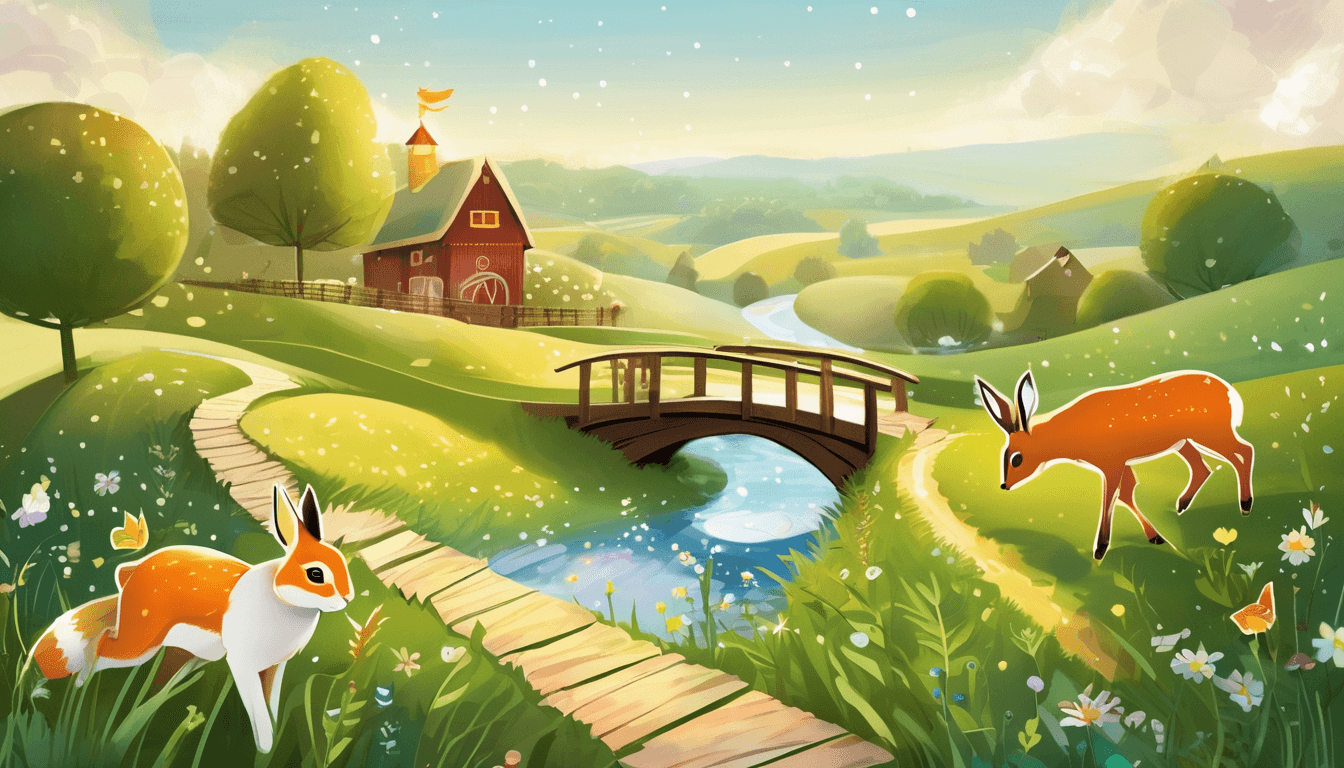
On the edge of a wide, green meadow stood a little workshop made of red bricks and blue shutters. Its roof was shaped like a folded paper hat, with one pointed corner that leaned toward the moon.
Inside lived a paper engineer named Amara.
Amara did not build things from wood or stone, at least not at first. She built them from paper.
She could fold a sheet of cream-colored card into a lantern that stayed lit all night. She could cut tiny tabs into a map, then pull them, and the mountains would rise in ridges. She once made a paper wheelbarrow for a beetle named Rollo, who used it to carry raspberry seeds home.
But Amara’s finest work was always made from strong paper.
It was paper pressed with cotton threads, painted with waterproof berry ink, and sealed with a shiny glue made from sap. It could bend in the wind and hold steady in the rain. It rustled softly, but it did not tear.
One evening, a great rainstorm rolled over the meadow.
Rain drummed on the workshop roof.
Rain filled the little ditches.
Rain turned the dry stream called Whispering Run into a rushing, swirly river.
By morning, the meadow was flooded.
The buttercups poked out of the water like tiny yellow boats. The tall grass lay flat and shining. The stepping stones that usually crossed Whispering Run were gone beneath the brown, bubbling water.
From one side of the flooded meadow came worried sounds.
A family of rabbits huddled beside a willow tree.
A slow tortoise named Tenzin sat on a patch of dry ground, blinking at the water.
A fox with silver-tipped ears paced back and forth.
High above, a flock of starlings circled and chattered.
Amara put on her yellow rain boots, her coat with many pockets, and her round spectacles. Then she carried a long tube of rolled paper under one arm and a box of tools under the other.
She walked to the edge of the flood.
“Well,” said Amara, studying the rushing water, “this meadow needs a bridge.”
The animals gathered around.
“A bridge!” cried the rabbits.
“Yes, please,” said Tenzin. “I was meant to visit my cousin before lunchtime yesterday.”
“Make it quick,” said the fox, though his voice was kinder than it sounded. “The fish are swimming far too close to my favorite napping stump.”
Amara nodded. She unrolled a large sheet of paper on a smooth rock. It was a blueprint, covered in neat lines, circles, folds, and tiny notes.
She measured the width of the water with a tape made from braided reeds.
She tested the mud with a long stick.
She found two sturdy old oak roots, one on each side of the flooded meadow, and decided they would be the bridge’s anchors.
Then she got to work.
First, she folded wide paper beams into long triangles, because triangles are very strong shapes.
Then she joined them with little paper hinges.
She made railings with loops for small paws and larger paws.
She added flat strips for hooves and claws.
At the bottom, she folded hundreds of waterproof paper tubes into a floating base, like a long row of secret drums.
The animals helped.
The rabbits carried glueberries in walnut shells.
Tenzin pressed paper creases with the smooth edge of his shell.
The fox fetched long grasses to tie knots.
The starlings flew overhead with bits of silver thread in their beaks.
All day they worked beneath a sky that slowly changed from gray to pearl-white.
At last, when the first evening star appeared, Amara stepped back.
The bridge stretched from one side of the meadow to the other.
It was beautiful.
Its floor was the color of warm honey. Its railings curled like fern fronds. Along each side were paper flowers that opened when someone stepped close. Beneath it, the floodwater hurried and swished.
Amara placed one boot on the bridge.
It wobbled gently.
She placed both boots on it.
It held.
“Hooray!” cheered the animals.
The rabbits were first to cross.
But halfway across, the smallest rabbit, Miko, stopped.
“Amara,” he called, “where does this bridge lead?”
“To the other side of the meadow,” said Amara.
Miko wrinkled his nose. “But I thought it would lead to the carrot hill.”
“The carrot hill?” asked Amara.
“Yes. My grandmother says the sweetest carrots grow there after a flood. A bridge should lead somewhere delicious.”
Before Amara could answer, Tenzin began his slow journey across.
Step.
Step.
Step.
He reached the middle and looked east.
“I thought it would lead to the Quiet Pond,” he said. “My cousin lives beside the Quiet Pond. A bridge should lead somewhere peaceful.”
The silver-tipped fox trotted onto the bridge next.
“I was hoping it would lead to Moonstone Woods,” he said. “There are soft mossy paths there. A bridge should lead somewhere interesting.”
Above them, the starlings swooped down in a fluttering cloud.
“We thought it would lead upward,” they sang. “To the hilltop, where we can see the whole world.”
Soon every animal had an idea.
The badgers wanted the bridge to lead to the old apple orchard.
The field mice wanted it to lead to the warm barn.
The frogs wanted it to lead straight into the pond, though Amara gently explained that bridges were not usually built for splashing.
Even a ladybird named Sana landed on Amara’s sleeve.
“I think it should lead to a giant rose,” she whispered.
Amara looked at the bridge.
The bridge looked, in a way, as if it might be thinking too.
Its paper flowers folded closed.
Its railings rustled in the breeze.
Everyone was talking at once.
“To the carrot hill!”
“To the Quiet Pond!”
“To the woods!”
“To the orchard!”
“To the barn!”
“To the rose!”
The floodwater gurgled beneath them, as though it found the whole thing very funny.
Amara sat down on a dry stone.
For a while, she said nothing.
Being a paper engineer meant knowing how to make something strong. But it also meant knowing how to listen when something was not working.
At last, Amara opened her tool box and took out a small square of paper.
Then another.
Then another.
“What are you making?” asked Miko.
“A new sort of bridge,” said Amara.
“But this bridge is already finished,” said the fox.
“Perhaps,” Amara replied, “it is finished only as a crossing. Perhaps it has not yet become a journey.”
The animals grew quiet.
Amara walked along the bridge, examining every fold. At the middle, she found a wide platform where the beams met. She unfolded one little panel, then another. Underneath were tucked six narrow paper paths, folded tight as sleeping ribbons.
“One path for each direction,” said Amara.
The rabbits bounced. “To the carrot hill?”
“One of them.”
Tenzin lifted his head. “To the Quiet Pond?”
“Yes.”
The fox’s ears stood tall. “Moonstone Woods?”
“That too.”
Amara unfolded the first path. It curled away from the bridge toward the carrot hill, floating lightly over the floodwater. She secured it with reed ropes and placed tiny paper signs along it, each painted with an orange carrot.
She unfolded the second path toward the Quiet Pond. Its railing was low and broad, perfect for Tenzin. Paper lily pads bobbed along its sides.
The third path led into Moonstone Woods beneath the darkening trees. Amara added little silver paper leaves that glimmered under the moon.
The fourth went toward the apple orchard.
The fifth led to the warm barn.
The sixth was very small indeed. It curved through the grass to a rosebush with one enormous pink bloom at its top.
Sana the ladybird climbed onto the tiny path.
“Oh,” she said. “It is exactly right.”
The starlings fluttered sadly for a moment.
“And the hilltop?” they asked.
Amara smiled.
From her toolbox, she took a sheet of pale blue paper. She folded it into a tall spiral tower, one that rose from the center platform of the bridge. Around and around it curled, with perches tucked into its sides.
At the top was a little lookout deck.
The starlings flew up in a shining whirl.
“It leads upward!” they cried.
Now the bridge was no longer one straight line across the flooded meadow.
It was a meeting place.
A place with pathways.
A place for choosing.
Miko took the carrot path, then returned with an orange-topped carrot almost as big as his head.
Tenzin followed the pond path and found his cousin waiting with a basket of water mint.
The fox disappeared into Moonstone Woods and returned later with three pale feathers tucked behind one ear.
The badgers brought apples.
The mice brought crumbs of warm oat bread from the barn.
Sana returned from the rose with gold pollen on her red wings.
And the starlings came down from the lookout deck to report that the clouds had opened, the hills were shining, and the flooded meadow looked like a great silver blanket.
At the center of the bridge, all the animals shared their treasures.
There were carrots and apples, mint leaves and oat bread. The fox found a dry patch of moss and, after pretending he was not tired at all, curled up there. Tenzin rested beside him. The rabbits tucked their paws under their chins.
Amara sat quietly at the center, watching the bridge sway gently beneath the stars.
The paper flowers along the railings opened one by one.
They glowed with soft lantern light.
At last, Miko yawned.
“Amara,” he said sleepily, “where does the bridge lead now?”
Amara looked at the paths curling away through the moonlit meadow.
“It leads where you need to go,” she said. “And sometimes, it leads back to friends.”
The floodwater began to sink during the night.
By morning, Whispering Run was once again a little stream skipping over its stones.
But the bridge remained.
It did not need to float anymore, yet it still did, just a little, when the wind passed beneath it.
And whenever an animal stepped onto it, the paper flowers opened, the paths rustled softly, and the bridge seemed to ask:
Where shall we go today?
Then, after every adventure, it always knew the way home.

Leave a Reply