
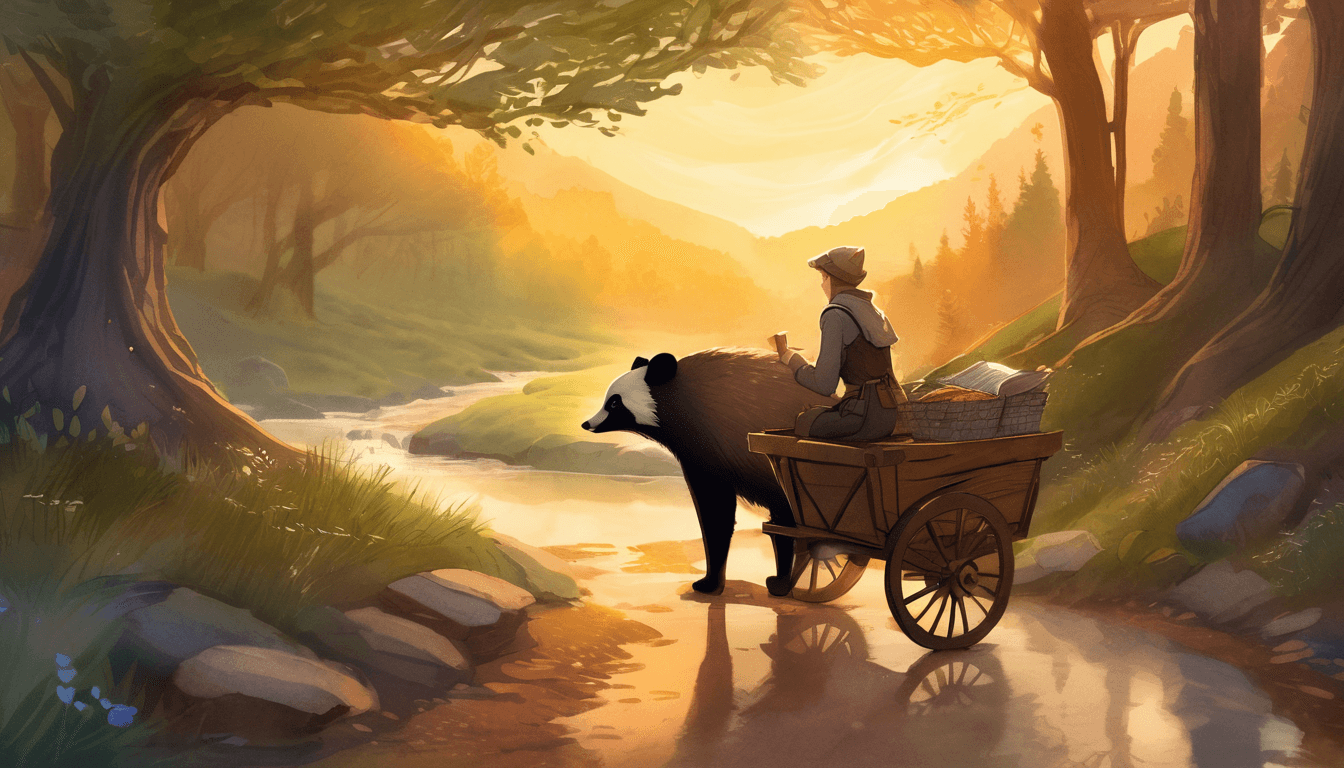
In the hill town of Varello, where every house had a red chimney and every chimney puffed out curls of lavender smoke, there lived a young courier named Samira.
Samira was not very tall, and her courier boots were a little too large because they had belonged to her older cousin. But she could run faster than the bakery boy on delivery day, climb stone walls without snagging her coat, and remember directions after hearing them only once.
Most of all, Samira loved letters.
She loved the fat, important letters tied with gold string. She loved tiny notes folded into triangles. She loved postcards painted with moons, seas, castles, and faraway cities. Every letter seemed to hum with a secret before it reached the hands meant to open it.
Samira worked at the Varello Post House, a round building with blue doors and a bell that rang whenever someone stepped inside.
One rainy morning, just as the sky was becoming pale and pearly, the Postmistress called Samira into her office.
Postmistress Odette was an old woman with silver braids wrapped around her head like a crown. Her spectacles were so thick that her eyes looked enormous behind them.
“I have a delivery,” said Odette.
Samira brightened. “To the lighthouse on Blackcap Bay? To the music teacher in the snowy mountains? To the mayor of Bramblewick?”
Odette shook her head.
“This one is farther.”
She opened a drawer beneath her desk and took out a single envelope.
It was not large. It was not tied with string. It had no bright stamp, no wax seal, and no fancy writing. It was plain cream paper, a little rough at the edges.
But on the front, written in neat dark ink, were the words:
To the one who lives beyond the edge of every road.
Samira read it twice.
Then she read it a third time.
“Where is that?” she asked.
Odette looked toward the rain-speckled window. “That is what you must find out.”
Samira held the letter carefully. It felt warm in her hands.
“Who sent it?”
“A person who did not leave a name,” said Odette. “They only said that it must be delivered before the next full moon.”
Samira glanced at the calendar. The full moon was seven nights away.
“I’ll leave at once,” she said.
Odette smiled, though there was something worried in her smile.
“You may take the Post House pony cart as far as the roads go. After that, you will have to trust your feet, your eyes, and your heart.”
Samira tucked the letter into the inner pocket of her yellow courier coat. She packed bread, apples, a little jar of honey, a wool blanket, a compass, and a small brass lantern.
Then she climbed into the cart beside Juniper, the shaggy gray pony, and set off through the rain.
At first, the journey was easy.
The road curled past Varello’s plum orchards, where purple fruit shone like tiny lanterns among wet leaves. It crossed a wooden bridge over the River Sol, where bright fish leaped through the silver water. It passed through the village of Bellafont, where every doorstep had a pot of marigolds.
Samira asked everyone she met, “Do you know who lives beyond the edge of every road?”
An old fisherman scratched his beard.
“A cloud giant, perhaps,” he said.
A woman selling ribbons said, “Could be a queen who rides a swan.”
A group of children shouted, “A dragon! Definitely a dragon!”
By evening, Samira had reached the last village marked on her map.
It was called Tamos, and it stood beside a wide field of tall, whispering grass. Beyond Tamos, the road continued for a little way, growing bumpier and narrower until it became two faint tracks between the hills.
At the village inn, Samira gave Juniper extra oats and tucked her beneath a roof.
“I’ll be back,” she promised, rubbing the pony’s soft nose.
The innkeeper, a broad man named Bastian, looked at the letter when Samira showed it to him.
“Beyond the edge of every road,” he murmured. “My grandmother used to speak of such a place. She said roads do not truly end. People simply stop looking after a while.”
“Did she know where it was?”
Bastian pointed through the inn window, toward the darkening hills.
“She said to follow the road until it becomes a path, follow the path until it becomes a question, and follow the question until someone needs your help.”
Samira did not entirely understand, but she thanked him.
At dawn, she set out on foot.
The road soon became a path.
The path led into a forest of tall white-barked trees. Their leaves flickered in the wind like thousands of little green hands waving hello. Samira walked until her boots were dusty and her shoulders ached.
Around noon, she heard a squeak.
Then another.
Beneath a thorny bush, a small badger was tangled in a loop of old wire. It kicked its striped paws and squeaked in fear.
Samira looked at the sun. She had so far to go. The full moon was coming closer every day.
But she knelt beside the badger.
“Easy now,” she whispered. “I’m here.”
The wire had bitten into the badger’s fur. Samira took off her gloves, used a small cutter from her courier kit, and carefully snipped the wire apart. Then she wrapped the badger’s sore paw with a strip of clean cloth.
The badger blinked at her.
“You are a brave little fellow,” Samira said.
The badger waddled into the ferns, then paused and looked back. It gave one small chuffing sound, as if saying thank you, before disappearing.
Samira continued on.
The forest ended at a valley filled with yellow flowers. A stream ran through it, but the little stone bridge across the stream had crumbled. On the far side stood a boy with a basket of mushrooms.
He looked about Samira’s age. His trousers were muddy, and his eyes were full of tears.
“Are you all right?” Samira called.
“My grandmother is ill,” the boy said. “She needs these mushrooms for soup, but I cannot cross back. The water is too cold and too fast.”
Samira studied the stream. It was not wide, but its stepping stones were slippery.
Again she looked toward the distant hills.
Again she thought of the letter in her pocket.
Then she rolled up her trousers, stepped carefully into the water, and crossed. The current tugged at her boots, but she kept her balance. On the other side, she picked up the basket.
“Hold my hand,” she told the boy.
Together, slowly and carefully, they crossed the stream.
When they reached the other side, the boy hugged the basket to his chest.
“Thank you,” he said. “My name is Kojo.”
“Samira,” she said.
Kojo pointed toward a narrow trail climbing a hill. “That path will take you to the old wind gate. My grandmother says it is the last gate before the roads run out.”
Samira followed the trail.
By sunset, she reached the wind gate.
It was an archway made of black stone, standing all alone on top of a hill. No fence stretched from it. No wall joined it. It was simply a gate, with no gate doors, looking out across a vast empty plain.
The path stopped there.
Samira stood beneath the arch and stared.
Ahead lay fields of soft blue grass, then distant mountains, then a sky full of floating clouds painted pink and gold by the setting sun.
There was no road.
No house.
No dragon.
No queen on a swan.
Only the wide, quiet world.
“This must be the edge,” Samira whispered.
But there was no one to deliver the letter to.
She sat beside the stone arch and ate her last apple. The evening grew chilly. She pulled her blanket around her shoulders.
For the first time since leaving Varello, Samira felt afraid.
What if she had come all this way for nothing?
What if the letter was meant for someone she would never find?
What if she was not clever enough to be a real courier after all?
Then, far across the blue grass, she saw a flicker of light.
It was small at first, like a firefly. Then it disappeared.
Then it flickered again.
Samira rose and picked up her lantern.
She walked across the field.
The grass brushed softly against her knees. Strange round flowers opened as she passed, glowing faintly in the twilight. Somewhere high above, a bird sang three low notes that sounded like a lullaby.
The flickering light led Samira to a hollow between two hills.
There, she found not a palace, not a cottage, and not a cave.
She found an old man sitting beside a tiny fire.
He wore a patched coat the color of moss. His hair was white and wild. Beside him was a wooden cart with one broken wheel. It was piled with bundles, kettles, blankets, and several pots of drooping herbs.
The old man looked tired. Very tired.
When he saw Samira, he smiled.
“Good evening,” he said. “Have you come from a town?”
“I have,” said Samira. “From Varello.”
“Ah,” he said dreamily. “Varello. I remember lavender smoke and red chimneys.”
Samira sat near the fire.
“My cart wheel broke,” he explained. “I was trying to reach the village of Tamos before nightfall, but I suppose I will sleep here instead.”
“Are you traveling alone?” Samira asked.
“Yes,” he said. “I have been alone for a long while.”
Samira looked at him closely.
His hands were rough. His coat was thin. One of his boots had a hole near the toe.
“Do you live beyond the edge of every road?” she asked.
The old man chuckled softly.
“Perhaps,” he said. “Though I did not know that was what the place was called.”
Samira’s heart gave a small leap.
She reached into her coat and pulled out the cream-colored envelope.
“Is this for you?”
The old man’s smile faded. He stared at the writing on the envelope. His fingers trembled as he took it.
For a long moment, he did not open it.
Then he whispered, “I know this handwriting.”
With great care, he unfolded the flap.
Inside was a single sheet of paper.
The old man read it in the firelight.
Samira did not mean to peek, but he held the page close to his chest. A tear slipped down his cheek and disappeared into his white beard.
“What does it say?” Samira asked gently.
He looked at her.
“It says, ‘Dear Grandfather, I am sorry we argued. I have looked for you everywhere. If this letter reaches you, please come home. The door is open, and there is always a place at the table. Your grandson, Kojo.’”
Samira gasped.
“Kojo? The boy with the mushroom basket?”
The old man nodded.
“I left home after an argument,” he said. “I was too proud to return. I kept going farther and farther, telling myself I was fine. I went past every village, every bridge, every road. Soon, I suppose, I was living beyond the edge of them all.”
He looked at the letter again.
“But Kojo remembered me.”
Samira thought of the stream, the mushrooms, the boy’s worried eyes.
“He needs you,” she said.
The old man looked toward the dark distance behind them. “My wheel is broken. And I am not as young as I once was.”
Samira stood up.
“Then we will fix it.”
By lantern light, Samira searched among the stones while the old man, whose name was Amadou, found a sturdy branch. Samira used her courier rope to bind the branch beneath the cart. It was not a perfect repair, but it held.
Then she gave Amadou half her blanket, even though the night was cold.
Together, they rested by the little fire.
Before sleeping, Amadou said, “You know, young courier, many people believe messages are only words on paper.”
Samira looked at the letter tucked safely back inside its envelope.
“Aren’t they?”
“Sometimes,” said Amadou. “But sometimes a message must travel in the way you stop for a frightened animal. In the way you cross a cold stream for someone else. In the way you share your blanket when you would rather keep it all for yourself.”
Samira listened to the soft crackle of the fire.
She thought of the badger, Kojo, and Amadou.
Perhaps that was why the road had become a path, and the path had become a question.
The next morning, they began the journey back.
It took two days to reach Tamos. The cart bumped and creaked, but it rolled.
When they came near the village, Kojo was standing beside the stream with his grandmother. The moment he saw Amadou, he dropped his basket and ran.
“Grandfather!”
Amadou knelt, though his knees shook, and opened his arms.
Kojo crashed into him so hard that they both laughed and cried at the same time.
Samira stood quietly nearby, feeling something warm and bright inside her, warmer even than the letter had felt in her pocket.
Kojo’s grandmother thanked Samira with a long hug and a loaf of cinnamon bread.
Bastian the innkeeper repaired Amadou’s cart properly, free of charge. “A road is better,” he said, “when it helps someone come home.”
On the seventh night, just before the full moon rose round and golden over the hills, Samira returned to Varello.
Postmistress Odette was waiting at the blue door of the Post House.
“Well?” she asked.
Samira smiled.
“I delivered it.”
Odette nodded, as if she had known all along.
“And did you find the one beyond the edge of every road?”
“I did,” said Samira. “But I think he was only there because he needed someone to carry kindness far enough to reach him.”
The Postmistress placed a hand on Samira’s shoulder.
“That,” she said, “is what makes a true courier.”
That night, Samira climbed into her bed beneath the sloping roof of her little house. Outside, the full moon shone over Varello’s red chimneys and lavender smoke.
On her bedside table sat her brass lantern, her worn gloves, and one small striped feather.
She did not know where the feather had come from.
Perhaps the badger had left it somehow.
Perhaps the wind had carried it.
Or perhaps it was simply a reminder that every journey, even the longest one, could begin with a letter, a pair of boots too big for you, and a kind heart ready to go wherever it was needed.
And as Samira drifted into sleep, she dreamed of roads turning into paths, paths turning into questions, and every question leading, at last, toward home.



Leave a Reply