
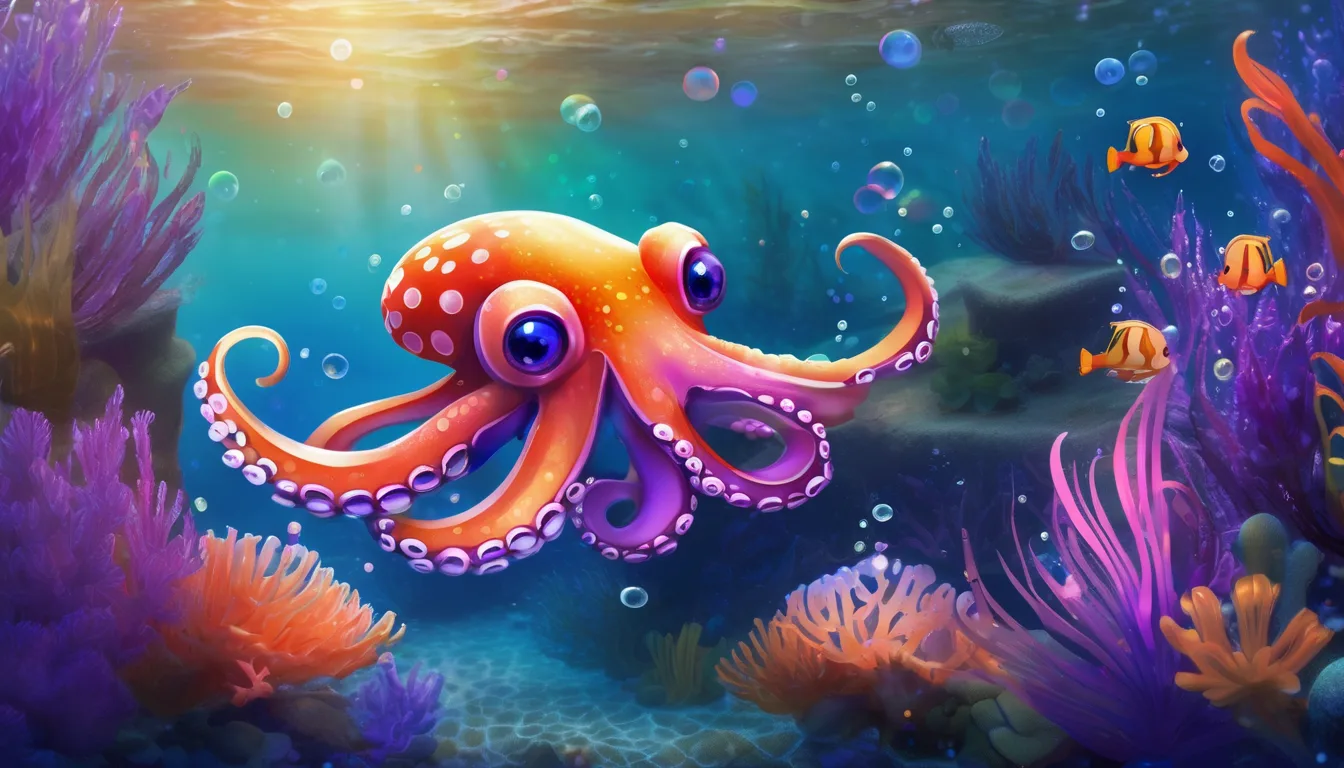
At the bottom of a warm, blue sea, where ribbons of sunlight danced through the water, lived a young octopus named Nima.
Nima had eight soft arms, bright curious eyes, and skin that could change color faster than a fish could swish its tail.
When she floated near the yellow coral, she became yellow.
When she curled beneath a purple sea fan, she became purple.
When she rested beside a patch of green sea grass, she turned green from head to toe.
Nima was very good at matching.
In fact, she was the best matcher in the whole lagoon.
“Look!” called Mako the parrotfish one morning. “Nima has disappeared into the coral again!”
“She has not disappeared,” said his sister. “She is right there.”
“Where?”
“Beside you.”
Mako blinked, spun in a little circle, and bumped gently into Nima, who was exactly the same orange-and-pink color as the coral wall.
“Oh!” said Mako. “There you are!”
Nima giggled, making tiny silver bubbles.
“I fooled you!”
“You always fool everyone,” said Mako. “You are impossible to spot.”
Nima felt proud. Being impossible to spot seemed like a wonderful thing.
So she practiced every day.
She matched the speckled rocks with gray spots.
She matched the sandy floor with pale, wavy stripes.
She matched a family of blue fish so perfectly that they thought she was one of them.
“Excuse me,” said one little fish, swimming right through the space between Nima’s arms. “Are you my cousin?”
Nima tried not to laugh.
“Maybe,” she said.
The fish frowned. “I do not remember you having eight arms.”
Then Nima laughed so hard that her skin flashed pink, orange, green, and blue all at once.
Every creature in the lagoon thought Nima’s color changing was marvelous.
The sea turtles asked her to hide beside their shells.
The shrimp asked her to blend in with their shimmering cave.
Even the sleepy sea horse asked, “Could you match the moonlight tonight? I would like to see if my baby can find you.”
Nima always said yes.
She loved being noticed for how well she could disappear.
But after a while, something strange began to happen.
Whenever Nima wanted to play with her friends, they could not find her.
One afternoon, she wanted to race with Mako and the other parrotfish around the coral garden.
“Ready, set, swim!” cried Mako.
All the fish darted away.
Nima hurried after them, but she had turned herself the same deep blue as the water. She floated through the race like a little blue shadow.
At the end, Mako panted happily.
“I won!”
“You did not,” said Nima.
Mako looked around. “Who said that?”
“It was me.”
“Where are you?”
“Right here.”
Mako peered at the water. “I cannot see you.”
Nima changed to pale yellow.
“There!”
“Oh!” said Mako. “I thought you had not joined the race.”
“I did join,” said Nima softly.
“I am sorry,” Mako said. “Next time, maybe be easier to find.”
Nima did not know what to say.
The next day, she wanted to share a funny shell she had found with a group of tiny crabs. The shell looked like a little curled-up moon, and when Nima held it near her ear, she could hear the sea whispering inside.
But when she reached the crabs, she turned the same sandy brown as their beach.
“Look what I found!” Nima said.
The crabs kept scuttling.
“Hello?” she called.
One crab stepped right over one of Nima’s arms.
“Sorry!” the crab said. “I did not see you there.”
Nima tucked the moon shell beneath her arm.
“It is all right,” she whispered.
That evening, Nima drifted alone near the edge of the lagoon.
The water there was quiet and darkening. Far above, the sky was turning peach, then lavender, then deep velvet blue. Little stars began to blink in the world above the waves.
Nima rested beside a round rock.
Without thinking, she turned herself the same color as the rock.
Gray.
Plain.
Still.
Nearby, beneath a small ledge, lived a crab named Toma.
Toma was not a fast crab. He was not a loud crab. He did not have shiny claws or fancy spots.
His shell was the color of warm chestnuts, with one small white mark shaped like a comma near the top.
Every evening, Toma came out from beneath his ledge to gather bits of seaweed for his supper.
That evening, he paused beside the gray rock.
“Good evening, Nima,” he said.
Nima blinked.
“How did you know it was me?”
Toma set down a strand of seaweed.
“Your eyes look like yours,” he said. “Even when the rest of you looks like a rock.”
Nima looked down at herself. “No one else can tell.”
“I can,” said Toma.
Nima moved one arm slowly through the sand.
“Does that mean I am bad at matching?”
“No,” Toma said. “It means you are very good at matching.”
“Then why does it make me feel sad?”
Toma was quiet for a moment. He was good at being quiet. He let the little waves whisper against the rocks. He watched a pair of silver minnows flicker past.
Then he said, “Perhaps you have been hiding when you wanted to be found.”
Nima thought about Mako at the race. She thought about the tiny crabs walking right by her. She thought about the moon shell tucked under her arm.
“I like changing colors,” she said. “Everyone says it is amazing.”
“It is amazing,” said Toma.
“But sometimes I do not know what color to be.”
Toma nodded.
“Do you know,” he said, “why I have this white comma on my shell?”
Nima looked at the little white mark.
“No.”
“When I was small, I wished it was gone. All the other young crabs had smooth brown shells. I thought my mark made me look odd.”
“What happened?” asked Nima.
“One night, there was a great storm,” said Toma. “The water roared. Sand flew everywhere. The sea grass bent flat against the ground. All the young crabs hid in different places.”
Nima’s eyes grew wide.
“Were you scared?”
“Very scared,” said Toma. “In the morning, everyone was safe, but no one could find their brothers, sisters, cousins, or friends. The beach was covered in bits of shell and seaweed. All the crabs looked brown and muddy.”
“What did you do?”
Toma gave a small smile.
“My mother saw my white comma shining through the sand. She called, ‘There is Toma! If Toma is there, the others may be nearby!’”
“Did they find everyone?”
“They did,” said Toma. “And after that, my little mark did not seem so odd. It helped the ones who loved me know where I was.”
Nima was very still.
A tiny starfish crawled across the sand between them.
“So your mark is like a hello?” Nima asked.
“Yes,” said Toma. “A hello. A here-I-am. A little way of saying, ‘You know me.’”
Nima touched one arm to her own head.
“But I do not have one color.”
Toma looked kindly at her.
“Perhaps you have not found your favorite color yet. Or perhaps your favorite color is one that changes a little, just as you do.”
Nima looked toward the open water. Moonlight was pouring down in a pale silver path.
“I do not know how to choose,” she said.
“You do not have to choose forever,” said Toma. “Try a color that feels like you tonight.”
Nima closed her eyes.
She thought of the warm orange coral where she liked to play.
She thought of pink shells hidden in the sand.
She thought of the purple sky above the sea at sunset, which she had only seen as a soft glow through the water.
Slowly, Nima’s skin began to shimmer.
First came a deep, gentle purple.
Then little rose-pink dots appeared across her arms.
Around her eyes, she glowed a soft coral orange.
She was not the color of the rocks.
She was not the color of the sand.
She was Nima-colored.
Toma smiled.
“There you are,” he said.
Nima looked at her eight arms. “Do I look strange?”
“You look recognizable,” said Toma.
The next morning, Nima swam into the coral garden.
The fish were gathering for another race.
Mako looked up and nearly dropped the pebble he was using as a starting marker.
“Nima!” he cried. “I saw you from all the way over there!”
Nima felt a flutter in her tummy.
“You did?”
“Yes,” said Mako. “Your purple is beautiful. And your pink spots look like tiny sea flowers.”
The other fish nodded.
“There is Nima!” called one.
“Come race with us!” called another.
This time, when Mako shouted, “Ready, set, swim!” Nima did not turn blue.
She swam as herself.
Her purple body twirled through the water. Her pink spots flashed. Her coral-orange eyes shone with joy.
She did not win the race.
Mako did.
But when everyone gathered at the end, they all clapped their fins and waved their tails.
“And Nima came third!” Mako said.
“I came third?” Nima asked.
“You did,” said Mako. “We could see you the whole time.”
Later, Nima visited the tiny crabs at the sandy shore.
“I have something to show you,” she said.
The crabs looked up at once.
“Nima!” they cried.
Nima held out the little moon shell.
The crabs gathered around it in a circle. They listened to the soft sea-whisper inside.
“It sounds like a bedtime song,” said one crab.
Nima smiled.
That evening, she swam to Toma’s quiet ledge.
He was carrying seaweed as usual.
“Good evening, Nima,” he said.
“Good evening, Toma,” she replied.
“Did you match anything today?”
Nima thought about it.
“A little,” she said. “When I was playing hide-and-seek with the fish, I turned green behind the sea grass.”
“Did they find you?”
“Yes,” said Nima. “When I wanted them to.”
Toma’s eyes crinkled happily.
Together, they watched the moonlight ripple across the lagoon.
Nima’s colors softened in the silver water, but they did not disappear. Her purple became like twilight. Her pink spots became like tiny shells. Her coral-orange glow became warm and gentle.
All around her, the sea settled down for the night.
The fish tucked themselves into the coral.
The sea horses curled their tails around sea grass.
The turtles rested beneath rocky shelves.
And Nima floated near Toma’s ledge, bright enough for her friends to find, calm enough for the moon to kiss with light.
She had learned that it was wonderful to blend in when she needed to be safe.
But it was wonderful, too, to be seen.
For when the sea was wide, and the night was deep, and someone called her name, Nima wanted to be able to answer:
“Here I am.”




Leave a Reply