
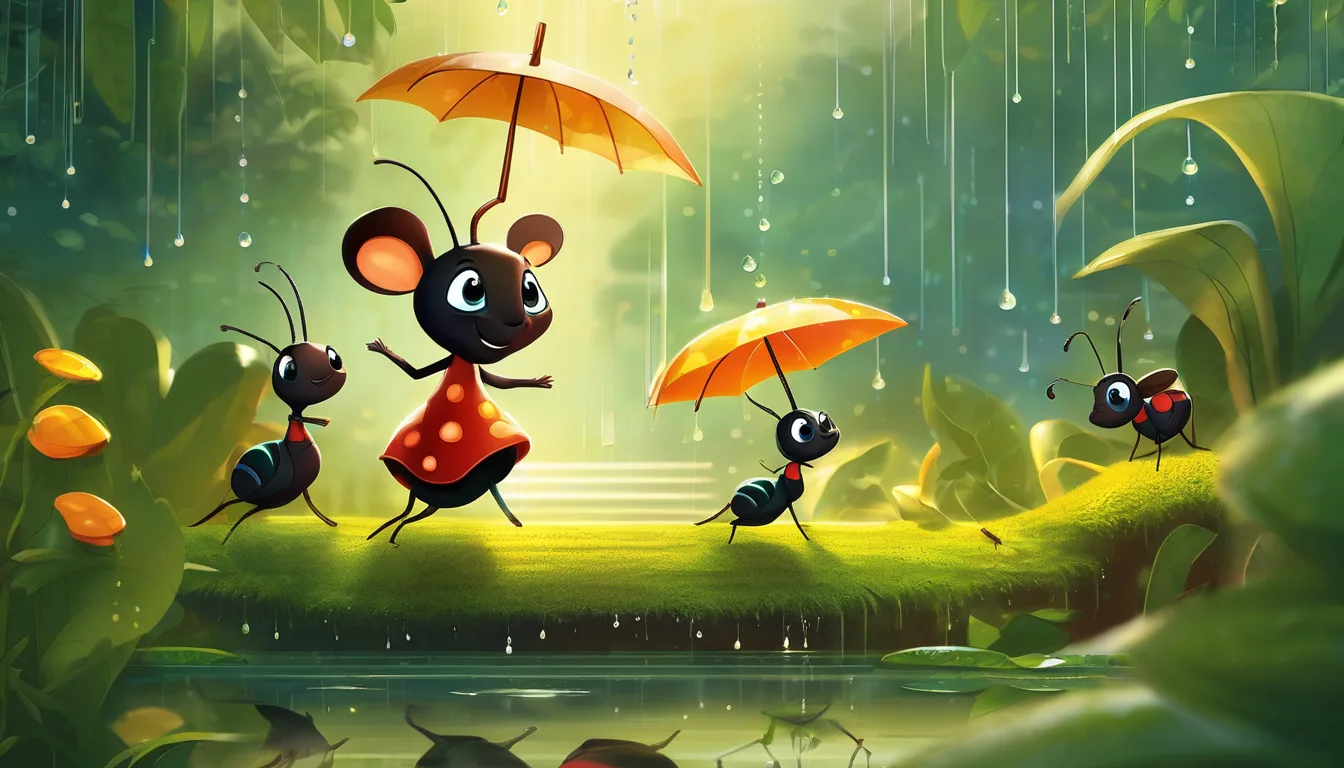
Beneath a flat gray stone at the edge of a sunny meadow lived a colony of ants.
There were ants who carried seeds. Ants who swept tiny tunnels with dry grass brooms. Ants who watched the doors. Ants who cared for pearly white eggs in warm, quiet rooms. Ants who followed the crumb trails that led to the roots of old trees, the picnic blankets of humans, and the hollow stems of wildflowers.
Every ant had a job.
Every morning, when the dew still shone like glass beads on the clover, the colony gathered in the Great Root Hall. It was a wide underground chamber held up by thick, twisty roots. The Queen sat on a soft bed of moss, surrounded by attendants.
“Seed gatherers to the east,” called Captain Zola.
“Berry scouts to the meadow,” called Auntie Marwa.
“Leaf carriers to the fern hill,” called Old Bima, whose left antenna had a little bend in it.
Then all the ants hurried away, their six feet pattering over the earth.
All except one.
His name was Toma.
Toma was a small reddish ant with bright, curious eyes. He was supposed to be a seed gatherer. He had a strong back, quick feet, and excellent antennae for sniffing out food. But Toma also had a mind that fizzed and popped with strange ideas.
While the other seed gatherers marched in neat lines, Toma noticed things.
He noticed how a pebble could roll down a slope.
He noticed how a curled leaf could become a little boat when rain filled a puddle.
He noticed that if you rubbed two dry seed pods together, they made a sound like tiny drums.
And one afternoon, when he was supposed to be carrying a sunflower seed home, Toma found three acorn caps, a smooth round pebble, and a fallen feather.
“Perfect,” he whispered.
He placed the acorn caps in a row.
He set the pebble at one end.
He tucked the feather at the other.
Then he called to his friend Nadi, who was carrying a crumb nearly as big as her head.
“Nadi! Come and see!”
“I am gathering,” Nadi puffed.
“It will only take one blink.”
Nadi stopped. “One blink?”
“One blink.”
So Nadi watched as Toma pushed the pebble. It rolled along the dirt path, bumped into one acorn cap, then another, then another.
Plink. Plink. Plink.
The feather jumped into the air and floated down on Nadi’s head.
Nadi stared at it.
Then she laughed.
It was not a loud laugh, because ants are small. But it was a bright little laugh, like the first raindrop landing in a puddle.
“What was that?” she asked.
“A game,” said Toma proudly. “You must make the pebble knock all three cups before the feather falls.”
“That sounds difficult.”
“It is!”
Nadi tried. The pebble rolled crookedly and missed every acorn cap.
Toma tried. The pebble hit one cup, then toppled into a crack.
They laughed again.
Then they remembered the food.
Nadi hurried off with her crumb. Toma found his sunflower seed, but it was too late. A beetle had taken it.
That evening, in the Great Root Hall, Captain Zola counted the day’s supplies.
“Twenty berry bits.”
“Sixteen seeds.”
“Two pieces of biscuit.”
“Three crumbs of cheese.”
She looked up sharply.
“We should have had seventeen seeds.”
The seed gatherers shifted their feet.
Toma stared at the floor.
The next day, he promised himself he would work properly. Truly, he would. He found a shiny brown seed beneath a thistle plant and lifted it onto his back.
But on the way home, he saw a twig lying across a narrow ditch.
Aha, thought Toma.
He moved the twig. Then he found two more twigs and laid them side by side. He placed a small leaf on top.
It made a bridge.
Toma called over two ants from the leaf-carrying team.
“Would you like to cross the Ditch of Wobbling Doom?” he asked.
“The what?” said one ant, named Sefu.
“The Ditch of Wobbling Doom. You must cross without falling into the wet mud.”
Sefu peered at the ditch. “It is hardly doom.”
“It is doom if you are carrying a leaf and your feet slip.”
That seemed sensible.
Soon, six ants were taking turns crossing the twig bridge. They learned to spread their feet wide. They learned not to push. They learned to wait until the ant ahead had reached the other side.
When the last ant crossed, everyone cheered softly.
Then a sudden wind swooped through the grass.
Whoosh.
The leaf bridge fluttered away.
The ants all had to find another route home.
And once again, Toma returned late.
This time Captain Zola noticed.
“Toma,” she said, in a firm voice, “where is the seed you were assigned to bring back?”
Toma’s antennae drooped.
“I did not bring it.”
“Did you lose it?”
“Not exactly.”
“Did a bird steal it?”
“No.”
“Then what happened?”
Toma swallowed.
“I was making games.”
The Great Root Hall went very quiet.
Even the baby ants seemed to stop wiggling.
“Games?” said Old Bima.
“Yes,” said Toma. “A rolling pebble game. And a bridge game. And I have ideas for a game with pine needles, but I have not tried it yet.”
Captain Zola clicked her jaws, not angrily, but seriously.
“Toma, winter will come. Rain may flood our tunnels. Food does not gather itself. Every ant depends on every other ant.”
“I know,” whispered Toma.
“Games are not seeds,” said Captain Zola.
“No,” said Toma.
“Games are not berries.”
“No.”
“Games are not crumbs of cheese.”
Toma looked at his six small feet.
“No,” he said for the third time.
The Queen, who had been quiet, raised one gentle antenna.
“Toma,” she said, “tomorrow you will work beside Old Bima. No wandering. No inventing. No games until the stores are full enough.”
“Yes, Your Majesty,” said Toma.
That night, Toma lay in his little sleeping nook between two roots. All around him, the colony hummed with quiet bedtime sounds. Someone snored. Someone whispered a dream. Drops of water ticked softly somewhere deep in the earth.
Toma felt as heavy as a stone.
Maybe Captain Zola was right, he thought. Maybe games were silly. Maybe they were only for ants who had nothing useful to do.
The next morning, dark clouds covered the sky.
Old Bima led Toma and several other gatherers toward the meadow.
“We need seeds before the rain begins,” Bima said. “The wind has knocked many down.”
The ants marched through tall grass. Above them, the sky rumbled.
They reached a patch of dry earth scattered with seeds.
“Quickly now,” said Bima.
The ants lifted and carried.
But the first raindrops began to fall.
Plop.
Plop.
Plop.
Each raindrop was enormous to an ant. It struck the ground like a bouncing ball.
“Back to the colony!” cried Bima.
The ants turned toward home.
Then the rain came harder.
The dirt path became slippery. Water rushed through little grooves in the earth. The usual trail vanished under muddy puddles.
“This way!” called one ant.
“No, that is the thorn patch!” cried another.
A young ant named Minu slipped into a shallow puddle and dropped her seed.
“I cannot get up!” she squeaked.
Several ants rushed toward her, but the mud was too slick. They slipped back.
Toma’s heart thumped.
Then he remembered the Ditch of Wobbling Doom.
Not doom, he thought. Practice.
“Make a line!” Toma called.
The others looked at him.
“Use your feet wide, like the bridge game! Do not all rush at once. One ant plants her feet. The next ant holds on. We make a chain.”
Old Bima nodded at once. “Do it!”
The ants formed a line from the dry patch to the puddle. One braced against a pebble. Another held her middle. Another gripped the first ant’s legs.
Toma crawled carefully to Minu.
“Hold my antenna!” he said.
Minu grabbed on.
Behind Toma, the chain of ants leaned backward together.
“Pull!” called Old Bima.
They pulled.
For one long moment, Toma’s feet slid through the mud.
Then Minu popped free.
The whole line tumbled backward in a heap, safe on the dry ground.
Minu clutched Toma’s arm. “You knew how to do that.”
“I only knew because of the game,” said Toma.
Rain drummed all around them.
“We still cannot get home,” said Nadi.
Toma looked around. The path was gone, but nearby lay a curled brown leaf, filling with rainwater.
He remembered his leaf boats.
“Seeds in the leaf!” he cried. “The light ones first. We can float them across the little stream by the roots.”
“It may work,” said Bima.
“It may not,” said Toma.
“That is not very comforting,” said Nadi.
“But it is true.”
The ants hurried. They folded the leaf edges inward and placed the smallest seeds inside. Toma and Nadi pushed the leaf into the rushing water.
At first it spun in a circle.
Then it caught the current and glided toward the great root of the oak tree.
“Run along the bank!” shouted Toma.
The ants ran. At the root, they caught the leaf boat and carried the seeds to safety.
Again and again they sent leaf boats across.
Some wobbled. One sank, though the ants rescued most of its seeds. One bumped against a twig and had to be nudged free.
But by the time the rain softened, every ant was safe. Most of the seeds were safe too.
Back in the Great Root Hall, everyone was wet, muddy, tired, and breathing hard.
Captain Zola hurried over.
“Are all the gatherers home?”
“Yes,” said Old Bima.
“Are any hurt?”
“Only muddy,” said Minu.
“And the seeds?”
Bima looked at the pile. It was smaller than they had hoped for, but much larger than it might have been.
“Toma helped save them,” said Bima. “His games taught us how to make a chain. And how to use a leaf as a boat.”
All eyes turned to Toma.
Toma wished he could hide behind a mushroom.
Captain Zola came close. “Is this true?”
Toma nodded. “I did not mean to make trouble.”
“I know,” said Captain Zola.
The Queen stepped down from her moss bed. She moved slowly, because queens had many important things to think about.
“Food is important,” she said. “Work is important. But a colony is more than a pile of food and a list of jobs.”
The ants listened.
“A colony must know how to help one another. How to think when the path disappears. How to stay calm when rain comes. Perhaps play can teach these things.”
Toma lifted his head.
Captain Zola’s stern face softened a little.
“From now on,” she said, “when the day’s work is done, there will be a short play hour in the Great Root Hall.”
A cheer rustled through the colony.
“But,” Captain Zola added, “first the food must be gathered.”
“Of course,” said Toma quickly.
“And,” said Old Bima, “the games must be useful.”
Toma’s eyes shone. “I have many ideas.”
That evening, after the seeds were sorted and the tunnels were swept, the ants gathered in the Great Root Hall.
Toma set out acorn caps.
He arranged smooth pebbles.
He built a little tunnel maze from twigs and bark.
There was the Pebble Plink Game, which helped ants learn careful aiming.
There was the Wobbling Bridge Game, which taught balance and patience.
There was the Leaf Boat Race, which taught how to steer with tiny sticks.
And there was a new game called Find the Crumb, in which one ant hid a bit of dry bread while the others followed its scent trail through a maze of roots.
Even Captain Zola played one round.
She missed every acorn cap.
Old Bima laughed so hard his bent antenna shook.
Soon, the Great Root Hall was full of soft cheers, tiny footsteps, and happy little ant voices.
The colony still worked hard each day. They gathered seeds, berries, crumbs, and leaves. They fixed tunnels after storms. They cared for the eggs. They watched for spiders and hungry beetles.
But when evening came, they played together.
And something wonderful happened.
The shy ants began speaking up.
The fast ants learned to wait for the slow ones.
The strong ants learned to carry with care.
The clever ants shared new ideas.
And whenever a rainy day made the paths muddy, or a fallen branch blocked the way, or a crumb rolled into a crack, the ants did not panic.
They gathered close.
They listened.
They thought.
Then someone would say, “This is a bit like one of Toma’s games.”
And often, it was.
Far above the stone, the moon rose over the meadow. It painted the clover silver and made the puddles shine. Beneath the earth, warm in their busy home, the ants curled up in their sleeping nooks.
Toma lay between the roots, tired from gathering seeds all day and inventing one small new game after supper.
He had learned that play was not the same as work.
But sometimes play could help work become wiser.
Sometimes a laugh could help friends become brave.
And sometimes a silly little feather, floating down from the air, could remind a whole colony that they were stronger together.
With that comforting thought, Toma tucked his antennae close, listened to the gentle hum of his family, and fell fast asleep.




Leave a Reply