
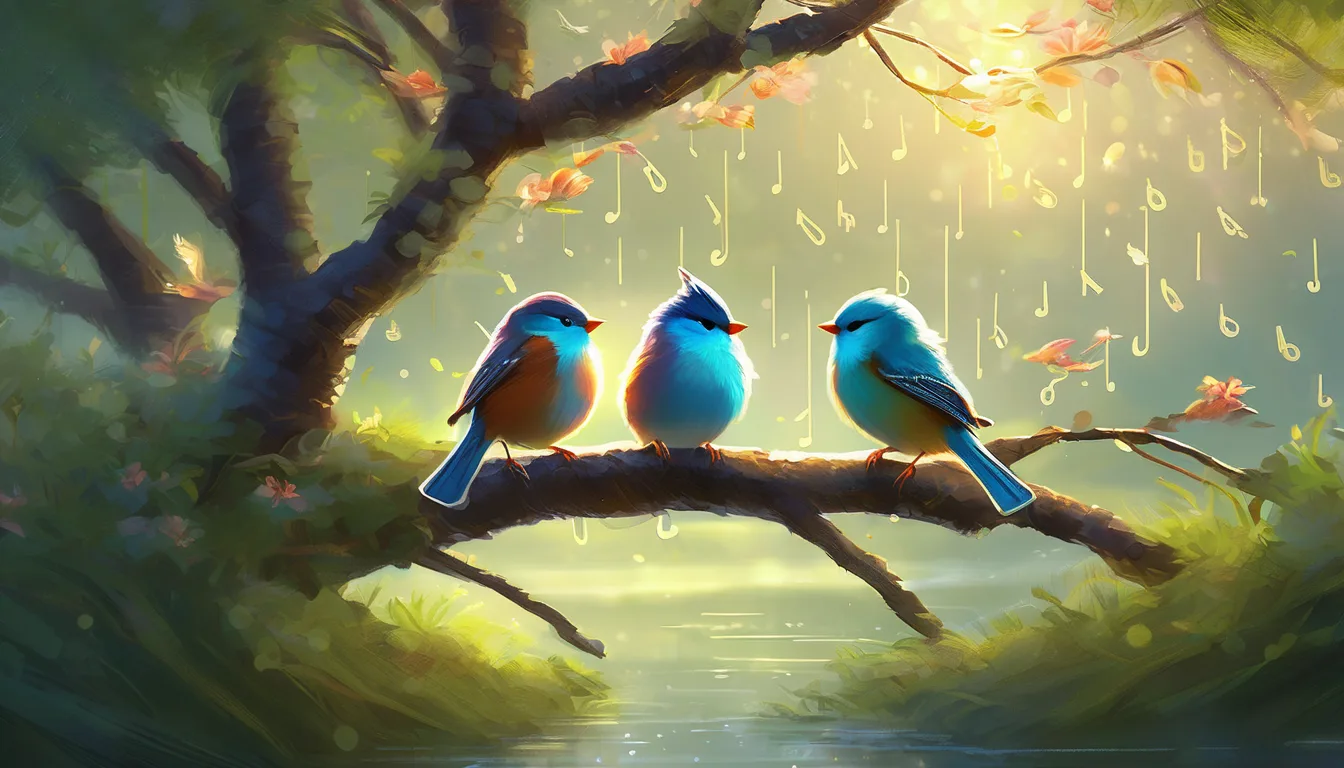
At the edge of a misty meadow stood the tallest willow tree in all of Brindlewood.
Its trunk was wide enough that three badgers could nap side by side on it. Its branches swept down like long green curtains. In spring, the willow made thousands of little silver leaves that trembled whenever a beetle sneezed.
High in that willow tree lived two bird choirs.
On the east side, where the sun climbed up each morning, lived the Dawn Chorus.
The Dawn Chorus were goldfinches, yellowhammers, wrens, and one very serious little robin named Kaito. They liked bright songs that jumped from note to note like pebbles skipping over water.
“Up, up, up!” sang Kaito every morning.
“Shine, shine, shine!” trilled the goldfinches.
“Wake the worms! Wake the bees! Wake the sleepy bumblebees!” chirped the wrens.
Their nest was woven among the willow’s eastern branches, warm and round, lined with moss, lamb’s wool, and the soft gray fluff from cattails.
On the west side, where the sky turned peach and lavender each evening, lived the Moon Chorus.
The Moon Chorus were blackbirds, thrushes, starlings, and a plump nightingale named Zola. They preferred slow, deep songs. Their notes curled around the trunk of the willow and floated over the meadow like smoke from a tiny chimney.
“Low, low, low,” hummed Zola.
“Rest, rest, rest,” sang the thrushes.
“Fold your wings. Close your eyes. The moon has climbed the evening skies,” whistled the blackbirds.
Their nest rested in a broad crook of the western branches. It was made with dry grass, shiny threads, soft feathers, and several blue strings that a starling had found near a picnic blanket.
For many seasons, the two choirs had been rivals.
The Dawn Chorus thought the Moon Chorus sang far too slowly.
“By the time they finish one song,” said Kaito the robin, puffing out his red breast, “a snail could travel across a mushroom.”
The Moon Chorus thought the Dawn Chorus sang far too loudly.
“By the time they sing their first sunbeam note,” said Zola, ruffling her brown feathers, “every mouse in the meadow has hidden under a boot.”
The choirs argued about everything.
They argued about which side of the tree had the prettiest view.
“The east has the sunrise,” said the goldfinches.
“The west has the sunset,” said the blackbirds.
They argued about which songs were best.
“Songs should sparkle!” cried Kaito.
“Songs should sigh,” replied Zola.
They even argued about the willow’s branches.
“That twig is ours!” chirped a wren.
“It leans toward our nest,” said a thrush.
“It leans toward both nests,” called old Miro the wood pigeon, who lived lower down in the tree.
But nobody listened to old Miro, because he often fell asleep in the middle of his own sentences.
Then, one warm morning in early summer, something very important happened.
In the Dawn Chorus nest, beneath a cover of soft breast feathers, were three tiny eggs. One was pale blue with brown freckles. One was cream-colored. One was so small that Kaito worried it might roll away if the wind blew too hard.
In the Moon Chorus nest, tucked among the silver willow leaves, were four glossy eggs. Two were speckled. One was greenish gray. One was nearly black, with a little spot of white as if someone had touched it with a paintbrush.
The whole tree became quieter.
At least, it was supposed to.
“We must rehearse our Morning Brilliance,” said Kaito. “The eggs need to hear a strong song so they know they are coming into a lively world.”
“Lively?” said Zola. “Those eggs need a proper lullaby. A song that tells them the world is safe and soft.”
Kaito flapped his wings. “Soft songs make sleepy singers.”
“Loud songs make cracked acorns,” Zola replied.
That afternoon, the Dawn Chorus began practicing.
“Up, up, up! Shine, shine, shine!”
Their bright voices bounced through the willow branches.
The little blue egg in the eastern nest wobbled.
“See?” said one goldfinch. “It likes it!”
But it was not wobbling happily. It was wobbling because the song was very bouncy.
Then the Moon Chorus began practicing.
“Low, low, low. Rest, rest, rest.”
Their deep voices hummed through the trunk.
The black egg in the western nest gave a tiny shiver.
“See?” said a blackbird. “It likes it!”
But it was not shivering happily. It was shivering because the song was so low that the nest trembled.
Soon, the Dawn Chorus sang louder, trying to be heard over the Moon Chorus.
The Moon Chorus sang deeper, trying to cover the Dawn Chorus.
The willow leaves shook.
A squirrel named Nandor dropped his hazelnut.
A family of field mice hurried into their burrow.
Even the bees, who usually enjoyed a good humming sound, flew away to a patch of clover farther down the meadow.
Then came the rain.
Not a wild thunderstorm, not a crashing storm with roaring clouds.
It was a soft rain, the kind that arrived in a gray shawl and tapped politely on every leaf.
Tap, tap, tap.
Drip, drip, drip.
The bird choirs stopped singing.
Water gathered on the willow branches. The long green leaves bent low and sparkled with raindrops.
Kaito tucked himself close to the three eggs in the eastern nest.
Zola settled over the four eggs in the western nest.
For a little while, all anyone could hear was the rain.
Tap on leaf.
Drip on bark.
Plink into puddle.
From below, old Miro the wood pigeon woke up.
“One must admit,” he murmured, “the rain has a rather excellent rhythm.”
Kaito looked across the willow tree. Zola was looking back.
Neither of them said anything at first.
Then Zola quietly said, “Do you hear that?”
“The rain?” asked Kaito.
“No. Under the rain.”
Kaito listened.
At first he heard only tiny drops pattering on the leaves. Then he heard something else.
A faint sound came from the eastern nest.
Peep.
It was so small that it might have been a raindrop slipping from a feather.
Then, from the western nest, another tiny sound answered.
Preep.
Kaito’s eyes grew round.
Zola leaned forward.
The eggs were not hatching yet. But something inside them had made a little sleepy sound.
Peep.
Preep.
The two sounds came again, one from each nest, almost as if the eggs were speaking to one another through the willow branches.
Kaito lowered his voice. “Perhaps they do not want Morning Brilliance.”
Zola nodded slowly. “Perhaps they do not want Moon Meadow Lullaby either.”
“Then what do they want?” asked Kaito.
Old Miro gave a gentle coo from his branch below. “Maybe,” he said, “they want a song that has room for everyone.”
Kaito frowned. “What would that sound like?”
Zola looked at the rain, at the silver drops gathering along the willow leaves.
“I do not know,” she admitted.
It was difficult for Kaito and Zola to admit they did not know something. Both of them were choir leaders, and choir leaders liked to look as though they had every note tucked neatly beneath their wings.
But the rain kept tapping.
The eggs kept resting.
And the willow tree seemed to wait.
Zola sang one soft note.
“Loooo.”
It was low, but not too low. It sounded like a pond settling after a frog had jumped in.
Kaito listened. Then he added a little note above it.
“Lee.”
Zola sang again.
“Loooo.”
Kaito answered.
“Lee.”
The two notes did not fight.
They fit together.
Below them, old Miro gave a warm, round coo.
“Roo-roo.”
A wren added a tiny trill, as light as a raindrop.
A blackbird tucked in a gentle whistle.
The goldfinches sang a soft thread of sunshine.
The thrushes gave the song a smooth, quiet path to walk upon.
Soon both choirs were singing, but no one was trying to be louder than anyone else.
They listened between each note.
They left little spaces for the rain.
They left little spaces for the wind.
They left little spaces for the eggs to dream.
The song went like this:
“Leaf to leaf and wing to wing,
Hush now, little hidden thing.
Morning gold and evening blue,
The willow has a place for you.
Rain may tap and breezes sway,
Night will come and day will stay.
Sleep beneath the silver tree,
Safe as any egg can be.”
When they finished, nobody spoke.
The rain had nearly stopped.
One bright drop slid from the highest willow leaf and fell all the way down into the meadow.
Plink.
In the eastern nest, the smallest egg gave a tiny, peaceful wiggle.
In the western nest, the greenish-gray egg made a small sound.
Preep.
Then the blue egg answered.
Peep.
Kaito smiled, though he tried not to smile too widely in case it made the nest wobble.
Zola smiled too.
“That song had brightness,” she said.
“And it had softness,” said Kaito.
“It had slow parts.”
“And little jumping parts.”
“It had you,” said Zola.
“It had you too,” Kaito replied.
From that day on, the Dawn Chorus and the Moon Chorus were still different.
The goldfinches still loved shiny high notes.
The blackbirds still loved deep evening whistles.
Kaito still believed songs should have at least one cheerful bounce.
Zola still believed every good tune needed a place to rest.
But each morning, the two choirs sang their shared Willow Song for the eggs.
And each evening, they sang it again, even more gently.
The meadow animals came to listen.
Nandor the squirrel sat with his paws folded over his hazelnut.
The field mice peeked from their burrow.
The bees hummed along, very quietly this time.
And old Miro the wood pigeon listened from his lower branch until he fell asleep before the second verse, his head tucked beneath one gray wing.
Days passed.
The eggs warmed.
The willow leaves danced in the sun.
And one early morning, just as the eastern sky became the color of buttercups, there came a little crack.
Then another.
Then a third.
By sunset, tiny fluffy chicks had appeared in both nests.
Some had yellow fuzz. Some had dark soft down. One had a ridiculous tuft sticking straight up from its head.
The chicks blinked at the world.
They heard the last golden notes of morning.
They heard the first velvet notes of evening.
And every time the two choirs sang together, the little birds grew calm and still, tucked safely beneath their parents’ wings.
High in the oldest willow tree in Brindlewood, east and west became part of the same home.
And while the moon rose and the meadow curled itself into sleep, the tree held two nests, seven chicks, many soft feathers, and one gentle song that knew exactly how to make even the smallest eggs dream.


Leave a Reply