
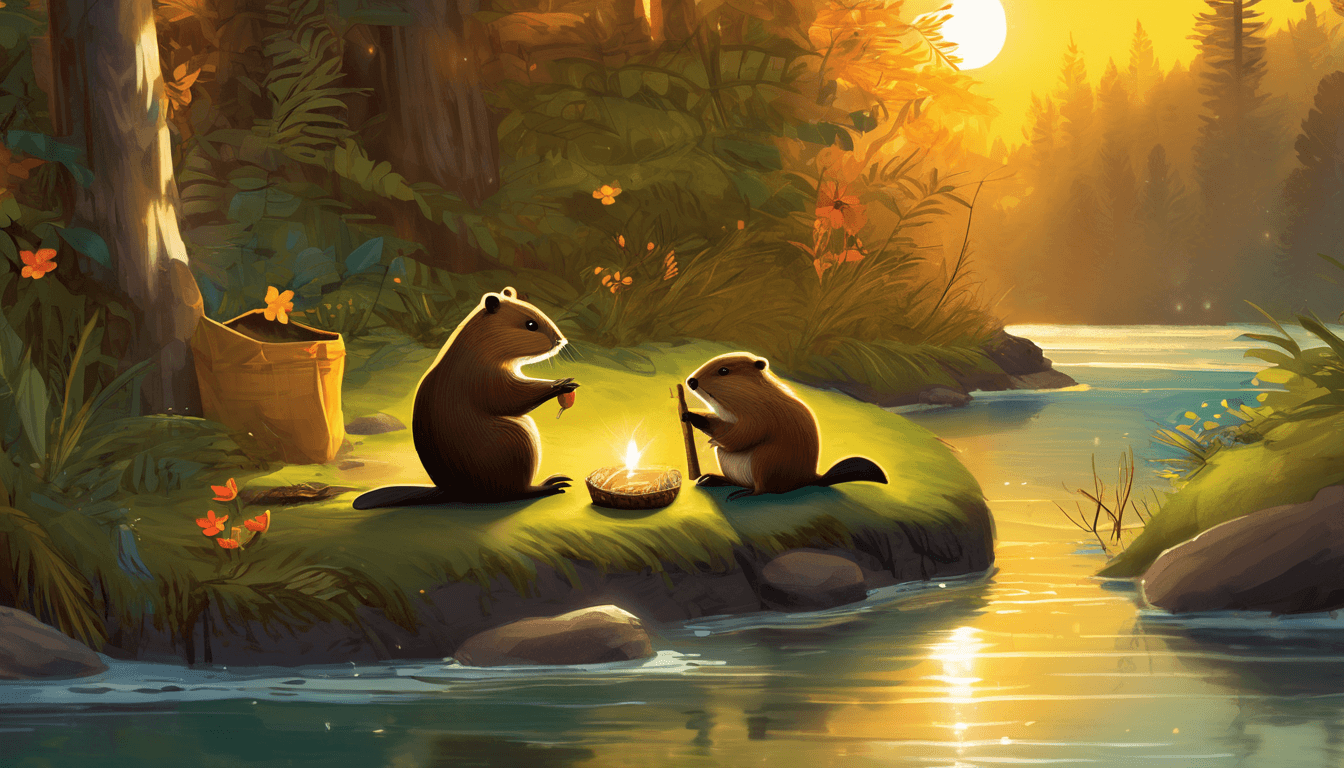
At the bend of the blue-green River Sova, where willow branches dipped their fingers into the water, lived a family of beavers.
There was Baba, the grandbeaver, who had silver fur around his nose and could hear a loose twig creak from three ponds away.
There was Miro, who liked making careful plans in the mud with the tip of his tail.
There was Saffi, who could carry twice as many reeds as anyone expected.
And there were the young beavers, Niko and Tama, who were not yet very good at sitting still.
Their home was a warm round lodge made of smooth sticks, river stones, and soft moss. It had two underwater doors, a dry sleeping room, a little shelf for winter roots, and a roof that sang quietly whenever rain fell.
Plink, plink, plink, it would sing.
Niko loved the roof song.
Tama loved the underwater doors.
But Baba loved the walls best.
“A good wall,” Baba often said, tapping the lodge with one broad paw, “does not only keep the cold out. It knows who is resting inside.”
Niko thought that sounded mysterious.
“How can a wall know things?” he would ask.
Baba would twitch his whiskers. “By listening while it is being built.”
Niko did not understand, but he nodded as if he did.
One spring morning, the River Sova began to change.
At first, it was only a little different. The current swirled faster around the bend. Tiny bubbles gathered under the bank. A sandy shelf near the otters’ den slipped into the water with a soft shush.
Then came three days of warm rain far away in the hills.
The river grew wide and brown. It pushed against its banks. It tugged at roots. It lifted old branches and spun them downstream.
By the fourth morning, a whole part of the riverbank had disappeared.
The mouse family who lived beneath a clump of grass had to scramble up a hill.
The kingfishers’ nesting wall had crumbled.
The old tortoise, Yara, found her sunny mud patch covered by chilly water.
Even the otters, who usually thought every splash was splendid, looked worried. Their den entrance was now beneath a rushing, swirling pool.
Animals came from all along the river bend, shaking water from their fur, feathers, and paws.
“We need somewhere dry!” cried a field mouse named Olek.
“My nest was in that bank,” said Zhen, the kingfisher, looking at the empty space where the earth had fallen away.
“I need a warm stone,” said Yara the tortoise. “My toes are cold, and when my toes are cold, I become very grumpy.”
“That is true,” whispered Tama to Niko.
“It is extremely true,” Niko whispered back.
Miro looked at the crowded shore. He saw the wet animals, the tired animals, the tiny animals hiding under leaves. He looked at the branches and logs floating past.
Then he looked at his family.
“We can build,” he said.
Saffi’s eyes brightened. “A new lodge?”
“Not one lodge,” said Miro. “Many small homes. Safe ones, for everyone who has lost theirs.”
Niko leaped into the water so quickly that he made a splash over his own head.
“We can make the biggest home ever! With seven towers! And a slide! And a roof shaped like a fish!”
“A fish-shaped roof might be lovely,” said Baba gently. “But before we build anything, we must listen.”
Niko’s tail sank a little.
“Listen to what?”
“To the animals,” said Baba. “Every creature has a different way of living. A home for a mouse should not be a home for a kingfisher. A home for a tortoise should not be a home for an otter.”
So the beaver family did not gather sticks right away.
First, they listened.
Miro sat beside the mice beneath a dock leaf.
“What do you need?” he asked.
Olek the mouse wrung out his whiskers. “A place with small doors. We do not like big open doorways. Owls can look through them.”
“And a dry floor,” said Olek’s sister, Branka. “Not too far from seeds and berries.”
Saffi spoke to Zhen the kingfisher, who was perched on a low branch.
“What do you need?”
“A high entrance,” said Zhen. “I need to see the river. And I need a ledge where I can rest before flying in. But the inside should be dark and quiet for my eggs.”
Baba sat in the sunshine beside Yara.
“What do you need?” he asked.
Yara considered this for a long time.
“A flat place for sleeping,” she said at last. “A roof for rain. A patch of morning sun. A shallow pool nearby. And no steep steps. I am not climbing steep steps for anybody.”
“No steep steps,” Baba agreed.
Then the beavers swam to the otters, who had gathered around a calm little inlet.
“What do you need?” asked Tama.
The otters all talked at once.
“A water entrance!”
“A dry room!”
“A place to tumble!”
“More water entrances!”
“A place to keep fish!”
“And a tunnel!” said little Kavi Otter. “Every good home has a tunnel.”
The adult otters looked at one another.
“A small tunnel,” said Kavi’s mother.
Tama wrote this down in mud with a reed: Small tunnel. Very important.
At sunset, the beaver family held a meeting on a flat log.
Miro drew a map with his tail.
Here, above the new waterline, there was a hill with sturdy roots. It would be safe for the mice.
There, beneath a leaning willow, was a strong bank where small bird homes could be tucked into the earth.
Near a sunny pond edge, there was a broad patch of firm ground for Yara.
And close to the quiet inlet, where reeds grew tall and thick, there was room for an otter den with two underwater entrances and, yes, one small tunnel.
“We will need many sticks,” said Saffi.
“Many stones,” said Baba.
“Many reeds,” said Tama.
“And fish roofs,” said Niko.
Miro smiled. “Perhaps one fish roof.”
The next day, everyone began to work.
The beavers cut willow branches with their strong orange teeth. They carried logs, pushed stones, and wove reeds together. But they did not work alone.
The mice gathered soft grass for bedding and pointed out hidden holes where rainwater might collect.
The kingfishers brought little beaks full of clay and mud, perfect for sealing tiny cracks.
The otters fetched smooth stones from the riverbed and slid them up the bank, laughing all the way.
Yara the tortoise did not carry much, because her legs were short and she moved slowly. But she was very good at testing floors.
She walked over each one with great seriousness.
“This one bumps,” she said.
“This one tilts.”
“This one is excellent.”
The beavers trusted Yara’s feet.
By the second evening, the first homes were nearly ready.
The mice had a cozy house tucked beneath the roots of an alder tree. It had three little round doorways, all hidden beneath curtains of grass. Inside were tiny rooms lined with dry moss.
Olek peered in.
“It is wonderful!” he squeaked.
But Baba lifted a paw.
“Before you move in,” he said, “let us listen.”
Everyone became quiet.
The river murmured below. Leaves fluttered. A frog burped in the distance.
Then, from inside the mouse house, came a faint drip.
Drip.
Drip.
Drip.
Miro pressed his ear to the roof. A small root above the home was guiding rainwater straight toward one corner.
So the beavers added a little channel of pebbles to lead the water away, and they built a tiny overhang above the doors.
When they were done, they listened again.
No drip came.
Only the soft scratch-scratch of happy mouse paws arranging bedding.
The kingfisher homes were next. They were built into a firm bank beneath the willow, with narrow openings high above the water. Each entrance had a small clay ledge.
Zhen flew to one, then another, then another.
“They are lovely,” she said.
She went inside the first home.
A moment later, she came back out with feathers sticking up on her head.
“It is too bright,” she said. “The afternoon sun shines straight in.”
Niko had thought the bright light was beautiful. It made the clay walls glow gold.
But then he remembered Baba’s words.
A home knows who is resting inside.
So the family made the entrance turn slightly, like a gentle curved hallway. Light could still come in, but not too much. The inside became shaded, calm, and safe.
Zhen flew in again.
This time, she did not come out for a while.
At last, her small voice called, “Perfect.”
The otter den took the longest.
Its main room was dry and roomy, with a floor of sand and reeds. It had two water entrances, one on each side, so the otters could swim out if one became blocked. It had a shelf for fish. And it had Kavi’s small tunnel, which curled under a pile of roots and came out near a patch of ferns.
When it was finished, the otters rushed inside.
They tumbled through the tunnel.
They splashed through the entrances.
They slid across the sandy floor.
Then Kavi stopped.
“The tunnel is too scratchy,” he said.
“It is?” Tama asked.
Kavi nodded. “My belly says so.”
The beavers crawled through the tunnel. The ceiling was a little too low, and rough bark stuck out from the walls.
So Saffi smoothed the bark. Miro lifted the roof just a tiny bit. Tama lined one curve with soft mud. When Kavi tried again, he glided through with a delighted whoop.
“My belly is pleased!” he announced.
At last, there was only Yara’s home to finish.
It was a low, wide shelter made from arched branches covered in reeds. One side was open to the east, where the morning sun rose. A shallow pool lay nearby. The floor was flat, smooth, and warm with sand.
Niko had added the fish-shaped roof.
It was not a whole fish roof, exactly. It was a roof with two curved leaf fins at the top.
Yara looked at it for a long time.
“Does it leak?” she asked.
“No,” said Niko.
“Does it keep off rain?”
“Yes.”
“Does it make my toes warm?”
“It does.”
“Then the fish fins may stay,” said Yara.
Niko beamed.
That evening, the river was still wider than before, but the animals no longer stood shivering along the shore.
Small lights glowed from fireflies around the new homes.
The mice were carrying seeds through their grass-hidden doors.
Zhen settled into her quiet, shadowy nest.
The otters played one last gentle game of tunnel-tag before curling together in their dry room.
Yara rested on her smooth sandy floor, with her toes warm at last.
The beaver family sat on a log and watched the moon rise over River Sova.
“It was hard work,” said Saffi, her fur full of bits of reed.
“It was good work,” said Miro.
Niko looked at all the homes. None of them were exactly alike. The mouse house was small and secret. The bird homes were high and quiet. The otter den had water doors and a tunnel. Yara’s shelter had sun and no steep steps.
“Baba,” Niko said softly, “I think I understand now.”
“Understand what?” Baba asked.
“A good wall listens before it is built.”
Baba’s silver whiskers lifted in a smile.
“Yes,” he said. “And a good home is not made only from sticks, mud, roots, and stone.”
“What else is it made from?” asked Tama.
Baba looked toward the glowing riverbank, where every animal was settling down safely.
“Care,” he said. “Questions. Patience. And the wish to make room for someone else.”
The river made its gentle evening sound.
Shhush, shhush, shhush.
The willow leaves swayed above the homes.
The moon painted a silver path across the water.
And in their round warm lodge, beneath their roof that sang plink, plink, plink when the night mist fell, the beaver family went to sleep, dreaming of strong walls, quiet rooms, sunny floors, small tunnels, and all the many ways a home could say:
You belong here.


Leave a Reply