
In the city of Bellavento, everyone knew the sounds above the ground.
There was the clanging of the blue tram as it rounded Juniper Square.
There was the warm, buttery puff of the bakery door opening every morning.
There were bicycle bells, market sellers calling, dogs shaking rain from their ears, and the clock tower ringing every hour with a deep, polite bong.
But almost nobody thought about the sounds below the ground.
Almost nobody, that is, except for Nuru, Toma, and Mei.
Nuru lived above a tiny bookshop where the floorboards creaked in different notes. Toma lived beside a repair shop and could tell the difference between a loose screw and a rolling marble just by listening. Mei lived on the seventh floor of a tall apartment building and liked to press her cheek to the warm radiator pipes in winter.
“It sounds like a giant sipping soup,” Mei once said.
“It sounds like a dragon snoring through a flute,” said Toma.
“It sounds like something trying to tell us a secret,” said Nuru.
That was how the three friends began their Sound Catalogue.
They used a large notebook with a mustard-yellow cover and a silver clasp. On the first page, Mei wrote in her neatest handwriting:
THE SOUNDS OF BELLAVENTO, ABOVE AND BELOW.
Then they walked through the city with pencils, a small tin whistle for measuring echoes, and three upside-down cups tied with string.
They recorded the squabble of pigeons on rooftops.
They recorded the shush-shush of street sweepers’ brushes.
They recorded the sleepy hum of a flower stall refrigerator.
They even recorded the tiny plink of raindrops landing in the bronze hat of a statue in Fountain Park.
For every sound, they gave a description.
Tram wheels: Like a spoon stirring pebbles in a giant mug.
Bakery door: Like a soft sigh wearing an apron.
Pigeons: Like old ladies rustling paper bags.
But their favorite sounds came from below.
At first, they only heard them by placing their ears near drain covers, basement windows, and the warm metal pipes that ran through old buildings.
Under the fountain in Juniper Square, there was a blub-blub-blub.
Near the tram stop, there was a gentle clink-clink, as if someone were making tea far beneath the pavement.
Behind the library, they heard a strange, fluttery sound.
Frip-frip-frip.
“What is that?” Toma whispered.
“Maybe underground birds,” said Mei.
“Birds don’t live under streets,” Nuru said.
“How do you know?” asked Toma.
Nuru paused.
“I don’t,” he admitted. “Not yet.”
One chilly afternoon, when the clouds were the color of wool socks, the three friends went to the old public bathhouse on Marzipan Lane. The bathhouse had been closed for many years, but its brick walls were still rosy and strong. Curly iron pipes climbed along the outside, disappearing through little windows near the roof.
They had come because Mei had heard something the day before.
Not one sound.
A whole chorus.
She led the others around the back of the bathhouse, where ivy climbed a wall and an old metal grate sat low to the ground.
“Listen,” she said.
They knelt.
At first, Nuru heard only the distant city. A bus grumbled. A bicycle rattled past. Somewhere, someone laughed.
Then he heard it.
Tick.
Tick-tick.
Drip.
Whirrrrr.
Frip-frip-frip.
A low, cozy hum rose beneath all the other sounds.
It was not the sound of one thing.
It was the sound of many things living together.
The children stared at one another.
“We have to find out,” said Toma.
The grate was held shut by a bent latch. Behind it was a narrow stone stairway leading down into darkness.
Mei swallowed. “We should not go without telling someone.”
That was sensible, and Mei was often sensible in ways that made adventures possible instead of messy.
So they hurried to find Ms. Soraya, the caretaker of the old bathhouse. She was in the courtyard, watering a row of stubborn mint plants growing in cracked pots.
When the children told her about the sounds, Ms. Soraya did not laugh.
Instead, her eyes grew bright.
“Well,” she said, setting down her watering can, “I have been waiting for someone to notice.”
She fetched three small lanterns from a cupboard. Their glass sides were painted blue, green, and gold.
“The tunnels below the old bathhouse are safe enough if we walk carefully,” she said. “They used to carry water and warmth to many buildings. Most of the big passages are closed now, but some small pipes still do their work.”
“Do people live down there?” asked Toma.
“Not people,” said Ms. Soraya. “But perhaps you will see.”
The stone stairs were cool at first. Their lanterns painted puddles of color over the walls.
Down they went, one step at a time.
The city sounds faded behind them.
Below, the air smelled of wet stone, warm metal, and something green, like a garden after rain.
At the bottom of the stairway, they found a tunnel no taller than Ms. Soraya’s shoulders. Great copper pipes ran along the ceiling, wrapped in soft gray cloth. Every so often, a pipe gave a little shudder.
Clonk.
Then, slowly, it hummed.
Hummmmmm.
“That one sounds like a sleepy cello,” Nuru whispered, opening the yellow notebook.
He wrote:
Large copper pipe: A giant bee singing with its mouth closed.
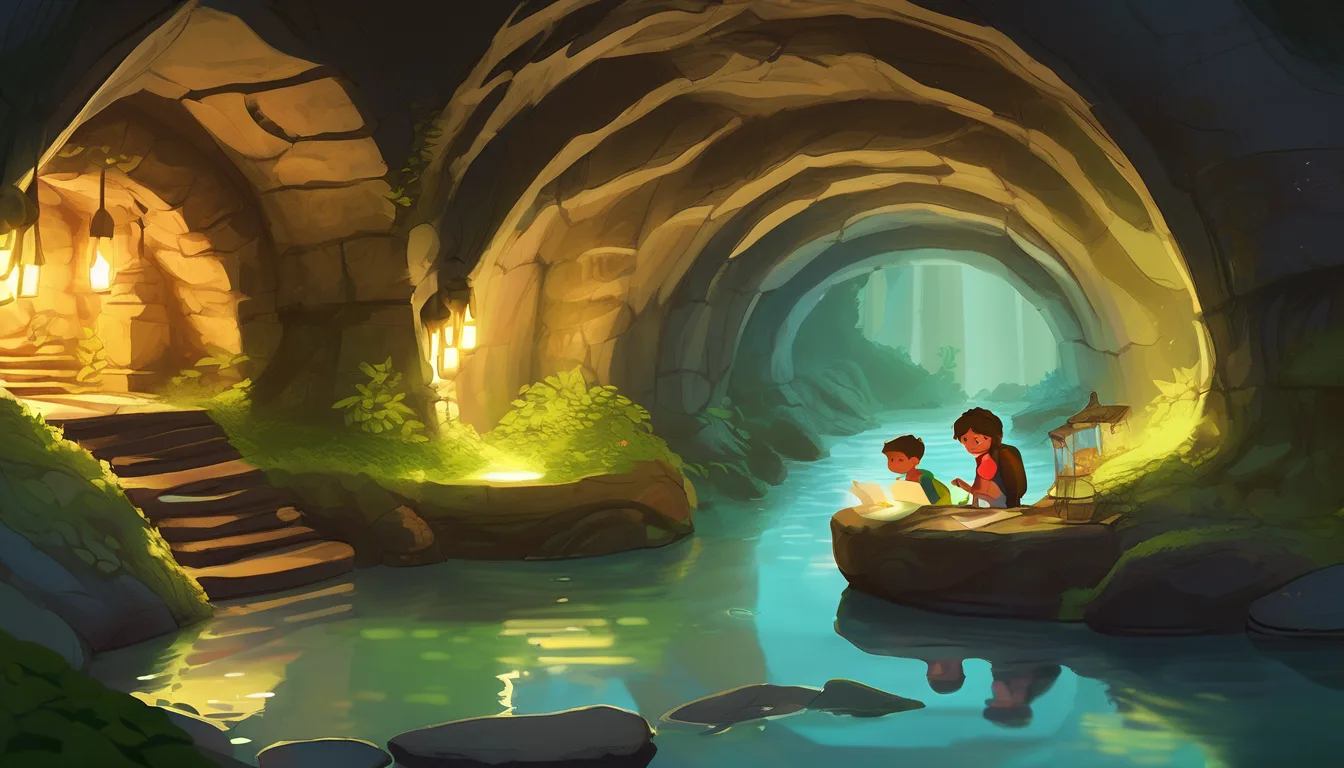
They followed the tunnel until it opened into a round chamber.
The children stopped so suddenly that Toma nearly bumped into Mei.
The chamber was beautiful.
Warm pipes curved around the walls like the roots of a great shining tree. Water dripped from a crack in the ceiling and collected in a clear stream that wound through the middle of the room.
Along the edges of the stream grew thick emerald moss.
Little white mushrooms, round as buttons, clustered in the shadows.
Tiny ferns curled from gaps between bricks.
And there were animals.
Not big animals.
Not frightening animals.
But astonishing animals.
Silverfish darted over the stones, their bodies flashing like pieces of moonlight.
A plump brown toad sat beneath a pipe, blinking as though it owned the place.
Pale little beetles crawled through the moss, carrying crumbs of old leaves.
Above them, hanging upside down from a warm pipe, were dozens of small bats.
Frip-frip-frip.
“There!” Mei breathed.
The bats were not birds after all.
They were no bigger than mittens, with velvety gray fur and tiny folded wings. Every few moments, one would flutter from the pipe, loop around the chamber, and return.
“A nursery,” Ms. Soraya said softly. “The pipes keep this room warm when the nights are cold.”
The children stood very still.
The underground place was alive with small work.
Water made the streams.
The streams watered the moss.
The moss sheltered beetles and snails.
The beetles and snails left tiny scraps for the fungi.
The fungi helped turn old fallen bits into dark, rich soil.
And all around it, the pipes brought gentle warmth.
“It is like a hidden village,” Toma said.
“Yes,” said Ms. Soraya. “A village without houses, but with many homes.”
Nuru carefully wrote in the notebook.
Dripping stream: Crystal beads falling into a secret bowl.
Bat wings: Paper flags waving in a very small wind.
Mossy stones: Quiet. Green quiet.
They explored deeper, though only as far as Ms. Soraya allowed.
In one tunnel, they found a puddle filled with water boatmen, skating upside down beneath the surface.
In another, they found a family of mice carrying seeds into a dry crack near a warm valve.
In a low brick archway, tiny orange salamanders rested beside the stream, their toes spread like little starbursts.
Mei wanted to name every creature.
Toma wanted to draw maps.
Nuru wanted to record every sound.
For a while, they forgot that the sky above them had changed.
Then they heard it.
A terrible sound.
Not a gentle hum.
Not a plink or a drip.
A loud, harsh roar came through the largest pipe.
GRRRRRRRRRRROOOOONK!
The chamber shook.
The stream trembled.
The bats woke all at once and spun through the air in a frightened cloud.
The toad leaped beneath a stone.
“What was that?” Toma cried.
Ms. Soraya lifted her lantern and listened.
Her face became serious.
“A pressure valve,” she said. “Something has blocked one of the water channels.”
Another roar came, followed by a sharp hiss.
Steam puffed from a joint in the pipe.
The warm chamber became warmer.
Too warm.
The moss near the pipe began to curl at its edges.
“We have to leave,” said Ms. Soraya.
But as they turned, Mei pointed toward a narrow side channel.
“The stream!” she said.
A pile of soggy leaves, twigs, and city litter had gathered where the hidden stream passed beneath an iron gate. The water was backing up, spilling into the pipe room.
“That blockage may be causing the trouble,” said Ms. Soraya.
The water rose around their boots.
Nuru felt his heart knock against his ribs.
He did not like the sound of it.
It was too fast, too scared.
But then he saw the little salamanders crowding onto a dry brick. He saw the bats fluttering near the ceiling. He saw the moss shining darkly, still and waiting.
“We can help,” he said.
Ms. Soraya looked at the children. “Only if you stay together.”
Together, they did.
Toma found a long wooden handle left beside an old maintenance door.
Mei held the lantern close so they could see the iron gate.
Nuru lay flat on his tummy at the edge of the water and used the handle to poke at the pile.
First, nothing happened.
Then a muddy newspaper scrap slid free.
A bottle cap spun away.
A clump of leaves loosened.
The water made a new sound.
Gurgle.
Gurgle-gurgle.
Then, suddenly, WHOOSH!
The whole pile rushed through the gate and vanished down the channel.
The backed-up water hurried after it, swirling away from their boots.
At the same moment, the large pipe gave one deep, steady sigh.
Hooooooom.
The fierce hiss stopped.
The chamber cooled.
Slowly, the bats settled again.
One by one, the tiny creatures returned to their places.
The toad emerged from beneath its stone.
The salamanders slipped back toward the stream.
And from the warm pipe overhead came a soft, peaceful vibration.
Hummmmmm.
“It sounds different now,” Mei said.
Nuru listened.
“It sounds relieved,” he said.
Ms. Soraya smiled. “Perhaps it is.”
Back in the daylight, Bellavento seemed louder than ever.
The tram clanged.
The bakery door sighed.
Pigeons rustled their wings.
But now the children knew that under every busy sound, another world was gently singing.
They spent the next month adding new pages to their Sound Catalogue. They also made a map called The Listening Map of Below.
They showed Ms. Soraya where the bat nursery was.
They marked the salamander arch.
They drew the hidden stream and the warm pipe chamber.
Then they made a special sign for the gate where the litter had gathered.
PLEASE KEEP OUR STREAMS CLEAR, it said.
Below, in smaller letters, Mei wrote:
SOMEBODY LIVES DOWN THERE.
Soon, people in Bellavento began to listen more carefully.
The baker saved clean vegetable peelings for the community garden instead of tossing them toward the drain.
The tram driver told schoolchildren about the little bats.
The librarian put books about mosses, streams, and city wildlife by the front door.
Even the mayor came to see the Listening Map. He wore very shiny shoes and asked many questions.
But the best moment came one evening, when Nuru, Toma, and Mei sat together on the steps outside the old bathhouse.
The sky was deep blue. Windows glowed gold all along Marzipan Lane.
Mei leaned her cheek against the warm outside pipe.
Toma did the same.
Nuru listened with his ear close to the metal.
From far below came the water’s tiny music.
Drip.
Whisper.
Plink.
And under it all was the low, patient song of the city’s hidden warmth.
Hummmmmm.
“What do you think it is saying?” Toma asked.
Mei closed her eyes.
“I think,” she said, “it is saying good night.”
And because the city had so many sounds above and below, and because every small living thing had found its cozy place, the three friends went home with their yellow notebook tucked safely between them.
All through the night, beneath Bellavento’s sleeping streets, the warm pipes hummed, the clear stream curled around its mossy stones, and the little bats dreamed upside down in their secret underground home.

Leave a Reply