
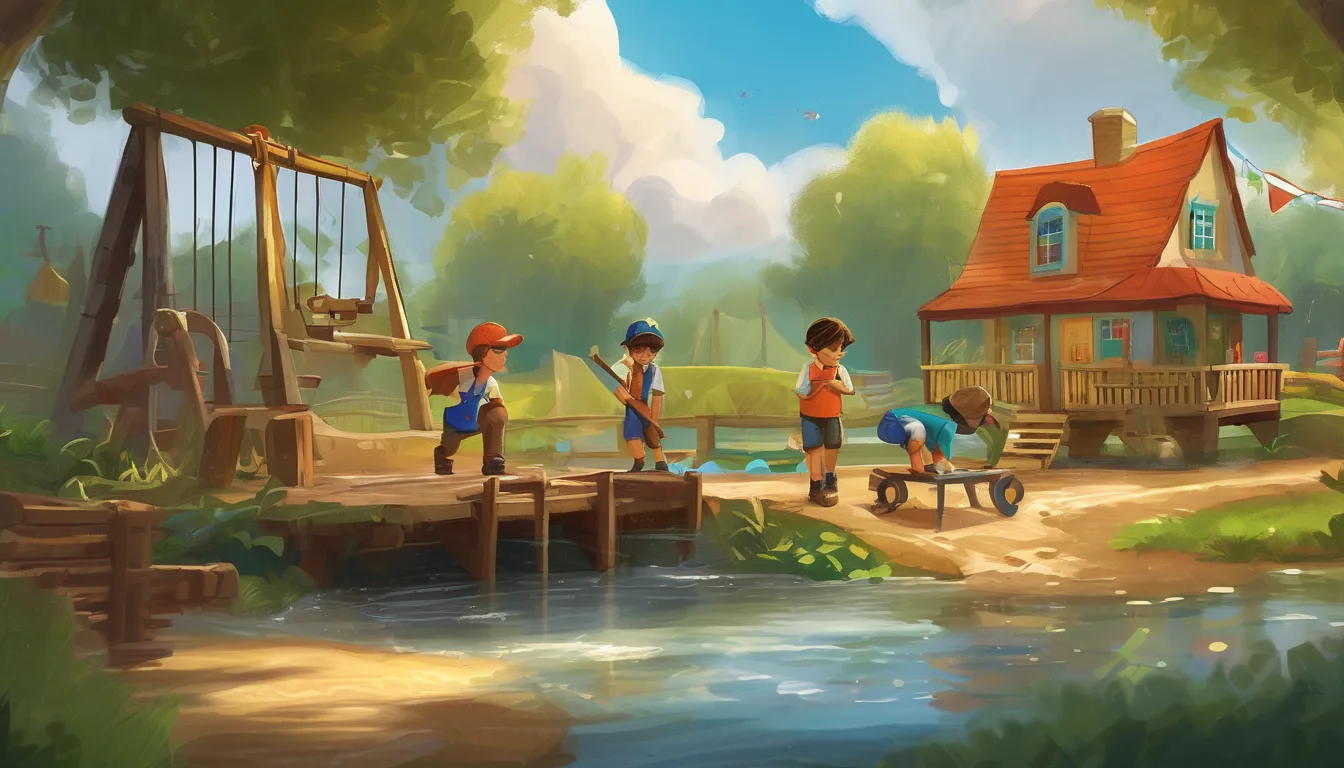
After the Great Flood, when rivers climbed over their banks and streams rushed through fields where sheep once grazed, many little towns had to move uphill.
People carried what they could.
They carried kettles, family pictures, seed packets, books, shoes tied together by their laces, and sometimes sleepy cats tucked inside coats.
But there were things they could not carry.
They could not carry the playgrounds.
Swings stood in muddy water. Slides were buried beneath branches and leaves. Roundabouts leaned sideways. Seesaws waited beneath tall grass, their handles rusting in the rain.
For a long time, everyone was too busy fixing roofs, mending roads, and planting gardens again.
Then, one bright spring morning, a repair crew came rattling down the lane to the hill village of Orinovo.
Their truck was painted sunflower yellow, though most of the paint was hidden beneath scratches, patches, and cheerful handprints. It pulled a blue wagon full of tools, ladders, ropes, pots of paint, bundles of wooden planks, and a small silver bell that rang whenever the wagon bumped over stones.
On the side of the truck, in wobbly red letters, were the words:
THE ROAMING PLAYGROUND REPAIR CREW
Nine-year-old Miro saw the truck from the window of his grandmother’s bakery.
He had been kneading dough with his elbows because his hands were covered in flour.
“Look!” he cried.
His grandmother, Sanaa, peered out over her spectacles. “Ah,” she said. “The repair crew has come at last.”
“Are they going to fix the old playground by the river?” asked Miro.
“If anyone can, it is them.”
Miro pressed his nose to the window. Beyond the new houses on the hill, the old river valley glittered in the sunshine. There, between willow trees, was the playground he had loved before the flood.
Its bright red slide had once looked like a dragon’s tongue. Its swings had flown so high that Miro’s stomach had tickled. There had been a climbing frame shaped like a ship, with a wooden wheel at the front.
Now it was quiet.
The flood had gone away months ago, but it had left mud, broken branches, and a deep brown line on every wall and tree trunk.
Miro watched as three people climbed down from the yellow truck.
The first was a tall woman named Amina, who wore a tool belt full of hammers and screwdrivers.
The second was a round, laughing man named Tomas, whose pockets seemed to contain every kind of screw, nail, bolt, and biscuit.
The third was a serious-looking girl with two black braids, perhaps twelve years old, named Natsuki. She carried a clipboard and a pencil behind one ear.
Last of all, a small old dog hopped out of the truck. His ears were too large for his head.
“That,” said Grandmother Sanaa, “must be Bristle.”
Bristle sniffed the bakery door, sneezed at the flour, and wagged his tail.
Miro ran outside.
“Hello!” called Amina. “Do you know the way to the old playground?”
“Yes!” said Miro. “I know every path there.”
Natsuki looked down at him. “Are the paths clear?”
“Mostly. Except for the blackberry tunnel, and the place where the bridge is missing, and the field with the grumpy geese.”
Tomas grinned. “Sounds like we need a guide.”
Miro’s heart gave a great leap.
“Could I come?”
Grandmother Sanaa stood in the bakery doorway, her floury arms folded.
“For the day?” Miro asked quickly. “I can carry things. I know where the best stones are for skipping, and I can tell when rain is coming because my left knee feels fizzy.”
Amina crouched beside him. “Repair work is careful work. It means listening, thinking, and never touching a loose beam without an adult.”
“I can do that,” said Miro.
Grandmother Sanaa pretended to think very hard.
Then she placed a small cloth bundle in Miro’s hands. Inside were three honey buns, a piece of cheese, and a red apple.
“Be back before the moon rises,” she said.
Miro climbed into the blue wagon beside a coil of rope. Bristle climbed into his lap. The silver bell jingled, and the travelling repair crew rolled away.
The first part of the journey was easy. They passed yellow fields full of buttercups and stone walls draped in moss. Lambs bounced beside their mothers. A windmill turned slowly on a far hill.
Then they reached the blackberry tunnel.
It was not really a tunnel, though it felt like one. Blackberry bushes had grown wildly over an old footpath, their thorny branches bending together above it. Purple berries hung like tiny lanterns among the leaves.
“No truck through there,” said Tomas.
“No wagon either,” said Natsuki, checking her map.
“But there is an old farm road around the hill,” said Miro. “It goes past the pond.”
“Does it still go all the way through?” asked Amina.
Miro paused.
“I think so.”
That was not quite the same as knowing.
Still, the crew turned the truck around and followed Miro along the farm road. At first it was smooth. Then it became bumpy. Then it became very bumpy indeed.
The blue wagon rattled so much that Tomas had to hold down a bucket of yellow paint with both hands.
At the pond, they found that the road had vanished beneath a wide puddle full of reeds.
On the far side stood an old wooden sign, half hidden by grass.
PLAYGROUND THIS WAY, it said.
“Well,” said Tomas. “That is encouraging. The road is still there. It is just wearing a pond.”
Miro felt his cheeks grow warm. He had led them the wrong way.
“I’m sorry,” he said.
Amina did not look cross. She studied the water.
“Every explorer finds a few wrong turns,” she said. “The trick is to notice what the wrong turn can teach you.”
“What can this teach us?” asked Miro.
“That the pond is shallow near the reeds,” said Natsuki. “And that there is a fallen fence farther along.”
Tomas pointed to a row of broken posts just under the water.
“We could lay planks from the wagon across the muddy bit,” he said.
Soon everyone was working. Amina chose strong planks. Tomas tied them together with rope. Natsuki tested each section with her boots. Miro carried small stones and packed them beneath the wobbly ends.
Bristle supervised by sitting on a dry rock and barking whenever someone forgot to be careful.
At last, the truck crept across the planks.
Creak.
Creak.
Creak.
The wagon bell gave one tiny jingle.
Then they were safely through.
Miro let out the breath he had been holding.
“Good guiding,” said Natsuki.
“But I got us stuck.”
“And then you helped get us unstuck,” she replied.
They reached the missing bridge near lunchtime.
The bridge had once crossed a narrow stream. Now only one side remained, with its wooden rails pointing into the air like surprised arms.
The stream below was clear and quick, running over round stones. Little fish flickered through the water.
“We can’t take the truck across,” said Amina.
“The playground is just beyond those willows,” said Miro.
Tomas scratched his chin. “We will have to carry the smaller tools.”
The crew unloaded the wagon. They brought hammers, bolts, paint, brushes, rope, a hand saw, gloves, measuring tape, and a sturdy wooden box of special metal brackets.
Miro wanted to carry the biggest hammer, but Amina gave him a small tin of bolts instead.
“Important work comes in every size,” she told him.
They crossed the stream by stepping from stone to stone.
Tomas went first, holding a rope stretched between the banks. Natsuki crossed next with the clipboard held high over her head. Amina carried the paint. Miro followed carefully, bolt tin clutched to his chest.
Halfway across, one stone wobbled under his shoe.
Miro flapped his arms.
The bolt tin slipped.
Plink!
It landed in the stream.
“Oh no,” whispered Miro.
Tiny silver bolts twirled in the water like fish scales.
Before he could jump after them, Bristle splashed into the stream. The little dog paddled in a determined circle, then began nosing the tin toward the shore.
Tomas laughed so loudly that birds flew from the willow branches.
“Bristle has rescued the bolts!”
Miro hurried to the bank and pulled the tin out. Only a few bolts had escaped, and they were caught among smooth stones.
Natsuki counted them.
“All here,” she said. “Though they will need drying.”
Miro rubbed Bristle’s wet ears with his handkerchief.
“You are the best repair dog in the whole countryside,” he told him.
Beyond the willows, they found the old playground.
Miro stopped walking.
He had seen it from far away, but he had not been close since the flood.
The ship-shaped climbing frame was tilted in the mud. One of its rails had broken free. The slide was coated in dry brown silt. The swings were tangled together, their chains wrapped around the top bar.
A bright blue roundabout lay upside down in a patch of nettles.
For a moment nobody spoke.
Then Amina rolled up her sleeves.
“First,” she said, “we make it safe.”
Everyone moved at once.
Tomas tested every post and beam. Natsuki wrote notes on her clipboard.
“Swing frame is sturdy,” she said.
“Slide ladder needs two new steps,” said Tomas.
“Ship deck is solid, but the wheel is loose,” said Amina.
Miro and Bristle searched the grass for pieces that had drifted away. They found a wooden star, a bent bell, a red plastic flag, and a small metal plaque that read:
RIVERBANK PLAYGROUND, BUILT BY THE PEOPLE OF ORINOVO
Miro wiped the plaque clean with his sleeve.
“The people built it together,” he said softly.
“That means the people can bring it back together,” said Amina.
All afternoon, the playground rang with sounds.
Tap, tap, tap went the hammers.
Scrape, scrape went the wire brushes.
Swish, swish went the paintbrushes.
Miro helped wash mud from the slide using buckets of stream water. Tomas showed him how to hold a brush so the paint went on smooth instead of clumpy.
Natsuki let Miro check off jobs on the clipboard.
New steps on ladder: done.
Swing chains untangled: done.
Ship wheel tightened: done.
Roundabout turned right side up: very nearly done.
The roundabout was the hardest part. It was heavy, half buried, and muddy underneath.
They pushed.
They pulled.
They rocked it side to side.
But it would not move.
Miro looked around. Near the stream was an old tree branch, thick and strong. Suddenly he remembered Grandmother Sanaa using a long spoon to lift a heavy bread tray from the oven.
“A lever!” he cried. “We could use the branch like a giant spoon.”
Amina’s eyes brightened. “That is exactly right.”
They placed a flat stone beneath the branch, carefully slid one end under the roundabout, and pressed down together.
The roundabout lifted.
Just a little.
Then a little more.
Tomas shoved a wooden block beneath it.
Again they pressed.
With a squelching, sucking sound, the roundabout came free from the mud and rolled onto its base.
Everyone cheered.
Even Natsuki, who usually only smiled with one side of her mouth, threw both hands in the air.
As evening settled over the valley, the crew added the final touches.
The slide became shining red again.
The swing seats were painted deep green.
The ship got a new flag, bright orange with a silver star.
And the roundabout was painted blue, with yellow circles around the edge like little suns.
Miro painted the last yellow circle himself.
When he finished, he stepped back.
The playground did not look exactly as it had before.
It looked better.
It looked like something that had been through a great deal, but had not given up.
Just then, voices came from the hill path.
Children from Orinovo were hurrying down with their parents. Grandmother Sanaa was among them, carrying a basket covered with a checkered cloth.
She saw Miro standing beside the repaired ship and opened her arms.
“My travelling repair worker,” she said.
Miro ran to hug her.
Then the children began to play.
They climbed the ship. They slid down the red slide. They pushed one another gently on the swings. The blue roundabout spun beneath the gold evening sky, and laughter flew over the river valley like a flock of bright birds.
Miro did not rush to join them at first.
He stood beside Amina, Tomas, Natsuki, and Bristle.
“What happens next?” he asked.
Amina unfolded a map from her pocket. It was covered in small stars.
“Next,” she said, “we travel to Bellamira, where a playground has a crooked bridge.”
Tomas pointed at another star. “Then to the village of Ketu, where a sandpit has become a pond for frogs.”
“And after that,” said Natsuki, “there is a town with a tower made of old tires. It needs a new climbing rope.”
Miro stared at the map.
So many stars.
So many playgrounds waiting quietly beneath weeds, mud, leaves, and time.
“Could I come again?” he asked.
Grandmother Sanaa lifted the cloth from her basket. Inside were honey buns, still warm.
“For one adventure at a time,” she said.
Amina smiled. “We pass through Orinovo every spring.”
Miro looked at the yellow truck, the blue wagon, the ladders, ropes, tools, and the silver bell.
Then he looked at the playground glowing in the fading light.
He knew that one day he would travel with the repair crew across hills and fields, through blackberry tunnels and over broken bridges. He would carry bolts, paint rails, tighten wheels, and help turn forgotten places into places full of laughter again.
But tonight, he had done enough.
He ate a honey bun beside his grandmother.
Bristle curled warmly around his boots.
The river murmured below the willow trees, no longer wild, no longer rushing, only whispering its long, watery song.
And as the first stars appeared above Orinovo, Miro felt sleepy in the nicest possible way.
Like a small lamp had been lit inside him.
A lamp for tomorrow’s adventures.
And a gentle light for dreams.
Leave a Reply