
In the little hill town of San Aurelio, where the roofs were orange and the mornings smelled of warm bread, lived a young paleontologist named Nadiya.
Nadiya was not very tall yet, and her boots still had to be tied twice so the laces would not come loose. But she had a wonderful pair of eyes for noticing things.
She noticed a moth wing caught in a spiderweb.
She noticed the different sounds rain made on leaves, windows, and stone steps.
And she noticed things in the ground that other people walked past without ever seeing.
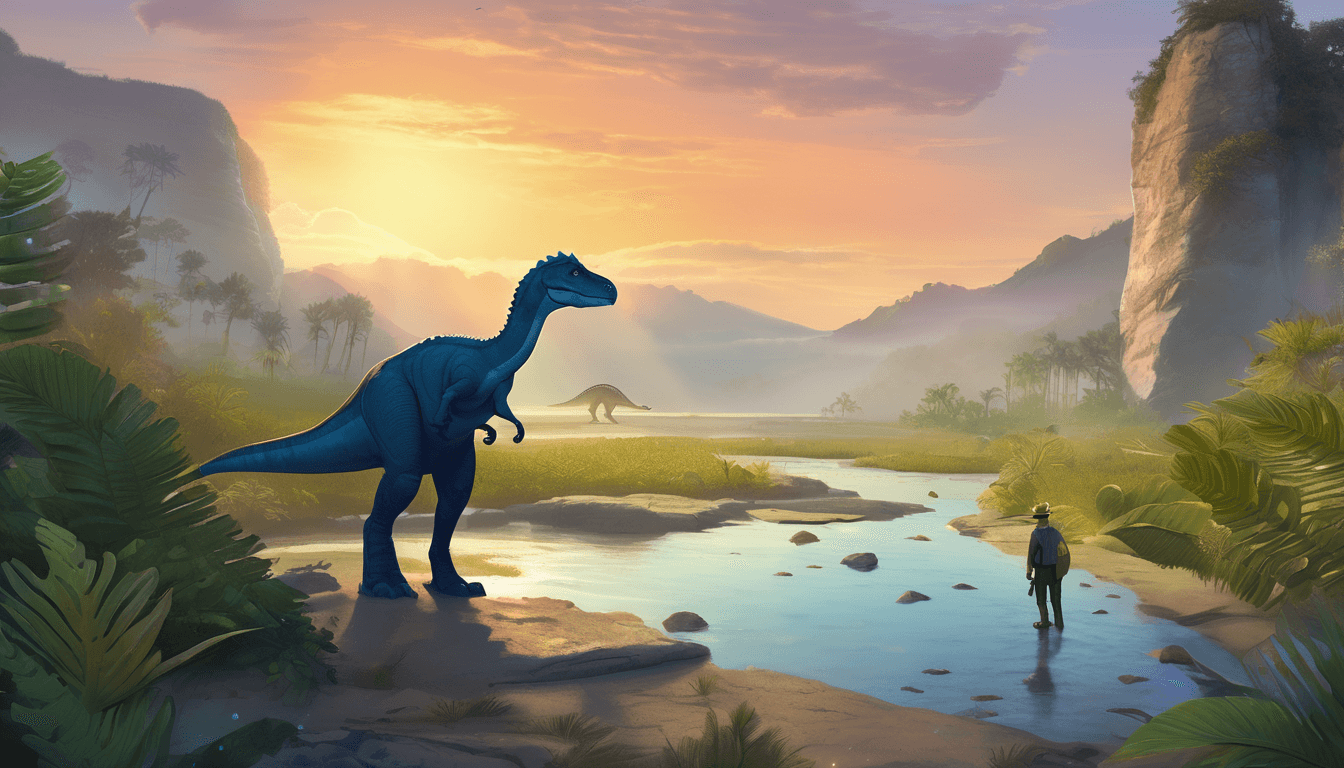
Behind the town was a wide, dry valley called the Sleeping Basin. Long ago, before there were houses or roads or even people, the basin had been the muddy shore of a vast lake. Dinosaurs had wandered there. Giant ferns had grown there. Strange insects had buzzed beneath trees with scaly trunks.
Now the lake was gone. In its place were sun-baked cliffs striped with layers of brown, gray, gold, and red.
Nadiya worked at the small Museum of Ancient Things with Professor Tomas, who had a round belly, a woolly white beard, and spectacles that always slid down his nose when he was excited.
One morning, Professor Tomas burst into the museum carrying a folded cloth.
“Nadiya,” he said, “a shepherd found something on the eastern ridge.”
“What kind of something?” Nadiya asked.
Professor Tomas opened the cloth.
Inside lay a large, smooth stone.
It was oval and bluish-gray, fitting perfectly into two hands. One side had a faint white stripe curling through it like a tiny river in a map.
“A stone?” Nadiya said.
“Not just any stone,” said the professor. “This kind comes from the River Veyra, far beyond the western hills. Yet it was found on the eastern ridge, where there has never been a river.”
Nadiya turned it over gently. It was polished as though it had been rolled by water for a very long time.
“How did it get there?”
“That,” said Professor Tomas, smiling, “is a fine question.”
By midmorning, Nadiya was climbing the eastern ridge with her small satchel. Inside were her notebook, magnifying lens, brush, ruler, little paper envelopes, and a lunch of cheese, figs, and a round bread roll.
Professor Tomas came behind her with larger tools, puffing cheerfully.
At the top of the ridge, the land opened wide beneath them. The Sleeping Basin stretched out in folds of pale rock. A hawk circled above. Dry grasses whispered around their ankles.
The shepherd had left a pile of white stones to mark the place.
Nadiya knelt beside it.
At first, all she saw was a slab of dusty rock tilted toward the sky.
Then she brushed away the loose grit.
Her breath caught.
There, pressed into the stone, was a footprint.
It had three broad toes, each ending in a rounded tip. The print was bigger than Nadiya’s whole hand.
“Dinosaur,” she whispered.
Professor Tomas crouched beside her. His spectacles slid down his nose.
“Indeed,” he said.
Nadiya brushed farther.
There was another footprint.
And another.
A trail crossed the rock shelf, curving gently toward a patch of crumbling yellow earth. The tracks were not deep and fierce, like the marks of an animal charging after prey. They were shallow, steady, and almost peaceful.
“Which dinosaur made them?” Nadiya asked.
“We can make a guess,” said Professor Tomas. “But first, we listen to what the ground is telling us.”
That was one of his favorite sayings. The ground cannot speak with a mouth, he often explained, but it leaves messages for patient people.
Nadiya measured the distance between the footprints. She drew each one in her notebook. She noticed that one print was slightly deeper on the outside edge.
“Could the dinosaur have been hurt?” she asked.
“Possibly,” said Professor Tomas. “Or perhaps it stepped on uneven mud. One clue is only one clue.”
So Nadiya kept looking.
Near the trail, she found small, round marks clustered in the stone. They looked like tiny bowls.
“Raindrops?” she guessed.
“Very likely. They fell into soft mud and dried before the next layer covered them.”
Nadiya pictured a rainy day long ago. She imagined raindrops plinking around a dinosaur’s feet.
Then, a little farther on, she found something else. Fine lines lay in the rock, wavy and thin. They were so delicate that she almost missed them.
“Plant stems?” she asked.
Professor Tomas nodded. “Perhaps. Let us collect a sample from that yellow earth nearby.”
Using a tiny trowel, Nadiya carefully loosened a bit of the crumbly earth. She put it into a paper envelope and wrote: Eastern Ridge, beside trackway, yellow layer.
The smooth blue-gray stone had been found in the same yellow layer.
Nadiya held it in her palm again.
“Maybe the dinosaur carried it,” she said.
Professor Tomas’s eyebrows rose.
“Why would it carry a stone?”
“Maybe it liked it.”
“That is not impossible,” he said. “Many animals pick up curious things. Crows collect shiny objects. Otters play with pebbles. But we must see what else we can learn.”
They worked until the sun stood high and bright. When they stopped for lunch, Nadiya sat under the thin shade of a juniper tree and ate her figs.
A lizard darted over a rock, paused, and flicked its tongue.
“What do you think the dinosaur was doing?” Nadiya asked.
Professor Tomas took a bite of bread.
“Perhaps it was crossing the lake shore. Perhaps it was looking for food. Perhaps it was meeting other dinosaurs. Perhaps it was simply going somewhere, as we are always doing.”
Nadiya liked that thought. A dinosaur did not have to be roaring or fighting or stomping through thunder. Maybe it had once been having an ordinary day.
Back at the museum, Nadiya and Professor Tomas examined the yellow earth.
They placed a pinch of it in water and swirled it gently. Heavy grains sank to the bottom. Tiny bits of old plant matter floated free.
Then they looked through a microscope.
Nadiya leaned close.
There were golden specks, spiky specks, round specks, and little grains shaped like three-pointed stars.
“Pollen,” she said.
“Yes,” said Professor Tomas. “Ancient pollen.”
Pollen was dust made by plants. It could be carried by wind, water, insects, feathers, fur, and feet. Some kinds lasted for millions of years, hidden in mud and stone.
Nadiya compared the grains to the museum’s pollen chart.
“These round ones came from conifers,” she said. “And these bumpy ones might be from water ferns.”
Professor Tomas clapped his hands once.
“So what does that suggest?”
“There were trees nearby,” Nadiya said slowly. “And wet places. Maybe the dinosaur walked by a pond or marsh.”
The next day they returned to the ridge, this time following the fossil footprints in the direction they pointed.
The trail vanished beneath a layer of rock, but Nadiya found another clue farther down the slope. There was a thin bed of dark, cracked mud. In it were many stems pressed flat, along with tiny shells from creatures that once lived in shallow water.
A pond had been there.
Not a huge lake, Nadiya thought. A quiet pond at the edge of a larger lake, with ferns in the shallows and conifer trees beyond.
She imagined the young dinosaur walking there.
In her mind, it was a plant-eater, about as tall as a pony at the shoulder, with a long neck, sturdy legs, and a tail held straight behind it for balance. Its skin was the color of mossy bark with lighter spots along its sides. It had a watchful eye and a soft, snuffling nose.
Nadiya named it, just for her notebook, Miro.
“Miro woke before sunrise,” she murmured, writing.
Professor Tomas looked over her shoulder.
“Are you writing a scientific report or a story?”
“Both,” said Nadiya.
Professor Tomas smiled. “The best scientists know where the facts end and the wondering begins.”
Nadiya thought about Miro’s morning.
Miro had slept among low trees near the River Veyra, far west of the Sleeping Basin. The river ran over smooth stones, singing and turning them under its clear water. Miro had eaten tender leaves there with its herd.
Perhaps, while drinking, Miro noticed one beautiful blue-gray stone at the river’s edge. It was cool against its tongue. Maybe it picked the stone up by accident with a mouthful of water plants. Maybe it carried it for a while, curious about its smoothness.
Or perhaps Miro swallowed it on purpose.
Some dinosaurs, like birds today, swallowed stones called gastroliths. The stones helped grind up tough leaves inside their bellies.
Nadiya’s eyes widened.
“The stone could have been in its stomach,” she said.
Professor Tomas nodded slowly. “That is a very good possibility.”
“But then how did it get onto the eastern ridge?”
“Ah,” said the professor. “Now we need to find out whether the river journey and the footprints happened at the same time.”
They studied the layers of rock.
The footprint layer lay just below the yellow pollen-rich earth. The smooth river stone had been buried in that yellow earth, close enough that it might have been dropped soon after Miro passed through the mud.
Nadiya looked at the trackway once more. It approached the pond. It slowed. The spaces between the prints became shorter.
“Miro was not running,” she said. “It was walking carefully.”
Near the end of the trackway, Nadiya found a shallow scooped shape in the mudstone. It was not exactly a footprint. It was a soft, curved dent, as if something large had rested there.
“Could that be where it sat down?” she asked.
“Or lay down,” said Professor Tomas.
Nadiya looked around. The fossil pond would have been a fine place to rest. There were ferns to eat, water to drink, and trees nearby for shade. The rain had recently stopped. Little puddles would have shone between the plants.
Miro may have wandered away from its herd for a short while. It may have heard the calls of tiny creatures in the reeds. It may have watched dragonflies skimming above the water.
And perhaps, while resting, it had brought up the smooth river stone.
Nadiya found no bones. No dinosaur skull. No great claw. Only the tracks, the pollen, the pond mud, and the blue-gray stone.
But when she placed the clues together, a day began to appear.
A young plant-eating dinosaur had come from the west, perhaps traveling with a herd along a path between water places. It had carried a river stone from far away, likely in its stomach. On a damp morning, after rain, it had reached a ferny pond near the great lake. It had slowed to drink and eat. It had rested in the soft mud. Then it had continued on, leaving its tracks to dry in the sun.
A little later, the pond water rose or mud slid gently over the prints. Pollen drifted down from trees and ferns. Fine earth covered the stone. Layer upon layer built up over millions of years.
Until Nadiya found the messages waiting in the rock.
That evening, the museum held a small gathering. The shepherd came. So did the baker, the schoolchildren, and old Señora Amina, who knew every bird in the valley by its song.
Nadiya stood beside the display case. Inside were photographs of the footprints, a drawing of the ancient pond, and the smooth blue-gray stone.
She felt nervous at first. Her voice was small.
But then she looked at the stone and remembered the river that had once polished it.
“This dinosaur did not leave us a name,” Nadiya told everyone. “It did not leave us a diary. It only left little things. A few steps in mud. Pollen from plants growing nearby. A stone from a faraway river.”
The children leaned closer.
“And from those little things,” Nadiya continued, “we can discover part of its ordinary day.”
The baker raised his hand. “Do you think the dinosaur knew the stone was special?”
Nadiya considered.
“I think,” she said, “that the stone was special because it traveled such a long way. And because it helped us listen.”
That night, after the museum was closed and the town windows glowed softly beneath the hills, Nadiya walked home.
The moon hung over the Sleeping Basin, pale and round.
She imagined the ancient pond, silver under another moon long, long ago. She imagined Miro walking quietly through wet ferns, leaving one careful footprint after another.
Not every important discovery, Nadiya thought, came with a roar.
Sometimes it came as a smooth stone in your hand.
Sometimes it came as a speck of pollen no bigger than dust.
Sometimes it came as an old footprint, waiting patiently beneath the sky.
And when Nadiya climbed into bed, she placed her notebook on the table beside her. On its last page, she wrote:
Today I learned that even an ordinary day can last forever, if the earth remembers it.
Then she closed her eyes.
Outside, the dry grasses whispered on the hills.
And far below the stars, the ancient footprints rested safely in the stone, keeping their gentle secret until morning.


Leave a Reply