
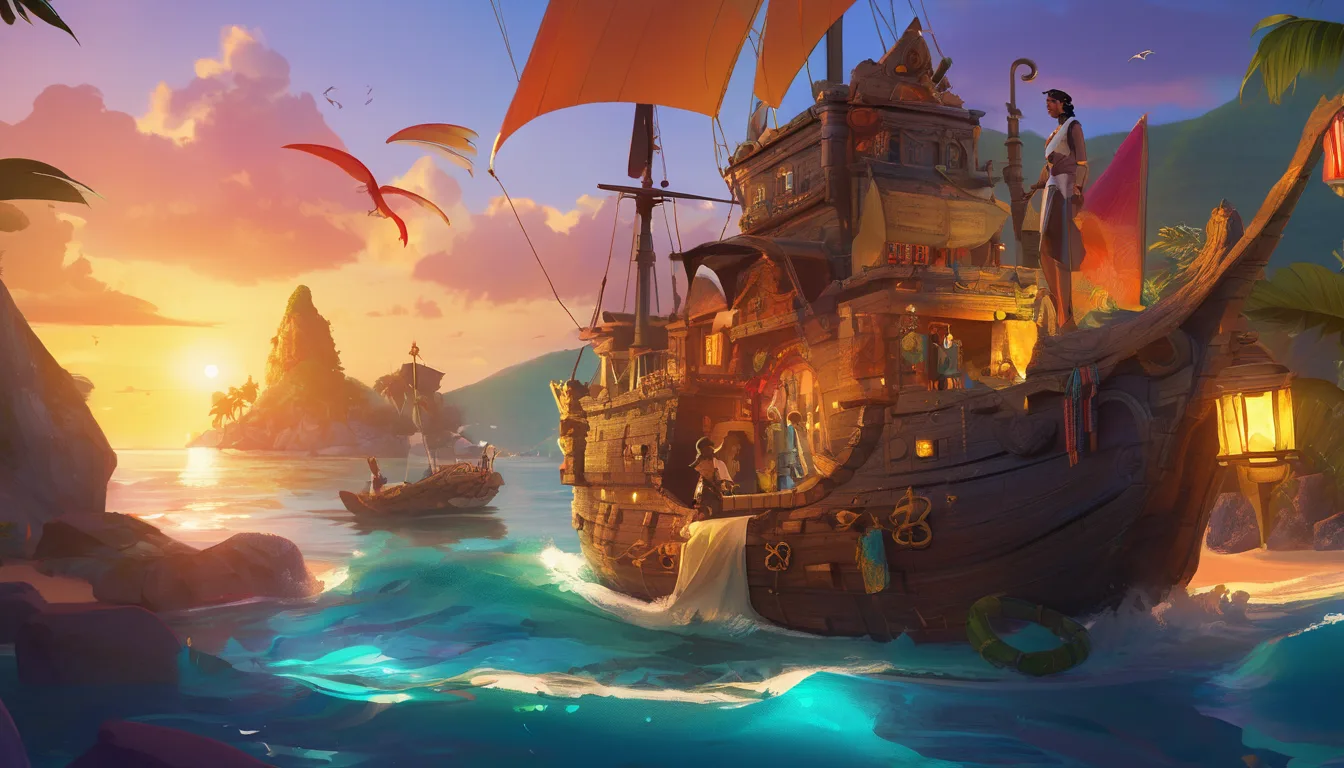
On the quiet island of Sereva, where orange trees grew beside old stone towers, there lived a pirate archaeologist named Captain Nadiya Bell.
Captain Nadiya had a bright blue coat with brass buttons, a weather-soft hat, and a small silver telescope that had belonged to her grandmother. She was a pirate, yes, but not the kind who stole jewels or frightened sailors.
“Oh, no,” she would say, polishing a shell with the corner of her sleeve. “The finest treasure is a story that has been lost.”
She sailed aboard a little green ship called the Turnip Moon. Its sails were patched in yellow, its deck smelled of cinnamon tea, and its figurehead was carved like a sleepy sea turtle.
Captain Nadiya traveled from island to island searching for clues from long ago. Broken cups, buttons in the sand, carvings on cave walls, rusty anchors, old maps, and sometimes even tiny messages tucked inside bottles.
One evening, when the sea was as smooth as polished glass, Nadiya and her crew spotted something strange.
Far beyond the reefs, where silver moonlight touched the waves, rose the curved ribs of a great wooden ship.
It was stuck in a shallow blue lagoon.
“Shipwreck!” called Kaito, the Turnip Moon’s cook, who was holding a ladle in one hand and a spyglass in the other.
“Not just any shipwreck,” whispered Nadiya.
She leaned over the rail.
The old ship was enormous. Barnacles clung to its sides like knobbly white buttons. Sea grass curled through holes in its deck. Little fish swam in and out of its broken windows.
But what made Captain Nadiya gasp was the ship’s shape.
Its front was carved like a dragon with curling whiskers. Its sides were painted with faded red-and-gold flowers. Its tall back wall had tiny blue tiles, each decorated with a white star. The wooden boards were not all alike. Some were pale and smooth. Some were dark and shiny. Some were striped with golden resin.
“This ship was built from many places,” Nadiya said softly.
The crew lowered the rowboat.
With careful oars, they glided across the lagoon. The water was so clear that they could see purple clams resting in the sand below. A shy stingray flapped past like a floating gray blanket.
When they reached the old vessel, Captain Nadiya climbed aboard.
The deck gave a low creak.
“Thank you for holding us,” she told the ship.
That was an archaeologist’s first rule. Be gentle with old things. They had been waiting a long time to speak.
All night, under the lantern light, the crew searched carefully.
Kaito found a bowl made of creamy white porcelain. Painted on it were cranes flying over mountains.
Mirela, the mapmaker, found a small glass bead. It was bright turquoise, the color of tropical shallows.
Bashir, the ship’s carpenter, found a brass coin stamped with a lion and a crescent moon.
Captain Nadiya found something most curious of all.
Tucked beneath a loose floorboard was a smooth black stone marked with tiny pictures.
There was a river.
There was a mountain.
There was a star.
There was a little ship.
And beside the ship were six marks, like the six petals of a flower.
“It is not a map exactly,” Nadiya said. “It may be a memory.”
The next morning, the Turnip Moon sailed back to Sereva with the clues carefully wrapped in cloth. Captain Nadiya spread them out on a long table in the island library.
The library was built inside an old lighthouse. Books curled around its round walls from floor to ceiling. A gentle cat named Toma slept beside the fireplace, though he opened one eye whenever someone unwrapped anything crinkly.
Nadiya invited wise people from all over the island.
There came Auntie Sora, who knew old songs.
There came Farid the glassblower, whose family had made blue beads for generations.
There came Grandmother Inez, who could tell what kind of wood a chair was made from just by tapping it twice.
And there came a group of children, because Captain Nadiya believed children were especially good at noticing things adults missed.
The children gathered close.
“What do you think?” Nadiya asked.
A little boy named Omari pointed to the white bowl. “Those birds look like the birds on the paper fans at my aunt’s house.”
“They do indeed,” said Auntie Sora. “This bowl may have come from the Eastern Isles, beyond the misty sea.”
A girl named Zeynep held up the turquoise bead. “My uncle has beads like that sewn onto his festival vest.”
Farid nodded. “Glass like this was made in sunny desert workshops, where fire glows day and night.”
Grandmother Inez tapped one of the wooden boards. Tok, tok.
“This dark wood grew in rain forests,” she said. “And this pale one grew in colder lands. This ship was repaired many times.”
Captain Nadiya’s eyes sparkled.
“A ship with boards from forests, tiles from warm cities, bowls from far islands, beads from desert workshops, and coins from busy ports,” she said. “Perhaps it did not belong to only one people.”
“Perhaps,” said Omari, “it belonged to everyone who helped it.”
The lighthouse became very quiet.
Even Toma the cat opened both eyes.
“Yes,” Captain Nadiya said at last. “I think you have found the first piece of its story.”
For many days, Nadiya followed the clues.
The little pictures on the black stone showed a river, so she sailed up a wide brown river where pink dolphins bobbed near the banks. In a riverside village, an old fisherwoman saw the stone and smiled.
“My grandfather spoke of this,” she said. “A sailing ship came here long ago. The sailors traded salt, cloth, and a box of beautiful seeds. In return, our people taught them how to read the river currents.”
“What did the ship look like?” asked Nadiya.
“It had a dragon at its bow,” said the fisherwoman. “But someone had painted flowers around its eyes.”
The next picture showed a mountain.
So the Turnip Moon crossed a windy sea to a harbor beneath snowy peaks. There, bells chimed from rooftops, and people carried baskets of peaches through narrow streets.
A bellmaker named Luka examined the brass coin.
“This coin was used here many years ago,” he said. “But look closely. It has a hole near the edge.”
“A hole?” said Mirela.
Luka smiled. “Sailors made holes in old coins to string them together. They wore them as lucky charms when crossing dangerous waters.”
He brought them to the bell tower, where a huge bronze bell hung overhead.
Inside the bell was scratched a small picture of a ship.
A dragon-headed ship with painted flowers.
Next to it were words in several different languages.
Captain Nadiya could read only some of them. But the children in the town helped with the rest.
Together, they discovered what the words said:
We came as strangers.
We left as friends.
The sea is wide enough for every song.
Captain Nadiya copied the message into her notebook.
At the last picture on the black stone, there was a star.
Mirela studied the six petal-like marks near the ship. “They are not flower petals,” she said.
“What are they?” asked Kaito.
“Six different stars,” she replied. “A sailor’s sky chart.”
That night they sailed out beneath a deep velvet sky. Mirela pointed to six bright stars arranged around the moon.
“The old ship followed these,” she said. “They lead to the Whispering Passage.”
The Whispering Passage was a narrow stretch of sea between tall black cliffs. Waves rushed through it with a hush and a shiver, making sounds like a thousand people talking very softly.
Captain Nadiya guided the Turnip Moon into the passage.
Then a sudden fog rolled over the water.
The crew could not see the cliffs.
They could not see the stars.
They could barely see the tip of the green ship’s own nose.
Kaito gripped his ladle. “Perhaps we should turn back.”
But Captain Nadiya listened.
Under the whispering of wind and water, she heard another sound.
Tap. Tap-tap. Tap.
Bashir heard it too. “Wood knocking against wood.”
They drifted toward the sound and found a line of old wooden posts rising from the sea. On each post was a carving.
A bird.
A crescent.
A wave.
A flower.
A mountain.
A star.
The same signs from their clues.
“These are markers,” said Nadiya. “Someone placed them here to help ships pass safely through the fog.”
The Turnip Moon followed the posts, one by one, until they came out into clear moonlight.
On the other side of the passage lay a hidden bay.
And in the bay stood an island unlike any Captain Nadiya had ever seen.
Its harbor had docks built in many styles. Its houses had round windows, pointed roofs, tiled courtyards, and colorful shutters. In the market, people baked flatbread, steamed buns, sweet coconut cakes, and cinnamon pastries. Music floated from every corner, with drums, flutes, strings, bells, and voices all playing together.
At the center of the island was a small museum.
Above its door was a picture of a dragon-headed ship with flowers around its eyes.
An old curator named Señora Amara welcomed them inside.
“You found the ship,” she said, before Captain Nadiya had even spoken.
“You knew about it?” Nadiya asked.
“We have been hoping someone would find it with care,” said Señora Amara.
She led them to a large painting.
The painting showed the old ship when it was new.
It had first been built by boatmakers from the Eastern Isles. Then a storm damaged it near the desert coast, where glassworkers gave it bright blue beads for good luck. In the mountain harbor, bellmakers repaired its metal fittings. Along the river, fishermen showed its crew safe paths through shifting waters. In tropical forests, carpenters replaced its broken boards with strong dark wood.
And everywhere it traveled, people added something small.
A tile.
A carving.
A song.
A recipe.
A new way to tie a rope.
A word for rain.
A word for home.
“The ship carried spices and stories,” said Señora Amara. “But its greatest cargo was kindness. It helped people who did not know one another become neighbors across the sea.”
Captain Nadiya looked at the painting for a long time.
Then she looked at her crew.
“We must not take the ship apart,” she said. “We must keep its story together.”
So Captain Nadiya returned to the lagoon, not with treasure hunters, but with builders, divers, historians, artists, and children from many islands.
Very slowly, gently, they lifted loose boards and cleaned away sea grass. They did not make the ship look brand new. Its scratches, patches, and mismatched pieces were important. They told where it had been.
The dragon’s wooden face was mended, but the painted flowers stayed faded, just as they were.
The blue tiles were placed back on the stern.
The white bowl, turquoise bead, brass coin, and black stone were kept in a little cabin on board.
And beside each object, Captain Nadiya wrote a small card:
This came from someone far away.
This was given, shared, repaired, or carried.
This is part of the journey.
When the work was finished, the old ship rested safely in the harbor of Sereva, under a roof of glass that let sunshine and starlight pour in.
People came from all over to see it.
They did not call it the Dragon Ship, though it had a dragon.
They did not call it the Flower Ship, though flowers curled along its bow.
They called it the Many-Homes.
At night, when the museum was closed and the harbor lamps glowed golden on the water, Captain Nadiya would sit on the deck of the Turnip Moon with a cup of cinnamon tea.
Sometimes she thought she could hear the Many-Homes creaking softly nearby.
Not a sad creak.
A happy one.
Like an old ship dreaming of rivers and mountains, of stars and markets, of hands passing bread across a table, and strangers becoming friends.
Captain Nadiya would tip her hat toward it.
“Rest well,” she would whisper.
And the sea, wide and shining under the moon, would whisper back.
There is room.
There is room.
There is room for every story.



Leave a Reply