
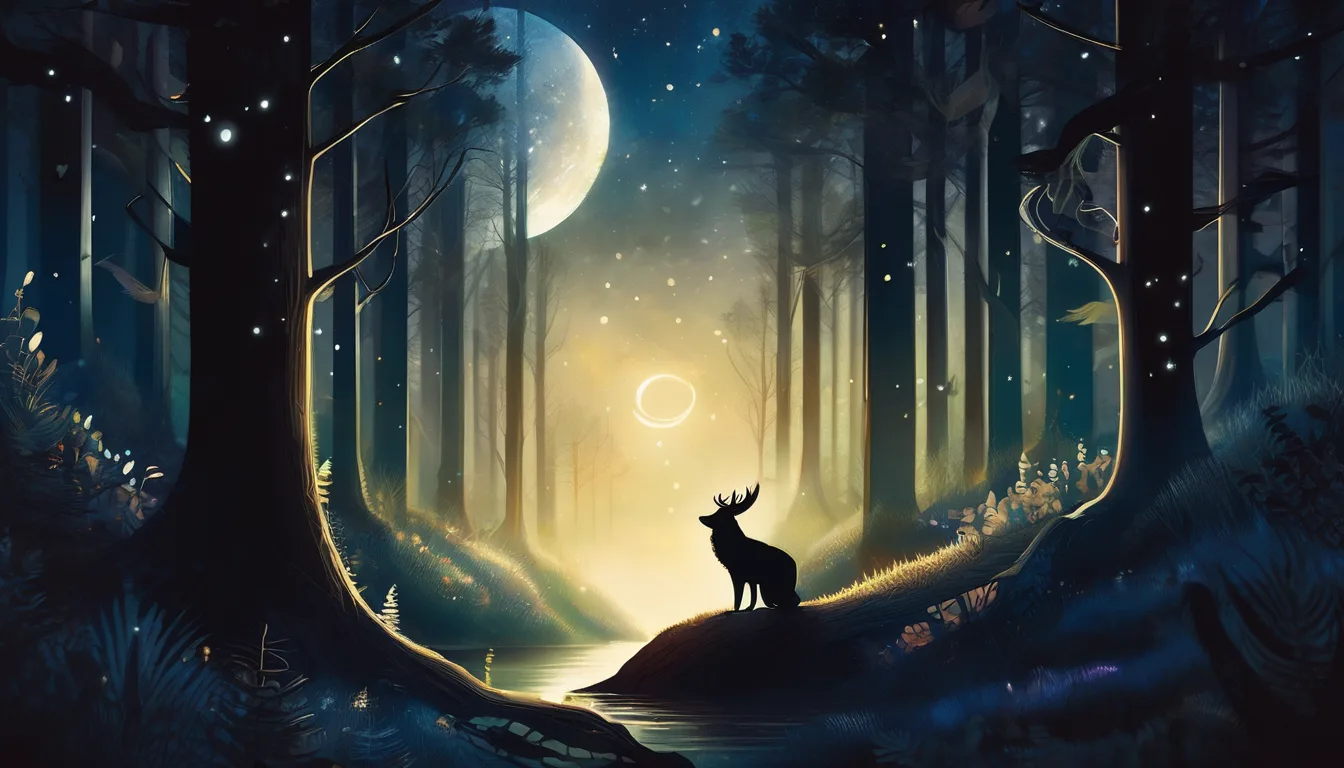
In a valley wrapped in silver mist, where the stars seemed to hang just above the treetops, there stood a quiet little kingdom named Lumeria. The castle of Lumeria was not tall and frightening. It was wide and gentle, with round towers, blue roofs, and windows that shone like sleepy eyes at night. Around it, rivers curved like shining ribbons, and forests whispered secrets to the moon.
In this castle lived a young princess named Elara. She had dark, curly hair that always seemed to escape its ribbons, and eyes the color of morning dew. Elara loved three things more than anything else: the sound of crickets at dusk, the smell of bread baking in the royal kitchen, and the feeling of cool grass under her bare feet.
Elara was not like the princesses in the old painted tapestries on the castle walls. Those princesses stood still and serious, holding golden cups or wearing heavy crowns. Elara preferred to run through the garden, climb low branches, and listen to every tiny sound the world made. She loved sounds. She collected them in her mind like other children collected stones.
At night, when the kingdom grew quiet, Elara would sit on her balcony and hum soft little tunes. She did not think much of her voice. To her, it was just something that followed her heart when it felt too full. Sometimes her songs were gentle and slow. Sometimes they were playful and quick, like dragonflies over a pond. She sang mostly for herself, and for the moon, and for the shadows that listened.
But one night, something changed.
It was late, and the castle had fallen into its deep, comforting silence. The cooks had banked the fires, the guards walked their slow circles, and the king and queen were already dreaming. Elara sat in her favorite place, on the stone ledge of her balcony, wrapped in a soft green cloak. The air smelled like pine needles and cool water.
She was humming a tune she had never heard before. It rose and fell like a bird gliding over hills. As she hummed, she closed her eyes and felt the sound move through her chest and up into the sky. The melody curled around the towers, slipped between the leaves, and floated over the dark fields.
Far away, at the edge of the Mistwood Forest, a tiny silver moth fluttered in confusion. The moonlight was hidden behind a thick cloud, and the paths it usually followed were swallowed by shadow. It had flown too far, chasing a spark of light, and now it did not know the way back to its hollow tree.
Its delicate wings trembled. The night felt too big, too empty. Then, through the dark, a sound reached it. Soft at first, like a memory. A humming, gentle and warm. The moth turned its tiny head toward the sound. It felt a tug inside, a quiet pull, as if someone had lit a candle in the middle of the sky.
The moth followed.
It fluttered over rocks and around tall ferns, guided by the tune that seemed to grow brighter with every beat of its wings. The melody wrapped around the moth like a soft scarf, promising warmth and safety. Soon, the forest thinned, and the moth saw the familiar outline of its hollow tree, glowing faintly with moonlight.
The little creature slipped inside, tucked its wings, and fell into a peaceful sleep. Outside, the last notes of Elara’s humming drifted away into the night.
Back at the castle, Elara did not know any of this had happened. She yawned, wrapped her cloak tighter, and went to bed, her song still echoing faintly in her dreams.
The next morning, the kingdom woke to birdsong and the clatter of wooden wheels on cobblestones. Elara’s day began as usual. There were lessons in reading scrolls, in drawing maps, and in the history of Lumeria. Her tutor, a kind old woman named Madame Vesna, spoke in a slow, careful voice that made the candles flicker with boredom.
Elara tried to listen, but her thoughts kept slipping away like fish in a pond. She wondered what the forest looked like at dawn, how the river sounded when no one else was listening, and if the clouds ever wanted to touch the ground. When lessons were finally done, Elara ran to the gardens, kicking off her slippers the moment she reached the soft grass.
The royal gardener, a tall man named Rafi with gentle hands and a laugh that sounded like wind chimes, waved to her. He was planting small purple flowers in a neat row. Elara knelt beside him, sniffed one of the blossoms, and smiled at the sweet, peppery scent.
“Princess Elara,” Rafi said, brushing soil from his fingers, “did you hear the owls last night? They were restless. Hooting and calling for a long time.”
Elara shook her head. “I was humming,” she answered. “Maybe I did not notice.”
Rafi tilted his head. “Humming, hmm? Perhaps your song kept them company.”
Elara laughed and chased a ladybug across a leaf. The idea that her simple humming could matter to anyone felt silly. Songs were just shapes in the air, here for a moment, then gone.
But that night, the air felt different.
Clouds rolled in early, thick and heavy, hiding the stars. The moon was only a faint round blur, like a coin under a cloth. The wind carried a strange smell, half rain and half something lonely. Elara sat on her balcony again, pulling her cloak tight against the chill.
She listened.
The castle creaked and sighed. A horse stomped in the stable. Somewhere, the kitchen cat knocked over a pot. Then, beyond all that, she heard it. A sound that did not belong to the castle at all. It was small and thin, like a thread pulled too tight. A cry.
Elara stood up. The sound came again, a tiny, shaking whine. It seemed to drift from the direction of the northern fields, where the grass grew tall and the fog often slept. Her heart squeezed. Something was lost.
Without thinking, Elara began to hum.
This time, the song rose from her throat like a bright ribbon. It was not a tune she knew. It shaped itself as she listened to that faraway cry. Her voice grew round and warm, like a lantern held up in a dark hallway. The notes reached out and stretched over the fields, over the fences, and into the mist.
Out in the northern fields, a young fox with copper fur and white-tipped ears stumbled through the grass. His name was Ivar, though no human knew it. The fog had rolled in suddenly, swallowing the familiar scents and shapes of the land. He had been chasing fireflies, leaping and spinning, when he realized he could no longer see the line of trees that marked the way back to his den.
He called once, twice, three times, but the fog swallowed his voice. His paws were damp and cold. His heart beat too fast.
Then a strange thing happened. The fog seemed to tremble. A sound slipped through it, soft and clear. A humming, rising and falling like the movement of tall grass in the wind. Ivar lifted his head. The sound wrapped around him, gentle and sure.
He took one step, then another, following the music.
Every time he hesitated, the song grew a little stronger, guiding him left or right. The fog thinned. The sharp scent of pine reached his nose. He knew that smell. The old pine tree beside his den. With a small yip of joy, Ivar ran forward. The fog broke apart, and there it was, his home, snug between two rocks, with the pine’s roots curled around it like a giant’s fingers.
Ivar slipped inside, curled into a ball, and listened as the humming slowly faded. His last waking thought was that the night was not as empty as he had once believed.
Back in the castle, Elara’s song came to a gentle end. Her throat felt warm, her chest calm. The strange, faraway cry had gone silent. She did not know why, but she felt sure that somewhere, something had found its way again.
She went to bed with a quiet smile.
Days passed, and the nights grew stranger.
Sometimes Elara would wake in the middle of her sleep, her heart beating fast, a chill on her arms. She would hear a faint whimper, a confused hoot, or the frightened rustle of wings. Each time, without planning it, she would climb from her bed, go to the balcony, and sing.
Her voice changed with each call she answered. For a lost bird, it fluttered and dipped. For a wandering deer, it stretched long and slow, like a path through the trees. For a tiny mouse, it became soft and close, like a whisper just beside the ear.
Word spread, though not among the humans at first.
In the roots and branches, in burrows and nests, the creatures of Lumeria began to speak of the Night Voice. They did not know she was a princess. They only knew that when the world turned confusing and shadows swallowed their paths, a song would find them. A song that felt like home.
A hedgehog named Mirela told her children, “Do not fear if you wander too far. Listen for the warm song. Follow it, and you will find your way.”
An old owl named Bram, whose feathers were now more gray than brown, hooted to the younger owls, “There is a singer in the sky. Respect the night, and she will guide you.”
Even the wind, which loved to play tricks and chase leaves in circles, began to carry Elara’s songs more carefully, as if it understood their purpose.
Inside the castle, Elara began to notice little signs that something was different. Birds gathered on her windowsill in the mornings, more than before, watching her with bright, curious eyes. Fireflies hovered near her when she walked in the gardens at dusk, their lights pulsing in quiet rhythm with her steps.
One afternoon, as she sat under a willow tree, humming to herself while braiding long grass, Madame Vesna approached with a thoughtful look.
“Princess,” the tutor said, lowering herself onto the bench with a soft grunt, “the guards tell me you have been waking at night. Walking to your balcony.”
Elara’s fingers paused. “I listen,” she answered slowly. “And sometimes I sing.”
Madame Vesna’s eyes, faded but sharp, studied her face. “Do you know why?”
Elara hesitated. She thought of the moth, the fox, the deer, the mouse. She had never seen them find their way, but she had felt something each time. A small, steady click inside, like a puzzle piece sliding into place.
“I think,” Elara said at last, “someone needs help. And my voice knows the path, even when I do not.”
Madame Vesna did not laugh. She did not tell Elara it was only dreams. She simply nodded, very slowly. “There are gifts that cannot be measured by scrolls or weighed by crowns,” she murmured. “Listen carefully, child. But also, rest when you can.”
One night, as autumn brushed the leaves with gold, the kingdom faced a storm like none it had seen in many years.
Clouds rolled in black and heavy, filling the sky from edge to edge. The wind howled around the towers, rattling shutters and bending tree branches low. Lightning scratched bright, jagged lines across the darkness, and thunder followed with a deep growl that made the stone walls shudder.
Elara could not sleep. The storm felt too loud, too wild, as if the sky itself had lost its way. She wrapped a blanket around her shoulders and stepped onto the balcony. Rain whipped against her face, cool and sharp. She could barely see the far fields through the curtain of water.
Then, cutting through the roar of the storm, she heard it. Not one voice, but many. Panicked bleats, frightened whinnies, the high, thin cry of something very small and very scared. The sound came from all directions at once. Creatures all across the valley were confused, their familiar paths washed away by the rain, their scents torn apart by the wind.
Elara’s heart pounded. This was not like the other nights. This was bigger. She took a deep breath. The air tasted like iron and wet stone.
She began to sing.
At first, the wind tried to snatch her song away. It tore at the notes, twisting them into strange shapes. But Elara closed her eyes and planted her feet firmly. She felt the stone beneath her, solid and steady. She thought of every creature she had ever helped, even without knowing their names. She thought of their tiny hearts, their eyes wide with fear, their paws and hooves slipping in the mud.
Her voice grew stronger.
The song that poured from her now was not a small, simple tune. It was wide and deep. It rolled over the valley like a river of sound. It rose above the thunder, slipped between the raindrops, and glowed faintly in the dark.
Out in the storm, a flock of swallows fought the wind, their wings aching. They heard the song and turned, gliding with the notes until they reached the safe shelter of the castle eaves.
In a flooded ditch, a family of rabbits shivered, water licking at their fur. The melody found them, wrapped around them, and led them hopping, slipping, but moving, toward a dry burrow beneath an old stone wall.
A young foal, separated from its mother, stumbled through the field, blinded by rain. Its small legs shook. Then a thread of music reached its ears, soft but sure. The foal lifted its head and followed, step by muddy step, until the warm shape of its mother appeared through the downpour.
On and on Elara sang.
Her throat burned. Her lungs ached. Her blanket grew heavy with rain, clinging to her shoulders. Still she sang, because somewhere out there, someone was still lost. She could feel it. A tiny flicker of fear, far away, like a candle struggling in the wind.
At the very edge of the valley, where the land rose into rocky hills, a little dragon crouched beneath an outcropping of stone. He was no bigger than a pony, with shimmering green scales and small, new wings that had not yet learned to carry him far. His name was Taro. He had flown out, proud and excited, to chase the lightning, thinking it was a game. But the storm had grown fierce, and the clouds had swallowed the shapes of the mountains he knew.
Now he shivered, rain dripping from his horns, smoke puffing nervously from his nostrils. Dragons were supposed to be brave. That was what his grandmother always said. But Taro did not feel brave. He felt very young and very lost.
Then, through the crash of thunder, he heard it. A sound unlike any he had ever known. It was not the rumble of dragons, not the sharp caw of crows, not the whistle of wind through rocks. It was a voice, high and clear, glowing like a lantern in his mind.
He lifted his head. The song flowed around him, warm and steady. It did not scold. It did not laugh. It simply called.
Taro stepped out from under the stone, into the rain. Each time he turned the wrong way, the song seemed to dim, and when he turned back, it brightened again. Slowly, carefully, he followed it. Down the slippery slope, across the swollen stream, through the curtain of wet branches.
At last, the storm began to soften. The thunder rolled farther away. The lightning drew thinner lines. Taro blinked through the fading rain and saw, below him, the valley of Lumeria, shining with wet grass and tiny lights in the windows.
He did not know this place. Dragons usually stayed in the high mountains. But the song led him onward, gentle and sure, until he reached a sheltered cave in the side of a hill. It smelled of dry leaves and old stone. Safe.
Inside, Taro curled up, his scales still dripping. As he closed his eyes, the last notes of the princess’s song brushed his ears like a soft hand.
Back in the castle, Elara’s voice finally fell silent. Her knees shook. She had to grip the balcony rail to stay upright. The storm was nearly gone now, leaving behind the soft patter of light rain and the sweet smell of wet earth.
Down in the courtyard, the stable hands were calming the horses. In the fields, farmers were counting their sheep. In burrows, nests, and hollows, creatures were settling, hearts slowing, eyes drifting shut.
Elara staggered back into her room and sat on the edge of her bed. Her ears still rang with echoes of her own song. She felt tired, but also peaceful, like a lamp that had burned bright and now glowed softly.
The next morning, the sun rose bright and clean over the washed valley. Puddles sparkled like tiny lakes. The air felt new. The king and queen walked through the castle, checking on everyone, making sure no one had been hurt in the storm.
When they reached Elara’s room, they found her sitting by the window, a cup of honey tea beside her, her hair still damp from the rain that had blown in the night before.
“Elara,” the queen said, concern in her gentle voice, “the guards told us you were on the balcony through the worst of the storm. You could have caught a chill.”
Elara looked up at her parents. Their crowns were simple, their faces lined with kindness and worry. She hesitated, then spoke.
“I heard them,” she said. “All of them. The lambs, the foal, the birds, and even someone very far away. They were lost. So I sang until they were not.”
The king and queen exchanged a quick glance. The king knelt beside his daughter. His hands were rough from years of holding reins and tools as much as scepters.
“Little star,” he said softly, “what do you mean, you heard them?”
Elara pressed a hand to her chest. “Not with my ears,” she tried to explain. “With this. It is like… like a tug. A tiny string that pulls when someone cannot find the way. And when I sing, the string becomes a path.”
The queen reached out and smoothed a curl from Elara’s forehead. “Has this been happening often?” she asked, her eyes searching.
Elara nodded. “Since the night of the moth, I think. Or maybe before, and I just did not notice.”
The queen did not laugh. The king did not frown. They both sat very still for a long moment. Then the queen said, “There are stories, very old ones, of those who can hear what others cannot. They say that long ago, before the first tower was built, there was a woman who sang the rivers into their beds and guided the birds in their journeys.”
The king added, “Such gifts are rare, and they belong as much to the land as to the person. If your voice can guide the lost, then it is a gift for all of Lumeria, not just for this castle.”
Elara’s cheeks warmed. “But I am only me,” she whispered.
The queen smiled gently. “You are you. And that is exactly who this gift chose.”
From that day on, Elara’s nights were watched more carefully. A warm cloak was always folded at the end of her bed. A lantern was kept ready, though she rarely needed it. Madame Vesna made sure she napped in the afternoons, so her strength would not fade. Rafi the gardener planted soft moss on the balcony floor, so her bare feet would not grow cold when she stepped outside to sing.
The kingdom slowly learned of the Night Voice. Farmers spoke of how their animals returned safely after storms. Children whispered of a song that could be heard when they were scared and alone. No one knew exactly where the voice came from, though a few guessed. But Elara did not stand in the great hall and announce it. The magic of it felt too tender for trumpets and banners.
One evening, as winter crept closer and frost painted the windows with silver feathers, Elara heard a different kind of call.
It was not full of panic. It was heavy, like a stone resting at the bottom of a pond. Sad. Lonely. It came from the forest, from deep among the oldest trees, where the light rarely touched the ground.
Elara wrapped herself in a thick cloak and stepped out onto the balcony. The sky was clear, sharp with stars. Her breath made little clouds that vanished quickly. She closed her eyes and listened to that faraway sadness.
Then she began to sing.
Her voice started low and soft, like the first glow of dawn behind the hills. It carried a promise, not of quick rescue, but of company. Of not being alone.
In the heart of the forest, under the roots of a giant oak, an ancient badger named Odetta lay awake. Her joints ached. Her eyes were cloudy. She had lived through many winters. Her children had grown and left long ago. She did not fear being lost. She feared being forgotten.
The song reached her like a memory of her mother’s warmth. It slipped through the cracks in the earth, brushed her whiskers, and filled her den with a gentle light only she could see.
Odetta closed her eyes. “Ah,” she murmured, “someone still sings for me.”
The melody did not guide her to a new place. It guided her gently inward, to the quiet place inside where her stories lived. She remembered every path she had ever walked, every berry bush, every hidden spring. She realized that none of it was truly gone, not as long as she remembered, and as long as someone, somewhere, sang in the night.
When Elara’s song finished, she felt tears on her cheeks. Not from sadness, but from something deep and old that she did not have words for. She pressed her hand to her heart and whispered into the cold air, “You are not alone.”
One night, not long after the first snow had dusted the rooftops, a visitor came to the castle. Not by road, not by gate, but by sky.
Elara had just finished guiding a flock of geese, who had lost their way in a sudden swirl of winter wind, when she heard a soft thump on the roof above her balcony. Then another. And a small slide of claws on slate.
She looked up.
A pair of bright, green-gold eyes peered over the edge of the roof. Then a snout. Then a head, crowned with two short, curved horns. Finally, with a careful wiggle, the rest of the little dragon pulled into view and settled on the balcony rail, his tail curling around it for balance.
Elara gasped, but not in fear. The dragon was beautiful. His scales shimmered between green and blue, like leaves under water. His wings were folded tight, and a tiny puff of smoke escaped his nostrils when he exhaled.
“Hello,” Elara said softly, so as not to startle him. “Are you lost?”
The dragon shook his head. His voice, when it came, was scratchy but clear. “Not this time,” he said. “This time I followed the song on purpose.”
Elara’s eyes widened. “You can speak,” she whispered.
He tilted his head. “So can you.”
She laughed, a quick, surprised sound. “I mean, you speak like I do. Not like the fox, or the birds, or the rabbits in my dreams. Your words are like mine.”
The dragon’s chest swelled a little with pride. “My name is Taro,” he said. “You helped me in the storm. I wanted to see who the sky singer was.”
Elara’s heart fluttered. “I am Elara,” she said. “I did not know dragons lived so close.”
“We usually stay in the high mountains,” Taro replied, glancing toward the distant peaks, now dusted with snow. “My grandmother says the valleys belong to humans and to the small ones. But I was lost, and your song did not care who I was. It just cared that I needed a way home.”
He looked at her for a long moment. “Why do you do it?” he asked. “It must be tiring.”
Elara thought of the nights she had stayed awake, of the ache in her throat, of the heavy sleep that came with the sunrise. She also thought of the moth, the fox, the foal, the rabbits, the badger, the geese, the countless others whose names she did not know.
“Because being lost feels bigger than the world,” she said quietly. “If I can make it feel smaller, just for a little while, then the tired is worth it.”
Taro’s eyes softened. “Dragons are supposed to guide, too,” he said. “We remember old paths in the mountains. We show the wind which way to blow when it forgets. Maybe that is why I heard your song so clearly. We are both… path keepers.”
Elara liked that. Path keepers. It felt true.
From that night on, Taro visited whenever the sky was clear enough for him to fly. Sometimes he came just to curl on the balcony rail and listen to Elara’s songs. Sometimes he brought news from the mountains. He told her of hidden lakes that reflected the stars, of caves filled with crystals that chimed softly when the earth moved, and of long, narrow paths where even dragons had to walk carefully.
In return, Elara told him of the valley. Of the way the river changed color in different seasons. Of the secret patch of wild strawberries in Rafi’s garden. Of the way the town bells sounded on the first day of spring.
They became friends, bound by stories and by the quiet understanding of those who listen very carefully to the world.
As winters and summers passed, Elara grew taller. Her hair grew longer, her voice richer. Children in the kingdom who had once been rocked to sleep by her unseen songs now ran through the fields, telling their own children of the Night Voice. Some called her the Star Singer. Others simply said, “There is someone who listens when you are lost. Do not be afraid.”
One evening, when the sky was painted with orange and rose, the king and queen called Elara to the highest tower. The stairs spiraled up and up, and by the time she reached the top, her legs tingled. Taro was already there, perched on the parapet, his tail swishing slowly. Madame Vesna stood beside him, leaning on her cane. Rafi was there, too, his hands still smelling faintly of earth.
The king stepped forward. His eyes shone with pride and something else, something like letting go.
“Elara,” he said, “this kingdom has always had roads and rivers, maps and markers. But in the quiet places, in the dark, there was something missing. You have given Lumeria a new kind of path. One that cannot be drawn on paper, but can be heard in the heart.”
The queen took Elara’s hand. “We wish to ask you something,” she said. “Not as your parents, but as the keepers of this land. Will you be the Guardian of the Lost Paths?”
Elara blinked. The title felt big, like a cloak that might be too heavy for her shoulders. But then she thought of every night on the balcony, every call she had answered, every creature that had found its way home. She realized that she had been the guardian of lost paths for a long time already. This was only giving a name to what her heart had chosen.
“Yes,” she said simply. “I will.”
Taro let out a little puff of smoke in approval. Madame Vesna smiled, her wrinkles deepening. Rafi wiped at his eye with the back of his hand.
That night, Elara stood on the highest tower instead of her usual balcony. The stars felt close enough to touch. The air was cool and clear. She looked out over the valley, over the forests and rivers and hills, and even beyond, toward the faint, jagged line of the mountains where dragons flew.
She took a deep breath.
She sang.
Her song flowed over the land like a gentle tide. It carried the smell of the first snow, the warmth of summer sun on stone, the whisper of leaves in autumn, and the bright laughter of spring water. It was a promise, wrapped in sound.
A promise that if you were ever lost in the kingdom of Lumeria, if the path disappeared and the night felt too big, there would be a voice in the dark. A voice that listened. A voice that cared. A voice that could turn fear into footsteps and wandering into home.
In a hollow tree, a moth twitched its wings in sleep, comforted by a familiar melody.
In a den under a pine, a fox dreamed of a path lined with song.
In a cave in the hills, a young dragon curled closer to his grandmother, his heart steady and sure.
And in the castle of Lumeria, in a room with a window that faced the stars, Princess Elara, Guardian of the Lost Paths, finished her song, lay down upon her bed, and closed her eyes.
Outside, the night listened.
It sighed softly, like a child settling under a blanket.
And all across the valley, from the smallest mouse to the tallest tree, the world felt just a little less lost.

Leave a Reply