
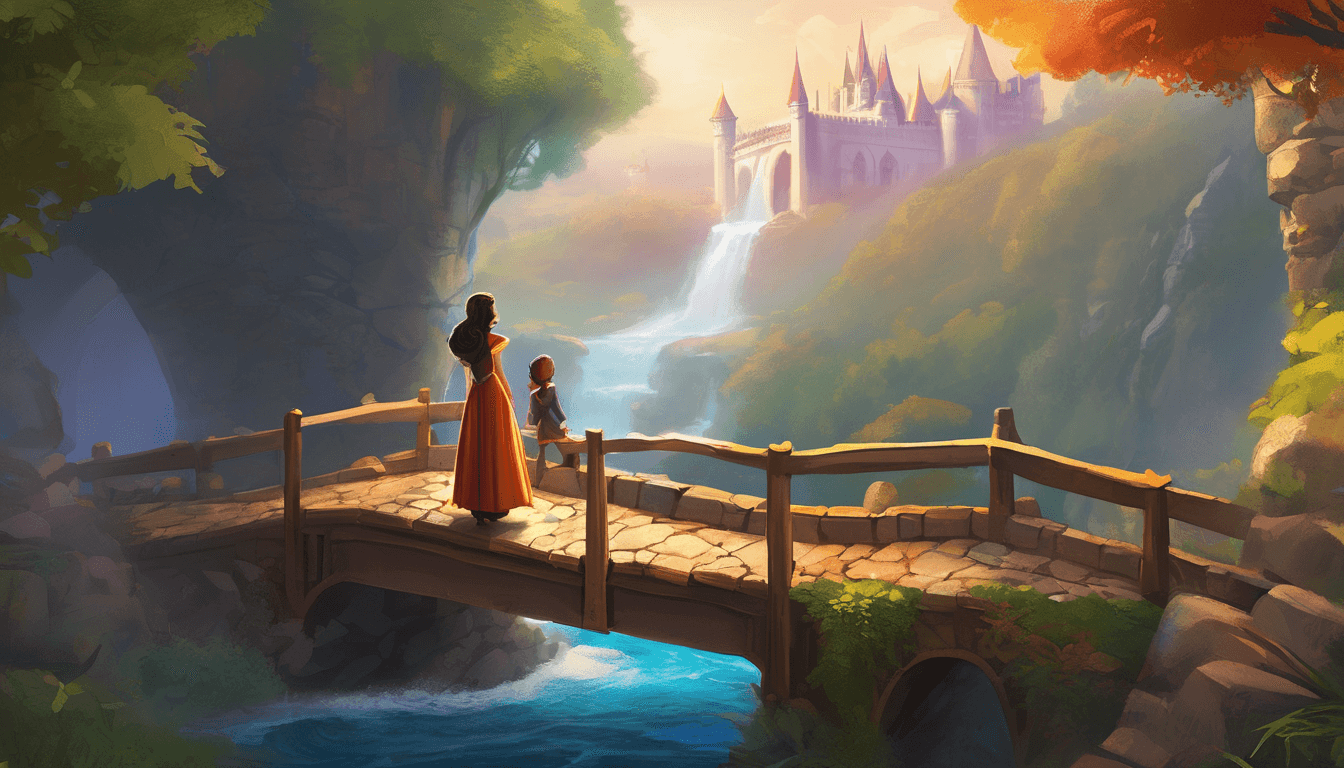
Princess Samira had spent most of her life listening.
She listened when the mountain people came down in their woolly cloaks to trade silver bells for salt. She listened when the fishermen arrived with boots full of sand and stories full of storms. She listened when the gardeners argued about whether roses should grow in straight rows or cheerful tangles.
Her father, the king, used to say, “A crown shines brightest on the head of someone who listens well.”
Samira was not yet queen, but she had learned something important: sometimes people argued because they wanted different things, and sometimes they argued because nobody had stopped to ask what they were afraid of.
So, when she was old enough to make a royal decision all by herself, she opened a school.
It was called the School of Friendly Envoys, and it stood in a round yellow tower beside the palace orchard. Its windows were shaped like open eyes, and its front door was painted blue, because blue was the color of distant seas and wide skies.
At the school, children learned how to greet visitors in many languages.
“Bonjour,” called Monsieur Oren, the teacher from the western valleys.
“Salam,” said Lady Nadiya, who taught greetings from the sunlit deserts.
“Ni hao,” said Master Wen, bowing gently.
“Hello,” said Princess Samira, smiling at them all. “And the most important greeting of all is this: I am glad you are here.”
The children learned how to sit at a table with someone who ate differently from them. They learned never to laugh at unfamiliar hats. They learned that a gift could be a basket of dates, a painted stone, a song, or simply careful attention.
They practiced talking through problems.
“I need the river water for my sheep,” said Haruto, who was tall and had a voice like a drum.
“And I need it for my bean field,” said Zola, who wore bright yellow braids.
“What might we do?” asked Princess Samira.
“We could take turns,” said Haruto.
“We could dig a new channel,” said Zola.
“We could plant less thirsty beans,” offered another child.
“Excellent,” said Samira. “A diplomat does not begin by shouting. A diplomat begins by looking for a door, even when the room seems to have no walls.”
Many children came to the school from all over the kingdom.
There was Saanvi, who could remember every rule after hearing it once.
There was Mateo, who drew maps so beautiful that people wanted to walk into them.
There was Kofi, who could imitate birds so well that real birds came to sit on his shoulders.
And there was little Aiko.
Aiko was the smallest student in the whole school. She was so small that her feet did not quite touch the floor when she sat on the high classroom stools. Her uniform sleeves had to be rolled up three times. Her hair was gathered into two round buns, each tied with a green ribbon.
Aiko did not speak very much in class.
But she watched everything.
She watched who sat alone at lunch.
She watched who frowned during lessons.
She watched which grown-ups smiled with their mouths but not with their eyes.
One crisp autumn morning, as pear leaves twirled through the orchard, a silver-horned messenger rode up to the blue door of the school.
He carried a scroll tied with red cord.
Princess Samira opened it.
Her smile faded.
The scroll was from the rulers of two neighboring lands, the Kingdom of Luma and the Kingdom of Brindle.
Between their lands stood an ancient bridge called Moonstone Bridge. It crossed a deep gorge where swallows nested in the cliffs and a river flashed far below like a ribbon of glass.
For hundreds of years, the people of Luma and Brindle had shared the bridge. Traders carried spices across it. Musicians crossed it to play at festivals. Families used it to visit cousins on the other side.
But that morning, the bridge had been closed.
The Luman queen said the Brindlers were bringing too many carts and wearing down the stones.
The Brindler duke said the Lumans were charging unfair tolls.
Both sides had placed guards at their ends of the bridge.
Both sides had stopped speaking.
And worst of all, a great traveling fair was due to arrive in three days. The fair brought lantern-makers, soup-sellers, acrobats, puppet shows, and the famous Cloud Carousel, whose horses rose so high that riders could touch the mist.
The fair could not cross the bridge.
“If the bridge stays closed,” said Princess Samira, “the fair will turn away. But more importantly, two neighbors may begin to think of each other as enemies.”
The students leaned forward.
“May we help?” asked Mateo.
Princess Samira looked at their eager faces. “Yes,” she said. “This is exactly why our school exists.”
By noon, they were on the road.
They traveled in a small royal coach with blue wheels, pulled by two sturdy gray ponies named Turnip and Pepper. Master Wen came along with a bag of maps. Lady Nadiya brought a basket of food. Princess Samira carried the red-corded scroll.
Aiko sat beside the window, quiet as a mouse in a library.
The road curved through pumpkin fields, then over hills dotted with sheep. At last they reached Moonstone Bridge.
It was even more beautiful than the students had imagined.
Tall pale arches stretched over the gorge. The bridge stones were white with tiny flecks of glittering crystal. In the middle, a round tower stood with a copper roof shaped like an upside-down teacup.
On one side stood Luman guards in violet cloaks.
On the other stood Brindler guards in brown coats.
They glared at one another across the empty bridge.
Princess Samira climbed down from the coach.
“I have come to help,” she said.
The Luman captain folded her arms. “The Brindlers must pay more. Their heavy wagons are cracking the bridge.”
“The Lumans are greedy,” shouted the Brindler captain. “They want gold for every wheel that passes.”
“That is not true!”
“It is exactly true!”
Soon everyone was talking at once.
Haruto tried suggesting turns.
Zola suggested a new toll.
Saanvi recited rules about shared roads.
Mateo unrolled a map and pointed to a long route around the gorge, but it would take six extra days.
The captains listened for a moment, then began arguing again.
Princess Samira felt a small worried knot forming in her stomach.
She had listened carefully. Yet there was still no door.
Then Aiko tugged on her sleeve.
“Princess Samira?”
“Yes, Aiko?”
Aiko looked up at the bridge tower in the middle.
“Who lives there?”
Samira blinked. “I do not know.”
The Luman captain stopped shouting.
The Brindler captain stopped shouting too.
“No one lives there,” said the Brindler captain. “Not for many years.”
“Then why is there smoke coming out?” asked Aiko.
Everyone looked.
From the little copper chimney on top of the tower came the thinnest curl of gray smoke.
Princess Samira took a deep breath. “Perhaps,” she said, “we should find out.”
The guards looked uncertain. The bridge was closed, after all.
But Aiko had asked such a simple question that nobody could find a reason not to answer it.
Slowly, carefully, the Luman captain unlocked her gate.
The Brindler captain unlocked his.
Together, they walked onto Moonstone Bridge.
Their footsteps echoed over the gorge.
At the middle tower, Princess Samira knocked on the green wooden door.
Nothing happened.
She knocked again.
At last, the door creaked open.
Inside sat an old woman with snowy curls, a patchwork shawl, and enormous round spectacles. She was stirring something in a tiny iron pot over a little stove.
“Ah,” she said. “Visitors.”
“Who are you?” asked Princess Samira.
“I am Bibi Aruna,” said the old woman. “Keeper of Moonstone Bridge. Or I was, once.”
“Why are you here?” asked the Luman captain.
Bibi Aruna looked surprised. “Because the bridge is ill.”
Everyone went very quiet.
“The bridge is ill?” whispered Aiko.
Bibi Aruna nodded and led them down a narrow spiral staircase.
Below the tower was a hidden chamber inside the bridge itself. The walls were lined with old wooden beams. In the center, an iron chain hung loose and broken.
“The bridge is not cracking because of carts,” said Bibi Aruna. “It is cracking because this old support chain snapped during last week’s thunderstorm. The stones are shifting. If too much weight crosses at once, one of the arches may fall.”
The captains stared at the broken chain.
“But why did no one tell us?” asked the Brindler captain.
Bibi Aruna’s face became sad.
“I sent letters,” she said. “To both kingdoms. But the messengers could not cross because each side had already started arguing over tolls and wagons.”
Princess Samira looked at the Luman captain.
The Luman captain looked at the Brindler captain.
Their angry faces changed.
They looked embarrassed.
Then Aiko asked her most important question.
“Could we fix it together?”
It was such a small question.
Just seven words.
But it opened a door bigger than the palace gates.
The Luman captain cleared her throat. “Luma has strong rope-makers.”
The Brindler captain said, “Brindle has excellent metalworkers.”
“We have carpenters,” said a Luman guard.
“We have stone-lifters,” said a Brindler guard.
Princess Samira smiled. “Then let us begin.”
For two days, people worked on Moonstone Bridge.
Rope-makers twisted thick golden ropes. Metalworkers forged a new iron chain. Carpenters replaced old beams. Stone-lifters fitted each pale moonstone piece back into place.
The children from the School of Friendly Envoys helped too.
Mateo drew signs showing where tools should go.
Saanvi made a list so nobody forgot anything.
Kofi called messages across the gorge with birdlike whistles.
Haruto and Zola carried water to thirsty workers.
And Aiko sat beside Bibi Aruna, handing her nails, biscuits, and cups of warm mint tea.
On the third morning, the new support chain was fastened.
The bridge stood steady and bright beneath the rising sun.
Then, from far down the road, came music.
The traveling fair had arrived.
There were wagons painted with moons and tigers. There were lanterns shaped like pears and stars. There were jugglers, bakers, puppeteers, and musicians with fiddles tucked beneath their chins.
At the very end rolled the Cloud Carousel.
Its painted horses had silver wings.
The people of Luma and Brindle cheered as the fair crossed Moonstone Bridge, not all at once, but carefully, in small groups, just as Bibi Aruna advised.
That evening, lanterns glowed from both sides of the gorge.
The Luman queen and the Brindler duke met in the middle of the bridge. They spoke quietly for a long while.
Then the queen said, “We should have asked what was really wrong.”
The duke nodded. “We were so busy being right that we forgot to be curious.”
Princess Samira looked down at Aiko.
Aiko’s green ribbons fluttered in the evening breeze.
“You asked the question that helped everyone,” said Samira.
Aiko’s cheeks turned pink. “It was only a little question.”
“Little questions can be very brave,” said Princess Samira.
Later, when the children returned to the yellow tower school, Princess Samira hung a new sign above the classroom door.
It read:
Before you decide, ask.
The students practiced many important questions after that.
What do you need?
What are you worried about?
What have we missed?
How can we fix it together?
And whenever a problem seemed too big, or too tangled, or too loud, Princess Samira would remember Moonstone Bridge and the smallest student in the school.
Then she would pause, listen, and make room for one more question.
Because sometimes the question that changes everything arrives in a very small voice.



Leave a Reply