
On the edge of a quiet town called Bellora, where the hills wore long grass like soft green coats, stood a round house with a silver roof.
It belonged to the Okafor family.
There was Amara, who wore her curly hair in two puffing clouds and asked at least seventeen questions before breakfast. There was her older brother, Tomas, who preferred to ask fewer questions but wrote every answer carefully in a blue notebook. Their mother, Nadiya, worked at the little observatory above the town. Their father, Kenji, repaired radios, weather balloons, old clocks, and sometimes toasters that had become mysteriously full of raisins.
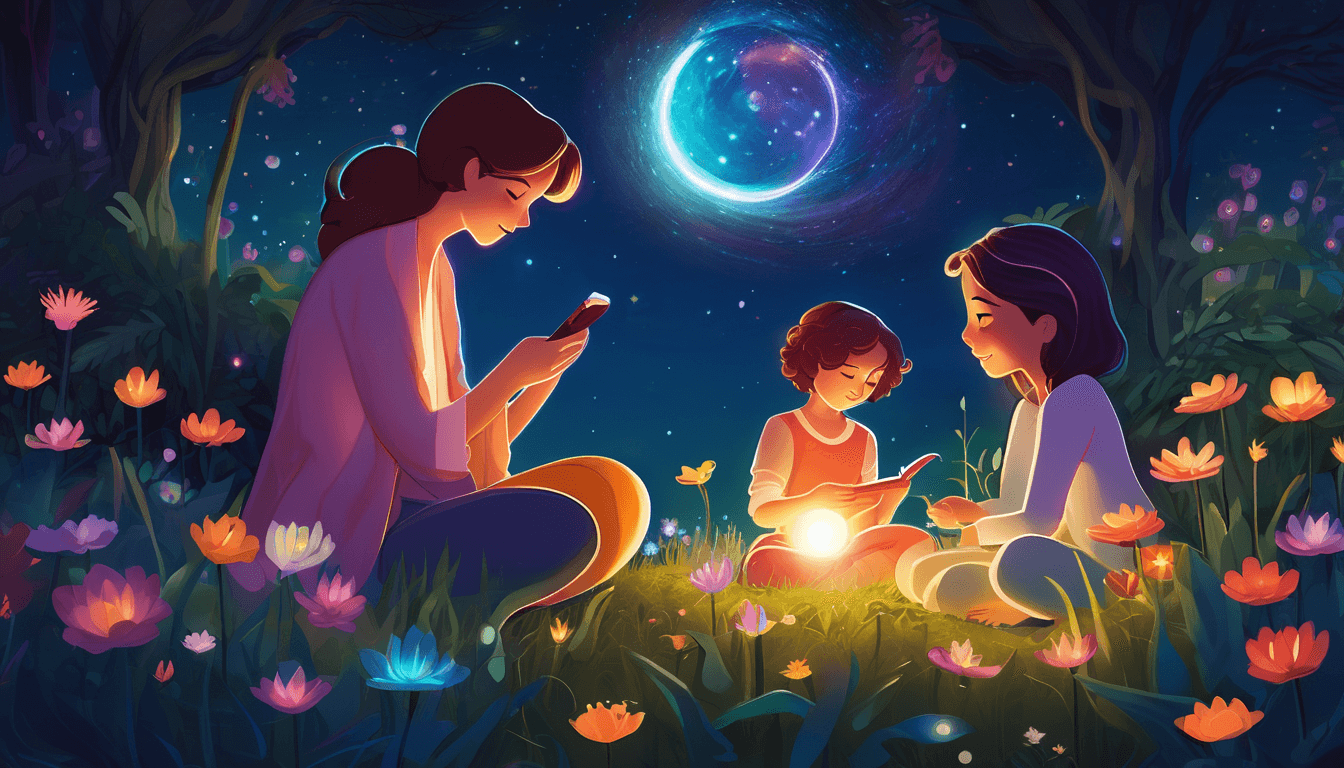
Their house had a garden that curved around it like a hug.
There were carrot beds, moonflowers, raspberries, basil, and one very proud pumpkin vine that climbed wherever it pleased. In the middle of the garden stood a glass table, where the family often ate supper beneath the stars.
One autumn evening, a week after the first leaves had turned coppery gold, Nadiya came home from the observatory carrying a box.
It was no bigger than a lunch box.
It was black, smooth, and cool enough to make mist curl from her fingertips.
“Is it a treasure?” Amara asked.
“Is it a machine part?” Tomas asked.
“Is it a very stubborn toaster?” Kenji asked hopefully.
Nadiya smiled, but her eyes were round with wonder.
“It fell from the sky,” she said.
Everyone grew still.
Even the pumpkin vine seemed to stop climbing.
Nadiya set the box on the glass table. On its lid was a tiny mark, made of lines and dots that did not look like any writing from Earth.
“Last night,” Nadiya explained, “the observatory caught a flash of light over the northern hills. We found this in the meadow at sunrise. It did not burn the grass. It did not make a crater. It simply landed there, gently, like a leaf.”
Kenji leaned close. “Can it open?”
“It already did,” said Nadiya.
She lifted the lid.
Inside, resting in a bed of silvery threads, was one seed.
It was shaped a little like a bean, but it shimmered in colors that changed as they looked at it. First it was deep blue. Then gold. Then purple like the evening sky. Then clear as a raindrop.
Amara held her breath.
“It is beautiful,” she whispered.
“It might be dangerous,” Tomas said.
“It might be both,” said Nadiya.
They did not touch it that night.
Instead, they sat around the glass table with their hot cocoa, looking at the seed under a clear bowl. The stars winked overhead. Somewhere far away, an owl called from an oak tree.
“Where did it come from?” Amara asked.
Nadiya pointed toward a cluster of stars above the dark hills.
“Perhaps from there. Or farther than we can imagine.”
“Maybe it is a plant seed,” said Kenji.
“Maybe it is a message,” said Tomas.
“Maybe it is a plant that sends messages,” Amara said.
No one could prove that she was wrong.
The next morning, the Okafors turned their sunny spare room into a careful study room. Kenji built a special clear case with soft lights and tiny air holes. Tomas made labels in his best neat handwriting.
UNKNOWN SKY SEED.
DATE FOUND.
COLOR TODAY.
TEMPERATURE.
SOUND?
SMELL?
MOOD?
“Seeds do not have moods,” Tomas said as he wrote it.
“Then why is it purple when it rains?” Amara asked.
Tomas looked at the seed.
It had, in fact, turned purple.
So he kept the label.
For three days, the seed did nothing at all.
The family watched it in the mornings. They watched it after lunch. They watched it before bed.
Amara sang to it.
Tomas shone different colors of light on it.
Nadiya listened to it with instruments from the observatory.
Kenji held an old radio near it, turning the dial slowly through crackles and whistles.
On the fourth evening, while rain tapped gently on the silver roof, the radio gave a soft chiming sound.
Plink.
Plink-plink.
Plink.
Everyone rushed into the study room.
The seed was glowing.
Not brightly, not like a lamp. More like a firefly tucked inside a little blue pearl.
And on the clear wall of its case, a thin green line appeared.
It curled in a spiral.
Then another line appeared beside it.
Then tiny dots.
Tomas opened his notebook so fast that three pages tore out.
“It is making symbols!” he cried.
Nadiya pressed her hand over her heart.
“It may be responding to the radio,” she said.
Kenji turned the dial again.
Crackle.
Whistle.
Plink-plink.
The seed glowed warmer.
On the glass, the lines changed.
Amara stared at them until her nose nearly touched the case.
“They look like roots,” she said.
The others looked.
The symbols did look like roots. Long curling paths, branching and joining, spreading down and down.
“That could be writing,” said Tomas.
“Or a picture,” said Nadiya.
“Or roots,” Amara said.
That night, they made the most important decision of all.
They would plant it.
Not outside in the cold garden. Not yet. They would plant it in a large round pot filled with clean soil, warm stones, and a little water from the rain barrel.
“But what if it is a message?” Tomas worried.
“Then perhaps it needs to grow in order to speak,” said Nadiya.
“What if it is not a plant?” Amara asked.
Kenji tucked a blanket around her shoulders. “Then we will learn what it is, one careful day at a time.”
They placed the seed in the soil.
For a moment, nothing happened.
Then the earth gave a tiny shiver.
A pale green shoot rose from the dirt.
It did not push upward like an ordinary sprout. It unwound.
Slowly, gracefully, it uncurled into the air, making a shape like a question mark.
Amara gasped.
“It has a question!”
The shoot continued to grow.
By morning, it was as tall as Amara’s knee. It had no leaves, only smooth curling stems that shone faintly in the dark. Along each stem were little round buds, like beads made of moonlight.
When Tomas touched one with the tip of a pencil, it made a sound.
Doo.
He touched another.
Ree.
Another.
Maa.
The buds were notes.
Soon, the study room was full of gentle sounds.
Doo. Ree. Maa. Soo.
Kenji brought in his radio. Nadiya brought a star map. Tomas brought his notebook. Amara brought her favorite yellow stool and sat very quietly, which was difficult for her but seemed important.
Every evening, the strange plant made a different tune.
At first, the notes sounded like random drops of water.
Then Tomas noticed something.
“It repeats every seven notes,” he said.
Nadiya listened.
“It repeats like a pattern,” she agreed.
They wrote the notes down. They played them back through the radio. The plant’s buds glowed one by one.
Doo. Ree. Maa. Soo.
Then the room filled with a soft, humming light.
Above the plant, a picture appeared in the air.
It was not exactly a picture, and not exactly a movie. It was made of floating points of light.
The family saw a planet.
It had three small moons and wide blue deserts that sparkled like snow. Tall silver trees rose from the sand. Between them moved tiny glowing creatures, round as pebbles, with long ribbon-like tails.
Amara whispered, “Hello.”
The image shifted.
They saw one of the glowing creatures place a seed into a small dark box.
Then they saw the box travel through space.
Past blue clouds of dust. Past bright stars. Past the shining rings of a giant planet.
At last, the box drifted toward Earth.
“It is a message,” Tomas breathed.
“But it is also a plant,” said Nadiya.
The image changed again.
Now the light showed the silver trees growing in a circle. Their roots were linked beneath the blue sand. Each tree sent soft colors through the ground to the others.
Gold.
Blue.
Green.
Violet.
The little glowing creatures sat beneath the trees, touching the soil with their hands.
The colors moved between them all.
“It is how they talk,” Kenji said quietly.
The plant in the pot gave a long, sweet note.
Maaaaa.
Amara looked at the glowing stems.
“It came here to say hello,” she said.
Perhaps that was true.
But the next picture made everyone quiet again.
The blue deserts on the faraway planet began to darken.
The silver trees became fewer.
A great shadow passed over the land.
The glowing creatures gathered their seeds, placing them into many little boxes. Some were sent into the sky.
“They were looking for help,” Tomas said.
Nadiya knelt beside him.
“Or looking for friends,” she said.
For the next few days, the Okafors worked harder than ever.
They invited the observatory scientists to listen to the plant’s music. They sent recordings through powerful antennas. They pointed signals toward the planet with three moons.
The town of Bellora helped too.
Mrs. Valdez from the bakery brought warm bread and asked if the plant liked cinnamon. Mr. Bako, the school gardener, brought soil from his greenhouse. Children painted pictures of silver trees and taped them in the observatory windows.
But still, no answer came from the stars.
One evening, Amara found the plant drooping.
Its glowing buds were dim. Its curling stems had folded close to the soil.
“Oh no,” she said.
Everyone gathered around.
Nadiya checked the light, the water, and the temperature. Tomas studied every note in his notebook. Kenji tested the radio.
Nothing seemed wrong.
Then Amara remembered the floating picture.
The silver trees had grown in circles.
Their roots had joined beneath the ground.
“This plant is lonely,” she said.
Tomas blinked. “Plants do not get lonely.”
“But this one sends messages through roots,” Amara replied. “Maybe it needs someone to talk to.”
Kenji looked out the window toward the garden, where the moonflowers had opened in the dusk.
Nadiya smiled slowly.
The family carried the round pot outside.
They set it in the middle of the garden, near the pumpkin vine, the basil, the carrots, the raspberry bushes, and the moonflowers.
Then they waited.
The night was still.
A cool breeze wandered through the grass.
For a while, nothing happened.
Then the sky seed plant stretched one curl toward the soil.
Its tip touched the earth.
A blue glow slipped down into the dirt.
The pumpkin vine trembled.
The moonflowers lifted their white faces.
The basil gave off a stronger, sweeter smell.
All through the garden, tiny lights began to blink beneath the soil, traveling from root to root.
Blue.
Gold.
Green.
Violet.
The plant stood tall again.
Its buds rang softly.
Doo. Ree. Maa. Soo.
This time, the music was joined by other sounds.
The whispery rustle of leaves.
The plump plop of a pumpkin settling on the ground.
The tiny crackle of carrot roots.
The garden was answering.
Amara laughed, though tears sparkled in her eyes.
“It has friends now.”
Above them, the stars shone in their deep velvet sky.
Then, from the observatory high on the hill, a radio signal chirped.
Once.
Twice.
Three times.
Nadiya’s little receiver, resting on the glass table, began to glow.
The same notes came through.
Doo. Ree. Maa. Soo.
Far away, beyond the moon and the wandering comets, something had heard.
Maybe it was a silver tree on a blue desert.
Maybe it was a glowing creature with a ribbon tail.
Maybe it was another family, gathered beneath three moons, listening carefully to a tiny new sound from Earth.
The sky seed’s buds opened at last.
Inside each one was not a flower, but a small clear globe holding a moving star.
The garden shimmered.
The Okafors stood together, hands linked, while the roots beneath their feet carried gentle colors through the sleeping earth.
They did not know every answer.
They did not know if the seed was a plant, a message, or both.
But they knew it had traveled a very long way to find them.
And they knew that when something small and strange arrives from the unknown, the kindest thing to do is to listen.
Later, after the instruments were switched off and the garden lights had faded, Amara lay tucked into bed beneath her quilt.
Tomas sat on the floor nearby, writing one last line in his blue notebook.
UNKNOWN SKY SEED, he wrote.
Then beneath it, he added:
NOT UNKNOWN ANYMORE.
Outside the window, the moonflowers nodded in the dark. From the garden came one soft musical note.
Maaaaa.
Amara smiled into her pillow.
Somewhere very far away, under three quiet moons, perhaps someone smiled too.
And all across the wide, dreaming universe, roots, stars, messages, and gardens kept reaching gently toward one another.
Leave a Reply