
On the far side of a sleepy city called Bellavento, where the streets curled around hills like ribbons and the chimneys wore little hats of smoke, there stood an old clock tower no one used anymore.
It had a green copper roof, four clock faces, and a tiny blue door at its bottom.
Every night, when the last baker had swept flour from his doorstep and the last cat had chosen its warm window ledge, the blue door creaked open.
Out floated a friendly ghost named Miro.
Miro was round as a mooncake and pale as a pearl. He wore a small waistcoat with brass buttons, although no one knew why, since ghosts did not need buttons. He also wore spectacles, which rested on the very tip of his misty nose.
Miro had lived in the clock tower for a long, long time.
He did not rattle chains. He did not say boo.
He collected buttons.
Not ordinary buttons, of course. Miro collected unusual buttons that had fallen from the coats of violin players, mountain climbers, circus jugglers, sea captains, grandmothers, and once, very mysteriously, a king in pajamas.
One rainy evening, while Miro was sorting his buttons by shininess, he heard a soft thump from the attic above.
Thump.
Then another.
Thump-thump.
Miro floated through the ceiling and found something very strange.
In the middle of the attic sat a wooden trunk with silver corners. It had not been there the night before. On its lid was a brass label that read:
LOST BEFORE FOUND
Miro blinked behind his spectacles.
“Well,” he said, “that sounds exactly like my sort of thing.”
The trunk was locked with a keyhole shaped like a teardrop. Miro searched every drawer in the clock tower. He looked beneath the dusty rug, inside the old clock gears, and even in the pocket of his own waistcoat.
At last, tucked behind the smallest clock face, he found a tiny silver key.
It fit.
Click.
The trunk opened with a sigh, as if it had been holding its breath for a hundred years.
Inside were no socks, no hats, no umbrellas, no ordinary lost things at all.
There was a little paper sailboat folded from a map of a country that no longer existed.
There was a gold thimble full of laughter, bubbling like lemonade.
There was a small red mitten with a note tied to it.
There was a jar of wind labeled: FOR A CHILD WHO WILL LOVE KITES.
There was a smooth green pebble that hummed a lullaby.
And beneath all these things lay a thick book, bound in midnight-blue leather.
On the cover, in silver letters, it said:
THE GREAT BEFORE-BIRTH LOST-AND-FOUND REGISTER
Miro opened it carefully.
The first page explained everything.
Before children were born, while they were still waiting among the bright stars and sleepy clouds, they sometimes misplaced important things.
Not toys or shoes, because they had not yet needed those.
They misplaced the first brave thought they would need on a stormy day.
They misplaced a joke that would make a lonely friend giggle.
They misplaced a song, a dream, a favorite smell, or the memory of a place they had never been but would someday love.
These things drifted down into the world and hid themselves in odd corners.
For centuries, they had waited.
And now, the book said, it was Miro’s job to find them.
Miro’s little ghostly mouth made an O.
“Oh,” he whispered. “I am going to need shelves.”
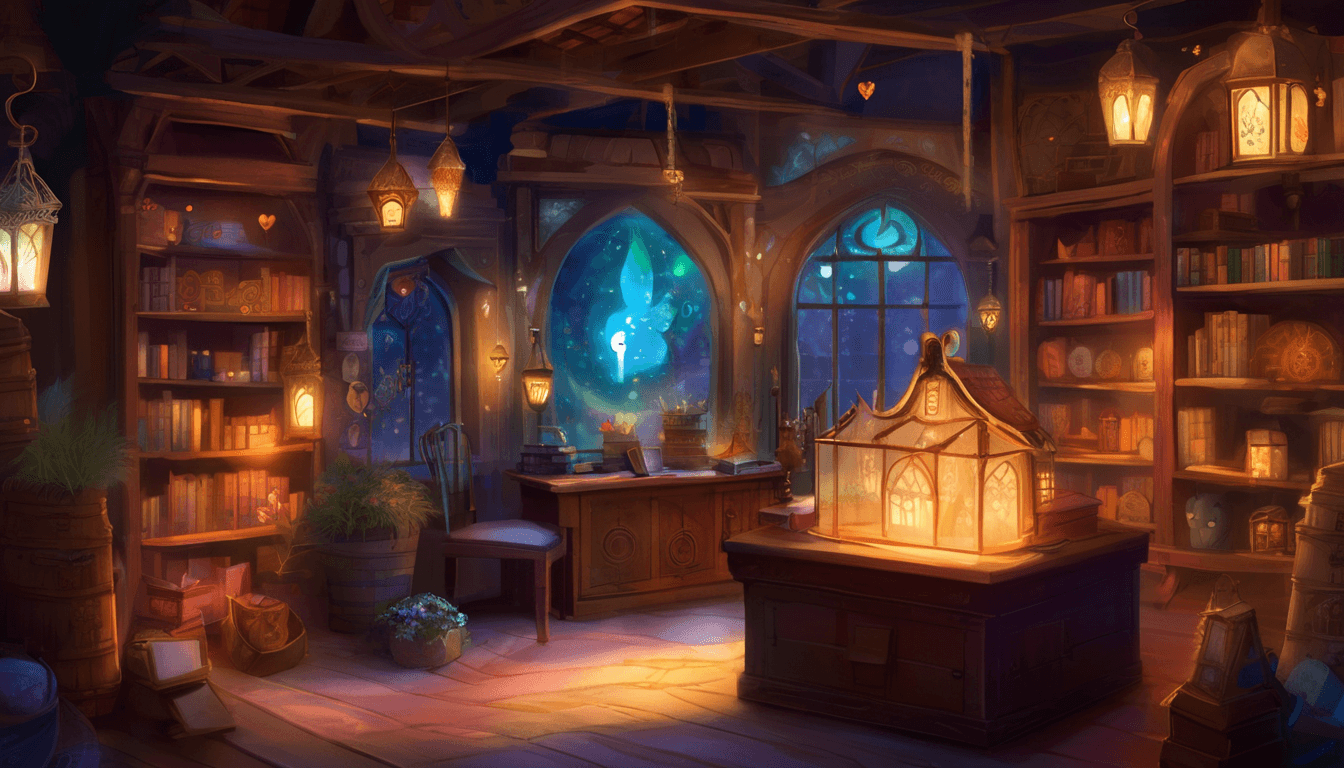
By morning, the bottom room of the old clock tower had become the most unusual shop in Bellavento.
Above the blue door, Miro hung a sign:
MIRO’S LOST-AND-FOUND
FOR THINGS MISPLACED BEFORE YOU WERE BORN
He built shelves from old apple crates. He placed labels on everything.
A yellow feather was marked: FIRST IDEA FOR A GIRL WHO WILL BUILD A BOAT.
A cinnamon-scented scarf was marked: COURAGE FOR A BOY WHO IS AFRAID OF BIG DOGS.
A marble that showed tiny dancing stars was marked: WONDER, ONE SMALL PIECE.
At first, nobody came.
People hurried past the clock tower, carrying bread, flowers, baskets, and worries.
Then one afternoon, a girl named Safiya stopped outside the blue door.
Safiya had springy black curls and muddy boots. She was holding the hand of her grandfather, who sold roasted chestnuts in the market.
“What does that sign mean?” she asked.
Miro floated down through the door, upside down by accident.
“It means,” he said, turning himself right-side up, “that perhaps you lost something before you were born.”
Safiya thought about this.
“I don’t remember being born.”
“Most people don’t,” said Miro kindly.
He opened his big blue book. The pages fluttered on their own until they stopped.
“Safiya,” he read. “Ah. Here we are. You misplaced… a compass.”
“I don’t have a compass,” she said.
“Not a metal one,” Miro explained. “A heart compass. It helps you know when someone needs help, even if they do not ask.”
Safiya’s grandfather looked surprised.
“She does seem to find every sad kitten in Bellavento,” he said.
Miro searched the shelves. He looked behind a jar of cloud crumbs and under a box marked: THREE SPOONS OF PATIENCE, DO NOT SPILL.
But the heart compass was gone.
In its place was a note written in spidery green ink.
TAKEN TO THE WHISTLING MOUNTAINS,
WHERE THE WIND KEEPS WHAT IT DOES NOT UNDERSTAND.
Miro adjusted his spectacles.
“Oh dear,” he said. “That is very far away.”
Safiya’s eyes shone.
“Can we go get it?”
Miro looked out at the golden afternoon. Beyond Bellavento’s rooftops were forests, rivers, cliffs, and the blue-gray teeth of the Whistling Mountains.
A sensible ghost might have said no.
But Miro was not always sensible.
“Pack a biscuit,” he said.
Safiya packed three.
Her grandfather packed six more, plus a wool blanket, a flask of mint tea, and a small brass lantern. He kissed Safiya’s forehead.
“Home by moonrise,” he said.
“We shall try,” said Miro.
They set off just as the city bells chimed four.
Miro floated ahead, carrying the lantern. Safiya walked beside him, her boots squelching through puddles left by the morning rain.
They crossed the market square, where a violinist was playing for pigeons. They passed the canal, where boats bumped gently together. Then they followed the road beyond the city, through fields where yellow flowers nodded in the breeze.
At the edge of the forest, they found a fox caught in a tangle of silver thread.
“Oh!” said Safiya.
The fox was not frightened. It simply looked annoyed.
Miro read the tiny tag tied to the thread.
“Hmm,” he said. “This is a Thread of Good Luck. Lost before birth by someone who will someday need to be very lucky indeed.”
The fox gave a sharp little yip.
“It belongs to you?” Safiya asked.
The fox nodded.
Safiya carefully untangled the thread from its paws and tail. When it was free, it shook itself and scampered in a circle. Then it trotted down a narrow path between the trees and looked back.
“I think it wants us to follow,” said Miro.
The path was hidden beneath ferns and blue mushrooms. It led through the forest much faster than the main road would have done. At last, the fox stopped beside a river.
Across the river was a bridge, but one of its planks was missing.
The water below rushed over dark stones.
Safiya peered down. “I can jump it.”
“You could,” said Miro. “But perhaps there is another way.”
The fox tugged at the wool blanket from Safiya’s backpack. Safiya understood. She tied one end around a sturdy tree. Miro floated across with the other end and looped it around a post on the far side.
Together, they made a handrail.
Safiya crossed slowly, holding tight.
When she reached the other side, the fox bowed. Then, with its silver thread gleaming around its neck, it vanished into the trees.
The sun was lowering when Safiya and Miro reached the foot of the Whistling Mountains.
They truly did whistle.
Wind poured through holes in the rocks, making sounds like flutes, kettles, whistles, and sometimes a giant trying to sing through his nose.
At the mountain’s highest ledge stood a nest the size of a cottage.
Inside slept a great gray bird with wings like storm clouds.
Under one enormous feather, something glowed.
Safiya could see the heart compass.
It was a round little disk, warm and golden, with a needle that trembled gently toward anyone in need.
“We must not wake the bird,” Miro whispered.
But just then, a rock rolled under Safiya’s boot.
Clack.
The great bird opened one silver eye.
“WHO DISTURBS MY NEST?” it boomed.
Miro floated behind Safiya.
Safiya took a breath. Her knees felt wobbly, but she stood straight.
“We came for something that does not belong to you,” she said.
The bird’s eye narrowed.
“EVERYTHING THE WIND BRINGS IS MINE.”
“Even if someone else needs it?” Safiya asked.
The bird paused.
No one had ever asked it that.
“I NEED THINGS TOO,” it said, quieter now.
“What do you need?” asked Safiya.
The bird looked away toward the darkening sky.
“I used to fly above the clouds,” it said. “But I lost my first feather long ago. Without it, I do not dare fly high.”
Miro opened the blue register. Pages whirled.
“Ah!” he cried. “A first feather, lost before birth by a young mountain bird who was meant to become a keeper of winds.”
He rummaged in his satchel.
He pulled out a rubber boot, a spoon, two buttons, and a sleepy-looking acorn.
Then he found it.
A small gray feather, shining at its tip like frost.
The great bird bent its head.
“Mine,” it breathed.
Miro placed the feather in its wing.
At once, the bird’s feathers lifted and rustled. Wind curled around the mountain peak. The bird opened both wings, wider and wider, until they covered the evening sky.
Then it gave a joyful cry and soared upward.
The whistle of the mountain changed into a warm, clear song.
As it circled above them, the heart compass slipped from the nest and floated gently down into Safiya’s hands.
It was warm.
The needle spun once, twice, and then pointed straight at Miro.
“Me?” Miro said.
Safiya smiled.
“You needed help too.”
Miro’s spectacles fogged up a little.
The great bird landed once more, lighter now, almost young-looking.
“TAKE THE MOON PATH HOME,” it said. “IT IS SAFE FOR THOSE WHO RETURN LOST THINGS.”
A trail of pale stones appeared down the mountain, glowing beneath the rising moon.
Safiya and Miro followed it home.
They reached Bellavento just as the clock tower struck nine soft chimes.
Safiya’s grandfather was waiting at the blue door with his arms folded.
Then he saw the lantern, the muddy boots, the fox hair on Safiya’s blanket, and the golden compass in her hand.
He did not scold.
He simply hugged her very tightly.
After that night, people began coming to Miro’s shop.
A boy found the tune he had been humming in dreams.
An old woman found the smell of oranges that reminded her to visit her sister.
A quiet child found a tiny blue spark of courage and used it to speak at school for the first time.
And Safiya became Miro’s helper.
She organized the shelves, polished jars of moonlight, and wrote neat labels for the things they found.
Sometimes, late at night, after Bellavento had gone quiet, Miro and Safiya would sit at the top of the clock tower.
Below them, the city slept beneath silver roofs.
Above them, stars blinked in the deep blue sky.
Miro would open the great register, and a new page would flutter forward.
Then he would smile.
“Another adventure tomorrow,” he would say.
Safiya would tuck the heart compass safely into her pocket.
And somewhere in the world, a lost thing would glow softly in the dark, waiting to be found.

Leave a Reply