
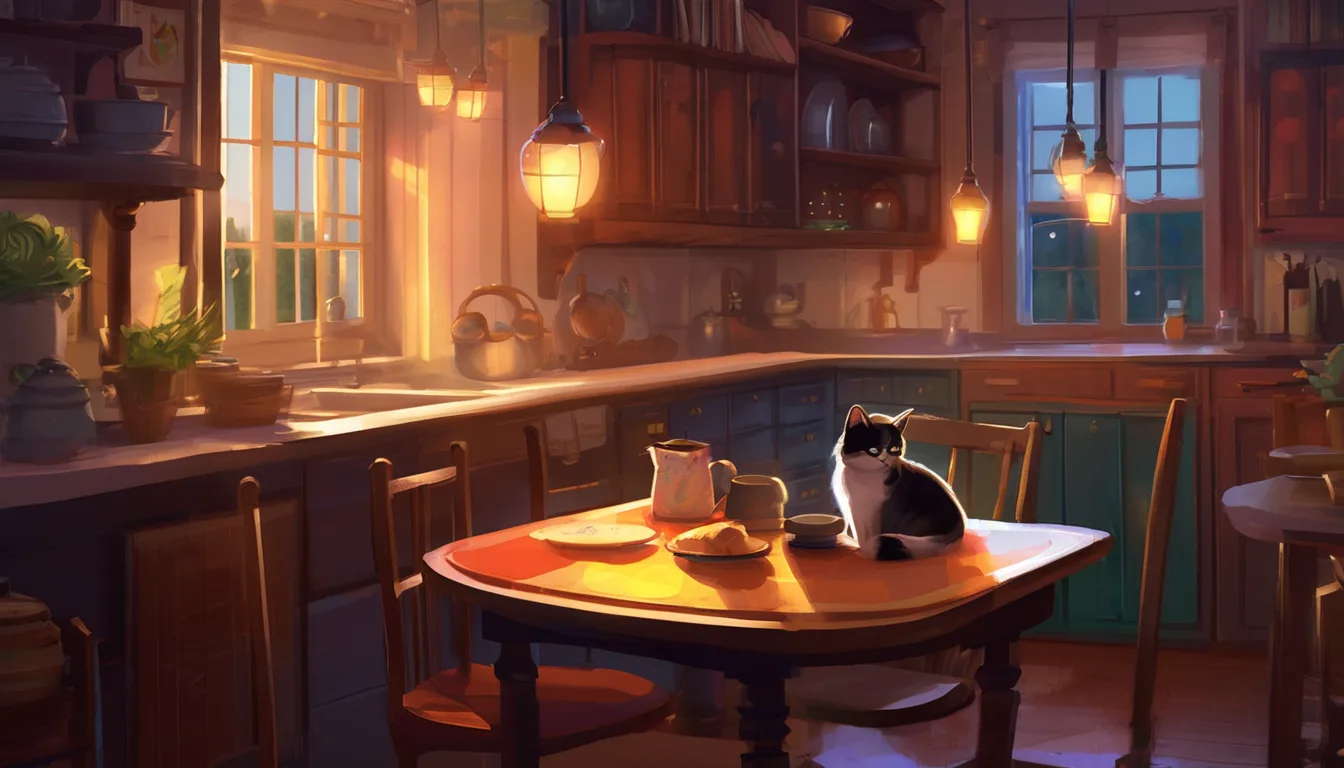
In a narrow blue house at the end of a cobbled lane lived a striped cat named Momo.
Momo had white paws, a silver bell on a green ribbon, and the very serious habit of sitting on important papers.
By day, Momo slept in sunbeams, inspected the bread basket, and watched dust float through the hallway. By night, when the family had gone to bed and the moon shone through the kitchen window, Momo had another job.
He ran the Household Complaint Desk.
The desk was hidden behind the umbrella stand in the front hall. It was a small walnut table with a brass lamp, a pot of ink, a feather pen, and a wooden sign that read:
COMPLAINTS HEARD AFTER MIDNIGHT
PLEASE TAKE A NUMBER
NO SHOUTING, SQUEAKING, CLATTERING, OR SLAMMING
Momo had painted the sign himself, though the letters leaned a little to the left because he had held the brush in his mouth.
Every object in the house knew about the desk.
The chairs knew.
The spoons knew.
The doors knew.
Even the old blue teapot, who had a very round bottom and very strong opinions, knew.
Usually, Momo’s work was simple.
A sock might complain that it had been separated from its twin. Momo would check behind the washing basket and find the missing sock curled up with a marble.
A pencil might complain that it had been chewed. Momo would write a polite note to the child: PLEASE DO NOT NIBBLE MR. PENCIL. HE IS TRYING HIS BEST.
Once, a broom complained that nobody admired its fine sweeping.
Momo awarded the broom a tiny paper medal that said: BEST BRISTLES IN THE HOUSE.
But on the night of the harvest moon, things were not simple at all.
At exactly midnight, Momo lit the brass lamp.
At one minute past midnight, there came a knock.
At two minutes past midnight, there came another knock.
At three minutes past midnight, the whole house began to grumble.
Tap tap tap went the wooden chairs from the dining room.
Clink clink clink went the spoons from the kitchen drawer.
Creeeak. Thump. Creak.
That was the front door, swinging itself open and shut in a most dramatic manner.
Momo’s whiskers drooped.
“Oh dear,” he murmured. “This will be a busy night.”
He placed a bowl of water beside the desk, straightened his green ribbon, and rang the little bell.
“Next complaint, please.”
The first visitors were the chairs.
There were six of them, marching in a line from the dining room. They had polished wooden backs, sturdy legs, and cushions in different colors. The tallest chair, which belonged at the head of the table, was named Arman.
Arman bowed as deeply as a chair could bow.
“Mr. Momo,” he said, “we have been treated unfairly.”
“Unfairly?” asked Momo, dipping his feather pen in ink.
“Terribly unfairly,” said a small chair with a yellow cushion. Her name was Suki. “The spoons have been making fun of us.”
From the kitchen came a bright chorus.
“We have not!”
“You have too!” cried Suki.
“We only said chairs are boring,” called a spoon.
“That is making fun,” said Arman.
Momo wrote carefully in his notebook.
Complaint Number One: Chairs feel called boring by spoons.
“What did the spoons say, exactly?” he asked.
Suki’s legs stiffened. “They said that all we do is sit around.”
For a moment, Momo had to cover his mouth with one paw.
Then he looked very official again.
“I see,” he said. “And how did that make you feel?”
“Unappreciated,” said Arman.
“Squashed,” said Suki.
“Wobbly,” said a chair with one leg that had been repaired with a little silver cap.
Momo nodded. “That sounds difficult.”
Before he could ask another question, the kitchen drawer flew open.
Out slid the spoons.
There were soup spoons, teaspoons, serving spoons, a ladle with a deep round bowl, and one small silver spoon named Nandita, who had a tiny scratch across her handle.
They came sliding across the floor in a shining heap.
Nandita lifted herself proudly.
“Mr. Momo, we also have a complaint.”
“Of course you do,” said Momo.
“The chairs have said we are noisy, fussy, and always stirring things up.”
“Well,” said the tall chair Arman, “you are always stirring things up.”
“That is our job!” cried Nandita.
The spoons clinked in agreement.
The chairs scraped their feet.
The front door gave such an enormous slam that a hat fell off its peg.
“Order!” cried Momo.
But nobody heard him.
“Boring!” called a spoon.
“Clattery!” called a chair.
“Stiff-backed!” called a teaspoon.
“Bent-headed!” called the little chair with the yellow cushion.
Then the doors arrived.
Not just the front door.
The kitchen door came swinging in on its hinges.
The bedroom door shuffled down the hall, carrying a fuzzy blue robe on its brass knob.
The cupboard door waddled in from the pantry, smelling faintly of cinnamon and crackers.
And from upstairs came the old attic door, who was so creaky that every step it took sounded like a sleepy violin.
The front door spoke first.
“I would like to file a complaint,” it boomed.
“Get in line,” said Momo.
“I cannot,” said the front door. “I am a door. I do not have legs.”
“That is true,” Momo admitted. “Please lean against the wall while you wait.”
The front door leaned against the wall.
The kitchen door leaned beside it.
The bedroom door leaned against the umbrella stand.
Soon the hall was filled with doors, chairs, and spoons, all grumbling and knocking and clinking.
Momo climbed onto his desk.
“EVERYONE BE QUIET!” he meowed.
That worked.
Momo did not often raise his voice. When he did, it was like hearing a thundercloud say please.
The room became still.
Even the attic door stopped creaking.
Momo sat down again, smoothed his chest fur, and said, “One at a time. Doors, you may speak.”
The front door swung forward.
“We are tired of being blamed for everything,” it said.
“Everything?” asked Momo.
“Yes. If a draft comes into the house, they blame us. If someone forgets their keys, they blame us. If someone bumps their toe while walking into a room, they blame us. And when children slam us, nobody says, ‘Poor door.’”
The bedroom door nodded sadly.
“I only creak because my hinges need oil,” she whispered. “But everyone says I am trying to be spooky.”
The cupboard door sniffed.
“I keep the biscuits safe, but does anyone thank me? No. They say, ‘Why is this cupboard stuck again?’”
“And,” said the kitchen door, “the chairs keep saying we are always standing in the way.”
“We do not stand in the way,” said Arman. “You swing into the way.”
“I swing because I have feelings,” said the kitchen door.
The spoons clinked nervously.
Momo made three neat lists in his notebook.
The chairs felt unappreciated.
The spoons felt misunderstood.
The doors felt blamed.
Outside, the harvest moon slid behind a cloud. The house became dimmer, and the brass lamp made a warm circle of light around Momo’s desk.
He looked at the objects.
They looked back at him.
For the first time, nobody said anything.
Then Momo noticed something odd.
On the kitchen door was a smear of strawberry jam.
On Arman’s seat cushion was a dusting of flour.
On little Nandita’s handle was a thin blue thread.
“Where did all this come from?” Momo asked.
The objects looked embarrassed.
“It was from dinner,” said Suki quietly.
“And baking,” said the cupboard door.
“And the rainy afternoon,” said the bedroom door.
Momo’s ears lifted.
“Tell me about the rainy afternoon.”
At first, no one wanted to.
Then Nandita spoke.
“The family made blackberry tarts. We spoons mixed the sugar and butter. It was difficult work. The butter was cold.”
“We held everyone at the table while they rolled the dough,” said Arman. “The little boy stood on Suki to reach the counter, though I must say that was not very polite.”
Suki gave a little squeak. “He was muddy.”
“The kitchen door kept the warm smell of tarts inside,” said the cupboard door. “And I kept the flour from getting damp.”
“The front door held back the rain,” said the bedroom door.
The big front door gave a shy creak.
“And later,” continued Nandita, “when the family ate the tarts, the chairs held them up. We spoons carried cream. The doors let everyone come and go. We all did our part.”
Momo tapped his feather pen against his paw.
“So,” he said slowly, “all of you helped make the same afternoon.”
Nobody answered.
The spoons gazed at the chairs.
The chairs gazed at the doors.
The doors gazed at the spoons.
“But they still called us boring,” said Suki.
“And they called us noisy,” said Nandita.
“And they called us in the way,” said the kitchen door.
Momo nodded. “Words can be small, but they can leave a big scratch. Like the one on Nandita’s handle.”
Nandita looked down at her scratch.
“Sometimes,” Momo continued, “when things get busy, everyone only notices what other people do wrong. Chairs notice clinking. Spoons notice sitting. Doors notice bumping. But a house is not made warm by one object alone.”
The old attic door creaked softly.
“What should we do?” it asked.
Momo’s eyes gleamed.
“I think,” he said, “we need a House Appreciation Supper.”
“A supper?” said the spoons.
“For objects?” said the chairs.
“With no humans?” said the doors.
“Exactly,” said Momo.
At once, everyone had something to do.
The chairs arranged themselves around the dining table in a moon-shaped circle.
The spoons polished one another with a clean dish towel until they shone like little rivers.
The cupboard door opened wide and offered a plate of oat biscuits, three sugar cubes, a jar of honey, and a very old tin of peppermint drops.
The kitchen door swung back and forth to make a gentle breeze.
The front door opened a crack to let in the smell of wet leaves and moonlight.
Momo climbed onto the table.
He wore a paper hat made from an old grocery list. On it, in large letters, he had written:
CHIEF LISTENER
Then he rang his little bell.
“Tonight,” he announced, “each guest must say one kind thing about someone else.”
Arman, the tallest chair, went first.
He cleared his wooden throat.
“Nandita,” he said, “you are small, but you do important work. You carry warm soup to tired people. You stir cocoa on cold mornings. You make ordinary meals feel cared for.”
Nandita’s silver bowl gleamed.
“Thank you,” she said.
Then Nandita turned toward Suki.
“Suki, your yellow cushion is cheerful even on gray days. When the little girl has a fever, she curls up on you with a blanket and her rabbit. You are soft and steady.”
Suki’s legs stopped wobbling.
The kitchen door spoke next.
“Arman, when the grandparents visit, you always give up your place at the head of the table so Grandfather can sit there. That is very gracious.”
Arman’s polished back became almost glossy with pride.
The bedroom door looked toward the front door.
“You are very strong,” she said. “You stand through wind, snow, parcels, boots, muddy paws, and surprise visitors. You keep the house safe.”
The front door was silent for a moment.
Then it said, “Thank you.”
Its voice was quieter now.
Even the attic door received a compliment.
“You remember old things,” said the cupboard door. “You keep trunks of photographs, wool blankets, and the tiny red sled safe above us. That is special.”
The attic door made a sound that might have been a creak, or might have been a happy sigh.
Soon there was laughter.
The soup spoons told a joke about a fork who was always getting into a jam.
The chairs told a joke about a stool who had no back-up plan.
The doors told a joke about a window who could not stop pane-icking.
It was not a very good joke, but everyone laughed anyway.
At the end of the supper, Momo brought out three small paper certificates.
For the chairs, he wrote:
FOR HOLDING EVERYONE UP
For the spoons, he wrote:
FOR STIRRING KINDNESS INTO EVERY DAY
For the doors, he wrote:
FOR KEEPING THE HOUSE OPEN AND SAFE
The objects were so pleased that they hung the certificates in their proper places.
The chairs tucked theirs behind a picture frame.
The spoons slipped theirs into the cutlery drawer.
The doors pinned theirs near their hinges, where only other doors could read them.
By the time the moon had crossed the roof, the complaints had become quiet.
The spoons slid back into their drawer, carefully nesting bowl to bowl.
The chairs returned to the dining table, their legs resting neatly on the rug.
The doors swung home one by one.
Before the bedroom door settled into its frame, she whispered, “Goodnight, Momo.”
“Goodnight,” said Momo.
The front door closed with a soft click instead of a slam.
The attic door gave one last gentle creak.
Then the blue house grew still.
Momo returned to his complaint desk. He wrote one final note in his notebook.
Complaint Number One, Two, and Three: Settled.
Underneath, he wrote:
A house works best when everyone remembers they belong to the same home.
He put down his feather pen, blew out the brass lamp, and curled up on top of the important papers.
Above him, the sleeping house gave tiny sounds.
A chair settling.
A spoon dreaming in its drawer.
A door resting on its hinges.
And Momo, the cat with the green ribbon, purred until morning.


Leave a Reply