
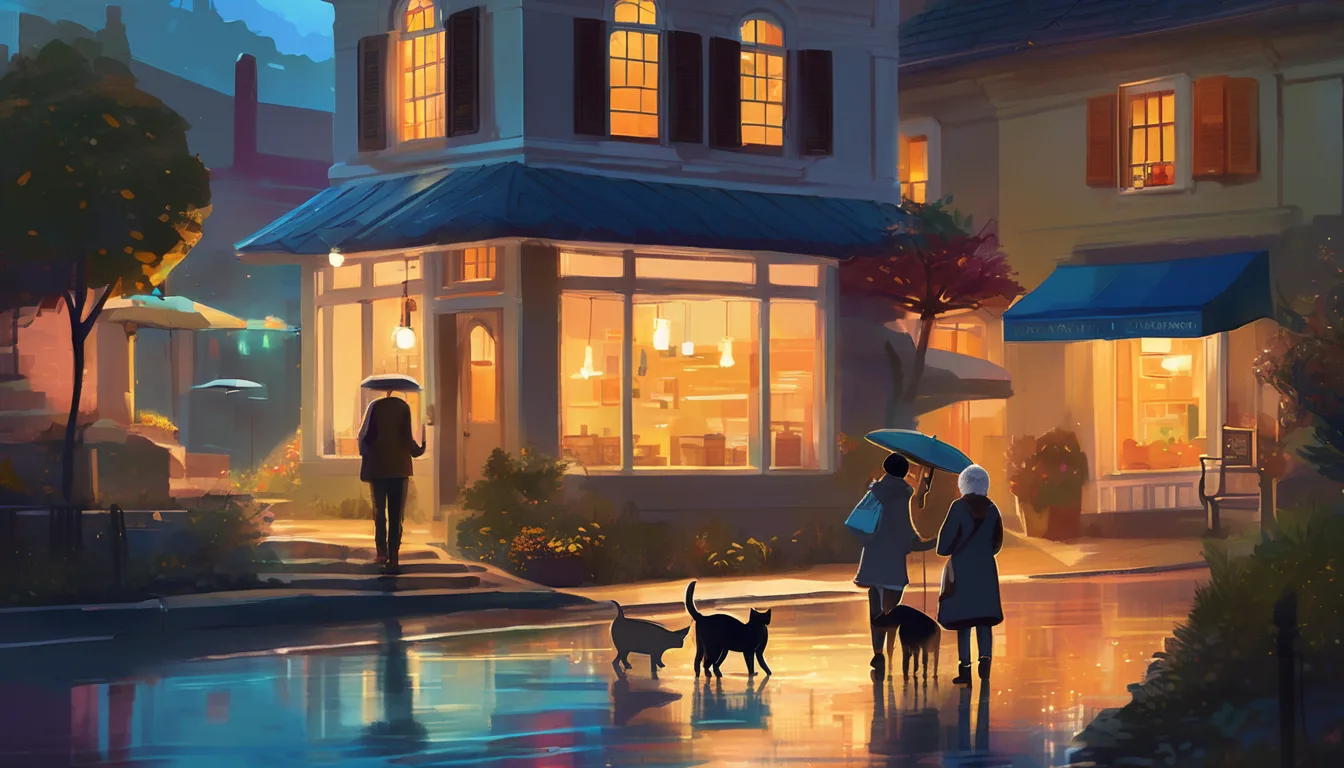
On a narrow street in the old city of Valparaíso, where the houses were painted orange, blue, lemon-yellow, and green, there lived a family of cats who listened to feet.
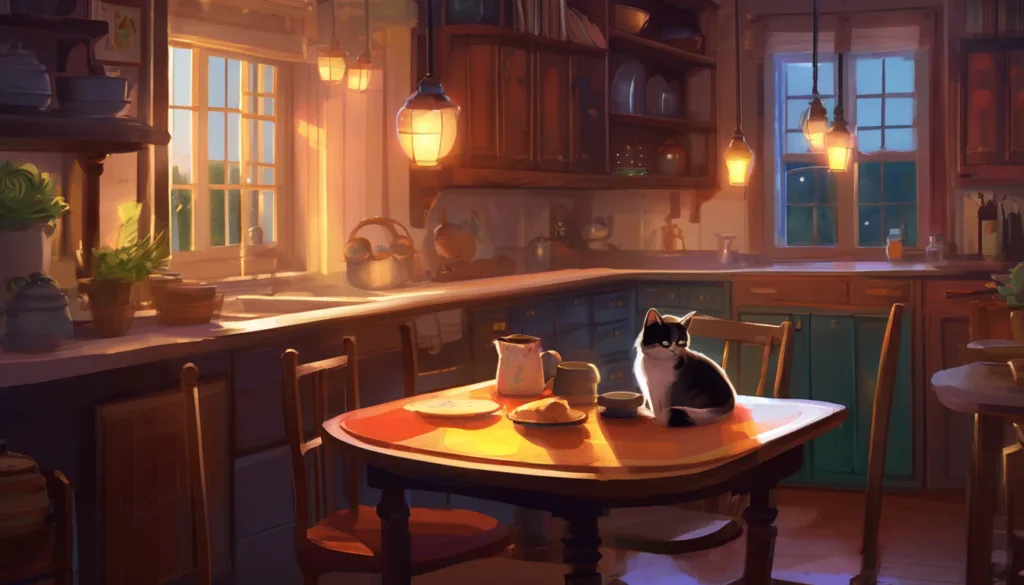
They lived above a little bakery called The Honey Crust, in an attic filled with warm flour-smells and soft piles of cloth. Their window looked down onto the cobbled lane, where shoes clicked, boots thumped, sandals slapped, and sometimes bare feet padded through puddles after rain.
The cat family was unusual, though they did not think so.
There was Mother Sora, a silver-gray cat with a white chin and wise green eyes. There was Father Nabil, broad-pawed and striped, who could sleep through thunder but wake at the faintest creak of a gate. And there were their three kittens: Mina, who had bright whiskers and questions for everything; Tomás, who was careful and quiet; and little Badu, whose tail always looked like a bottle brush because he was delighted by nearly everything.
Every evening, after the bakery was closed and the last loaf had been tucked into its paper bag, the cats would sit by their open attic window.
“Listen,” Mother Sora would say.
And they listened.
“Tap-tap, drag, tap-tap, drag,” said Mina one night.
“Mrs. Varga,” Father Nabil said. “Her left shoe has a loose heel.”
“Clomp, clomp, clomp, pause. Clomp, clomp, clomp, pause,” said Tomás.
“Mr. Kenji coming home with his vegetable basket,” Mother Sora said. “He stops by the lamppost to rest his knees.”
Then Badu’s ears sprang up.
“Scuff-scuff, skip! Scuff-scuff, skip! And a tiny jingle!”
“That is Asha from the flower shop,” cried Badu. “She has bells on her red boots!”
Father Nabil purred. “Exactly right.”
You see, the cats had studied human footsteps for years.
They knew that every person walked in their own special way. Some hurried with their toes first, as if racing their own thoughts. Some walked slowly on their heels, carrying heavy worries. Some danced without meaning to. Some shuffled when they were sad. Some marched when they were cross. Some walked very softly when they had a surprise hidden behind their back.
The cats did not simply hear footsteps. They read them like stories.
Mother Sora had taught the kittens that footsteps could tell you where a person had been, what they carried, whether they were tired, and sometimes, if you listened with kindness, whom they were missing.
“People do not always say the things that make their hearts ache,” she told them. “But their feet often whisper it.”
Mina liked this idea very much.
“Do feet have secrets?” she asked.
“Oh yes,” said Mother Sora. “Shoes are terrible at keeping secrets.”
One late autumn evening, a soft rain began to fall over Valparaíso. It ticked on the rooftops and made silver strings beneath the streetlamps. The baker, Señora Inez, shut the bakery door and went upstairs, leaving the alley quiet.
The cat family was curled together in their attic basket when they heard a strange sound below.
Step.
Pause.
Step.
Pause.
Then a slow scrape across the stones.
Mother Sora lifted her head.
“That is not a familiar walk,” she murmured.
The kittens hurried to the window.
Below, near the bakery door, stood an elderly man in a long brown coat. He held a small umbrella that was turned inside out by the wind. His shoes were soaked. One of his feet pointed straight ahead, but the other turned slightly sideways with every step.
Step.
Pause.
Step.
Pause.
He looked up and down the street as if he had forgotten what he was looking for.
“Poor fellow,” whispered Mina.
“He is lost,” said Tomás.
“Or perhaps his umbrella is lost,” said Badu, who had never trusted umbrellas.
The man sat on the bakery’s front step. From his pocket, he took out a folded piece of paper and looked at it for a long time. Then he sighed.
His footsteps, even while he sat, seemed sad.
Father Nabil stood. “We should learn where he came from.”
“And where he meant to go,” said Mother Sora.
This was the work of the Footstep Family.
They slipped down the back stairs, through a crack beside the flour sacks, and into the wet evening. Mother Sora led the way, her paws silent on the stones. Father Nabil followed. Mina, Tomás, and Badu moved close together, their tails held high to keep them out of the rain.
The old man’s trail was easy to find. His right shoe made a firm little square mark. His left shoe dragged at the edge, leaving a curved smudge in the damp dust.
Step. Pause. Step. Pause. Scrape.
The cats followed the marks past the flower shop, past the tiny library with blue shutters, and across the square where pigeons huddled under the statue of a sailor.
At the corner of Lantern Lane, Mother Sora stopped.
“Look,” she said.
There were other footsteps there.
Small ones. Quick ones.
Tap, tap, tap, tap.
They had arrived from the opposite direction and circled around the old man’s footprints. Then they had run away toward the hill.
“Children?” guessed Mina.
“Not children,” said Tomás, lowering his nose close to the ground. “The steps are too light. And there are four toes pressed into the mud.”
“A dog!” said Badu.
“Indeed,” said Father Nabil. “A small dog with a wiggly walk.”
The dog’s tracks hurried up the hill, then turned behind a row of houses. The cats climbed after them. Rain dripped from the balconies. Somewhere, someone was playing a slow tune on a guitar.
At the top of the hill stood a pale pink house with a bright green door. Beneath the door was a narrow gap, and beside it lay a chewed blue scarf.
The cats heard a sound from inside.
Woof.
Then another.
Woof-woof!
The green door opened. A girl of about seven stood there in striped pajamas. Her dark curls were tied in a loose knot, and she held a tiny brown dog in her arms.
“Oh, Churro,” she said. “You keep barking at the rain. Are you missing Abu again?”
The little dog gave a worried whine.
Mina looked at Mother Sora.
“Abu?” she whispered.
“It means grandfather,” Mother Sora said.
Inside the house, an older woman came down the hallway carrying a candle.
“Leena, darling, bedtime,” she said gently.
“But Abu said he would visit today,” the girl replied. “He always brings me peppermint sweets. He never forgets.”
The woman’s face became quiet.
“The storm may have made the buses late.”
Churro twisted in Leena’s arms and stared toward the street. His little paws scratched the air.
Then Father Nabil gave a low, important purr.
“The old man,” he said. “His footprints came from the bus station. He has probably been searching for this house.”
“But why did he not find it?” Mina asked.
Tomás remembered the folded paper in the man’s hand. “Perhaps he cannot read it in the rain.”
“And perhaps,” added Mother Sora, “his feet have become tired.”
The cats hurried back down the hill as fast as their paws would carry them.
They found the old man exactly where they had left him, sitting on the bakery step. His umbrella lay beside him like a wet black bird.
Badu approached first. He was small, but brave in sudden bursts.
“Meow!” he called.
The old man looked down. “Well, hello there.”
Badu trotted a few steps, then looked back.
“Meow!” he said again.
The old man smiled faintly. “Do you want me to follow you?”
Badu flicked his tail.
The man slowly got to his feet.
Step. Pause. Step. Pause.
The cats led him to Lantern Lane. They waited when he needed to rest. They sat on the wall when he looked uncertain. At each corner, Badu ran ahead and called, and Mina circled back to make sure the man was coming.
At last they reached the pale pink house with the green door.
Churro began barking so loudly that a light came on upstairs.
The door opened.
“Abu!” cried Leena.
The old man’s umbrella slipped from his hand.
“Leena!” he cried.
The girl ran down the steps in her pajamas, with Churro bouncing beside her like a spring. She threw her arms around her grandfather’s coat. Churro danced around his shoes, sniffing them over and over as if the footsteps had finally become a person again.
“I thought you were lost,” Leena said.
“I was,” said Abu, hugging her. “But some very clever cats showed me the way.”
He looked around.
But the Footstep Family had already slipped behind the flower boxes.
From there, they watched Leena lead her grandfather into the warm house. The older woman wrapped a blanket around his shoulders. Churro curled on his lap. And after a little while, Abu reached into his pocket and brought out three peppermint sweets, slightly melted but still wrapped in shining green paper.
Badu sighed happily.
“Did you hear their feet?” he asked.
“Which ones?” said Mina.
“All of them,” Badu said. “Leena’s feet ran like drumbeats. Churro’s paws went patter-patter. And Abu’s shoes stopped dragging.”
Mother Sora listened.
From inside the house came a new rhythm.
Tap-tap, tap-tap, tap-tap.
Abu was walking across the floor, slowly but steadily, with Leena holding one hand and Churro trotting beside him.
“He is not lost now,” said Tomás.
“No,” said Father Nabil. “He has arrived.”
The rain softened into a mist as the cats made their way home. The city was tucked under its blankets of darkness. Windows glowed gold. Behind doors, neighbors spoke, laughed, washed dishes, read stories, and missed people who were far away.
Over the next weeks, the Footstep Family listened even more carefully.
They helped a boy find the aunt who always walked with one squeaky sandal. They led a lonely violin teacher to the door of her old friend, whose boots made neat little clicks like wooden beads. They helped a sleepy postman discover that the woman with the fast, worried footsteps was waiting at the hospital for news of her brother.
Sometimes the cats only needed to sit where they could be seen.
Sometimes they needed to race down an alley and call loudly.
Sometimes they simply followed a trail until two sets of footsteps met.
And whenever neighbors found the people they missed, something changed in the street.
The footsteps grew lighter.
The doors opened wider.
The city sounded warmer.
At night, back in their attic above The Honey Crust, the cat family curled into their basket. The bakery below smelled of cinnamon and tomorrow’s bread.
Mina rested her head on Mother Sora’s paw.
“Do you think every person has someone who misses them?” she asked sleepily.
Mother Sora looked out at the moon shining on the cobbles.
“Perhaps,” she said. “And if they do, perhaps their footsteps are already finding the way.”
Outside, far down the lane, someone walked home.
Tap.
Tap.
Tap.
The cats listened for a moment.
Then Father Nabil began to purr.
One by one, the kittens joined him, until the attic was filled with a soft, steady sound, gentle as rain on a roof and warm as a hand held tight.
And below them, all through the sleeping city, footsteps carried people toward home.

Leave a Reply