
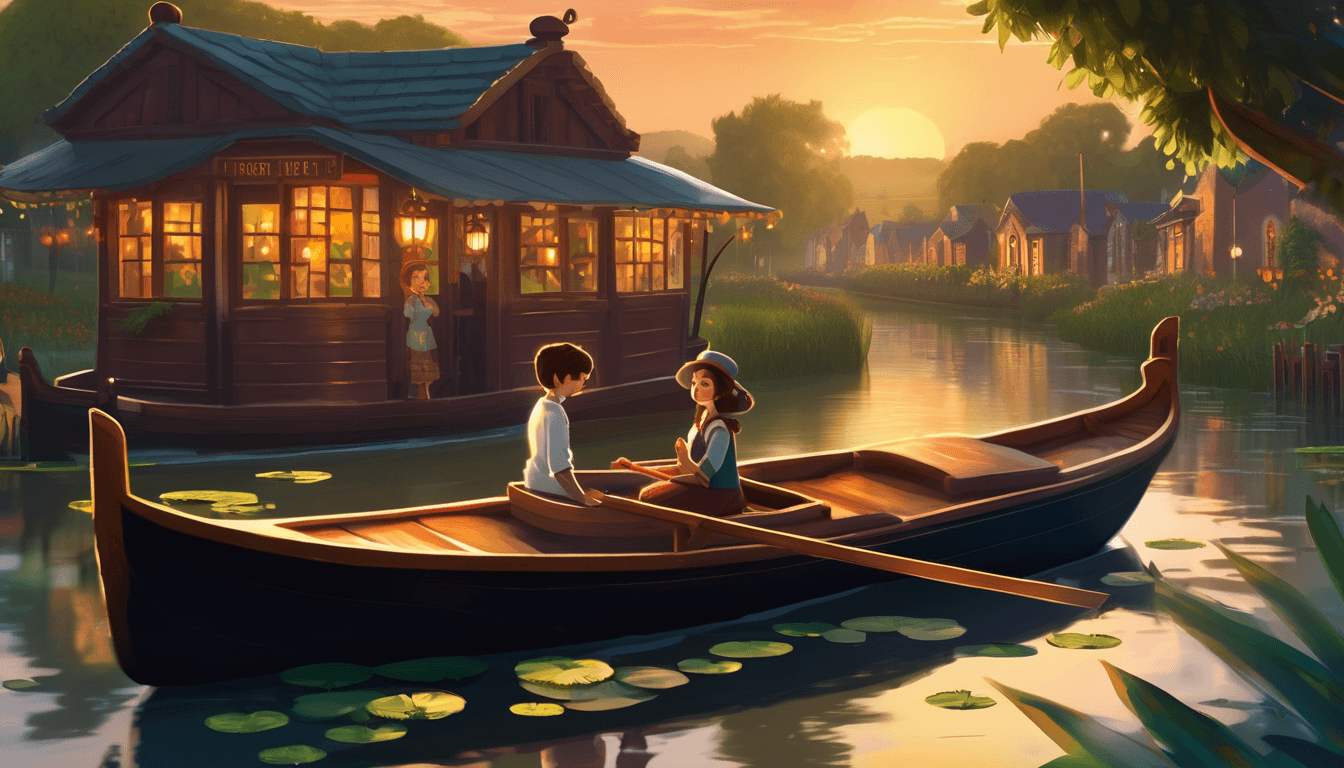
On the far side of the village of Brindlewick, beyond the bakery that smelled of warm cinnamon and beyond the field where goats wore little brass bells, there was an old canal.
It was not a busy canal anymore.
Once, long ago, it had been full of narrow boats painted in shining colors. They carried apples, coal, letters, wool, jars of honey, bundles of reeds, and sometimes even musicians with fiddles and flutes. But now the water lay quiet beneath the willow trees. Ducks paddled where barges had once passed. Moss grew over the stone lock gates. Most people in Brindlewick had forgotten where the canal went.
Most people, but not siblings Niko and Maren.
Niko was ten and liked maps, knots, and fixing things with bits of wire. Maren was seven and liked questions, secret doors, and listening very carefully to places that seemed empty.
One late summer afternoon, while their grandmother was picking beans in the garden, Niko and Maren followed a narrow towpath through tall grass.
“Look,” said Maren.
Half-hidden under drooping willow branches was a canal boat.
It was long and slim, with a curved roof and faded green paint. Its windows were dusty. One little chimney leaned to the side like a sleepy hat. Across the bow, just beneath a curl of peeling gold paint, were the words:
THE MARIGOLD STAR
Niko ran his hand over the letters.
“An abandoned boat,” he whispered.
“It does not look abandoned,” Maren said.
“It has a hole in the roof and a family of snails living on the door.”
“That could happen to anyone,” said Maren.
The door creaked open when they pushed it. Inside, the boat smelled of old wood, rainwater, and something sweet, like dried oranges. There was a tiny stove, a table bolted to the floor, two narrow bunks, and shelves full of dusty jars. On one shelf sat a blue teapot with a painted white moon on it.
And beside the teapot lay a thick leather book.
Niko opened it carefully.
It was a logbook.
The first pages were old and brown at the edges. They were filled with neat writing.
June 3rd. Delivered flour to Mossmere.
June 5th. Stopped at Bellwether Lock. Mrs. Varga traded us six onions for a spool of red thread.
June 9th. Reached Ferncliff. Children there sang from the bridge.
The names went on and on. Mossmere. Bellwether Lock. Ferncliff. Willowquay. Moonpond. The canal had curled across the pages like a ribbon, joining places Niko and Maren had never heard of.
Tucked into the back of the book was a map.
At the bottom, written in faded ink, was a note.
To whoever finds the Marigold Star, follow the old route kindly. The canal remembers those who care for it.
Maren looked around the quiet little boat.
“Do you think it wants to go home?” she asked.
Niko looked at the map. Then he looked at the roof hole, the broken rope, the stiff rudder, and the weeds tangled around the hull.
“It will need repairs,” he said.
“That means yes,” said Maren.
For the next two weeks, Niko and Maren worked on the Marigold Star.
Their grandmother, who had known about the boat all along, did not stop them. She only raised one eyebrow when they asked for old paint, a hammer, a bucket of nails, and three jars of blackberry jam.
“Where exactly do you plan to go?” she asked.
“Along the old canal route,” said Niko.
“Perhaps as far as the first lock,” said Maren, though her eyes shone when she said it.
Their grandmother smiled a small, knowing smile.
“Then take dry socks,” she said.
Niko patched the roof with wood from an old shed. Maren scrubbed the windows until sunlight flashed through them. Together they painted the boat green again, with yellow stars along the side. Their grandmother mended a curtain for the bunk beds from a pair of old blue tablecloths.
The village blacksmith fixed the little stove. The baker gave them a loaf of bread. The goat keeper donated a coil of sturdy rope.
And on the morning they were ready to leave, half of Brindlewick came to the towpath to wave.
Their grandmother stood at the front with a basket packed with cheese, apples, and dry socks.
“Remember,” she called, “a canal is not a road. You cannot hurry water.”
Niko untied the rope.
Maren pushed off with a long pole.
The Marigold Star bobbed once, as if clearing its throat.
Then, with a soft chug-chug-chug from its newly mended engine, it began to glide down the canal.
At first, the journey was easy. Dragonflies danced over the water like bright blue sparks. Herons stood among the reeds, still as statues. Niko steered while Maren sat on the roof with the old map spread over her knees.
“First stop,” she announced, “Bellwether Lock.”
By afternoon, they saw the lock ahead. It had two great wooden gates, green with moss. Beside it stood a stone cottage with a round chimney.
But the lock gates were shut tight.
Niko called, “Hello?”
No one answered.
Then a small face appeared in the cottage window. It belonged to a boy about Maren’s age, with curly hair and a smudge of flour on one cheek.
“You cannot come through,” he called. “The lock keeper went away years ago.”
“We have the Marigold Star,” said Maren.
The boy’s eyes grew wide.
“My grandfather told me about that boat!”
His name was Toma, and he lived in the cottage with his grandfather, who had once been the lock keeper’s helper. Toma hurried outside with a giant key hanging from a string around his neck.
“My grandfather says the old lock is stuck,” Toma explained. “No boats come here now, so nobody has tried to open it.”
Niko examined the rusty wheel that worked the gates. “It needs oil,” he said.
Maren searched the boat and found a small tin in a cupboard labeled FOR SQUEAKY THINGS.
Toma fetched a brush. Niko poured a few drops of oil onto the wheel. Together they pushed.
Nothing happened.
They pushed again.
The wheel groaned.
Maren began to sing a song she made up on the spot.
“Turn, turn, old wheel,
Wake your sleepy, rusty feel…”
Toma joined in. Then Niko did too, although he said he was only counting the turns.
At last, with a great creak and a splash, the lock gates opened.
Water rushed around the Marigold Star, lifting it gently into the next part of the canal.
Toma’s grandfather came out of the cottage, leaning on a cane. He had silver eyebrows and a red scarf tucked into his collar.
“I thought I would never see that boat again,” he said.
He touched the faded gold letters on its bow.
“Long ago, it brought flour for our winter bread,” he told them. “And news from all the villages. When the Marigold Star arrived, people would come down to the water just to hear where she had been.”
Before Niko and Maren left, Toma gave them a small brass bell.
“Ring it if you reach Ferncliff,” he said. “They might remember the sound.”
The next day, the canal became narrower. Trees leaned above it, their branches making a green tunnel. The old route was blocked in places by floating leaves and fallen twigs. Niko steered carefully. Maren used the pole to nudge away little piles of reeds.
Near sunset, they reached a place where the canal seemed to disappear beneath a thick wall of water lilies.
On the map, Maren found a tiny drawing of a bridge.
“Ferncliff should be beyond this,” she said.
“But the lilies are too thick,” said Niko.
They tried to push through. The boat moved one inch, then stopped.
Two inches, then stopped again.
Just then, there came a rustling from the bank. Out from the reeds stepped an old woman in a bright orange raincoat, followed by six children carrying rakes.
“I knew I heard an engine!” she cried. “Is that really the Marigold Star?”
Her name was Amaya, and she lived in Ferncliff, a village built on a hill above the canal. She explained that the people there had stopped clearing the water lilies when the boats stopped coming.
“We used to gather at the bridge when the boats arrived,” she said. “There would be parcels and visitors and sometimes a basket of peaches.”
The six children waded into the shallow edge of the canal. Niko and Maren climbed out too, and everyone worked together until the path through the lilies was wide enough.
When the Marigold Star emerged on the other side, the bell tower above Ferncliff began to ring.
Toma’s brass bell had worked.
People appeared along the bridge, first one or two, then dozens. They waved scarves and hats. A woman brought a basket of pears. A man carried a fiddle. Someone laughed so loudly that several pigeons flew into the sky.
That evening, the Marigold Star was tied beneath the bridge while the people of Ferncliff held a supper on the canal bank.
Amaya showed Niko and Maren an old painting of the boat, bright green and gold, passing beneath the very same bridge.
“We thought the route was gone,” she said softly.
“Maybe it was just waiting,” Maren replied.
The next morning, Niko and Maren set off once more.
They traveled for three more days.
At Mossmere, they found a tiny community of basket makers whose reeds had grown wild because no one came to collect them anymore. The basket makers filled the boat with a small bundle of golden reeds and taught Maren how to weave a star shape.
At Willowquay, they met a postmistress named Suri who still kept a drawer full of undelivered letters from long ago. Niko helped her sort them. Some were too old to send, but Suri read the names aloud, and people came from nearby farms to hear stories of their grandparents.
At Moonpond, the canal widened into a dark, round pool that reflected the night sky so clearly that it looked as if the boat were floating among stars.
There, a problem waited.
The old stone bridge at the far end had partly crumbled. A huge fallen branch lay across the water beneath it. The Marigold Star could not pass.
Niko studied the branch. It was far too heavy for the two of them.
“We have come all this way,” Maren said. Her voice was quiet.
The final place on the map was just beyond the bridge. It was called Lantern Hollow.
Niko looked at the water. “We do not have to do everything alone,” he said.
So they rang the brass bell.
Once.
Twice.
Three times.
At first, only the sound of frogs answered.
Then, far down the canal, another bell rang.
From Bellwether Lock came Toma and his grandfather in a little rowboat. From Ferncliff came Amaya and the six children with their rakes. From Mossmere came basket makers carrying ropes woven from reeds. From Willowquay came Suri with a cart full of tools.
By afternoon, people had gathered all along the canal bank.
Together, they looped ropes around the fallen branch. Some pulled from the bank. Some pushed with poles. Niko showed everyone how to tie the strongest knot he knew. Maren climbed onto the boat roof and called out the count.
“One, two, three, pull!”
The branch rolled.
“One, two, three, pull!”
It shifted into the reeds.
“One, two, three, pull!”
With a splash that soaked everyone’s boots, the branch slid free.
The canal lay open.
As the Marigold Star passed under the broken bridge, everyone cheered.
Beyond it was Lantern Hollow.
It was a little village nestled among round hills. Long ago, its people had made lanterns from colored glass, and every boat that passed had carried some away to other towns. But when the canal route was forgotten, the lantern makers had nearly stopped.
Now, when the Marigold Star arrived, the people of Lantern Hollow came out carrying lanterns of red, blue, amber, and green.
They hung them from the trees, the bridge, the boat roof, and the long poles along the water.
As night fell, the canal glowed.
The old route, which had seemed like a thin faded line in a dusty book, was alive again. It stretched behind them through locks and villages, under bridges and through willow tunnels. It connected people who had not known they were waiting for one another.
Niko stood at the bow beside Maren.
“We repaired a boat,” he said.
Maren shook her head.
“We repaired a journey.”
Later, after songs and soup and many happy goodbyes, the Marigold Star began the slow trip home.
This time, it did not travel through silence.
At every village, lamps shone beside the water. People waved from bridges. New letters waited in Suri’s post bag. Baskets of reeds rested on the deck. A parcel of flour was tucked beside the stove for Bellwether Lock.
And when Niko and Maren finally returned to Brindlewick, their grandmother was waiting beneath the willow tree.
She looked at the glowing lantern tied to the bow, the piles of letters and baskets, the muddy boots, and the two very tired children.
“Well,” she said, “did you get as far as the first lock?”
Maren yawned.
“Much farther,” she said.
That night, Niko and Maren slept in the little bunks aboard the Marigold Star.
The canal whispered softly against the sides of the boat.
Outside, the willow branches swayed.
Inside, the blue teapot gleamed in the moonlight, and the old logbook lay open on the table.
On a fresh, clean page, Niko had written:
Today, the Marigold Star sailed again.
Beneath it, Maren had added:
And nobody along the canal was forgotten anymore.
Then the boat gave one gentle creak, like a satisfied sigh, and carried them both into dreams of glowing bridges, secret maps, and water paths that led to wonderful places still waiting to be found.

Leave a Reply