
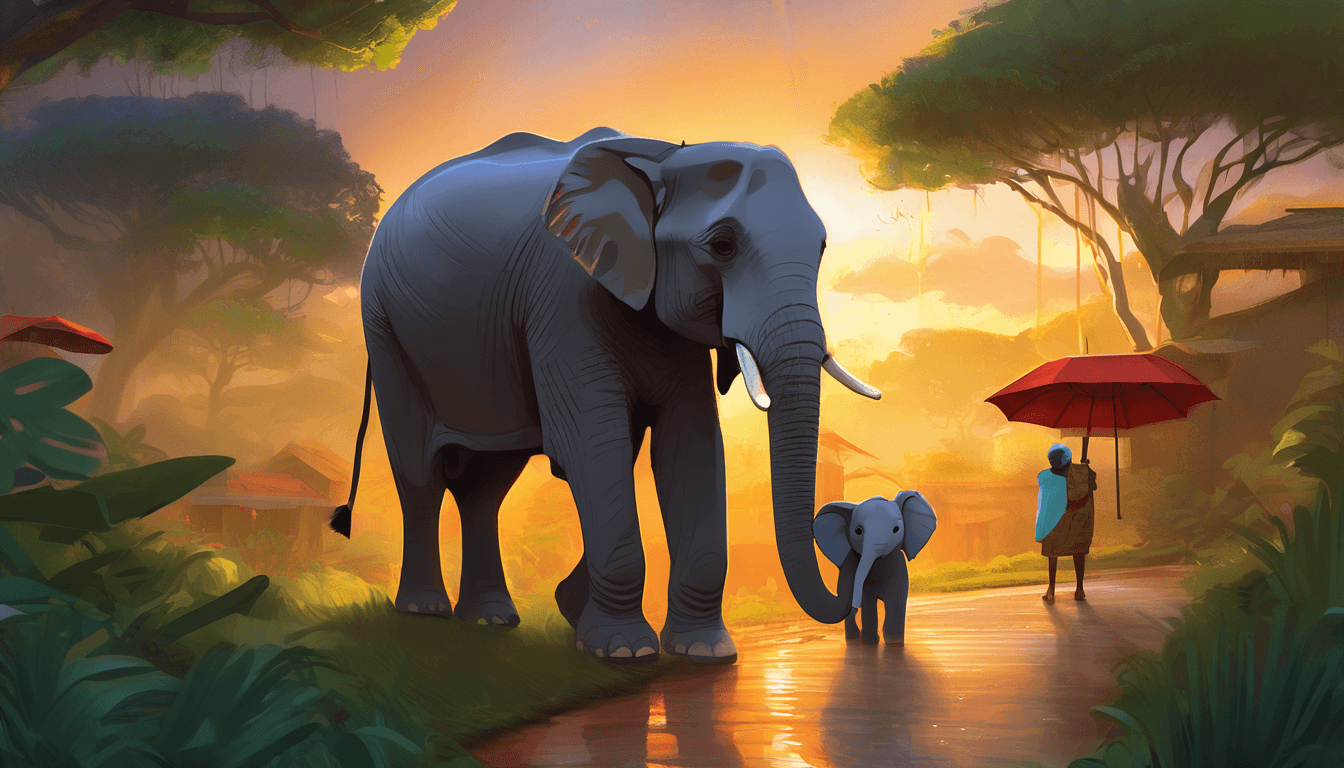
On the edge of a wide golden plain, where tall grass whispered all day and the moon rose round and silver each night, there lived a family of elephants.
They were called the Riverstone herd, because their oldest grandmother had been born beside a river full of smooth gray stones.
The herd had many members. There was Nuru, the great grandmother, whose ears were wide and soft as old blankets. There was her daughter, Amara, strong and gentle. There was Biko, who liked to splash in mud puddles. There was tiny Sade, who had a tail she could never quite catch. And there was Kofi, a young bull elephant with bright eyes and a trunk that was always reaching toward something interesting.
The Riverstone elephants remembered things.
They remembered where water hid beneath dry soil.
They remembered which trees made sweet fruit after the first rain.
They remembered the safest way down steep riverbanks, the places where lions liked to sleep in the shade, and the quiet paths between thorn bushes where even a baby elephant could walk without getting scratched.
But more than anything, they remembered the paths their ancestors had travelled.
These paths had been walked by elephant feet for hundreds and hundreds of years. Elephants had followed them under blazing suns, through cool forests, across sleepy valleys, and beside rivers that shone like ribbons in the morning.
The paths were not marked with signs.
They lived in the elephants’ memories.
Nuru carried the oldest memories of all.
Sometimes, at dusk, when the little elephants were tucked close beneath the grown elephants’ bellies, Nuru would sway slowly and tell them stories.
“My grandmother taught me a path,” she would say. “And her grandmother taught her. It begins at the crooked baobab tree, turns toward the hill that looks like a sleeping buffalo, and crosses a field where purple flowers grow after rain.”
“How can you remember so much?” Sade would ask.
Nuru would curl her trunk around Sade’s tiny trunk.
“Because remembering helps us care for one another,” she would say.
One late afternoon, the sky changed color earlier than usual.
Dark clouds rolled over the plain, big and blue-gray, and a warm wind hurried through the grass. Birds flew low toward their nests. Zebras trotted quickly toward the acacia trees. Even the sleepy tortoises tucked their heads in a little closer.
“A rainstorm is coming,” said Amara.
The Riverstone herd began to move toward a grove of trees near a shallow valley. It was a safe place to wait for storms. The ground there was high enough that it did not flood, and the trees made a leafy roof overhead.
Nuru led the way.
Her feet knew where to go.
Kofi stayed near the back, watching raindrops begin to dimple the dusty earth. He loved the smell of rain. It smelled cool and brown and full of secrets.
Then he heard something.
Not the rumble of thunder.
Not the squeak of bats waking in a nearby cave.
It was a small sound.
A crying sound.
Kofi stopped.
“Did you hear that?” he asked.
The elephants became still.
Their enormous ears lifted.
The cry came again, thin and shaky beneath the rustling grass.
Nuru turned toward a cluster of low bushes. “Stay together,” she said.
The herd moved carefully, their feet making almost no sound despite their size.
Behind the bushes, curled beside a fallen branch, was a child.
He was small, with muddy knees, a yellow raincoat, and one red boot. The other boot was missing. His cheeks were wet with tears. In one hand, he clutched a little wooden toy rabbit.
When he saw the elephants, his eyes grew very wide.
For a moment, nobody moved.
Then Nuru lowered herself as gently as she could and reached out her trunk. She did not touch the child. She only placed her trunk upon the ground nearby.
The child sniffed.
“Are you going to step on me?” he whispered.
Sade gave a surprised little squeak.
“No one steps on anyone in our family,” said Amara in her deep, warm elephant voice.
The child stared at her.
“You can talk?”
“Of course,” said Biko. “Though sometimes Kofi talks too much.”
“I do not,” said Kofi.
“You asked a dragonfly where it learned to fly this morning,” Biko reminded him.
The child made the tiniest smile.
Nuru looked at the yellow raincoat. “What is your name, little one?”
“Mateo,” he said. “I was walking with my grandmother and my dad near the park gate. Then the rain started. I chased my rabbit because the wind blew it away. And then I got lost.”
He held up the wooden rabbit. One ear was chipped.
“I found him,” Mateo said sadly. “But I couldn’t find them.”
Thunder rumbled far away.
The first real rain began to fall.
The elephants quickly formed a circle around Mateo. Their broad bodies made a warm living wall. Their backs caught the rain, and their legs made a safe little room in the middle.
Mateo looked up through the elephant legs at the wet grass beyond.
“I want to go home,” he said.
“We will help you,” Nuru told him.
“But where is your home?” asked Kofi.
Mateo pointed vaguely through the rain. “That way. Or maybe that way. There was a path. And a fence. And a red roof. And a man selling oranges.”
Biko blinked. “That could be many places.”
Mateo’s lip trembled.
Nuru touched the earth with the tip of her trunk. Her eyes became quiet and faraway.
“A fence,” she murmured. “A red roof. Oranges.”
Amara looked at her mother. “Do you remember something?”
“I remember an old path,” Nuru said. “Not from my own travels. From my mother’s memories. And from her mother’s before her.”
The younger elephants gathered close, even though rain ran down their faces.
Nuru began to speak slowly.
“Long ago, before this plain had roads, before the park had gates, elephants travelled from the river to a hill covered in wild olives. Along the way, they passed a little settlement. There was a market there. Traders brought bright cloth, baskets, and oranges that smelled like sunshine.”
Mateo lifted his head. “Oranges?”
“Yes,” said Nuru. “The settlement grew. The paths changed. But perhaps one old path still leads near it.”
“Can we follow it?” asked Sade.
Nuru listened to the rain.
“The storm will wash away many scents,” she said. “But the ground remembers. And we remember with it.”
When the rain softened to a silver mist, the Riverstone herd set off.
Amara carefully lifted Mateo with her trunk and settled him on the broad, warm space between her head and shoulders. Mateo held on to one of her ears. He had never sat so high before.
From up there, the world looked enormous.
Grass stretched away in shining waves. Raindrops clung to spiderwebs. A herd of impalas bounded across the plain like little springs. In the distance, the clouds broke open enough for a strip of sunset to glow peach-colored beneath them.
Nuru walked ahead.
Every so often she would pause. She would press her trunk to the ground, smell the damp soil, and listen.
“This way,” she would say.
They crossed a dry streambed where frogs now sang in the puddles.
“This was once a river crossing,” Nuru said.
They passed three flat rocks standing close together.
“My ancestors rested here during a season of great heat,” Nuru said.
They walked beside a line of thorn trees that curved across the plain.
“This was the edge of a forest,” said Nuru. “The forest is gone now, but the path remains.”
Mateo listened closely.
He began to understand that Nuru’s memories were like lanterns. They shone backward through time, helping them see forward.
Soon, however, they came to a wide road.
It was wet and black beneath the fading sky. Cars hurried along it, their lights blinking yellow and white. Beyond the road stood fences, houses, and the faraway glow of a town.
Mateo sat up straight.
“I think my home is over there,” he said.
But the road was busy, and the elephants could not simply cross.
The herd waited beneath a clump of trees.
Mateo grew quiet again.
“What if my dad and Grandma are worried?” he asked.
“Oh, they are worried,” said Amara kindly. “That is what families do when someone is missing.”
“Will they be angry?”
“They may have frightened voices at first,” said Nuru. “But under frightened voices, there is often love.”
Just then, Kofi lifted his head.
“I hear something!”
Everyone listened.
At first Mateo heard only cars and dripping leaves.
Then he heard it too.
“Mateo!” called a voice in the distance.
“Mateo!”
A woman was calling from beyond the road.
Mateo gasped. “Grandma!”
Across the road, near a little building with a red roof, people were searching with flashlights. A man in a soaked blue jacket called Mateo’s name. Beside him stood an older woman holding an orange umbrella. Near their feet was a park ranger, and beside the ranger was a small cart filled with bright oranges.
“The orange man!” Mateo cried.
Nuru rumbled softly. “Then we have found the right memory.”
The elephants could not cross the road safely, but they knew what to do.
Nuru lifted her trunk high and gave a deep, rolling call.
It was not loud in a sharp way. It was deep, like distant thunder under the ground.
The sound drifted over the road.
The people stopped.
The park ranger looked toward the trees.
The man in the blue jacket called again, louder than ever. “Mateo!”
Mateo waved both arms.
“Dad!”
His father saw him.
For one breath, the whole world seemed to stop.
Then the ranger quickly spoke to the drivers, and cars slowed. The road became quiet. Mateo’s father and grandmother hurried across, splashing through puddles.
Amara knelt low.
Mateo slid down her shoulder, still holding his wooden rabbit.
His grandmother reached him first. She wrapped him in her orange-smelling arms. His father hugged them both so tightly that Mateo could barely see the elephants anymore.
“I found an elephant family,” Mateo said into his father’s jacket.
His father laughed and cried at the same time. “I can see that.”
Mateo stepped back and looked at Nuru.
“Thank you,” he said.
Nuru bent her great head.
“You found your way home,” she said. “We only shared the path.”
Mateo took off his yellow raincoat. It was too small for an elephant, of course, but he held it out anyway.
“For you?”
Nuru’s eyes crinkled.
“That is a very kind gift,” she said. “But keep it. Rainy days may bring you more adventures.”
Mateo nodded seriously.
Then he looked at the herd, at their shining wet backs, their gentle eyes, and their trunks curled together.
“I will remember you,” he promised.
Nuru gave a soft rumble.
“And perhaps,” she said, “one day you will tell someone else about the night when an old memory helped you find the way.”
The elephants turned back toward the plain.
The storm had passed. Stars were beginning to appear, one by one, in the freshly washed sky.
As they walked, Sade pressed close to Nuru.
“Will Mateo remember the path?” she asked.
“Maybe not every turn,” said Nuru.
“Then what will he remember?”
Nuru looked back once toward the red roof, the orange umbrella, and the warm little lights of home.
“He will remember that he was not alone,” she said.
The Riverstone herd walked on beneath the stars, following the ancient paths held safely in their hearts.
Leave a Reply