

Princess Marisol lived in a palace with seven silver towers, each one topped with a blue glass roof that shone like a sleepy raindrop in the sun.
The palace stood on a gentle hill above the city of Varenna. From the tallest window, Marisol could see red chimneys, curving streets, tiny market umbrellas, and beyond them all, the forest. The forest was dark green in summer, coppery in autumn, white and quiet in winter, and full of soft bright leaves in spring.
Everyone in the palace said that the hill belonged to the royal family.
But Princess Marisol was not so sure.
Every morning, she noticed little signs.
A line of ants carried crumbs along the edge of the kitchen wall.
Pigeons tucked themselves beneath the bell tower when rain began.
Mice made warm nests behind the old library shelves.
A fox slipped through the palace garden at dawn, leaving neat pawprints among the roses.
And late at night, when the palace lamps were dim and the cooks had gone to bed, Marisol sometimes heard a gentle rustling beneath the stone floors.
Scratch, scratch.
Scurry, scurry.
Tap.
Once, while sitting on the carpet beside her bed, she pressed her ear to the floor and whispered, “Hello?”
For a moment, there was silence.
Then something small and cautious whispered back.
“Not hello.”
Marisol sat up straight.
“What should I say, then?” she asked.
A tiny voice came through the floorboards.
“Ask properly.”
“But I do not know how.”
There was a soft little squeak, almost like a laugh.
“Then learn.”
After that night, Princess Marisol could think of almost nothing else.
She asked the royal librarian, Old Master Barto, whether animals had special names.
“Of course they do,” said Master Barto, polishing his round spectacles. “The names we give them are sometimes only the names we can pronounce.”
“You mean Sparrow is not truly called Sparrow?”
“Perhaps not,” said the librarian. “Perhaps Sparrow has a name made of morning air, chimney smoke, and three quick wingbeats. Perhaps a badger’s name sounds like digging beneath wet earth. Perhaps a snail’s name is so slow that it takes all afternoon to say.”
Marisol’s eyes grew wide.
“How can I learn them?”
Master Barto closed his book.
“By listening with more than your ears.”
That was not a very easy answer, but Princess Marisol was determined.
The next morning, she carried a small basket of hazelnuts to the garden and sat beside the old walnut tree. Squirrels leaped from branch to branch above her, their tails flicking like feathery flags.
“I know your name,” Marisol called up. “You are squirrels!”
The squirrels froze.
One of them, a plump brown fellow with one white whisker, stared at her.
Then he chattered sharply.
“Chik-chik-chik!”
Marisol listened.
The sound was not quite a word. But as she watched him, she understood something. He was not saying, “I am a squirrel.”
He was saying, “I have hidden six walnuts under the stone lion, but I cannot remember where I hid the seventh.”
Marisol looked around. At the base of the stone lion near the fountain, a tiny walnut was tucked under a fallen leaf.
The squirrel dashed down, found it, and spun around joyfully.
“Chik!”
Marisol smiled. “Your name is Chik?”
The squirrel shook his tail.
No, not exactly.
He tapped his chest with both paws, then pointed at the walnut, then raced in a circle around the tree.
Marisol tried again.
“Your name is Chik-Walnut-Quick-Quick?”
The squirrel gave such a pleased chatter that three other squirrels came to see.
By lunchtime, Princess Marisol had learned the secret name of a shy hedgehog, who was called Prickle-Under-Moonlight, and a pair of pigeons named Roof-Warm and Crumb-Finder.
That evening, she visited the kitchen.
The palace cook, Madame Zsuzsa, was rolling dough for tomorrow’s bread.
“Your Highness,” said Madame Zsuzsa, “you have flour on your crown.”
“I am learning animal names,” Marisol explained.
Madame Zsuzsa nodded as though this was a very sensible thing for a princess to do. “Then you should meet the kitchen mice. They know everything.”
She set a saucer of oat milk by the wall and waited.
Soon, from a narrow crack behind the copper pots, came two small gray mice. One had a round belly. The other had ears so large that they seemed to listen before the rest of him had arrived.
Marisol sat very still.
The round mouse sniffed the air and squeaked, “Pip-pip-pip.”
The princess remembered that names were not always sounds.
The mouse looked at the milk, then at the flour, then at a little hole near the woodpile. He patted his belly.
“Milk-Before-Midnight?” Marisol guessed.
The mouse tilted his head.
The other mouse ran in a fast loop, climbed halfway up a chair leg, slid down, and squeaked three times.
“Fast-Ears-Behind-the-Pots?”
This time, both mice squealed with delight.
Each day, Marisol learned more.
Under the stairway lived a family of beetles whose oldest grandmother was called Polished-Shell-Who-Remembers-Rain.
In the stable, a chestnut mare named Amber-Breath-Gentle-Hooves told Marisol that the palace cats had been grumbling.
At the edge of the cellar, a pale spider named Thread-Between-Quiet-Corners warned her that water had been dripping somewhere it should not.
And in a little hollow beneath the palace greenhouse, Marisol met a mole.
He was velvety black, with wide digging paws and a pink nose that quivered importantly.
He pushed up through the earth and said, “Hrumph.”
Marisol knelt in the damp soil.
“Hrumph?” she asked.
The mole shook his head.
He dug one tunnel, then another. He made a tiny hill. He pointed his nose toward the palace. Then he made a worried sound.
Marisol watched carefully.
“You live beneath the palace,” she said.
The mole nodded.
“And your name is… Deep-Dark-Digging-Where-No-One-Looks?”
The mole’s nose wiggled with pleasure.
Then he gave a much more serious hrumph.
That night, the princess could not sleep.
The palace was still. Moonlight lay across the floor in pale squares. Somewhere in the distance, a clock chimed twelve times.
Marisol pressed her ear to the floor.
“Deep-Dark-Digging-Where-No-One-Looks?” she whispered.
From far below came a faint answer.
“Hrumph.”
“Are you worried?”
A long pause followed.
Then there was a scratching sound, a rustle, and many tiny feet moving beneath the stones.
Finally, the mole’s voice rose through a crack near the fireplace.
“The hill is thirsty,” he said.
Marisol sat up.
“What does that mean?”
“The underground stream has changed its path. The roots are dry. The tunnels are crumbling. Soon the old water may come into the cellar, and the creatures below will have nowhere safe to go.”
Marisol felt cold, though her room was warm.
“Why has no one told me?”
“People above do not listen below,” said the mole.
The next morning, Marisol rushed to her father, King Danyal.
“The hill is thirsty,” she told him. “The underground stream is moving. The animals under the palace are in danger.”
The king was a kind man, but he had a stack of papers beside his breakfast and three ministers waiting to speak with him.
“Animals beneath the palace?” he said gently. “Marisol, I am sure the gardeners can check for burrows.”
“But it is more than burrows.”
Minister Oskar cleared his throat. “Your Majesty, preparations for the Moon Lantern Ball must begin today. The grand ballroom needs new banners, the cellars must be cleared, and the old storerooms beneath the palace are to be opened.”
Marisol’s heart gave a jump.
“The cellars must not be cleared,” she said. “Not yet.”
The minister smiled the way grown-ups sometimes smiled when they thought a child was being sweet but mistaken.
“Your Highness, there are only cobwebs and old crates down there.”
“There are not only cobwebs,” Marisol said.
But no one listened.
So that afternoon, Princess Marisol did something very bold.
She wrote invitations.
Not on shiny royal paper, because paper would crinkle and tear in underground tunnels. Instead, she tied messages to acorn caps, smooth pebbles, bits of bark, and dry leaves.
To the mice she sent oats.
To the pigeons she sent seeds.
To the ants she sent crumbs arranged in a circle.
To the beetles she sent polished buttons.
To the fox, she left a silver-blue feather beside the garden gate.
And on each little invitation, Marisol wrote:
By order of Princess Marisol, keeper of listening ears, all animals living beneath, within, beside, and around the palace are invited to a Royal Council at moonrise.
That evening, she opened the great old music room. It was not used for dancing anymore because its wooden floor was scratched and its curtains were faded. Marisol thought it was perfect.
She placed cushions under the chairs for the hedgehogs.
She left the windows open for the pigeons and bats.
She put bowls of water along the walls.
She scattered nuts, seeds, berries, carrots, and crumbs.
Then she sat alone in the middle of the room, wearing her simplest blue dress and no crown at all.
At first, nothing happened.
The moon rose slowly.
A moth circled the chandelier.
Then, beneath the door, came a mouse.
Then another.
Then twenty more.
The squirrels arrived along the curtain rods. Pigeons fluttered down from the window ledges. A line of ants marched in through a crack in the wall. The stable cat, Whiskers-of-the-North-Stair, slunk in with great dignity and pretended not to notice the mice, because tonight was a royal council.
From the garden came the fox, Red-Feet-Among-Roses.
From the greenhouse came the mole.
And from a high beam, a little brown bat hung upside down and introduced herself with a squeaky song that meant, I am Echo-Finds-the-Way-Home.
Soon the room was full of soft noises. Sniffing. Chirping. Rustling. Fluttering. Tiny claws on wood. Little feet on stone.
Princess Marisol stood.
“Friends,” she said, “I have called you here because I have learned that this palace is not only my home. It is your home, too. I am sorry that people above have not listened.”
The animals grew quiet.
“The stream below is changing,” she continued. “The cellar will soon be cleared for the Moon Lantern Ball. I need to know what should be done.”
For a while, everyone spoke at once.
The pigeons cooed from the rafters.
The mice squeaked from the floor.
The ants tapped messages with their feelers.
The fox gave a low, worried whine.
Marisol tried to listen with more than her ears.
Then Deep-Dark-Digging-Where-No-One-Looks climbed onto a cushion.
He scratched a map into the dust with his broad paws.
There was the palace.
There was the old cellar.
There was the underground stream.
And there, beneath the west tower, was a round pool hidden behind a wall of loose stones.
“The old spring,” whispered Master Barto, who had quietly entered the room in his night robe.
“You knew about it?” Marisol asked.
“I had forgotten,” said the librarian sadly. “It was sealed long ago, before I was born. The palace was built around it.”
The mole pointed at the blocked spring.
If it were opened, the water could flow safely into an old stone channel leading to the garden pond. The roots would drink. The tunnels would stay dry. The cellar would not flood.
“But the channel is blocked by heavy stones,” said Marisol.
Red-Feet-Among-Roses lifted his nose.
The fox knew a path through the old storeroom.
Whiskers-of-the-North-Stair knew where the key to the storeroom was kept.
The pigeons knew how to reach the king’s bedroom window without waking the guards.
The ants knew which stones were loose.
And Echo-Finds-the-Way-Home knew how to guide everyone through the dark.
Princess Marisol smiled.
“Then we have a plan.”
At midnight, the royal rescue began.
The pigeons flew to King Danyal’s window and tapped their beaks against the glass until he woke.
The king opened the window, blinking in surprise.
“Princess Marisol?” he called, for there she was below in the moonlit courtyard with a fox, a cat, and what seemed to be an entire army of very determined small animals.
“Please come quickly,” she said. “The council has decided.”
King Danyal put on his boots, followed Marisol to the cellar, and listened as she explained.
This time, he did not smile as though she were mistaken.
He saw the damp walls.
He heard the water murmuring behind the stones.
He watched the mole’s paws tremble as bits of soil fell from the ceiling.
“I should have listened,” the king said.
Then he called the palace workers, not to clear the cellar for a ball, but to help save the hill.
By lantern light, they carefully moved the old crates. They followed the fox through the storeroom. The cat found the key. The ants showed which stones could be lifted first. The mole guided the workers to the old spring.
At last, with a deep rumble and a splash, the blocked channel opened.
Clear water rushed through the old stone path, singing as it went.
It flowed beneath the palace, out through the garden, and into the pond where sleeping ducks bobbed gently in the dark.
The roots drank.
The tunnels steadied.
The thirsty hill gave a long, quiet sigh.
In the morning, the king announced that the Moon Lantern Ball would not be held in the grand ballroom.
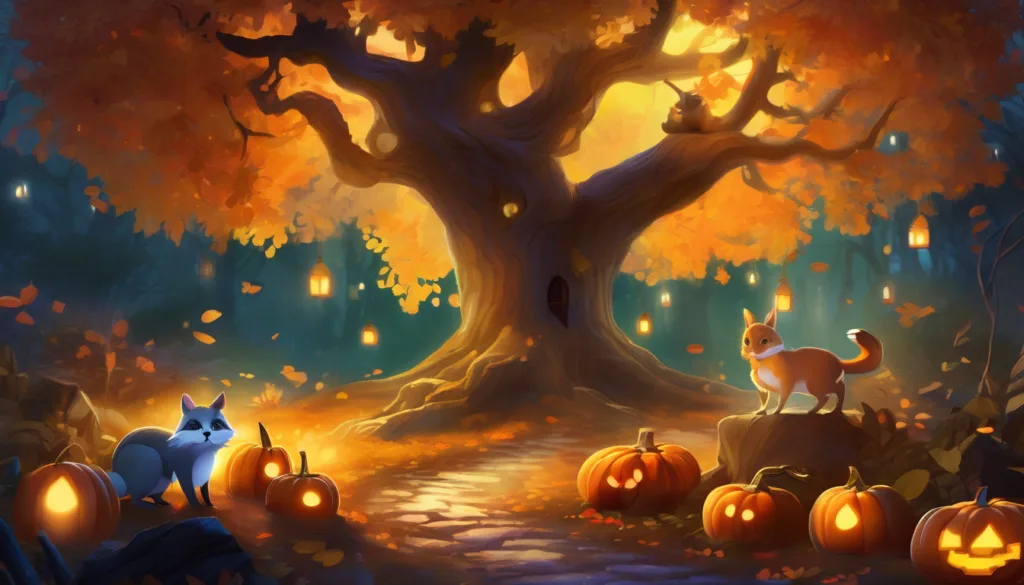
Instead, it would be held in the palace garden.
There would be lanterns in the trees, music by the pond, and a new promise carved above the palace gate:
This home is shared by all who shelter here.
Princess Marisol did wear her crown that evening, but only for a little while.
Then she set it on a cushion beside her chair and sat on the grass with the animals.
Chik-Walnut-Quick-Quick stole a sugared almond from a serving tray.
Prickle-Under-Moonlight slept beneath a fern.
Roof-Warm and Crumb-Finder danced in the fountain spray.
Deep-Dark-Digging-Where-No-One-Looks rested in a soft patch of garden soil, his pink nose shining.
And as the lanterns glowed above the palace, Marisol listened to the chirps, squeaks, rumbles, flutters, and rustles all around her.
They were not just noises anymore.
They were names.
They were stories.
They were neighbors saying, in their own secret ways, good night.


Leave a Reply