
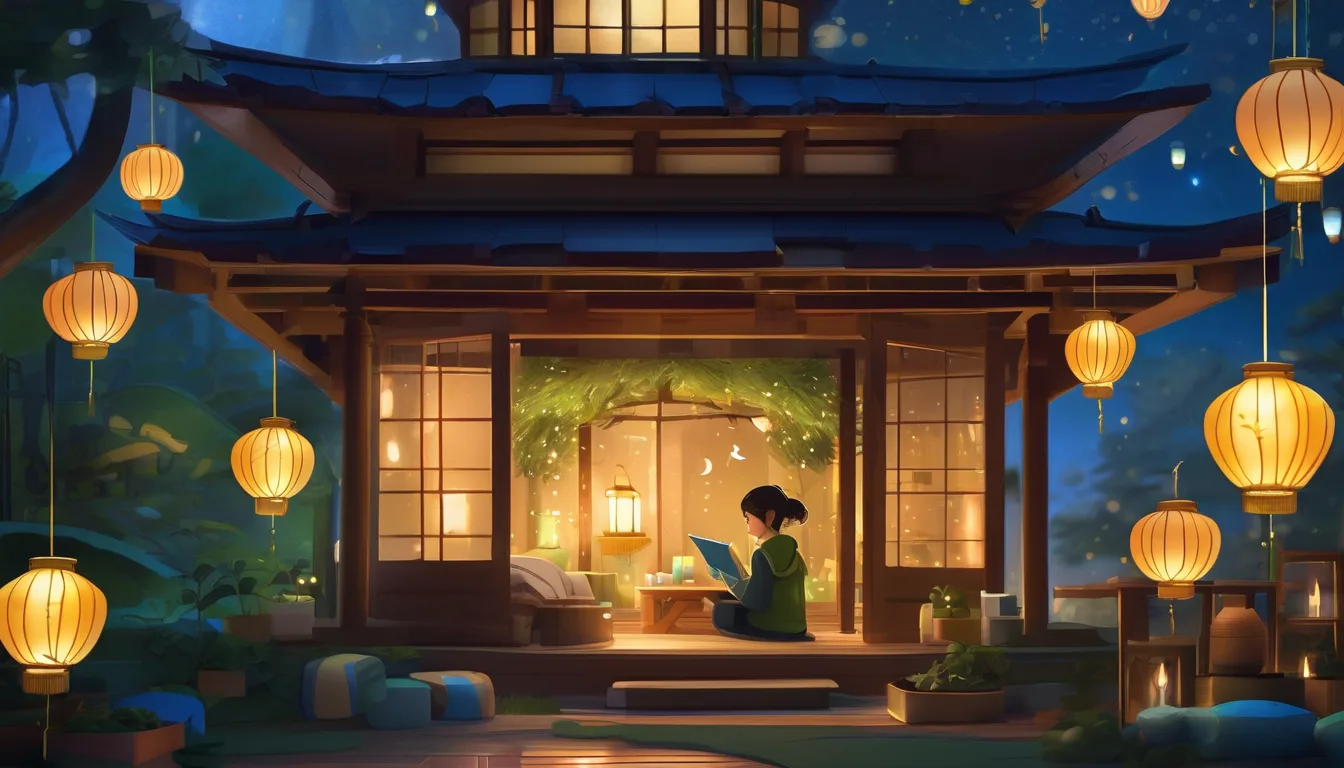
In the hillside town of Bellwether, every window had a round blue lantern hanging in it.
Some lanterns were tiny, no bigger than a teacup. Some were large enough for a child to sit inside. At dusk, when the sky turned purple and the first stars blinked awake, the blue lanterns shone all along the cobbled streets.
It was almost time for the Night of Many Windows, Bellwether’s oldest community celebration.
People said it began many, many years ago, when a thick fog had covered the valley for seven whole days. Families had placed lamps in their windows so travelers could find the road home. When the fog finally lifted, everyone had been so relieved that they shared soup, music, bread, and stories in the town square.
Ever since then, the people of Bellwether had lit blue lanterns each autumn.
But this year, a robot apprentice named Miko was going to help prepare.
Miko was made of polished copper, with small round feet, gentle bright eyes, and a little toolbox built into his chest. He belonged to Professor Safiya, the town’s historian and inventor.
“Human traditions,” Professor Safiya had told him that morning, “are very important things to study.”
Miko’s eyes glowed pale gold.
“Please define tradition,” he said.
Professor Safiya smiled as she tied up her silver hair with a yellow scarf.
“A tradition is something people do again and again because it reminds them of something they care about.”
Miko made a soft whirring sound as he thought.
“So, if I polish your teapot every Tuesday, that is a tradition?”
“It could become one,” said Professor Safiya. “Especially if one day I missed it.”
Miko opened the notebook kept behind the little door in his chest.
Tradition, he wrote carefully. Something repeated because it carries care.
Then he looked toward the windows, where blue lanterns waited on tables, shelves, and doorsteps.
“What does this celebration carry?” he asked.
“That,” said Professor Safiya, “is what you must discover.”
Miko’s apprentice wheels gave an excited squeak.
His first task was to help Mr. Bako, the baker. At the bakery, warm smells floated through the air like invisible blankets. Cinnamon, orange peel, melted butter, and bread crust curled around Miko’s metal head.
Mr. Bako was rolling dough into long ropes.
“For the Night of Many Windows,” he explained, “we make moon-knot bread.”
He crossed the ropes into loops, then tucked the ends beneath.
“Why knots?” asked Miko.
“My grandmother said the knots stood for neighbors holding together during the old fog.”
Miko watched closely. “Then each loaf must have three loops, perhaps, for the three kinds of neighbors?”
Mr. Bako paused. “Three kinds?”
“Nearby neighbors, faraway neighbors, and neighbors who are lost in fog.”
Mr. Bako’s floury eyebrows rose.
“That is a lovely thought,” he said. “Though my grandmother always made four loops.”
“Why four?”
“She had four sisters.”
Miko’s gears ticked. This did not match his plan.
“But if the knots represent neighbors, then the number should be the same for all bread.”
Mr. Bako laughed, not unkindly.
“Ah, little apprentice. Traditions are not always as neat as a row of buttons. My grandmother added a loop for each sister because they helped her through difficult days. That was her meaning.”
Miko wrote in his notebook.
Traditions may have extra loops.
He helped make the moon-knot bread, though his fingers were better at tightening screws than pinching dough. His first knot looked like a sleepy snail. His second looked like a shoe. His third, after Mr. Bako showed him slowly, became a proper plump loop.
By noon, Miko rolled to the town square. There he found Auntie Nori hanging hundreds of tiny paper stars from a wide old sycamore tree.
“They used to hang bells,” she said, passing Miko a string of stars. “But the bells frightened the sheep, so we changed them.”
“Changed them?” asked Miko. “But then was it still the same celebration?”
Auntie Nori looked up at the branches, which shivered green and gold in the breeze.
“My father loved the bells,” she said. “He said they sounded like cheerful rain. But my daughter, Hana, was scared of their clanging when she was small. So one year we folded paper stars instead. Hana drew silver dots on every point.”
She held up a star with a faded silver dot.
“That was forty years ago. We have made stars ever since.”
Miko inspected the paper star.
“Then the tradition changed because of Hana?”
“Yes.”
“Is Hana important to the Night of Many Windows?”
Auntie Nori smiled. “She is important to me. Sometimes that is enough.”
Miko’s eyes blinked slowly.
Traditions may change to make room for people, he wrote.
In the afternoon, he visited the river path, where children were painting lanterns with their families. There were lanterns with blue waves, blue cats, blue mountains, blue flowers, and blue moons.
A little boy named Tomas was painting his lantern bright green.
Miko rolled closer.
“Excuse me,” he said politely. “The lanterns are blue.”
Tomas frowned at his green paintbrush. “Mine is blue and green.”
“Mostly green.”
“My grandfather likes green.”
“But this is the Night of Many Windows. The lanterns should be blue because blue lanterns helped people in the fog.”
Tomas’ shoulders drooped.
“My grandfather cannot see blue very well,” he whispered. “He says blue looks gray to him. But he can see green. I want him to know which lantern is ours.”
Miko became very still.
He looked at the lantern. Green vines curled around a blue moon. In the middle was a tiny painted house, with a yellow square for a window.
“It will help your grandfather find you,” Miko said.
Tomas nodded.
Miko took out his notebook.
Traditions may change so someone can find their way.
That evening, just before the celebration began, dark clouds gathered over Bellwether.
The blue lanterns shivered in the wind.
Professor Safiya stood in the square, looking worried. “Rain,” she said. “A great deal of rain.”
The musicians tucked their instruments under their coats. Mr. Bako covered the moon-knot bread with cloth. Auntie Nori watched her paper stars spin wildly in the wind.
Then the first raindrop fell.
Plink.
Then another.
Plink.
Then the rain came down in silver curtains.
Everyone hurried beneath porches, awnings, and umbrellas. The lanterns began to go out one by one.
Miko’s chest made a low unhappy hum.
“Celebration interrupted,” he said. “Tradition unsuccessful.”
Professor Safiya crouched beside him. Rain tapped on her umbrella like small fingers.
“Is it?” she asked.
Miko looked around.
Mr. Bako had carried baskets of bread into the library. Auntie Nori was gathering wet paper stars and laying them carefully between book pages to dry. Tomas held his green-and-blue lantern beneath his coat, protecting it with both arms.
The mayor called, “Come to the town hall! We can light the lanterns there!”
“But the windows,” said Miko. “The tradition requires windows.”
“Does it?” asked Professor Safiya.
Miko searched his memory.
Blue lanterns. Windows. Fog. Neighbors. Knots. Bells. Stars. Green paint.
His thoughts spun faster than his gears.
The townspeople crowded into the warm town hall. They hung lanterns from chairs, shelves, curtain rods, and even the big old clock. Those whose lanterns had gone out relit them with matches and tapers. Blue lights, green lights, and blue-and-green lights glowed all around the room.
Then the power went out.
For one breath, everything became dark.
Children gasped.
Rain drummed on the roof.
Miko’s eyes shone gold, but he knew his small lights were not enough.
Then Tomas lifted his lantern.
Mr. Bako lit his.
Auntie Nori lit another.
Soon, every person held up a lantern, and the town hall filled with soft, dancing color.
Blue light shimmered on the ceiling. Green light lay gently over the floor. The wet paper stars sparkled where they had been tucked into bowls and jars.
Someone began to hum an old tune.
Someone else joined.
Then the musicians, unable to play outside, opened their instrument cases. A violin began singing. A drum began thumping softly. A flute made a sound like rain slipping past leaves.
Mr. Bako passed around moon-knot bread.
“This one has five loops!” cried a child.
“It was an accident,” Mr. Bako said.
“No,” said Miko, looking at the loaf. “Perhaps it has five loops because five people will share it.”
Mr. Bako’s eyes crinkled. “Perhaps it does.”
Professor Safiya handed Miko a small blue lantern. It had a copper-colored moon painted on it.
“I made this for you,” she said.
Miko held it very carefully.
“But I did not help people find their homes,” he said. “The fog did not come.”
Professor Safiya looked around the hall. Neighbors sat close together. A grandmother shared bread with Tomas. The mayor held an umbrella over a dripping dog. Two children had placed paper stars on Miko’s shoulders.
“Perhaps,” she said, “the old celebration was never only about finding a house. Perhaps it was about finding one another.”
Miko looked at the lanterns.
He understood at last.
A tradition was not a machine with parts that had to stay exactly the same. It was more like a garden. People planted it long ago, but each year new hands watered it. Some flowers stayed. Some grew in new places. Sometimes rain changed everything.
And still, it was a garden.
Miko opened the notebook in his chest and wrote one final note.
Traditions carry care forward. People add their own light.
Outside, the rain softened to a whisper.
Inside, the town hall glowed with many windows made of lanterns, faces, music, bread, and shining eyes.
Later, when Bellwether had grown quiet, Miko sat beside Professor Safiya’s teapot. He polished it until it gleamed.
“Professor,” he said sleepily, “may I polish the teapot next Tuesday too?”
Professor Safiya tucked a blanket around his copper shoulders.
“I would like that very much,” she said.
And while the last blue lantern flickered warmly on the sill, Miko’s golden eyes dimmed, one soft light at a time, until he dreamed of foggy roads, green lanterns, paper stars, and a garden that kept growing under the moon.
Leave a Reply