
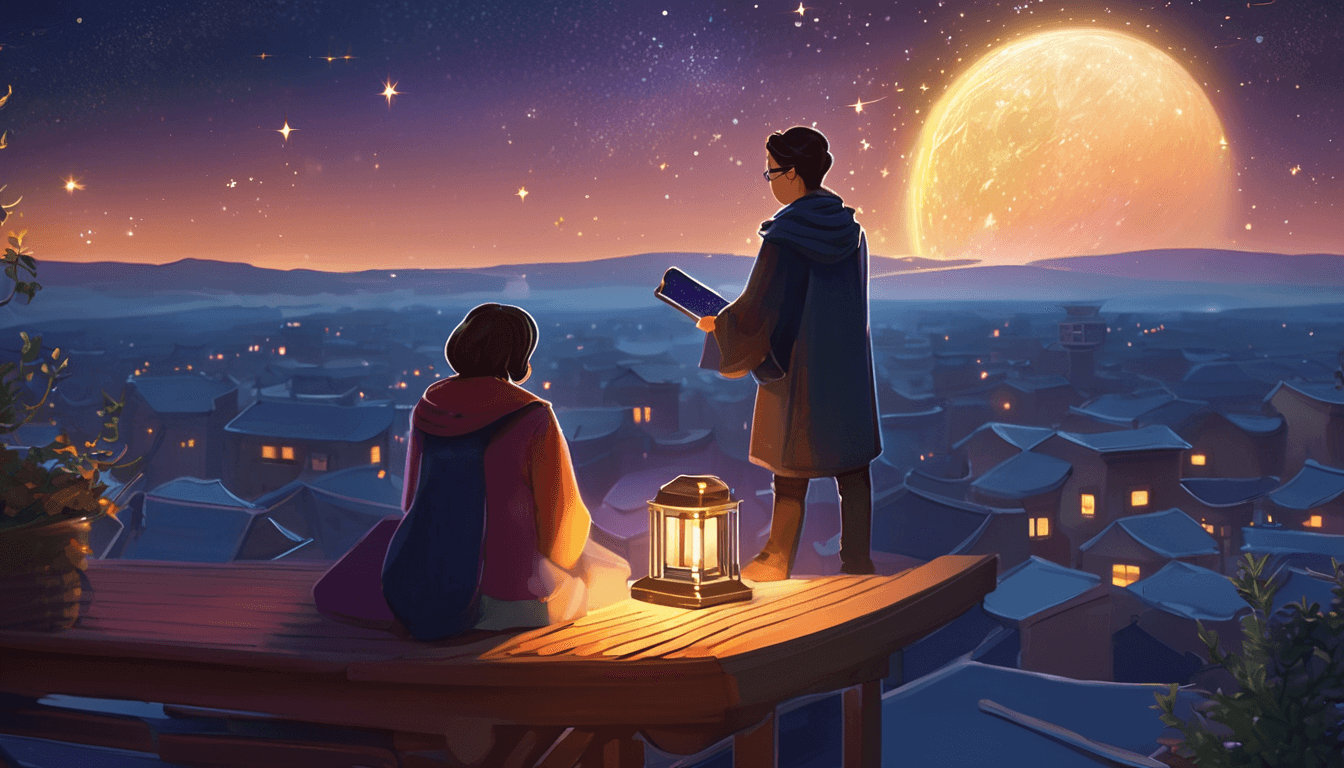
In the little hill town of Bellavita, where the rooftops were red and round like warm loaves of bread, there lived a young astronomer named Nadiya.
Nadiya was seven years old, which was not very old at all, but she already knew many important things about the sky.
She knew that the moon sometimes wore a thin silver smile and sometimes became so round that it looked like a pearl button sewn onto the night.
She knew that clouds could be shaped like rabbits, castles, and once, very clearly, a teapot with a curly handle.
She knew that owls blinked slowly when they were listening.
And she knew that stars did not truly twinkle because they were winking. They twinkled because the air above the world danced and bent their light in tiny, wobbly ways.
Nadiya had learned this from her grandmother, Sanaa, who had once worked at the small observatory on the hill. The observatory was a white round building with a copper roof, a narrow stairway, and a telescope so long that Nadiya imagined it could look straight through the night and see morning waiting on the other side.
Every evening, after supper, Nadiya packed a cloth bag with her notebook, two sharpened pencils, a wool scarf, and a little tin of toasted almonds. Then she climbed the hill beside Grandmother Sanaa.
They always greeted the observatory first.
“Good evening, old dome,” Nadiya would say.
The observatory never spoke back, but its copper roof gleamed in the starlight as if it were pleased.
One autumn night, the air smelled of damp grass and chimney smoke. Leaves made soft rustling piles around the path. Grandmother Sanaa carried the lantern, and Nadiya carried the notebook tucked safely under her arm.
“Tonight,” said Grandmother Sanaa, “we shall look at the Willow Constellation.”
“Is that the one with the bright star at the top?”
“That is the one. The brightest star is called Mirasol.”
Nadiya loved the Willow Constellation. It looked like a gentle tree leaning over a river. Five stars made the long drooping branches, and three smaller stars shone below like ripples in water.
When they reached the observatory, Grandmother Sanaa opened the heavy door. Inside, it smelled of brass, books, and a little bit of dust. Nadiya climbed the spiral stairs, one hand running along the smooth wooden rail.
At the top, Grandmother Sanaa turned a wheel.
With a low, sliding rumble, the dome roof opened.
Above them was the whole enormous sky.
Nadiya always felt a shiver then. Not a cold shiver. A wondering shiver.
The stars stretched in every direction, more than she could count. Some were bright as pinpricks in black velvet. Some were pale and shy. A silver river of light, the Milky Way, crossed the sky from one horizon to the other.
Grandmother Sanaa adjusted the telescope.
“Have a look,” she said.
Nadiya peered through the eyepiece.
There was the Willow Constellation.
But something was strange.
Nadiya blinked once.
Then twice.
“Grandmother,” she whispered. “Mirasol is in the wrong place.”
Grandmother Sanaa came to look.
The bright star should have been at the top of the willow shape. Instead, it hung a little to one side, all alone.
Perhaps it was only the telescope, Nadiya thought.
Grandmother Sanaa checked the knobs. She checked the sky chart. She checked the clock.
Then she put a hand softly on Nadiya’s shoulder.
“You are right,” she said.
“Can a star move?”
“All stars move,” said Grandmother Sanaa. “But most are so far away that their movement is too slow for us to notice in one night.”
“But Mirasol moved.”
“It seems so.”
Nadiya watched the lonely bright star for a long time.
The other stars of the Willow Constellation stayed in their familiar pattern. They shone together like friends holding hands in a circle.
But Mirasol seemed to be drifting away.
“Maybe it is lost,” Nadiya said.
“Maybe,” said Grandmother Sanaa.
Nadiya did not like the thought of a lost star. She imagined Mirasol floating in the great dark sky with no one to speak to, no shape to belong to, and no place on anyone’s map.
Before going home, she drew the Willow Constellation in her notebook. Then she carefully drew Mirasol in its new place, away from the others.
She added a tiny worried face beside it.
The next night, Nadiya hurried through her supper.
She tied her scarf before Grandmother Sanaa had even put on her boots.
At the observatory, they opened the dome.
The Willow Constellation was there.
And Mirasol had moved again.
Not far. Just a little farther toward the east.
Nadiya gasped.
“It is definitely going somewhere.”
For seven nights, they watched.
Each night, Mirasol moved a little farther from the Willow. It passed near the Lantern Constellation, whose stars made a golden square. It glided beneath the Sleeping Fox, where seven small stars curled nose to tail. It crossed a dark patch of sky where there were almost no bright stars at all.
Nadiya filled page after page of her notebook.
On the eighth night, Grandmother Sanaa said, “Perhaps we should ask the sky.”
Nadiya looked up. “How do you ask the sky something?”
“By paying very close attention.”
So they did.
They turned off the lantern. They did not eat the toasted almonds. They did not even whisper.
They listened to the quiet.
At first, Nadiya heard only the usual night sounds. A cricket chirping in the grass. A distant dog barking once. The tiny tick-tick-tick of the observatory clock.
Then she heard something else.
It was faint.
Like a glass bell ringing very far away.
Ting.
Then again.
Ting.
Nadiya lifted her face to the stars.
The sound seemed to come from Mirasol.
“Grandmother,” she breathed. “I think it is calling.”
Grandmother Sanaa’s eyes crinkled at the corners. “Then perhaps we should answer.”
Nadiya thought about this very seriously.
How could a little girl on a hill answer a star?
She looked around the observatory. There were charts, lenses, brass tools, old books, and the telescope. On a shelf beneath the window sat a forgotten signal lamp with colored glass panels.
Nadiya had seen sailors use lamps at the harbor long ago. They made patterns of light to send messages across dark water.
“The lamp,” she said.
Grandmother Sanaa smiled. “An excellent idea.”
Together, they carried the signal lamp to the open dome. Grandmother Sanaa lit the small flame inside, and Nadiya opened and closed the blue glass panel.
Flash. Flash-flash. Flash.
She did not know the proper sky language, if there was one. So she made the message as simple as she could.
Hello.
Are you all right?
The two of them waited.
The wind moved through the grass outside.
An owl flew silently past the dome.
Then Mirasol gave a bright, clear shimmer.
Once.
Twice.
Three times.
Nadiya clasped her hands.
“It answered!”
Over the next few nights, Nadiya and Grandmother Sanaa developed their own careful conversation with the wandering star.
One flash meant yes.
Two flashes meant no.
Three quick flashes meant not exactly.
A long, glowing shimmer meant listen.
“Are you lost?” Nadiya asked with the lamp.
Mirasol flashed twice.
No.
“Are you running away?”
Two flashes.
No.
“Are you looking for something?”
Mirasol shimmered long and bright.
Listen.
Then the sky did something Nadiya had never seen before.
A trail of silver light appeared behind Mirasol. It was not like a shooting star, which rushed and vanished. This trail was soft and slow, like moonlight being drawn across water.
Along the trail, Nadiya noticed several faint stars. They had always been there, perhaps, but she had never paid attention to them. One was bluish. One glowed amber. One was barely visible unless she looked sideways. Another pair sparkled close together, like two tiny buttons on a coat.
Mirasol drifted toward them.
“It is not leaving the sky,” said Nadiya.
“No,” said Grandmother Sanaa. “It is making a path.”
For the next three evenings, Mirasol stopped near the faint stars. It brightened each one in turn, as if greeting them.
The bluish star shone stronger.
The amber one seemed to warm.
The nearly invisible star gave a shy little flicker.
And the pair of close stars flashed together.
Nadiya opened her notebook. She drew them all.
At first, they looked like a messy scatter. Nothing like the neat Willow or Lantern or Sleeping Fox.
But then Nadiya turned the notebook sideways.
Her mouth made a round O.
“Grandmother,” she said. “Look.”
The stars formed a shape.
It was a small boat.
Mirasol was at the bow, bright and brave, like a lantern guiding the way. The bluish star made one curved side. The amber star made the other. The two close stars became little oars. And the shy, almost invisible star rested above them like a small sail.
A boat floated among the stars.
Grandmother Sanaa leaned close to the notebook.
“A new constellation,” she said quietly.
Nadiya stared up at the sky. “Mirasol was looking for stars to make a new picture with.”
“Perhaps it was.”
“But why?”
Grandmother Sanaa sat beside her on the observatory floor. She pulled Nadiya gently against her warm shoulder.
“Maybe the Willow Constellation was lovely,” she said. “But maybe Mirasol had a different shape inside its heart. Maybe it wanted to help others be seen. The faint stars might have been waiting a very long time for someone to notice them.”
Nadiya thought of the tiny shy star, almost hidden in the dark.
“It needed Mirasol,” she said.
“And perhaps Mirasol needed it too.”
Nadiya looked through the telescope again.
The starry boat floated in the east. It did not look large or grand. It did not have a hundred shining stars. But it looked as though it knew where it was going.
Nadiya picked up the signal lamp.
“What should we call you?” she asked.
Mirasol gave one long shimmer.
Nadiya waited.
Then a breeze entered the open dome. It lifted the corner of an old sky chart from the desk. The paper fluttered and folded, fluttered and folded, until its edge pointed toward the dark blue hills beyond Bellavita.
Beyond those hills was the sea.
Nadiya understood.
“The Little Voyager,” she whispered.
Mirasol flashed so brightly that for a moment the copper roof, the telescope, Grandmother Sanaa’s silver hair, and Nadiya’s notebook all glowed.
The Little Voyager.
From then on, Nadiya watched the new constellation every clear night. She drew it in her notebook and wrote down its place in the sky. She showed it to Grandmother Sanaa’s friends at the observatory, who checked her careful notes and peered through their telescopes.
They were surprised.
They were amazed.
And they agreed that Nadiya had discovered something special.
But Nadiya’s favorite part was not that grown-ups wrote letters to other observatories or that her drawing was copied onto a new sky chart.
Her favorite part was remembering that first lonely-looking star.
It had not been lost.
It had been searching.
One cold winter evening, after the Little Voyager had settled into its new place, Nadiya stood outside her house in her nightgown and wool slippers. Grandmother Sanaa had told her to come inside three times already.
Just one more moment, Nadiya thought.
Above the chimney tops, the Little Voyager shone.
Mirasol glittered at its bow.
Nadiya lifted one hand.
“Good night, Voyager,” she whispered. “Thank you for helping us see what was there all along.”
The star gave the tiniest flash.
Then Nadiya went indoors, where her bed was tucked beneath the window. Grandmother Sanaa pulled up the quilt, which was patterned with little stitched moons.
Outside, clouds drifted softly across the sky, but the Little Voyager remained bright enough for Nadiya to find.
She imagined it sailing through the dark, carrying its quiet crew of stars over silver seas no one could see.
And as sleep came closer, Nadiya thought of all the hidden things waiting to be discovered.
A new song inside an old instrument.
A tiny seed beneath the soil.
A shell on the shore with a secret swirl.
A path through the woods that led somewhere lovely.
A friend who had been standing quietly nearby.
Above Bellavita, the stars shone in their old shapes and their new ones.
And far beyond the hill, beneath the wide, gentle night, the Little Voyager sailed on.

Leave a Reply