
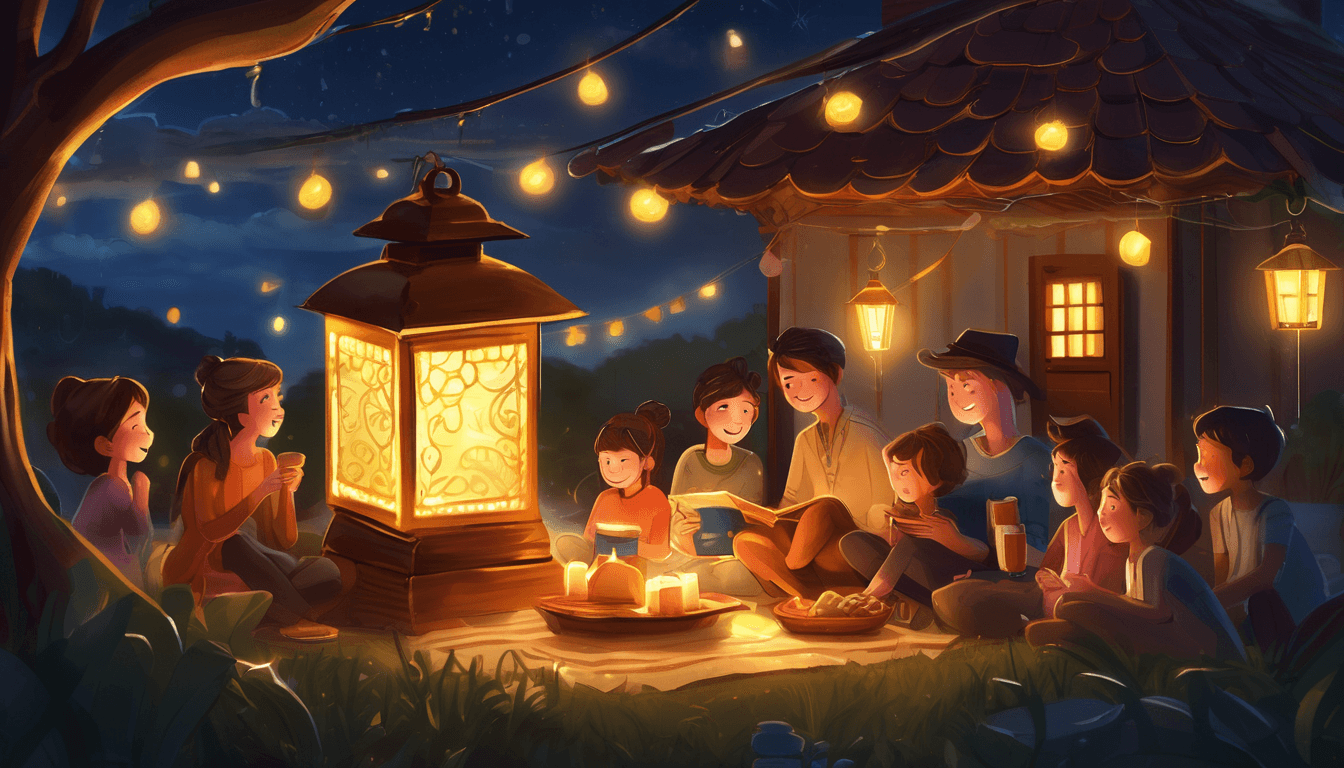
On a rainy Saturday afternoon, when the windows were silver with raindrops and the whole house smelled like cinnamon toast, Samira found a box beneath the stairs.
It was not a fancy box.
It was a bent, brown box with one corner taped three times. Written on the lid, in faded purple crayon, were the words:
OLD THINGS. DO NOT THROW AWAY.
Samira knelt beside it.
“Why not?” she whispered.
The box did not answer.
But from somewhere inside came the tiniest sound.
Creak.
Samira’s eyes grew round.
She lifted the lid.
Inside were all sorts of things: a brass key with no door, a blue teacup with a little crack across its handle, a wooden spoon polished smooth by years of stirring, a red wool mitten missing its partner, a small photograph in a silver frame, and a pocket watch that had stopped at twelve minutes past four.
Samira loved questions more than almost anything.
She asked questions while brushing her teeth.
She asked questions while putting on socks.
She once asked why soup steamed upward instead of downward, and her father had to sit down at the kitchen table before he could answer.
Now, looking at the old things, Samira had a new question.
“What happened here?”
She fetched a notebook with yellow pages and a pencil with a chewed eraser. On the front of the notebook she wrote:
THE GREAT HOUSE INTERVIEW
Then she sat cross-legged on the floor.
“First question,” she said. “Who is the oldest object in this house?”
From the box came a delicate clink.
The blue teacup trembled.
“I am,” said a soft, papery voice.
Samira nearly dropped her pencil.
“You can talk!”
“Of course,” said the teacup. “Though not always. Old objects prefer to speak when it rains. Rain reminds us of roofs, and roofs remind us of houses.”
Samira carefully lifted the cup out of the box.
“How old are you?”
“Older than your grandmother’s laugh,” said the teacup, “but younger than the old oak tree at the end of the lane.”
“That is not a number.”
“Numbers are rather rude,” said the teacup.
Samira decided not to argue. She wrote: VERY OLD. LIKES RAIN.
“Do you know a family story?” she asked.
“Oh, I know the most important one,” said the teacup. “The story of the Great Midnight Picnic.”
Samira looked up quickly. “What was that?”
The teacup gave a proud little clink.
“It happened many years ago, when your grandmother, Nani Yasmin, was a little girl. There was a storm so loud that the thunder bounced between the chimneys. The lights went out. The whole house turned dark.”
Samira leaned closer.
“And then?”
“Everyone was frightened,” said the teacup. “Except little Yasmin. She found a candle, climbed onto a chair, and announced, ‘If the lights are gone, we must have a picnic!’”
“A picnic at midnight?”
“Precisely. She spread a blanket on the kitchen floor. Everyone ate jam sandwiches by candlelight. Your great-grandfather played a song on a comb wrapped in paper. Your great-grandmother laughed so hard that she spilled tea into my saucer.”
The teacup sounded pleased about this.
“Was it a happy night?” Samira asked.
“The happiest,” said the teacup. “Yasmin saved everyone with her brave idea.”
Samira wrote quickly.
Then the brass key rattled in the box.
“Rubbish,” it said.
The teacup gave an offended clink. “Excuse me?”
“You heard me,” said the key. Its voice was low and scratchy, like a drawer opening after a long time. “Yasmin did not save everyone. It was her older brother, Farid.”
Samira picked up the key. It was cold in her palm.
“Tell me your version.”
“I do not have a version,” said the key. “I have the truth.”
The teacup sniffed, though Samira could not imagine how a cup sniffed.
The key continued. “Farid found me hanging in the hallway. He unlocked the cupboard under the stairs. Inside was a lantern, a tin of biscuits, and a jar of strawberry jam. Farid was the one who gathered everyone in the kitchen.”
“So Farid had the idea for the picnic?” Samira asked.
“Farid had every good idea,” said the key.
“Did he make the sandwiches?”
“He opened the jam jar.”
“That is not the same thing.”
“It is when the jar is stuck,” said the key.
Samira wrote: KEY SAYS FARID SAVED THE NIGHT.
The wooden spoon gave a warm little tap against the side of the box.
“If we are telling stories,” it said, “we ought to tell them properly.”
Samira lifted the spoon. Its handle was dark and smooth, with a little dent near the end.
“Were you there too?”
“I was in the soup,” said the spoon.
“In the soup?”
“Vegetable soup. Carrots, potatoes, peas, and a pinch of pepper. Your great-grandmother was stirring it when the storm began.”
“What happened when the lights went out?” asked Samira.
The spoon was quiet for a moment.
“Everyone was worried,” it said. “Not because of the dark. Not really. The rain had started coming through a crack near the back window. Water was dripping into a pan on the floor. Plink. Plink. Plink. The roof needed fixing, but there was no money for it yet.”
Samira’s pencil paused.
“Oh.”
“Your great-grandmother did not want the children to be scared,” said the spoon. “So she began making funny noises with me. She tapped me on the pot like a drum. Then Farid tapped two cups together. Little Yasmin danced in her socks. Soon, everyone was making music.”
“Then they had the picnic?” Samira asked.
“Yes,” said the spoon. “But it was not because someone had one brilliant idea. It was because each person did one small thing. Someone found the lantern. Someone spread the blanket. Someone opened the jam. Someone made the music. Someone told a silly joke about a potato wearing a hat.”
“Who told that joke?”
“Your great-grandfather,” said the spoon. “He had many jokes. Most were terrible.”
The red mitten wiggled.
“No, no,” it said. “It was not a potato hat joke. It was a turnip hat joke.”
Samira pulled the mitten from the box. It was tiny, made of fuzzy red wool, with three buttons sewn near the wrist.
“Were you at the midnight picnic too?”
“I was on Yasmin’s hand,” said the mitten. “Only one hand, of course. My partner had been lost in the snow the winter before.”
“What do you remember?”
“I remember that Yasmin was not brave at all,” said the mitten quietly.
The room seemed to get softer around Samira.
The rain ticked against the window.
“She was frightened by thunder,” the mitten continued. “She hid beneath the table. Her knees were tucked up. She squeezed me very tightly.”
“But the teacup said she stood on a chair and announced the picnic,” Samira said.
“She did,” said the mitten. “Later.”
“Then she was brave.”
“Yes,” said the mitten. “But people think brave means never feeling scared. That is not right. Yasmin was scared. Then she did something anyway.”
Samira looked down at the red mitten. One of its buttons was stitched on with green thread.
“Did someone help her?”
“Farid crawled under the table and said, ‘If we are going to have a picnic, we will need a picnic captain.’ He gave her the job because he knew she liked being in charge of important things.”
Samira wrote slowly this time.
YASMIN WAS SCARED, THEN BRAVE.
From the bottom of the box, the silver picture frame cleared its throat.
“Ahem,” it said.
Samira found the photograph inside. It showed a kitchen long ago. The picture was black and white, but Samira could see the shapes clearly.
There was a blanket on the floor.
There were cups and bowls.
There was a lantern glowing on the table.
A young girl sat in the middle with a red mitten on one hand. A boy held up a jar of jam. A woman was laughing with one hand over her mouth. A man had a wooden spoon raised like a conductor’s baton.
Samira could not see everyone’s faces well, because the photograph was blurry.
“Who took this?” she asked.
“Your Auntie Noor,” said the frame. “She was only six. She used a little camera and snapped this picture after everyone had stopped worrying.”
“Was the midnight picnic really the happiest night?” asked Samira.
The frame gave a gentle sigh.
“That depends who you ask.”
Samira waited.
“Your grandmother remembers it as the night she became the picnic captain,” said the frame. “Farid remembers it as the night he opened the cupboard and found the lantern. Your great-grandmother remembered the leaky roof and the soup nearly boiling over. Your great-grandfather remembered the music. Auntie Noor remembered the biscuits, because she ate four when nobody was looking.”
“Which one is the true story?” Samira asked.
All the objects became still.
The teacup stopped clinking.
The key stopped rattling.
Even the wooden spoon rested quietly in Samira’s hand.
Then the pocket watch, which had not spoken at all, made a small sound.
Tick.
Samira gasped.
The watch’s hands did not move, but its voice was deep and slow.
“Memories are not windows,” it said. “They are lanterns.”
“What does that mean?” Samira whispered.
“It means each person carries a small light. They shine it on the part they saw. One remembers the blanket. One remembers the thunder. One remembers the jam. The room was the same room. The night was the same night. But every lantern makes a different circle of light.”
Samira thought about that for a long time.
Then she opened her notebook to a clean page.
At the top, she wrote:
WHAT REALLY HAPPENED AT THE GREAT MIDNIGHT PICNIC
Below it, she wrote:
There was a storm. The lights went out. The roof leaked. Some people were scared. They made soup, music, jokes, sandwiches, and a picnic. Everyone helped in a different way. They remembered different things because they were each looking from a different place.
Samira read it aloud.
The old objects were silent.
But they sounded pleased in their silence.
That evening, when the rain had stopped and the sky turned lavender behind the chimneys, Samira brought the box to the living room.
Her grandmother Yasmin was sitting in a soft chair, knitting a scarf striped in yellow and green.
“Nani,” said Samira, “did you ever have a midnight picnic during a storm?”
Grandmother Yasmin’s knitting needles paused.
“A midnight picnic?” she said. Then her eyes twinkled. “Oh, goodness. Who told you about that?”
“The oldest things in the house,” said Samira.
Grandmother Yasmin smiled, as if this made perfect sense.
“Well,” she said, “I remember being very brave.”
From the sofa, Samira’s father laughed. “Mum, you told me you hid under the table.”
“I was brave later,” Grandmother Yasmin said.
“And Uncle Farid says he saved the evening with a lantern,” said Samira.
“He did find the lantern,” Grandmother Yasmin admitted. “Though he also dropped it on his foot.”
“He did?” Samira asked.
“Oh, yes. He howled louder than the thunder.”
Samira’s father laughed harder.
“And Auntie Noor ate four biscuits,” Samira added.
Grandmother Yasmin put a finger to her lips. “That part may be classified information.”
Soon they were all remembering.
Some details matched.
Some did not.
Grandmother Yasmin insisted the blanket was checkered.
Samira’s father said it was covered in yellow flowers.
They both agreed that the soup was too salty, though neither could remember who had added the extra pepper.
At last, Samira’s mother brought a tray into the room.
On it were cups of warm milk, slices of toast with strawberry jam, and a bowl of vegetable soup.
“The lights are not out,” she said, “but I thought we might have a tiny picnic anyway.”
So they spread a blanket on the living room floor.
Samira chose the place in the middle.
The old teacup sat safely on a shelf nearby, watching.
The brass key gleamed from its little dish.
The wooden spoon rested beside the soup pot.
And the red mitten, still missing its partner, lay on Samira’s lap.
Outside, the clouds sailed away from the moon.
Inside, everyone told the old story one more time.
It changed a little with every telling.
But the warm part stayed the same.


Leave a Reply