
On the evening when the travelling museum came to town, the sky was the color of warm milk, and every chimney puffed out a little gray cloud.
Mina was brushing her teeth when she heard a sound unlike any sound she had heard before.
It was not a truck.
It was not a train.
It was not the ice cream van, though it did have a tiny bell.
It was a soft rolling sound, like a hundred suitcases being pulled over a floor made of leaves.
“Mama,” Mina called, foam still around her mouth, “there is something outside.”
Mama looked through the bedroom window.
At the end of the street, where the baker’s shop stood closed and sleepy beneath its striped awning, a great silver building had appeared.
It had no wheels that Mina could see. It stood on the road as if it had gently floated down from a cloud. Its windows glowed gold. Little flags fluttered from its roof, though there was hardly any wind.
Across the front, in curling blue letters, a sign read:
THE MUSEUM OF TOMORROW’S ORDINARY THINGS
Below that, in smaller letters:
PLEASE COME IN. PLEASE DO NOT POLISH THE EXHIBITS.
Mina stared.
“A museum?” she said.
“At bedtime?” Mama said, lifting one eyebrow.
Then the front doors of the museum opened with a round, welcoming whoosh.
A woman in a green coat stepped out. Her hair was white and gathered into a bun shaped like a seashell. In one hand she carried a lantern. In the other, she held a large brass key.
“Good evening,” she called up the street. “I am Curator Odette. We are open until the moon reaches the chimney with the crooked hat.”
The crooked chimney was on Mina’s house.
Mama smiled in the way she did when she was trying to pretend something was perfectly ordinary.
“I suppose,” she said, “we could have a very quick look.”
Mina hurried into her slippers, though she wore them on the wrong feet. Mama did not make her change them.
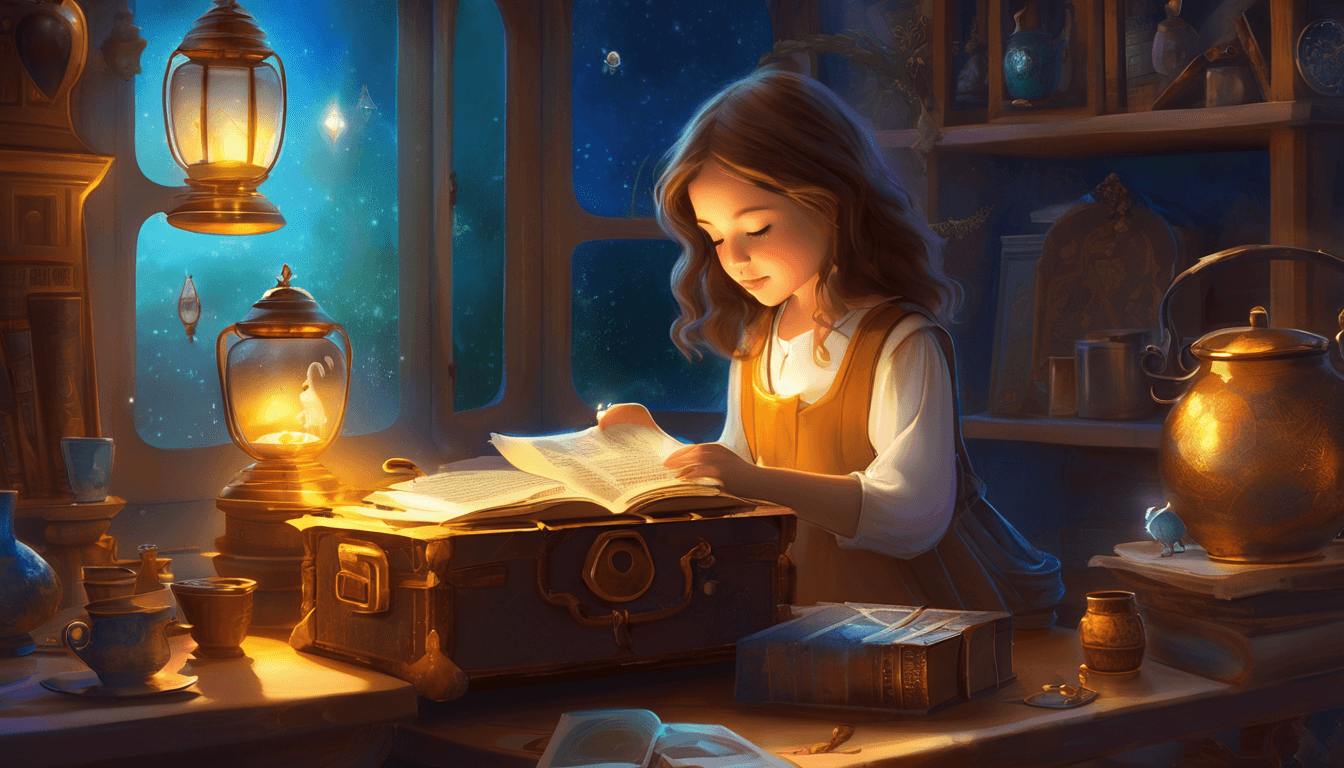
Inside, the museum smelled like rain, old books, and the warm dusty air from behind a radiator.
The rooms were enormous. They seemed much bigger inside than the silver building had looked from outdoors. Ceiling lamps floated overhead, shining softly. The walls were painted midnight blue, and the floor had tiny stars in it that twinkled when Mina stepped close.
But what surprised her most were the objects.
They were not crowns or dinosaur bones or paintings of serious-looking people.
They were ordinary things.
In the first glass case sat a spoon.
It was a small spoon, slightly bent at the handle. There was a dried spot of something purple near its bowl.
Its label read:
SPOON USED FOR PLUM JAM, 2041
OWNER FORGOT IT IN A FLOWER POT FOR THREE WEEKS
In the next case was one yellow sock.
Not a pair. Just one.
Its label read:
LEFT SOCK, 2046
FOUND INSIDE A PILLOWCASE
STILL WAITING FOR ITS TWIN
Mina pressed her nose close to the glass.
“Why are these in a museum?” she asked.
Curator Odette appeared beside her so quietly that Mina gave a little jump.
“Because,” said Odette, “the ordinary things are the best historians. A king may tell you about a battle. But a button can tell you who lost a coat in the rain. A mug can tell you which person liked cocoa before bed. A small shoe can tell you someone once had very little feet.”
Mina looked at her own feet in their crooked slippers.
“Are these things from the future?”
“They are,” said Odette. “Our museum travels through time, collecting small, everyday objects after their stories are finished. Then we bring them back, so people can see that even the tiniest things may be important.”
They walked through rooms filled with strange and familiar treasures.
There was a toothbrush with three different colors of paint on its handle.
A paper airplane with a torn wing.
A grocery list that said carrots, soap, noodles, and remember the moon seeds.
A lunchbox with a dent shaped like a heart.
A button from a red cardigan.
A pebble painted with a sleepy cat.
Mina liked every object. She tried to imagine the people who might have owned them. Perhaps the red cardigan belonged to a violin player. Perhaps the paper airplane had flown from a school window and landed in a mayor’s soup.
Then, in the middle of the largest room, Mina saw a tall glass cabinet with a velvet curtain over it.
The curtain was closed.
On a gold stand nearby was a sign:
ONE OBJECT IN THIS CASE BELONGS TO A VISITOR’S FUTURE LIFE.
IDENTIFY IT BEFORE THE MUSEUM DEPARTS.
Mina read the sign twice.
“What does that mean?” she asked.
Curator Odette looked suddenly very serious, though her eyes stayed kind.
“Every time our museum visits a town,” she said, “one object from the future belongs to someone who has come inside. We do not know who. We only know that the object wishes to be recognized.”
“Why?”
“Because ordinary things do not like to be forgotten.”
Mama squeezed Mina’s hand.
“Would you like to look?” she asked.
Mina nodded.
Curator Odette put the brass key into a lock at the side of the cabinet. It turned with a click.
The velvet curtain slid aside.
Inside were five objects.
The first was a little wooden box with a cracked lid. A tiny silver star had been painted on top.
The second was a green umbrella with one crooked spoke.
The third was a smooth gray stone with a hole through its middle, tied to a blue string.
The fourth was a glass jar holding three buttons, a feather, and something that looked like a dried orange peel.
The fifth was a small ceramic cup, pale blue with a chip along its rim. Around its middle was a picture of a rabbit wearing rain boots.
Mina felt something stir inside her, as if her heart had opened one eye.
She looked at the cup.
Then she looked away.
“It could be anyone’s,” she whispered.
“Indeed,” said Curator Odette. “That is the puzzle.”
There were labels beneath the objects, but they did not say whose they were.
The wooden box read:
KEPT A SECRET FOR NINE YEARS.
The umbrella read:
OPENED ONLY ON SUNNY DAYS.
The stone read:
CARRIED ACROSS THREE RIVERS.
The jar read:
COLLECTION BEGUN AT AGE SIX.
The cup read:
REPAIRED TWICE. USED OFTEN. NEVER THROWN AWAY.
Mina walked slowly around the cabinet.
She liked the stone. It looked like something a brave explorer would find on a beach. She liked the jar too, because she had once tried collecting things in a jar, though Mama had made her take out the muddy snail shell.
But the blue cup made her chest feel funny.
At home, Mina had a favorite cup. It was not blue. It was white with yellow moons. She used it for milk when she could not sleep.
“This one doesn’t belong to me,” she said aloud.
Curator Odette did not answer.
Instead, she led Mina to a nearby wall covered in clocks. Some had hands. Some had swinging silver balls. One had a little wooden bird that popped out every hour and said, “Almost!”
The hands on all the clocks were moving.
“The museum must leave when the moon reaches the crooked chimney,” Odette said. “There is time. But not too much.”
Mina returned to the cabinet.
She thought about the labels.
Kept a secret for nine years. Mina was only six. That did not fit, unless the box belonged to her when she was older.
Opened only on sunny days. That was silly, and Mina liked silly things. Maybe she would grow up to be the kind of person who opened umbrellas in sunshine.
Carried across three rivers. She had never crossed even one river.
Collection begun at age six. That sounded possible. She was six right now.
And the cup.
Repaired twice. Used often. Never thrown away.
Mina imagined herself bigger. Her legs would reach the floor when she sat on the kitchen chair. She might have longer hair, or short hair, or freckles. Maybe she would live in a house near the sea. Maybe she would make soup when it rained. Maybe she would have a rabbit one day.
But how could she know?
She closed her eyes.
The museum hummed gently around her.
Far away, someone laughed in the room of the lost sock. A bell chimed once. The silver building gave a soft creak, as though it were stretching before a long journey.
Then Mina remembered something.
Last winter, when she had a cold, Mama had brought her warm honey water in her yellow moon cup. Mina had held it with both hands.
“What happens when I am grown up?” Mina had asked sleepily.
Mama had tucked the blanket around her.
“You will have many new things,” Mama had said. “But I hope you keep one small thing that reminds you to be gentle with yourself.”
At the time, Mina had not understood.
Now she opened her eyes and looked at the blue cup.
It was chipped, but not broken.
It had been repaired twice. Someone had cared enough to fix it. Someone had used it often, perhaps for cocoa, perhaps for tea, perhaps for honey water on a rainy night. The rabbit in rain boots made Mina smile, though she did not know why.
“I think,” Mina said slowly, “it belongs to me.”
Curator Odette leaned closer.
“Why do you think so?”
Mina looked at the cup for a long moment.
“Not because I have seen it before,” she said. “I haven’t. And not because it is the prettiest.”
She placed one hand over her heart.
“I think it belongs to me because it looks like something I would want to keep. Even when it gets old.”
The museum became very quiet.
Then the cup gave a tiny sound.
Ping.
A thin golden line appeared along its chipped rim, glowing like the first stripe of sunrise. The rabbit’s rain boots shimmered. Inside the cup, though it was empty, Mina could smell warm cocoa and a little cinnamon.
Curator Odette smiled.
“Correct,” she said.
Mama bent down and kissed Mina’s hair.
The cup’s label changed. New words curled across the little card:
MINA’S CUP, 2053
FOR COCOA, COLD DAYS, BRAVE CONVERSATIONS,
AND REMEMBERING WHAT MATTERS
Mina stared at her own name.
“It really is mine?”
“One day,” said Odette.
“Can I take it home?”
“Oh no,” said Odette, but she laughed softly when Mina’s face fell. “The future still needs it. If you took it home now, it might get terribly confused. It could begin thinking it should be a flowerpot or a hat.”
Mina thought that a blue cup would make a very poor hat.
“But,” said Curator Odette, reaching into her green coat, “you may take this.”
She handed Mina a small square of paper.
On it was a drawing of the cup, with its rabbit and its chip and its round little handle.
At the bottom, in neat handwriting, were the words:
SOME THINGS BECOME SPECIAL BECAUSE WE KEEP CHOOSING THEM.
Mina held the paper carefully.
Outside, the moon had climbed to the top of the crooked chimney.
The clocks all chimed together. The sound was sweet and soft, like spoons touching teacups.
“It is time,” said Curator Odette.
The doors opened.
Mina and Mama stepped back onto their quiet street. The silver museum gave another gentle whoosh. Its flags fluttered. The golden windows dimmed, one by one.
Curator Odette stood in the doorway and lifted her lantern.
“Goodnight, Mina,” she called. “Take care of your ordinary things.”
Then the museum rose, just a little, above the road.
It floated over the baker’s shop, over the sleeping gardens, over the roofs and chimneys. It became smaller and smaller until it looked like a shining button sewn onto the dark blue sky.
Then it was gone.
Back in bed, Mina placed the drawing beside her yellow moon cup.
Mama tucked her in.
“Do you think I really will have that cup?” Mina asked.
“I think,” said Mama, “you will find many things that belong to your life. Some you will recognize right away. Some will take a little longer.”
Mina looked at the drawing one last time.
She imagined the future blue cup waiting somewhere far ahead, perhaps in a kitchen with rain tapping at the windows. She imagined holding it in her grown-up hands. She imagined the little chip, the repaired line, the rabbit in boots.
Then she took one small sip from her yellow moon cup.
It tasted of milk and sleep.
And as Mina’s eyes grew heavy, she decided that tomorrow she would begin a collection.
Not of grand treasures.
Just ordinary things.
A smooth button.
A bright leaf.
A pebble that looked like a tiny loaf of bread.
And perhaps, if she found one, a spoon with a little purple jam on it.
Leave a Reply