
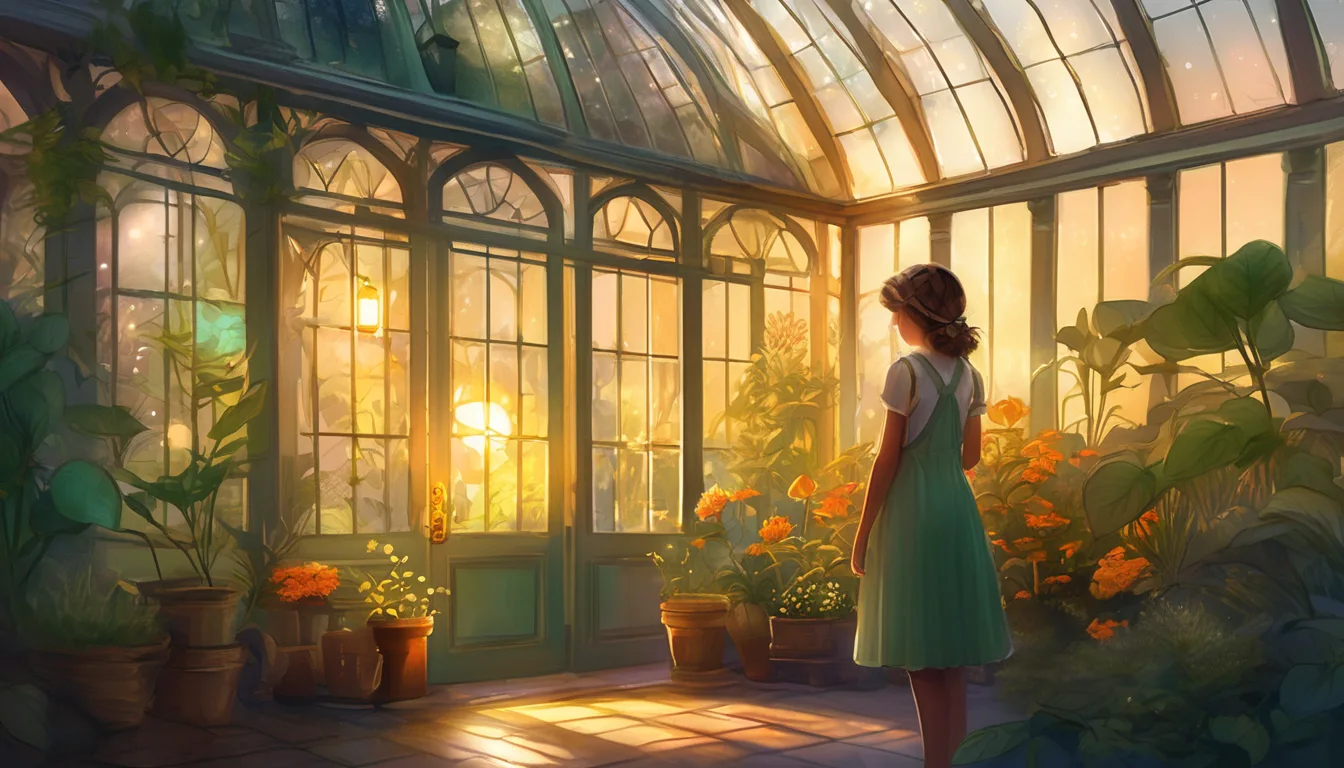
On the far side of the village, past the last row of blue-painted cottages and the field where sheep slept like crumpled clouds, there stood an old greenhouse.
It was made of cloudy glass panes held together by green metal frames. Ferns pressed their soft faces against the windows. Ivy climbed over the roof in curly loops. In summer, it looked like a giant glass teapot filled with leaves. In winter, when frost painted silver feathers on every pane, it glowed warmly from within.
Nobody knew exactly how old the greenhouse was.
Some people said it had been built by a gardener who could listen to seeds whispering underground. Some said it had belonged to a queen who preferred muddy boots to shiny crowns. But everyone agreed on one thing.
The plants inside did not grow ordinary fruit.
They grew memories.
Nia discovered this on the morning she was sent to fetch mint for tea.
Her grandmother, Sana, had said, “The mint in our garden has gone sleepy. Would you walk to the old greenhouse and ask Mr. Otto if he has a few leaves to spare?”
Nia loved visiting Mr. Otto. He was the keeper of the greenhouse, though he insisted that the greenhouse mostly kept itself.
When Nia pushed open the creaky door, warm, damp air wrapped around her like a blanket fresh from the dryer. The place smelled of rainwater, soil, lemon leaves, and something sweet she could not name.
“Hello?” Nia called.
From behind a great curtain of hanging vines came Mr. Otto. He had a round hat, a small gray beard, and gardening gloves with patches sewn onto every fingertip.
“Ah,” he said. “A visitor with curious eyes. The very best kind.”
“I came for mint,” Nia explained.
“Of course. But first, look.”
Mr. Otto led her down a narrow path between shelves of pots. Nia had seen tomatoes, strawberries, pears, and plums before. But these plants held stranger things.
On one vine hung little golden berries. Inside each berry, Nia could see a tiny moving picture.
In one, a baby laughed as a dog licked its toes.
In another, a woman in a red scarf danced in a kitchen while bread rose in the oven.
In a third, two brothers floated paper boats down a rain-filled gutter.
Nia stared so hard that her nose nearly touched the berry.
“Are those people trapped in there?” she whispered.
Mr. Otto chuckled. “Oh, no. Those are memories. Happy ones, mostly. Some are small enough to fit in a thimble. Some are too large for any jar, basket, or greenhouse.”
“But how do they get into the plants?”
“Memories travel in surprising ways,” said Mr. Otto. “A person may remember something so clearly that a little bit of it drifts away on a sigh. The greenhouse catches those bits and tucks them into its roots. Then, when the time is right, it grows them.”
Nia wandered farther in.
There were bell-shaped flowers that chimed with the sound of old lullabies. There were broad green leaves that, when touched, smelled exactly like a rainy school day. There were purple pods that opened with a soft pop, releasing the memory of someone learning to ride a bicycle.
One small tree bore round, blue fruit. Mr. Otto picked one and held it carefully.
“This one,” he said, “is the memory of a man meeting his new kitten for the first time.”
He peeled the fruit. A warm puff of air came out, carrying the sound of a tiny meow, the squeak of a basket lid opening, and a surprised laugh so full of joy that Nia found herself smiling.
“Can I grow a memory?” she asked.
“Perhaps one day,” said Mr. Otto. “But memories cannot be planted just because we wish it. They grow where they are needed.”
Then Nia noticed something.
At the very back of the greenhouse was a corner hidden behind tall shelves. It was darker there. The floor was dusty. Several empty pots sat crookedly in the soil. A watering can lay on its side, rusty and dry.
Unlike every other part of the greenhouse, that corner looked forgotten.
Nia pointed. “Why doesn’t anything grow over there?”
Mr. Otto’s face became quiet.
“That corner has been uncared for a long time,” he said.
“Why?”
“I used to tend it every day,” he replied. “Then I stopped.”
Nia waited, but Mr. Otto did not say more.
She knew some adults said “I stopped” when they meant something much bigger. It was the way a closed door sometimes meant there was a whole room behind it.
“Could I look?” Nia asked.
Mr. Otto considered this. Then he nodded.
“You may investigate,” he said. “But gently. Greenhouses have secrets, and secrets do not like being tugged.”
Nia borrowed a little hand broom, a notebook, and a pencil from the potting table. She put on a pair of yellow gloves that were much too large and flopped at the ends.
First, she swept away the dust.
Under it, she found a path of tiny white stones leading into the forgotten corner.
Second, she moved three empty pots.
Behind them was a small wooden sign, half buried in soil. Nia brushed it clean.
The letters were faded, but she could read them.
FOR REMEMBRANCES TOO TENDER TO PICK.
“What does that mean?” she asked.
Mr. Otto stood a few steps away, turning his hat in his hands.
“Some memories are lovely,” he said. “But they can also hurt a little. Like when you press a finger on a bruise just to see if it is still there.”
Nia looked at the dry pots.
“Did someone have a sad memory?”
“Yes,” Mr. Otto said softly. “Me.”
He knelt beside one particular pot. It was painted with yellow suns, though the paint had chipped away.
“Many years ago, I cared for this greenhouse with my little sister, Marisol. She was much younger than I was, and she believed every plant had a favorite song. She sang to the cucumbers, the roses, the moss, even the empty pots.”
“What happened to her?” Nia asked.
“She grew up and moved across the sea,” said Mr. Otto. “At first, she wrote letters. Then her letters came less often. She had a busy life, and I had mine. One day, I realized I could not remember the sound of her singing.”
His voice was not loud. It was almost as soft as the leaves.
“I came to this corner hoping the greenhouse would grow a memory of her. But nothing appeared. I thought perhaps it was because I had forgotten too much. So I stopped coming here.”
Nia looked around carefully.
The soil did not seem completely dead. Near the sun-painted pot, a tiny green curl poked through the earth.
“Mr. Otto,” she said, “there’s something.”
He leaned closer.
The curl was no bigger than a caterpillar. At its tip was a small bud, tightly closed and striped in pale yellow and green.
Mr. Otto gave a little gasp.
“I never saw it,” he said.
“Maybe it needed someone to care for the corner,” said Nia. “Not just wait for it.”
So Nia and Mr. Otto worked together.
They carried out cracked pots and swept away old leaves. They opened the high window to let in a slice of clean afternoon air. Mr. Otto fetched fresh soil, dark and crumbly as chocolate cake. Nia filled a watering can, holding it with both hands as water splashed over her boots.
They did not hurry.
They planted three mint cuttings in a bright blue pot. They gave the sun-painted pot a new place by the glass. Nia placed the wooden sign where it could be read.
Then, because Mr. Otto had said every plant liked a song, Nia asked, “Do you remember any song Marisol used to sing?”
Mr. Otto closed his eyes.
For a while, only the greenhouse made sounds. Drip. Drip. A leaf brushing another leaf. The faint clink of a memory flower opening somewhere nearby.
Then he began to hum.
At first, he hummed only three notes.
Nia hummed them back.
Mr. Otto added another note, then another. The tune was bright and bouncy, like a sparrow hopping over puddles. It had a little twist in the middle that made Nia giggle. Soon they were both humming, though neither knew any words.
As they sang, the striped bud began to tremble.
Its petals unfolded slowly.
Inside was not a flower.
It was a tiny glassy orb, clear as a dewdrop and glowing softly with gold light.
Mr. Otto lifted it in both hands.
The greenhouse filled with a sound.
A girl’s voice, young and merry, sang the very tune they had been humming. Then came the sound of a watering can sloshing, pots clinking, and someone saying, “Otto, you are pouring water on your own shoe again!”
Mr. Otto laughed.
It was a big laugh, round and surprised. He laughed until tears shone in his eyes.
“I remember,” he said. “Marisol always teased me about my shoes.”
The glowing orb floated from his hands and drifted upward. It settled among the vines near the roof, where it became a little golden lantern.
“Will it stay there?” Nia asked.
“For as long as it is needed,” Mr. Otto replied.
By evening, the forgotten corner no longer looked forgotten. It was still quiet, but it was a good kind of quiet, like a library or a sleeping cat.
Mr. Otto snipped a bundle of fresh mint for Nia’s grandmother. He also gave Nia a tiny pot with one green leaf growing in it.
“What memory does it make?” she asked.
“That,” said Mr. Otto, “is up to you. Care for it. Tell it about your days. Let it hear your laughter. Perhaps, when it is ready, it will grow a moment you will want to keep.”
Nia carried the mint and the little pot home as the sky turned lavender. Behind her, the old greenhouse glowed through its cloudy glass panes.
And high near its roof, one golden lantern shone brighter than all the others.
That night, Nia placed her tiny plant on the windowsill beside her bed. Before she fell asleep, she whispered to it about the warm greenhouse, Mr. Otto’s funny patched gloves, and a song that had been waiting quietly in the soil.
Then she closed her eyes.
Outside, the moon watched over the village.
Inside the little pot, beneath the soft dark earth, something very small and green began to grow.




Leave a Reply