
In a city called Bellwether, the streets curled like silver ribbons between tall houses made of brick, glass, and warm yellow wood. Some houses had round windows. Some had little balconies dripping with plants. Some had bright front doors painted red, blue, green, or the color of a ripe peach.
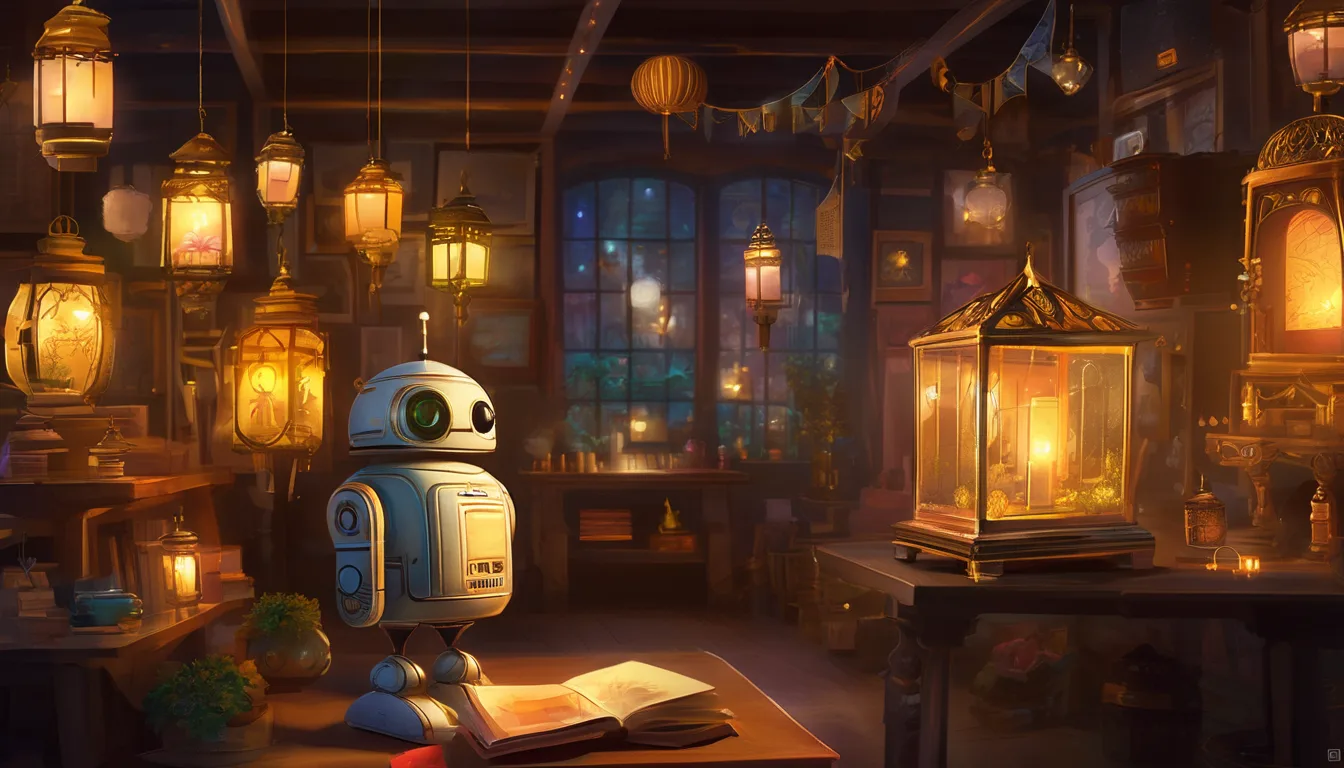
High above the chimneys, a young robot named Miko lived in a tiny workshop at the top of the Museum of Everyday Things.
Miko was not very large. His body was shaped like a polished kettle, his feet were small wheels, and his head had one bright, round eye that could blink blue when he was thinking hard. Inside his chest was a gentle whirring engine that went hum-hum-hum whenever he was curious.
And Miko was curious almost all the time.
At the museum, there were grand exhibits full of old clocks, squeaky bicycles, brass buttons, toy boats, umbrellas, and shelves of cups from different places around the world. Miko helped polish display cases and write little labels.
“Wooden spoon, used for soup,” he would type.
“Purple scarf, worn on windy days,” he would type.
“Fuzzy slipper, owner unknown, probably very cozy,” he would type.
But Miko’s favorite job was studying the homes below the museum hill.
Every evening, he would roll to the wide round window of his workshop and look through a telescope. In one house, he saw a family hanging paper stars in the kitchen. In another, an old man carefully placed tiny glass animals on a shelf. In another, two sisters covered a wall with drawings of suns, dragons, rainbows, and very wobbly cats.
Miko recorded everything in his notebook.
Humans decorate their homes, he wrote.
They place soft rugs upon floors.
They put paintings on walls.
They fill shelves with jars, photographs, feathers, candles, shells, ribbons, and objects whose purpose is not always clear.
Then he added, Why?
The next day, Miko went down into Bellwether to find out.
He wore his smallest visiting hat, a square yellow cap with a blue button on top. He carried a clipboard, three pencils, and a pocket magnifier.
His first stop was the home of Mrs. Amara, who lived beside the bakery.
Mrs. Amara’s front room was full of cushions in orange, gold, and berry red. There was a blue glass bottle on the mantelpiece, and beside it stood a small wooden horse with one chipped ear.
“Why do you keep that horse?” Miko asked politely.
Mrs. Amara smiled and lifted it gently.
“My brother carved this for me when we were children,” she said. “We lived near a field where real horses ran through tall grass. He made it with his pocketknife. He was not very good at carving yet, as you can see.”
“The ear is incomplete,” said Miko.
“Yes,” Mrs. Amara said. “But when I see it, I remember his face. I remember the field. I remember how we laughed when the horse came out looking more like a potato.”
Miko’s eye blinked blue.
“So the wooden horse holds memories?”
“In a way, it opens the door to them,” said Mrs. Amara.
Miko wrote this down very carefully.
Objects can open memory doors.
Next, he visited Mr. Kenji, who lived in a narrow house with seven steps leading to the door. Inside, every wall was covered with photographs.
There were photographs of babies in blankets, children with muddy knees, snowy rooftops, smiling friends, a dog wearing a hat, and a very serious-looking goose.
“Why do you hang these pictures?” Miko asked.
Mr. Kenji looked at the photographs for a long moment.
“Because days go quickly,” he said. “Sometimes we need help remembering that they happened.”
He pointed to a picture of a little girl balancing on a fence.
“That is my granddaughter, Sora, when she was five. She said she could walk on air. She fell into a bush, climbed out, and declared that the bush had cheated.”
Miko made a tiny sound like a happy bell.
“Was she injured?”
“Only her pride,” said Mr. Kenji.
Miko wrote, Pictures remind humans that small days are important.
His third stop was a house at the edge of town, where a family was tying ribbons around the porch railings.
The ribbons were long and bright. They fluttered in the breeze like streamers of sunset.
A boy named Tomas stood on a stool, trying to reach the highest post.
“Is this a holiday?” Miko asked.
“It is our house anniversary,” Tomas said. “We moved here three years ago today.”
His mother came outside carrying a tray of cinnamon buns.
“When we first arrived,” she told Miko, “we had no curtains, no garden, and only three chairs. It rained all afternoon. We ate supper on the floor, and the roof made such a drumming sound that we had to shout to hear one another.”
“Why celebrate rain and too few chairs?” Miko asked.
“Because that was the beginning,” said Tomas’s mother. “And beginnings are worth remembering.”
Miko’s engine hummed so loudly that Tomas laughed.
That night, Miko returned to his workshop. He spread his notes across the floor.
Wooden horse equals memory of brother.
Photograph equals memory of a small day.
Ribbons equal memory of a beginning.
Humans decorate homes not only because things are pretty, he thought. They decorate with reminders. They make little maps of their lives.
Miko looked around his own workshop.
There were tools in neat drawers. Spare bolts in labeled tins. A charging cable. A small oilcloth. Nothing colorful. Nothing surprising. Nothing that reminded him of anything at all.
“I would like memories,” Miko said softly.
He had records, of course. Every robot had records. He could tell you exactly how many raindrops had landed on the museum roof last spring. He could show you a chart of every book returned late to the library.
But records were not memories.
A record said: On Tuesday, at 3:16 in the afternoon, you assisted a lost child.
A memory said: The child had a green mitten and a trembling chin. When she found her father, she squeezed Miko’s metal hand and whispered, “Thank you, shiny friend.”
Miko had saved that moment, though he had not known why.
He rolled to the window and looked over Bellwether. Every home seemed to glow with stories.
“I will make a celebration,” Miko decided. “Not for new objects. Not for expensive things. A celebration for the memories that objects help us find.”
He called it Memory Lantern Night.
For three days, Miko worked very hard.
He made lanterns from thin paper, clear jars, and safe little glow bulbs. On each lantern, he wrote a question.
What is a sound you remember?
What is a smell that makes you smile?
Who taught you something important?
What happened on a day you thought was ordinary?
What place makes you feel safe?
He carried baskets of lanterns through Bellwether and invited everyone to the museum courtyard on the night of the full moon.
At first, people were puzzled.
“Do we bring decorations?” asked Mrs. Amara.
“You may,” said Miko. “But you must also bring a memory.”
“Can memories fit in a pocket?” Tomas asked.
“Sometimes they are too large for pockets,” Miko replied. “That is why we share them.”
On the night of Memory Lantern Night, the museum courtyard glowed softly beneath the moon.
People came carrying all sorts of objects.
Mrs. Amara brought her wooden horse.
Mr. Kenji brought a photograph of the serious goose.
Tomas’s family brought one of the ribbons from their first rainy day in the house.
A baker brought a floury rolling pin. A gardener brought a smooth green stone. A little girl brought one sock with a yellow moon on it.
Miko had worried that everyone might only look at the objects. He had arranged tables, ribbons, and signs. He had even polished the courtyard fountain until it shone like a silver bowl.
But then Mrs. Amara lit her lantern.
“My brother made this horse,” she began, holding it up. “He was eleven, and he believed every wooden animal should have a brave name. This one was called Captain Turnip.”
The crowd laughed.
Then Mr. Kenji lit his lantern.
“This goose used to visit our garden every morning,” he said. “My granddaughter believed it was the mayor of birds.”
More laughter.
The baker spoke about learning to make bread with his grandmother. The gardener spoke about finding her green stone on the first day she was brave enough to go to the river alone. The little girl with the yellow moon sock said it belonged to her baby brother.
“He only wore one because he always kicked the other one off,” she explained. “Now he is big, and he can run fast. But I remember when he was squishy.”
Everyone made the soft sound people make when something is sweet and a little sad at the same time.
Miko listened. His bright eye blinked blue, then gold.
Soon, people began noticing memories that had no objects at all.
A woman remembered the first time she heard snow falling.
A man remembered the taste of a pear he shared with his father on a train.
Tomas remembered being afraid of the dark until his sister taught him to make shadow rabbits on the wall.
Even the mayor stood up and confessed that when she was little, she had hidden under a table during thunderstorms because she thought thunder was a giant moving furniture in the sky.
By the end of the evening, the courtyard was full of stories. The lanterns floated from tree branches and windowsills. Their warm lights made everyone’s faces look peaceful and golden.
Miko rolled slowly through the crowd, listening.
He had invented the celebration, but he had discovered something even bigger.
The decorations were not the most important part.
The important part was the way one memory could wake up another. A rolling pin could bring back a grandmother’s kitchen. A ribbon could bring back rainy footsteps on a bare floor. A sock could bring back a squishy baby and the feeling of being someone’s big sister.
And stories, Miko realized, could decorate a place too.
They filled the air.
They made strangers smile at one another.
They made a courtyard feel like home.
When the last guests had gone, Miko sat beside the museum fountain. The moon had climbed high over Bellwether, and the lanterns flickered gently in the trees.
Mrs. Amara had left him a tiny blue ribbon.
“For your workshop,” she had said. “To remember your first Memory Lantern Night.”
Miko held the ribbon in his metal hand.
Then he placed it near his round window, beside a new photograph Mr. Kenji had printed for him. In it, everyone stood in the glowing courtyard, laughing beneath the lanterns.
Miko looked at the ribbon. He looked at the picture.
His workshop was still small. His drawers were still neat. His tools were still tools.
But it no longer felt empty.
It was beginning to hold little doors.
And behind every door, there was a warm, shining memory waiting to be opened.
Leave a Reply