
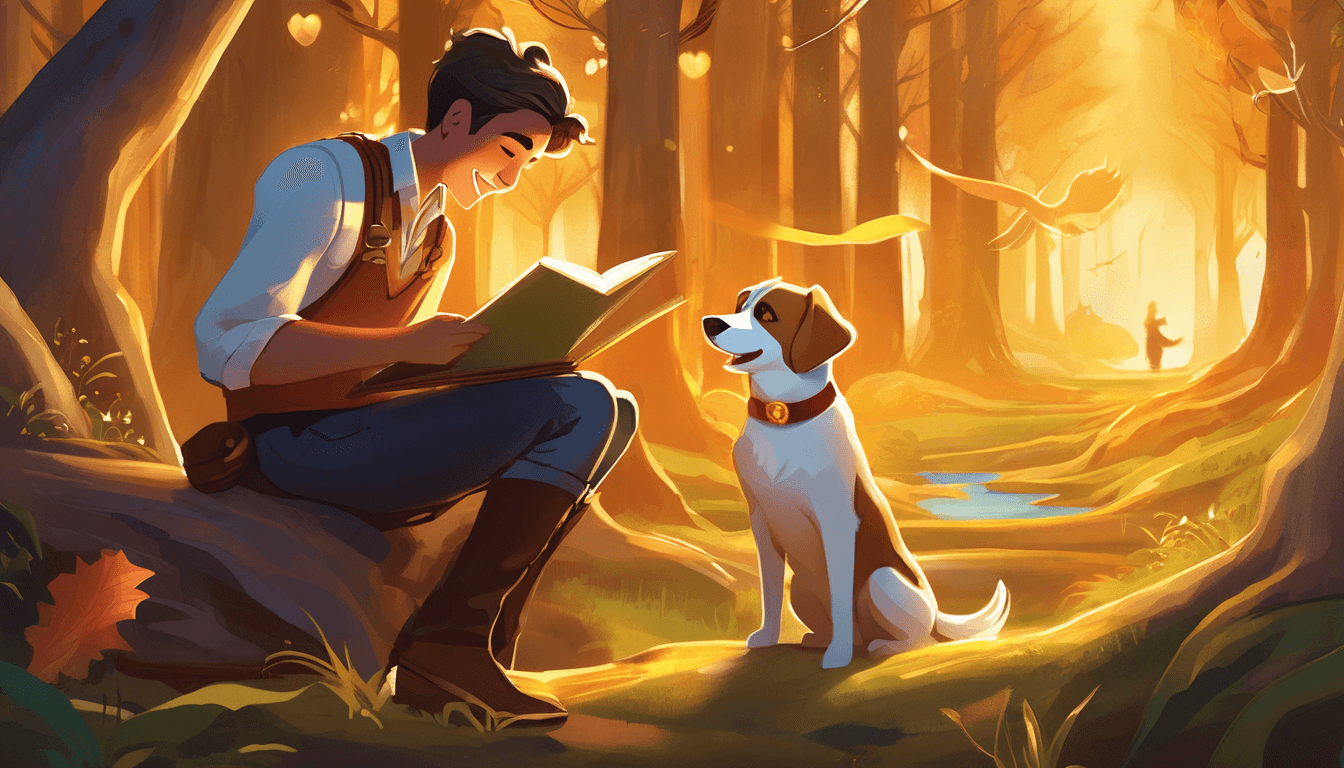
In the cliffside city of Valparaíso, where houses climbed bright hills like stacks of painted blocks, there lived an apprentice cartographer named Niko.
Niko worked in a narrow shop with a blue door, a round window, and a brass bell that gave a tiny hiccup whenever someone entered.
The shop belonged to Master Amara, the oldest mapmaker in the city. Her maps showed winding streets, hidden wells, sea caves, ferry routes, and every stairway that curled up the hills. People came from far away to buy her maps.
But the most wonderful maps were kept in a tall cedar cabinet at the back of the shop.
They were not maps of ordinary places.
One map showed the safest path through a thunderstorm, beginning at a child’s worried tummy and ending under a warm blanket.
Another showed where lost mittens went in winter. Tiny dotted lines led beneath beds, behind radiators, inside coat pockets, and once, very strangely, into a soup pot.
There was a map of the quietest spot in the entire city, marked by a silver star. It was inside the old library, behind a curtain, beneath a window where pigeons liked to nap.
Niko loved those maps most of all.
Every morning, Master Amara gave him a task.
“Measure the new bridge,” she might say.
Or, “Count the steps from the fish market to the yellow bakery.”
Or, “Find out whether the alley behind the clock tower is truly shorter at sunset.”
Niko would take his leather satchel, his pencils, his ruler, his compass, and his small notebook with its red cover.
Then one rainy afternoon, Master Amara opened the cedar cabinet and took out a rolled-up sheet of creamy paper.
“This,” she said, “is a very special assignment.”
Niko’s eyes grew wide.
The paper was blank.
“Blank?” he asked.
“For now,” said Master Amara.
She handed him a small bottle of blue ink, a feather pen, and a curious tool made of brass. It looked like a compass, except instead of sharp points, it had two tiny silver spoons at its ends.
“What does this measure?” Niko asked.
“Things that cannot be measured with rulers,” said Master Amara.
Niko turned it over carefully. “Like what?”
Master Amara smiled. Her silver hair was braided down her back, and her eyes always looked as if they knew where treasure was buried.
“Today, you must map three things,” she said. “A grandmother’s laugh. A dog’s loyalty. And the distance between two apologies.”
Niko blinked three times.
“How can I do that?”
“That,” said Master Amara, “is what you must discover.”
Outside, rain tapped the roofs. Far below, the harbor shone gray and green. Boats bumped gently together, and the clouds were so low they seemed to be resting on the chimneys.
Niko tucked the blank map into his satchel.
“Where should I begin?”
“Begin where you hear something that makes you curious,” said Master Amara.
So Niko stepped out into the wet, sparkling city.
He walked past the bakery, where steam fogged the windows and sweet bread sat in golden rows. He passed the flower seller, who wore a red rain hat and sang to her roses. He passed the funicular railway, which groaned up the hill carrying umbrellas, parcels, schoolbags, and one sleepy cat.
Then, from a little house with green shutters, Niko heard a laugh.
It was not a small laugh.
It was a round, rolling, bubbling laugh that tumbled out the open window and bounced down the cobbled street.
“Hoh-hoh-hoh! Oh, my buttons!”
Niko stopped.
Inside the green-shuttered house sat an old woman named Sahana. She had a purple cardigan, bright orange slippers, and a basket full of socks waiting to be mended. Across from her stood her grandson, Tomás, holding a knitting needle in one hand and a very puzzled sock in the other.
“I only wanted to help,” Tomás said.
“And you did help,” Sahana replied, still laughing. “You have made a fine scarf for a very skinny giraffe.”
Niko peered through the window.
Tomás had tried to sew up a hole in a sock, but he had stitched the sock’s toe to its top. It had become a long, twisty tube.
Tomás began to laugh too.
Soon, Sahana’s laugh and Tomás’s laugh mixed together. One was deep and warm, like a kettle beginning to sing. The other was quick and bright, like spoons clinking in a drawer.
Niko took out the brass measuring tool. The silver spoons trembled.
He placed one near Sahana’s laugh and one near Tomás’s.
The tool spun in a circle.
“What are you doing, young man?” Sahana called.
“I’m mapping your laugh,” said Niko shyly.
Sahana nodded as if this were a perfectly ordinary thing to do.
“Ah,” she said. “Then you must not only map the sound. You must map where it goes.”
“Where does it go?”
Sahana pointed to the kitchen table. “It goes into the tea, so tea tastes better.”
She pointed to Tomás. “It goes into him, so he remembers that mistakes can become funny stories.”
Then she pointed to the rain-streaked window. “And some goes out into the street, so lonely people may hear it and feel less alone.”
Niko thought hard.
On his blank map, he drew Sahana’s little house. From it, he drew golden swirls. One curled into a teacup. One wrapped around Tomás like a soft ribbon. One floated down the hill, past the bakery, past the flower stall, all the way to a bench where an old sailor sat under a newspaper hat.
The sailor heard the faintest piece of Sahana’s laugh.
His face changed.
He smiled.
Niko added a tiny golden dot by the sailor’s bench.
“A grandmother’s laugh,” he wrote, “cannot be measured in inches. It is measured by how far it travels inside people.”
The brass tool gave a pleased little ding.
Niko thanked Sahana and Tomás, then continued down the hill.
By afternoon, the rain had stopped. The city smelled of wet stone, salt, oranges, and chimney smoke. Puddles held upside-down pictures of balconies and birds.
Near the harbor, Niko saw a dog sitting beside a blue fishing boat.
The dog was shaggy and brown, with one white ear and a tail curled like a question mark. He sat very straight on the dock, looking toward the sea.
Beside him was a boy named Idris, holding a leash.
“Hello,” said Niko. “What is your dog’s name?”
“Batu,” said Idris.
“Is he waiting for someone?”
“My auntie,” said Idris. “She went out with the fishing crew before sunrise. Batu has been waiting since then.”
Niko looked at the dog. Batu’s nose twitched at every gust of wind. His ears lifted at every boat engine. He did not chase gulls. He did not sniff the fish baskets. He did not even accept a piece of sausage from the fishmonger, though it smelled very delicious.
“He could wait at home,” said Niko.
“He could,” Idris agreed. “But Batu believes Auntie Mina will need someone here when she comes back.”
Niko sat on the dock beside Batu. The harbor moved up and down with tiny splashes. Far away, a bell rang from a buoy.
“What does loyalty look like?” Niko wondered aloud.
Idris thought for a moment. “Sometimes it looks like staying.”
Niko held the brass tool over Batu’s back. The silver spoons stretched wide apart, farther and farther, until Niko thought they might fly off.
One spoon pointed toward Batu’s heart.
The other pointed across the water, toward the horizon.
Niko made a long blue line on his map from the dock to the far sea. But it did not feel right. The line was too simple.
Then he noticed something.
Batu had worn a little smooth patch into the wooden dock from sitting in the same spot day after day. And near the boat was an old rope with tooth marks in it. Idris explained that once, during a storm, Batu had held onto the rope while Mina pulled a basket of nets to safety.
Niko drew a blue line across the sea. Then he drew it back to the dock. Then he made the line circle Batu’s heart and the old boat and Idris and Auntie Mina’s red wool hat, which she had forgotten last week.
“A dog’s loyalty,” Niko wrote, “is not the distance from shore to sea. It is the distance a heart refuses to leave.”
At that very moment, a fishing boat appeared through the silver afternoon mist.
Batu sprang up.
His tail wagged so hard that his whole body wiggled.
“Auntie Mina!” cried Idris.
The boat came closer. A woman in yellow waterproofs stood at the front, waving both arms.
“Batu!” she called.
Batu barked once, twice, three times, and then raced in circles so fast that Niko laughed.
The brass tool dinged again, louder this time.
By evening, only one thing remained.
The distance between two apologies.
Niko had no idea where to find it.
He wandered up the hill as lamps began to glow in windows. The city turned honey-colored. People called good evening from doorways. Pots clinked. Radios played soft songs. Somewhere, someone was practicing a trumpet and only knew four notes.
At the top of a steep stairway, Niko found two girls sitting apart on the stone steps.
One was named Mei. The other was named Zuri.
Between them was a large chalk drawing of a moon garden. It had blue flowers, pink rabbits, a purple pond, and a castle with a green flag.
But someone had smudged the castle.
Mei sat with her arms crossed.
Zuri sat with her chin tucked into her coat.
Niko recognized the look on their faces. It was the look people got when they wanted to say something, but the words had become stuck behind a wall.
“Is everything all right?” he asked.
“No,” said Mei.
“Yes,” said Zuri at the same time.
Then both frowned.
Niko sat on a step below them.
“What happened to the castle?” he asked.
“Zuri stepped on it,” said Mei.
“It was an accident,” said Zuri.
“But she laughed,” said Mei.
“I laughed because my boot got chalk all over it,” said Zuri. “I did not laugh at your castle.”
Mei looked down.
“I thought you did.”
Zuri picked at a loose thread on her sleeve.
“I said I was sorry,” she murmured.
“But you said it while you were looking away,” Mei replied.
The air grew quiet.
Niko opened his map. He placed the brass tool between the girls.
The silver spoons did not stretch wide. They barely moved at all.
“That’s strange,” he said.
“They are sitting close together.”
“Sometimes,” said Niko, remembering Master Amara’s words, “close is not the same as near.”
Mei and Zuri looked at him.
Niko studied them. There were only three stone steps between their knees. But there was a whole tangle of hurt feelings, worried guesses, and unsaid thoughts between them.
He drew a tiny path on the blank paper.
It began at Zuri’s mouth.
It crossed a bridge labeled I DIDN’T MEAN TO HURT YOU.
Then it went through a garden labeled I SHOULD HAVE LOOKED AT YOU WHEN I SAID SORRY.
After that, it came to a gate labeled I BELIEVE YOU.
The path ended at Mei’s heart.
Zuri leaned closer to see.
Then she took a deep breath.
“Mei,” she said, looking right at her, “I am sorry I stepped on your castle. And I am sorry I laughed when you were upset. I was not laughing at you. I should have told you that right away.”
Mei’s eyes became shiny.
She rubbed her nose with her sleeve.
“I’m sorry I yelled at you,” she said. “I thought you did it on purpose.”
The brass tool gave the brightest ding of all.
Its silver spoons folded together.
Mei scooted one step closer.
Zuri scooted one step closer too.
Then, without another word, they each picked up a piece of chalk.
Together, they drew an even bigger castle. This one had two towers, five green flags, a drawbridge, and a tiny dog with one white ear sitting by the gate.
Niko smiled.
On his map, he wrote, “The distance between two apologies may be only a few steps. But it can contain a bridge, a garden, and the courage to walk across.”
When Niko returned to the blue-doored map shop, the moon was high over the harbor.
Master Amara was waiting beside the cedar cabinet. A lamp glowed on her desk. Its light made the room feel golden and sleepy.
“Well?” she asked.
Niko unrolled his map.
Master Amara leaned close.
She saw the golden swirls of Sahana’s laugh traveling into tea and lonely hearts.
She saw Batu’s blue line, crossing the sea and curling back home.
She saw the small chalk path between Mei and Zuri, with its bridge and garden and gate.
Master Amara was quiet for a long moment.
Then she smiled.
“You have made a true map.”
“But I did not use miles,” said Niko.
“Not all discoveries need miles,” said Master Amara. “Some discoveries teach us how big a laugh can be, how strong a waiting heart can be, and how brave it is to say sorry properly.”
She placed the map in the cedar cabinet, beside the map of thunderstorms, the map of missing mittens, and the map of the quiet library corner.
Then she gave Niko a new blank notebook with a red cover.
“For tomorrow,” she said.
“What will I map tomorrow?” Niko asked, yawning.
Master Amara turned down the lamp.
“Perhaps the weight of a secret,” she said. “Or the shape of a wish. Or the path a dream takes from one sleeping mind to another.”
Outside, Valparaíso shimmered beneath the moon.
The sea whispered against the shore.
And in the little shop with the blue door, Niko fell asleep in his chair, dreaming of maps with no edges at all.
Leave a Reply