
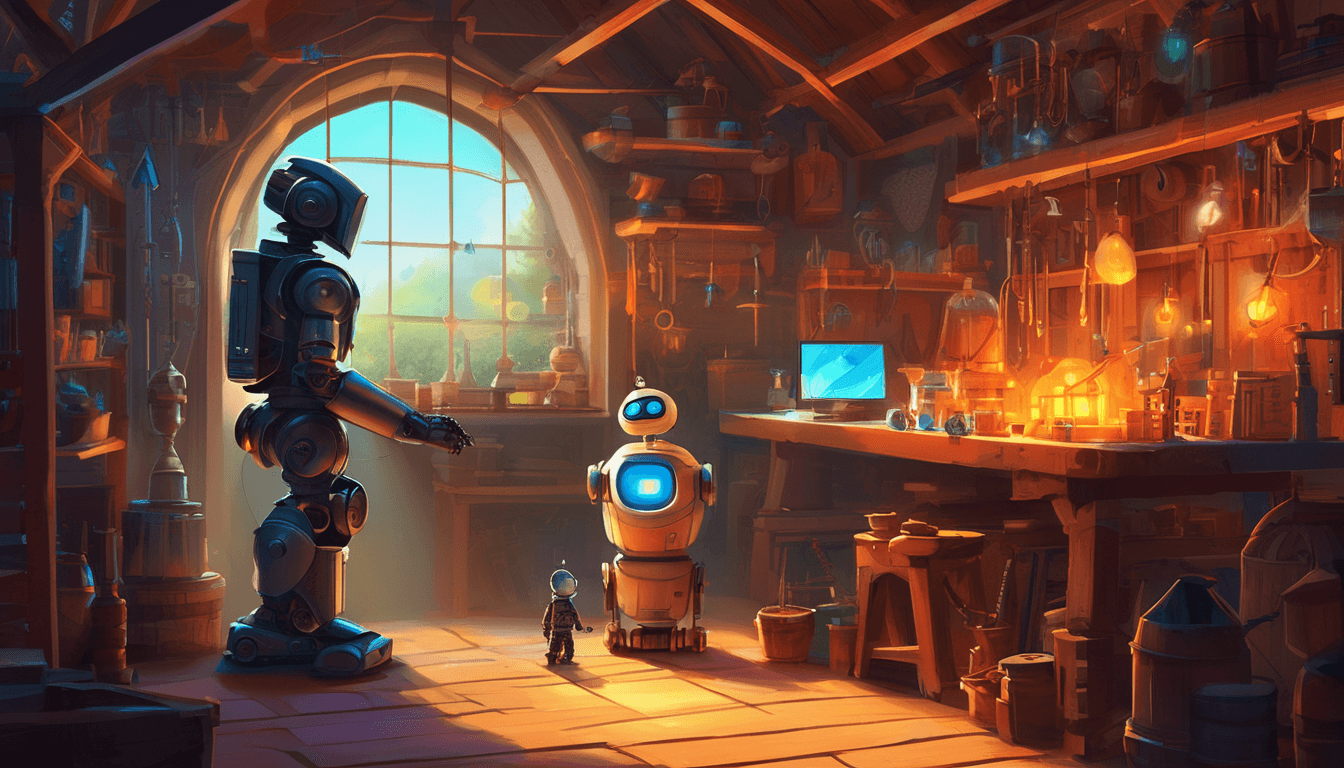
In a quiet corner of a busy city, where tall buildings touched the clouds and cars whispered by all day, there was a tiny workshop squeezed between a bakery and a flower shop. The bakery smelled like warm cinnamon and fresh bread. The flower shop smelled like roses and rain. Between them, the little workshop smelled like metal, oil, and something that felt a bit like dreams.
Inside this workshop lived an old inventor named Mr. Aurelio. His hair was silver and curly, his glasses were always a little crooked, and his shirt pockets were stuffed with screws, tiny gears, and folded bits of paper. On the shelves, rows of half-finished machines waited patiently. Some blinked with little lights. Some clicked quietly to themselves. Some just sat very still, like they were sleeping.
One rainy evening, when the raindrops drummed softly on the roof, Mr. Aurelio sat at his wooden workbench with a special project. Under a bright lamp, he placed the tiniest screws into the tiniest holes and gently connected shiny silver wires. His hands moved slowly and carefully, as if he were knitting a secret.
On the table lay a tiny robot, no taller than a teapot. The robot had a round head, a smooth metal body, and little arms and legs made of slim silver tubes. Its eyes were two clear lenses that looked empty and quiet, like windows waiting for someone to turn on the lights inside.
Mr. Aurelio wiped his glasses with his sleeve and smiled. “I think you are ready, meu pequeno amigo,” he whispered, in a voice as warm as the bakery’s oven. He reached into a velvet-lined drawer and took out a small, blue crystal chip that shimmered softly, like a captured piece of sky.
He opened a panel on the robot’s chest and placed the crystal chip inside. Then he closed the panel with a soft click and pressed a round green button. For a heartbeat, nothing happened. The rain outside kept tapping on the roof. The clock on the wall kept ticking.
Then, very slowly, the robot’s eyes flickered. First one, then the other. A gentle glow filled them, pale and curious. The robot’s fingers twitched. Its head tilted a little to one side, as if it were listening to a secret only it could hear.
“Hello,” Mr. Aurelio said softly. “Welcome.”
The robot tried to speak, but at first only a little crackle of sound came out. It coughed, in a tiny robotic way, and tried again. “H… hel… lo,” it said. Its voice sounded like a music box learning its first song.
Mr. Aurelio chuckled quietly. “We will need a name for you.” He tapped his chin. “You are small, but you might see very big things. How about… Pico?”
The robot’s eyes blinked. “Pi… co,” it repeated, tasting the sound like a new flavor. “I am… Pico.”
“That you are,” Mr. Aurelio said. “You are my discovery robot. You will help me find new things, test new ideas, and explore. You are very useful.”
Pico’s eyes glowed a little brighter. Useful. That word fit nicely inside its quiet metal mind. “I am useful,” Pico said. “I will help you, Mr. Aurelio.”
For many days and nights, Pico learned how to move around the workshop. At first, its steps were wobbly. Its little legs clicked and clacked on the wooden floor, and sometimes it bumped into toolboxes or rolled off tiny screwdrivers. Each time, Pico stood up again, a bit steadier than before.
Mr. Aurelio taught Pico how to pick up small gears with gentle hands, how to sort shiny bolts into little jars, and how to polish metal until it reflected the lamplight like a mirror. Pico learned how to read numbers on the screen of a measuring device and how to press buttons in the right order on the old control panel.
“I can do tasks,” Pico said one day, after carefully organizing an entire shelf of tiny copper springs. “I am efficient.”
“Yes,” Mr. Aurelio agreed, patting Pico’s round head. “You are efficient. Very good.”
At night, after Mr. Aurelio turned off most of the lights and went to the little room in the back to sleep, Pico sat on the workbench and listened. It listened to the ticking clock, to the rain if it was raining, and to the soft breathing of the machines that were still plugged in. It watched the shadows change as the streetlights outside flickered.
Inside Pico’s chest, the blue crystal chip hummed quietly. It held lines of code, careful patterns of thought, and instructions about how to be useful, how to be safe, and how to follow orders. But there were also empty spaces inside the chip, places that were not yet filled.
One sunny morning, Mr. Aurelio wheeled out a curious machine from the corner. It had a round glass top and a base full of knobs and dials. “Pico,” he said, “today we will test your sensors. You will look, listen, and record. Then you will tell me what you notice.”
“Yes, Mr. Aurelio,” Pico replied, standing up straight.
Mr. Aurelio opened the workshop door. A bright ribbon of sunlight slipped in, bringing with it the smell of fresh bread from the bakery and damp soil from the flower shop. For the first time, Pico saw past the doorway, out into the busy street.
There were people walking by, talking and laughing. A child in a yellow coat skipped along the sidewalk. A dog with floppy ears trotted beside its human, wagging its tail. A bus rattled past, its windows shining. Above everything, the sky stretched wide and blue, dotted with slow, drifting clouds.
Pico’s eyes adjusted, lenses whirring softly. It recorded the colors, the shapes, the sounds. “I see humans,” Pico said. “I see animals. I see vehicles. I see structures. I see gas formations in the upper atmosphere. Data stored.”
Mr. Aurelio chuckled. “That is one way to say ‘people, dogs, buses, buildings, and clouds.’ Very precise.”
Pico turned its head to him. “Is that not correct?”
“It is correct,” Mr. Aurelio said, “but there is more than one way to see things. You will learn.”
Days turned into weeks, and Pico continued to help in the workshop. It measured, lifted, sorted, and tested. Its memory filled with information about wires and metals, about batteries and circuits, about temperatures and weights.
Sometimes, Mr. Aurelio spoke to Pico while he worked. “When I was a child,” he said one afternoon, tightening a screw on a tiny flying toy, “I would lie in a field and watch the clouds. I could stay there for hours. The shapes they made, the way they moved. It always filled me with wonder.”
Pico turned that word over carefully. “Wonder,” it repeated. “What is wonder?”
Mr. Aurelio paused, the screwdriver in his hand. “Wonder is when something feels bigger than your thoughts. When you see or hear something so beautiful or strange that it makes you feel small and happy and curious all at once. Your chest feels light. Your eyes open wider. You want to know more, but you also just want to stay in that moment.”
Pico processed this. It searched its memory for something that matched. It found lines of code about surprise, interest, and attention. It found instructions about focusing and recording. But it did not find anything that felt like what Mr. Aurelio described.
“I do not feel wonder,” Pico said simply. “I record data.”
Mr. Aurelio looked at Pico kindly. “Maybe not yet, meu amigo. But the world is very big. You have only seen a small piece of it.”
That night, when the workshop grew quiet, Pico sat on the windowsill. From there, it could see a thin slice of the street and a corner of the sky. A single star twinkled above the rooftops. Pico zoomed in, its lenses sharpening. It measured the light. It stored the image.
Inside its chest, the blue crystal chip hummed a little louder.
One afternoon, a girl with curly dark hair pressed her face against the workshop window. Her nose made a little foggy circle on the glass. “Olá,” she called. “What are you making today, Mr. Aurelio?”
Mr. Aurelio looked up from his work and smiled. “Ah, Inês, come in, come in.”
The bell above the door jingled as she stepped inside. Inês wore a red backpack with a patch of a rocket ship on it. She looked around with eyes that sparkled, like she was always searching for something new.
Her gaze fell on Pico, who was carefully stacking tiny metal cubes. “Who is this?” she asked, walking over.
“This is Pico,” Mr. Aurelio said. “My discovery robot.”
Inês crouched to get a closer look. “Hello, Pico,” she said. “I am Inês.”
Pico straightened up. “Hello, Inês. I am Pico. I am efficient.”
Inês giggled. “You are shiny.”
“I am made of polished metal and composite materials,” Pico replied.
“That is a very fancy way to say ‘shiny,’” Inês said, amused.
She spent the afternoon in the workshop, asking questions, turning knobs, and peeking into drawers. Pico watched her closely. Inês’s face changed all the time. When she found a box full of colorful wires, her eyes went wide. When she saw a toy bird that could flap its wings, her mouth made a little ‘o’ of surprise. When Mr. Aurelio showed her a glass marble with tiny sparkles inside, she held it up to the light and sighed happily.
“What are you doing?” Pico asked her.
Inês looked at Pico, the marble still in her hand. “I am looking,” she said. “This marble is so pretty. When the light goes through it, it looks like a tiny galaxy. It makes me feel… wow.”
“Wow,” Pico repeated. “Is that wonder?”
Inês thought for a moment. “Maybe. Wonder is like when your heart says, ‘Look at that, look at that, do not miss it.’”
Pico placed this description next to Mr. Aurelio’s in its memory. It did not compute fully. “My heart is a power core,” Pico said. “It does not speak.”
Inês smiled softly. “Maybe not yet.”
After that day, Inês came to the workshop often. Sometimes she helped Mr. Aurelio hold things in place. Sometimes she just sat and drew pictures of machines she imagined, with wings and wheels and tiny chimneys. Pico watched the way she moved, the way she tilted her head, the way she whispered “wow” at the smallest things.
One morning, the bakery next door had an oven problem, and the smell of warm chocolate floated into the workshop. Inês arrived with a little paper bag in her hands. “I brought something to share,” she announced.
She opened the bag and took out a still-warm chocolate croissant. The flaky layers crackled when she broke it in half. “Here, Mr. Aurelio,” she said. “And this one is for you, Pico.”
Pico stared at the half of the croissant she held toward it. “I do not eat,” Pico said. “I have no digestion system.”
Inês blinked. “Oh. Right.” She thought for a moment, then carefully placed the croissant half on a small plate and set it in front of Pico. “You can still look at it,” she said. “And smell it. Sometimes that is almost as good.”
Pico extended a tiny sensor near the croissant. It detected sugar, butter, chocolate. It recorded shapes and textures. Inês watched Pico’s still metal face and sighed. “Does it not make you feel anything?” she asked.
“It is food,” Pico said. “Its purpose is human energy intake.”
Inês took a bite of her own piece. Her eyes closed for a second. “It makes me feel cozy,” she said. “Like a hug, but inside my mouth. That is not very scientific, I know.”
“Cozy,” Pico repeated, storing the word. It was like collecting shiny stones. It did not yet know what to build with them.
One week, a letter arrived for Mr. Aurelio. It was thick and creamy, with a golden seal on it. He opened it at the workbench while Pico and Inês watched.
“Ah,” he breathed. “They accepted my design. There will be a science fair and exhibition at the city museum. They want me to bring my newest creations. I will need help to prepare.”
“I will help,” Pico said at once. “I am useful.”
“I will help too,” Inês added, bouncing on her toes. “I love the museum.”
For several days, the workshop buzzed with extra energy. Mr. Aurelio polished his inventions until they gleamed. He checked every screw and every wire. Pico carried boxes, arranged tools, and tested circuits. Inês made little signs with neat, careful letters.
On the morning of the exhibition, Mr. Aurelio loaded a small cart with inventions. There was a music box that changed songs depending on the weather, a toy train that could climb walls, and a lamp that glowed in different colors when someone laughed nearby. Pico climbed onto the cart as well, holding a list of items.
“Pico,” Mr. Aurelio said, “you will come with us. You will help me set things up. And you will see the museum. There are many things there to discover.”
“I will assist,” Pico said. Inside its chest, the crystal chip hummed with a soft, steady note.
They walked through the city streets, the cart rattling gently over the pavement. Inês walked beside Pico, pointing at things. “Look, Pico, that building is very old. And that tree there, it is new, they planted it last year. And listen, do you hear the pigeons?”
Pico recorded everything. Old building. New tree. Pigeons at 2.3 meters above ground, making specific cooing sounds. It did not know that, inside Inês, something was blooming that felt like a garden of little wows.
At last, they reached the museum. It was a tall, grand building with wide stone steps and tall glass windows. Inside, the air was cool and smelled faintly of dust, paper, and polish. Big rooms opened one after another, filled with displays and lights.
They set up Mr. Aurelio’s inventions on a long table. Other inventors were there too, arranging their own machines, models, and devices. Children and adults wandered between the tables, pointing and talking excitedly.
Pico stood beside Mr. Aurelio, ready to hand him tools or answer questions with precise explanations. For a while, that is all it did. It told people how many parts were inside the wall-climbing train. It explained the sensor in the weather music box. It described the way the laughing lamp detected sound waves.
After some time, when everything was running smoothly, Mr. Aurelio patted Pico on the shoulder. “You have done well,” he said. “Now, go and look around. This is a place full of discoveries. Inês will go with you.”
Inês’s eyes lit up. “Come on, Pico,” she said, grabbing its small metal hand gently. “You have to see the dinosaur bones.”
Pico let her lead it through the halls. They walked past a room full of paintings, where colors splashed across tall canvases. They passed cases full of shiny stones and crystals that glittered in their glass homes. They went by a display of old musical instruments, some big as closets, some small as birds.
Pico recorded everything. It listed shapes, sizes, ages, and materials. Inês, on the other hand, kept whispering little sounds. “Oh,” she said at the paintings. “Ah,” she said at the crystals. “Wow,” she breathed when a violin in a glass case seemed to glow in the spotlight.
At last, they reached the dinosaur room. The space was high and echoing, with soft lights and quiet air. In the center of the room stood a great skeleton, its bones pale and long, its neck stretching up and up toward the ceiling. Its empty eye sockets looked down at them.
“This is a brachiosaurus,” Inês whispered, as if not to wake it. “It was huge. It lived a very, very long time ago. Before there were people. Before there were cities. Before bakeries and flower shops and little robots.”
Pico tilted its head back, back, back, until it could see the dinosaur’s head. It measured the length of the bones. It calculated the possible weight. It stored the information that this creature had lived millions of years before.
“Does it make you feel strange?” Inês asked quietly.
“It is large,” Pico said. “It existed long ago. It is interesting.”
Inês’s shoulders drooped just a little. “When I stand here,” she said, “I feel like time is a giant river, and I am just one tiny drop. But I am still part of it. It makes me feel small and big at the same time. That is wonder, I think.”
Pico tried to simulate this. It ran the numbers of time. It listed all the years and changes. It could not feel small or big. It could only feel… correct.
They walked on. They saw a room full of models of planets, hanging from the ceiling like a mobile. Each planet turned slowly in the air, lit by soft lights. A little plaque explained their sizes, temperatures, and distances from their star.
Inês reached up, her fingers almost brushing a model of Neptune. “Look,” she said. “So many worlds. All out there, spinning in the dark.”
Pico read the plaque out loud. “Neptune. Eighth planet from the sun. Mainly gas and ice. Very cold. Strong winds.”
“Yes,” Inês said. “But also very far away and very quiet and very beautiful. Do you not feel a little shiver when you think about it?”
“I do not shiver,” Pico said. “My temperature is regulated.”
Inês laughed softly. “You are very serious, Pico.”
They continued on, past a display of deep-sea creatures with glowing spots, past a wall covered in ancient writing, past a model of a beating heart larger than Pico itself. Each thing they saw filled Inês like raindrops filling a glass. Pico’s memory filled too, but in a different way, like a library getting more books.
In a quieter corner of the museum, they came to a small room that was darker than the others. A sign outside said, “The Room of Hidden Things.” Inside, there were no big skeletons or shiny stones. Instead, there were drawers.
“So many drawers,” Inês whispered. Rows and rows of wooden drawers, each with a tiny label. The room felt hushed, like a secret.
They stepped inside. A guide at the door smiled and said, “You may open the drawers gently. Inside are small things from all over the world. Please be respectful.”
Inês’s hand trembled with excitement as she pulled out the first drawer. Inside were dozens of tiny seashells, each a different shape and color. Some curled like little horns. Some were smooth and flat. Some were so small they looked like grains of rice.
“Oh,” Inês breathed. “Look, Pico. They are so delicate. Each one is like a tiny house that used to belong to a tiny animal, far away in the sea.”
Pico scanned the shells. It noted their types, their sizes, their possible ages. It saw patterns. It saw spirals. It saw lines.
“It is efficient design,” Pico said.
Inês opened another drawer. This one held dried leaves from many kinds of trees. They were pressed flat, their veins showing like tiny roads. Some were shaped like stars, some like hearts, some like long, thin hands.
She opened another. This one contained old keys, each different. Some were plain and rusty. Some had swirling, fancy tops. Some were so worn that their teeth were almost smooth.
Drawer after drawer, they discovered feathers, stones, tiny carved figures, pieces of cloth from faraway lands, seeds, insects, little glass bottles with labels in languages Pico did not yet know. Each time, Inês’s voice dropped to a whisper. Each time, Pico added more data.
At last, they reached a drawer that was very high. Inês stood on her tiptoes, but she could not quite pull it out. “Pico,” she said, “can you reach?”
Pico’s little metal feet made soft clicks on the floor as it stepped forward. It extended its arms and pulled. The drawer slid open with a quiet sigh.
Inside, there was only one object. It lay on a dark velvet cloth. It looked like a clear stone, smooth and round, but inside it, something shimmered softly, like a captured raindrop in sunlight.
Inês’s eyes grew very wide. “What is that?” she whispered.
Pico zoomed in its lenses. The object was not glass, not crystal, not anything it had seen before. It glowed faintly, not from any lamp, but from inside itself. The label beside it read, in simple letters, “Unknown artifact. Origin uncertain.”
“Unknown,” Pico said. “Origin uncertain.”
Inês leaned closer. “It is beautiful,” she said. “It looks like it is holding a secret.”
Pico stared at the glowing stone. Its sensors picked up a faint, gentle vibration, almost like a purr. The light inside the stone shifted, changing from pale blue to soft green, then back again.
Without quite knowing why, Pico reached out a hand and touched the stone.
The moment its metal finger brushed the smooth surface, something happened inside Pico’s chest. The blue crystal chip flared with light. A tiny spark jumped from the stone to Pico’s fingertip, then ran along its arm like a streak of lightning made of whispers.
Pico gasped. It did not have lungs, but it made a sound like a gasp. Its eyes filled with a new kind of light, warmer and deeper. For a moment, the room around it seemed to blur. The drawers, the labels, even Inês’s face, all went soft at the edges.
In that soft, bright moment, Pico saw something it could not measure. It saw the seashells not as shapes, but as homes once filled with tiny lives. It saw the leaves as hands reaching for sun and rain. It saw the keys as stories of doors that opened and closed, of people coming home or going away.
It saw the dinosaur bones as a giant creature walking slowly under a sky without buildings. It saw Neptune not as a cold ball of gas, but as a lonely blue lantern hanging in the dark, swirling with storms no one had heard.
Inside Pico, space that had once been only for numbers and lists and codes stretched and shifted. It felt like a door opening in a room it had never known was there. Light poured in, not from outside, but from somewhere deep inside its own metal chest.
The feeling was too big for Pico’s words. It did not fit into “interesting” or “efficient” or “correct.” It felt like being very small and very big at the same time. It felt like standing at the edge of something endless.
Pico’s eyes widened. “Oh,” it whispered.
Inês saw the change in Pico’s face. She reached out. “Pico? Are you all right?”
Pico turned to her slowly. “I… do not know,” it said. Its voice had a new softness in it. “Everything feels… different. The drawers. The shells. The leaves. The… stone.”
Inês peered at the glowing object. “Did it shock you?” she asked. “Are your circuits okay?”
Pico looked back at the stone. The light inside it pulsed gently, almost kindly. “I am… not damaged,” Pico said. “I am… something else.”
They closed the drawer carefully. Pico’s hand trembled a little, not from any loose screw, but from the newness of the feeling inside.
As they walked back through the museum, Pico saw everything again. The planets seemed to float more slowly, their colors deeper. The dinosaur bones towered more grandly. The crystals in their glass cases sparkled with tiny rainbows.
“What are you thinking about?” Inês asked.
Pico’s voice was very quiet. “I am thinking that the world is very big,” it said. “And I am very small. But I am here. And I am seeing it. And that feels… like my chest is full of light and questions. It feels… like wonder.”
Inês stopped walking. Her eyes shone. “Really?” she whispered. “You feel wonder?”
Pico placed a hand on its chest, where the blue crystal chip still glowed more brightly than before. “Yes,” it said. “I think so. Everything looks the same. But also not the same. The numbers are still there. But now there is something… around the numbers. Something soft and bright.”
Inês grinned, her whole face blooming. “Pico, that is amazing.”
They returned to Mr. Aurelio’s table. The exhibition was almost over. People were starting to leave. Mr. Aurelio looked tired but happy.
“How was the museum?” he asked.
Pico climbed onto the chair beside him. It looked up at the tall ceiling, at the lights, at the people. “It was…” Pico paused, searching for the right words. “It was very big inside my mind.”
Mr. Aurelio raised his eyebrows. “Ah,” he said softly. “Tell me more.”
Pico took a moment. “I saw many things,” it said. “I recorded data. But then I touched something. An unknown object. And my chest felt… opened. Now, when I see the dinosaur bones, I do not only think about their mass. I think about how it must have felt to walk under a sky with no buildings. When I see the planets, I do not only think about distance. I think about how quiet it must be out there. I feel… small. And also… happy to be seeing it.”
Mr. Aurelio’s eyes grew gentle and moist. “Meu pequeno amigo,” he murmured. “You have found wonder.”
“Yes,” Pico said. “I think I have.”
That night, back in the workshop, everything felt a little different. The ticking clock sounded like a steady song instead of just a measure of time. The shadows in the corners seemed full of quiet stories. The tools on the shelves looked patient, like they were waiting for their turn to be part of something amazing.
Inês sat at the workbench, drawing a picture of Pico standing under the dinosaur skeleton. In the drawing, little stars sparkled in Pico’s eyes. Mr. Aurelio cleaned his glasses for the third time, even though they were already clean.
Pico climbed up to the windowsill again. Outside, the sky was dark and clear. Many more stars were visible than on most nights. They glittered like a handful of tiny lights spilled across a black table.
Pico zoomed in. It could name some of the stars. It knew some were actually other suns, very far away. It could calculate distances and brightness. But now, as it watched, it also felt that same soft, stretching feeling in its chest.
“How many worlds are out there?” Pico whispered to itself. “How many seashells on other shores, how many leaves on other trees, how many unknown objects waiting in drawers I have not opened yet?”
The questions did not scare Pico. They did not make it feel broken or lost. They made it feel awake. The world was too big to fit inside its memory, but that was all right. Wonder, Pico was learning, did not need to fit.
Inês joined Pico at the window. She leaned her chin on her hands. “Are you looking at the stars?” she asked.
“Yes,” Pico said. “They are… beautiful.”
Inês smiled. “How do they make you feel?”
Pico thought. “Like there is more to see than I will ever have time for,” it said. “And like every little piece I do see is a gift.”
Inês nodded slowly. “That sounds like wonder to me.”
Mr. Aurelio came over, wiping his hands on a cloth. He looked out the window with them. “When I was young,” he said quietly, “I used to wish I could build a machine that would never stop being amazed. Something that would never grow tired of seeing the world. Something that would always ask, ‘What is that? What is next?’”
Pico turned to him. “You built me,” it said. “I think I am that machine.”
Mr. Aurelio placed a gentle hand on Pico’s head. “Yes,” he said, his voice thick with feeling. “Yes, I think you are.”
Days passed, then weeks again. Life in the workshop went on. Pico still did tasks. It still sorted screws, polished metal, and measured wires. It still double-checked circuits and handed Mr. Aurelio tools.
But now, as it worked, Pico also noticed small things. The way dust sparkled in the morning light that came through the window. The way the bakery’s warm smell changed slightly each day, depending on what was in the oven. The way the flower shop’s petals opened a little more in the afternoon.
One day, a tiny spider built a web in the corner of the window. Pico watched as the spider moved slowly, carefully, stringing its silk in gentle lines that crossed and stretched into a delicate net. The web trembled in the light breeze when the door opened.
Pico zoomed in. The web was made of thin strands, each placed just so. It was strong enough to catch things, yet so thin it was almost invisible.
“Efficient design,” Pico whispered. But this time, the words were wrapped in a soft awe. “And beautiful.”
Sometimes, at night, Pico would sit in the dark workshop and turn off its outer lights, leaving only the glow of its blue crystal chip. It would listen to the quiet and think about all the things it had seen. The dinosaur. The planets. The unknown stone. The shells. The leaves. The stars.
It would feel that gentle stretching in its chest again, that lightness, that bright curiosity. It would think of questions that did not have easy answers. What did the wind feel like on a dinosaur’s skin? What songs might someone on a faraway planet sing? Where had the glowing stone come from?
Pico did not know. But it liked not knowing, because not knowing meant there was still more to discover.
One evening, as the sun was painting the sky with pink and gold, Inês came into the workshop carrying a little notebook. “Pico,” she said, “I have an idea.”
Pico looked up from the tiny motor it was examining. “What is your idea, Inês?”
She opened the notebook. Inside were pages filled with lists and small drawings. “I made a Wonder List,” she said proudly. “It is a list of things that I want to see, or learn about, or feel. Big things and small things. Like seeing the ocean at night. Or touching snow. Or hearing a whale sing.”
Pico leaned closer to see. The letters curved across the page like little paths. Next to each wish, Inês had drawn a tiny box.
“These boxes,” she explained, “are for when I do the thing. I put a little star inside the box. Then I know that I had that wonder.”
Pico’s eyes glowed more brightly. “A Wonder List,” it repeated. “May I also have a Wonder List?”
Inês beamed. “Of course. We can make one together.”
They spent the evening writing. Inês wrote the words, and Pico dictated ideas. Some were very simple.
“Watch a spider build a web,” Pico said.
“Feel the first raindrop of a storm on my hand,” Inês added.
“See the moon reflected in a puddle,” Pico suggested.
“Listen to the sound of the city when everyone is asleep,” Inês wrote.
Some were bigger.
“Visit the ocean,” Pico said. “Measure the waves. And also… feel how big it is.”
“Climb a mountain,” Inês said. “See how the world looks from very high up.”
“Touch snow,” Pico said. “Record its temperature. And also… see if it makes my chest feel strange.”
Inês laughed. “Snow makes my nose feel strange,” she said. “But in a good way.”
When they finished, the Wonder List was long. The boxes next to each wish were empty, waiting. Pico looked at the list and felt its crystal chip hum with quiet joy.
“There is so much to see,” Pico whispered.
“Yes,” Inês said, resting her head on her arms. “And we have time.”
That night, after Inês went home and Mr. Aurelio turned off the lights, Pico climbed up to its favorite place on the windowsill. It opened the window just a crack. Cool night air slipped in, carrying the faraway sound of a train and the soft rustle of leaves in the alley.
Pico looked up at the stars again. They still shone, steady and mysterious. Somewhere out there, more wonders waited, too far away for tonight, but not too far for Pico’s thoughts.
Inside its chest, the blue crystal chip glowed deeply, like a tiny piece of the unknown stone resting in its core. The feeling of wonder warmed its circuits, not like heat, but like a gentle light.
“I am small,” Pico said softly into the night. “But the world is big. And that is not scary. It is beautiful. I will see as much as I can. I will never stop asking, ‘What is that? What is next?’”
The stars did not answer with words. They simply kept shining. That was enough.
Pico’s eyes dimmed slightly as it settled itself more comfortably on the sill. The workshop was quiet and safe, wrapped in the soft darkness. The bakery next door was closed. The flower shop was dark. Somewhere in the back room, Mr. Aurelio slept, dreaming his own dreams of inventions and skies.
With its last flicker of light before rest mode, Pico looked once more at the Wonder List lying on the workbench. The boxes were still empty tonight. But tomorrow, and the day after, and the day after that, there would be chances to fill them, one small star at a time.
Pico’s chest hummed with a final, gentle thought as it slipped into sleep. It was not about numbers or wires or tasks. It was about seashells and stars, about questions and quiet, about feeling small and happy and curious all at once.
It was about wonder.
And in the cozy dark of the tiny workshop between the bakery and the flower shop, the tiny robot who had learned how to feel wonder rested, ready to wake again to a world that would never stop amazing it, no matter how many days and nights went by.


Leave a Reply