
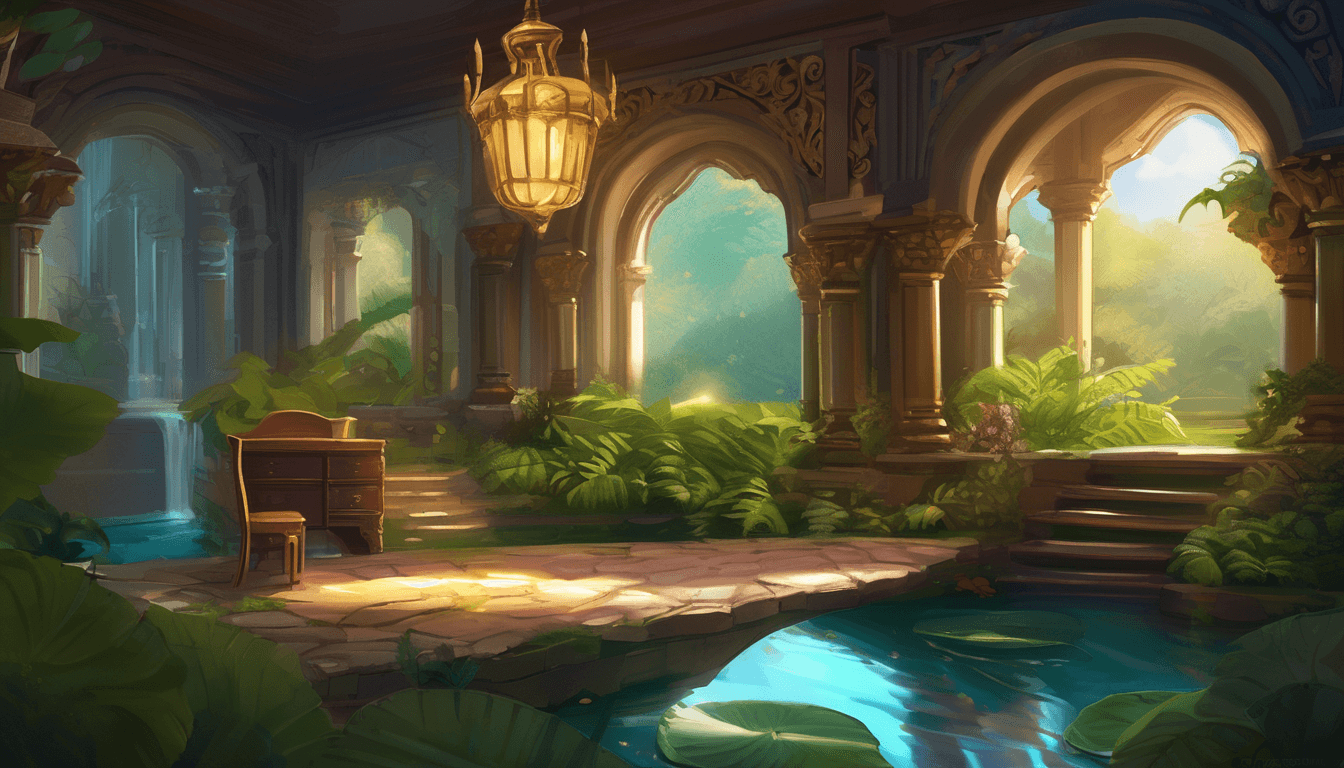
Princess Samira lived in a palace with seven blue roofs, each one shaped like a curled ocean wave.
From her bedroom window, she could see the city of Varenna spread below the palace hill. There were red chimneys, golden market tents, winding streets, and a river that shone silver in the moonlight. Beyond the river were fields of lavender, then a dark green forest, then mountains that wore little white hats of snow.
Samira loved almost everything about being a princess.
She loved riding in the palace kitchen lift with baskets of warm bread. She loved feeding the royal swans, who were greedy but polite. She loved the echoing hall where every portrait of her ancestors seemed to be watching her, even though most of them had serious eyebrows and very stiff collars.
But there was one thing Samira did not love.
It was the Day of Keeping.
Once every year, on the first evening of autumn, her family gathered in the oldest room of the palace. They lit twelve beeswax candles. They locked the door. Then the King, who was Samira’s father, would take a small wooden box from a shelf high above the fireplace.
Inside the box was an ordinary brown button.
That was all.
A button, smooth and round, with four tiny holes in its middle.
Samira had seen it every year since she was small enough to sit on her mother’s lap. And every year, everyone became very quiet when the button appeared.
Her father would hold it in his palm. Her grandmother would press one hand to her heart. Her uncle Idris would look toward the window as though expecting a storm. Then the button would be wrapped in soft cloth, placed back in its box, and returned to the high shelf.
No one ever explained why.
When Samira was six, she had asked, “Is it a magic button?”
“No,” her grandmother had said.
“Did it belong to a queen?”
“Not exactly,” said her father.
“Does it open a secret door?”
“Perhaps,” her uncle Idris had said mysteriously.
But when Samira asked which door, he had only smiled into his beard.
Now Samira was seven years old, and she had decided that seven was quite old enough for answers.
On the morning before the Day of Keeping, Samira found her grandmother, Queen Mother Yelena, in the palace greenhouse. Grandmother Yelena was watering tiny lemon trees with a silver watering can.
The greenhouse smelled of warm soil, mint leaves, and sunshine.
“Grandmama,” said Samira, “I need to know about the button.”
Queen Mother Yelena did not look surprised.
“Do you?” she asked.
“Yes. Everybody in our family acts as if it is more important than the crown jewels.”
“Sometimes a small thing is more important than a large thing.”
“But it is only a button.”
Her grandmother set down the watering can. “Come with me.”
Samira followed her through the greenhouse, down a narrow spiral staircase, and into a hallway she had never seen before. The walls were lined with old wooden cupboards. Each cupboard had a different tiny keyhole.
At the end of the hall stood a door painted green.
Queen Mother Yelena took a key from the ribbon around her neck. It was not shiny. It was old and black, like a key made from moonless night.
The lock clicked.
Inside was a room full of strange, ordinary objects.
Samira stared.
There was a chipped teacup on a velvet cushion. A bent brass spoon under a glass dome. A faded red mitten. A cracked clay whistle shaped like a bird. A piece of blue string. A wooden comb missing three teeth. A small, lumpy stone.
“Is this a museum?” Samira whispered.
“It is our family’s Room of Keeping,” said her grandmother.
“But why are all the things so plain?”
“Because grand things are often looked after by everyone,” said Queen Mother Yelena. “Crowns have guards. Gold has locks. Famous paintings have alarms. But ordinary things can be forgotten.”
Samira walked slowly from shelf to shelf.
“What happened to the mitten?”
“That belonged to your great-great-grandfather when he was a boy. He gave it to a child who was lost in a snowstorm. The child found her way home because one hand stayed warm.”
“And the spoon?”
“Your great-grandmother used it to tap a message through a prison wall during the Quiet War. On the other side was a friend who needed to know that help was coming.”
Samira looked at the chipped teacup.
“And this?”
Her grandmother smiled. “That was carried by a baker’s daughter all the way across the city during a flood. She used it to scoop water from the home of an elderly violin maker until he could be rescued.”
“But why did our family protect these things?”
“Because they are reminders,” said Queen Mother Yelena. “Not reminders of what our family owned. Reminders of what people chose to do.”
Samira’s eyes grew wide.
“Is the button in here?”
“Yes,” said her grandmother. “But the button’s story is different. It belongs not to one person, but to every generation.”
She walked to the far wall, where a narrow cabinet stood behind a curtain of deep purple velvet. The cabinet had seven keyholes.
Queen Mother Yelena unlocked it with seven little keys from her ring.
Inside lay the plain brown button.
In the bright room, it looked even more ordinary than ever.
“It began,” said Grandmother, “with your ancestor, Princess Anwen, more than two hundred years ago.”
Samira sat on a round footstool. She could already feel the story beginning to gather around her like a warm blanket.
“Princess Anwen,” said Grandmother Yelena, “was not much interested in royal lessons. She was expected to learn dancing, speeches, maps, and the names of every important visitor in the kingdom. But what she loved most was exploring.
“One rainy afternoon, she slipped away from her tutor and wandered into the palace laundry. She found dozens of people working there. They scrubbed sheets, mended uniforms, folded towels, and carried steaming baskets.
“In one corner sat a young seamstress named Marisol. Marisol had been sewing since sunrise. Her fingers were pricked with tiny red dots.
“Princess Anwen sat beside her and asked, ‘What are you making?’
“Marisol held up a brown wool coat. ‘A coat for a messenger,’ she said. ‘He must ride tonight to warn the villages that the river dam is cracking.’
“But the coat had a problem. Its final button was missing.
“‘Can you use a different button?’ Anwen asked.
“Marisol shook her head. ‘The rider must cross the northern pass. The wind up there bites like a wolf. Without this button, his coat will flap open. He could freeze before he reaches the first village.’”
Samira hugged her knees.
“What did Princess Anwen do?”
“She searched everywhere. In sewing baskets. Under tables. In piles of old uniforms. The rain beat against the windows. Thunder shook the laundry room.
“At last, Anwen looked down at her own sleeve. Her dress had little brown buttons, exactly the right size.
“She cut one off.
“Marisol sewed it onto the messenger’s coat. The messenger rode through rain, mud, and cold mountain wind. He reached every village before the dam burst.
“The people got to high ground. Farmers led their sheep to safety. Families carried sleeping babies up the hill. Even old Master Roko, who refused to leave his bean garden, was brought away by three neighbors and a wheelbarrow.
“When the dam broke, the river flooded the valley, but nobody was hurt.”
Samira smiled. “So the button saved everyone.”
“Not by itself,” said her grandmother gently. “The messenger saved them. Marisol helped. The villagers listened and hurried. The button was only a button. But it reminded Princess Anwen that even the smallest thing can help when someone notices what is needed.”
“Then why did every generation protect it?”
“Because Princess Anwen made a promise. She said, ‘When I am grown, our family will not only guard castles and treasure. We will guard the chances for people to help one another.’”
Queen Mother Yelena reached toward the button, but did not touch it.
“And so, when Anwen became queen, she gave every child in her family the same task on their seventh birthday. They had to find one ordinary thing that mattered, and learn its story.”
Samira blinked. “On their seventh birthday?”
“Exactly.”
“My birthday was last week.”
“It was.”
“And nobody told me.”
“You were meant to discover it,” said Grandmother Yelena.
Just then, a soft sound came from behind them.
Tap.
Tap-tap.
Samira turned.
The sound came from the old palace wall.
Tap.
There it was again.
Grandmother Yelena tilted her head. “That sounds like someone needs help.”
Samira remembered the spoon that had tapped a message through a wall. She hurried toward the sound. It came from a little brass vent near the floor.
“Hello?” called Samira.
A muffled voice answered, “Your Highness? Is that you?”
It was Bako, the palace gardener.
“What happened?” Samira asked.
“I was fixing the pipe in the rainwater room,” Bako called. “The old door swung shut, and the handle has broken off!”
Samira looked at her grandmother. The rainwater room was behind the Room of Keeping, but it had not been used in years.
“Is he all right?” Samira asked.
“I am fine,” said Bako. “But I have a tray of young fern plants in here, and they are getting thirsty.”
Grandmother Yelena laughed a little. “Of course Bako is worried about the ferns.”
Samira searched the room. The rainwater door was made of oak, with a small square hole where the outside handle should have been. The key was missing.
“How do we open it?” she asked.
“Perhaps there is a tool,” said her grandmother.
Samira ran her fingers over the shelves. A hammer was too big. The blue string was too soft. The wooden comb was much too thick.
Then she saw the bent brass spoon.
It was slim enough to slip through the square hole.
Carefully, Samira slid it in. She could not see the latch, but she wiggled the spoon left, then right, then up.
Click.
The door opened.
Bako stood inside beside a tray of green ferns. His hair was dusty, and his nose had a streak of cobweb across it.
“Wonderful!” he cried. “I knew someone would hear me.”
Samira held up the bent spoon. “It helped.”
Bako bowed solemnly to the spoon. “Then I shall thank it.”
Queen Mother Yelena placed one hand on Samira’s shoulder.
“What did you discover today?” she asked.
Samira thought about the brown button. About Princess Anwen, Marisol, the messenger, and the villages beside the river. She thought about the old spoon, which had once carried a message and now had opened a door.
“I discovered that ordinary things have secret jobs,” she said. “But only if somebody sees them.”
Her grandmother’s eyes sparkled.
That evening, the family gathered for the Day of Keeping.
Twelve beeswax candles glowed in the old room. The King lifted the wooden box from its shelf. He opened it, and there was the brown button, quiet and small in its soft cloth nest.
This time, he handed it to Samira.
It was warm from his hand.
Samira held it carefully. She did not expect it to shine or sing or turn into anything magical.
It did not.
It was still a plain brown button.
But Samira could almost see rain on palace windows, a seamstress at work, a messenger riding over a mountain pass, and hundreds of people climbing safely up a hill.
Then her father said, “Princess Samira, what will you keep?”
Samira looked around the candlelit room. She thought of Bako and his thirsty ferns. She thought of the bent spoon.
“I will keep stories,” she said. “Stories about small things that helped. So no one forgets to look closely.”
And from that year onward, Princess Samira kept a little notebook beside her bed.
In it she wrote about a lost marble that helped two children become friends. A woolen sock that warmed a baby bird. A paper boat that carried a message across a puddle during a storm. A rusty bell that warned a sleepy shepherd about a wandering goat.
Each story was small.
Each story mattered.
And every autumn, when twelve candles burned low in the oldest room of the palace, Samira would take out the ordinary brown button and remember that great kindness did not always arrive wearing a crown.
Sometimes it came as a button.
Sometimes it came as a spoon.
Sometimes, very quietly, it came from a child who was curious enough to ask why.



Leave a Reply