
In the little town of Bellwether, every house had a blue number painted near its door.
There was Number 1, the bakery with cinnamon windows. Number 12, where a violin teacher lived with three sleepy cats. Number 38, the old clockmaker’s shop, which smelled of brass, dust, and peppermint tea.
At the very end of Juniper Street stood Number 64, the town library.
It was not very large, but it had a round green roof and a weather vane shaped like an open book. Inside were shelves of stories, maps, newspapers, seed packets, old photographs, and a brass bell that rang whenever someone returned a book late.
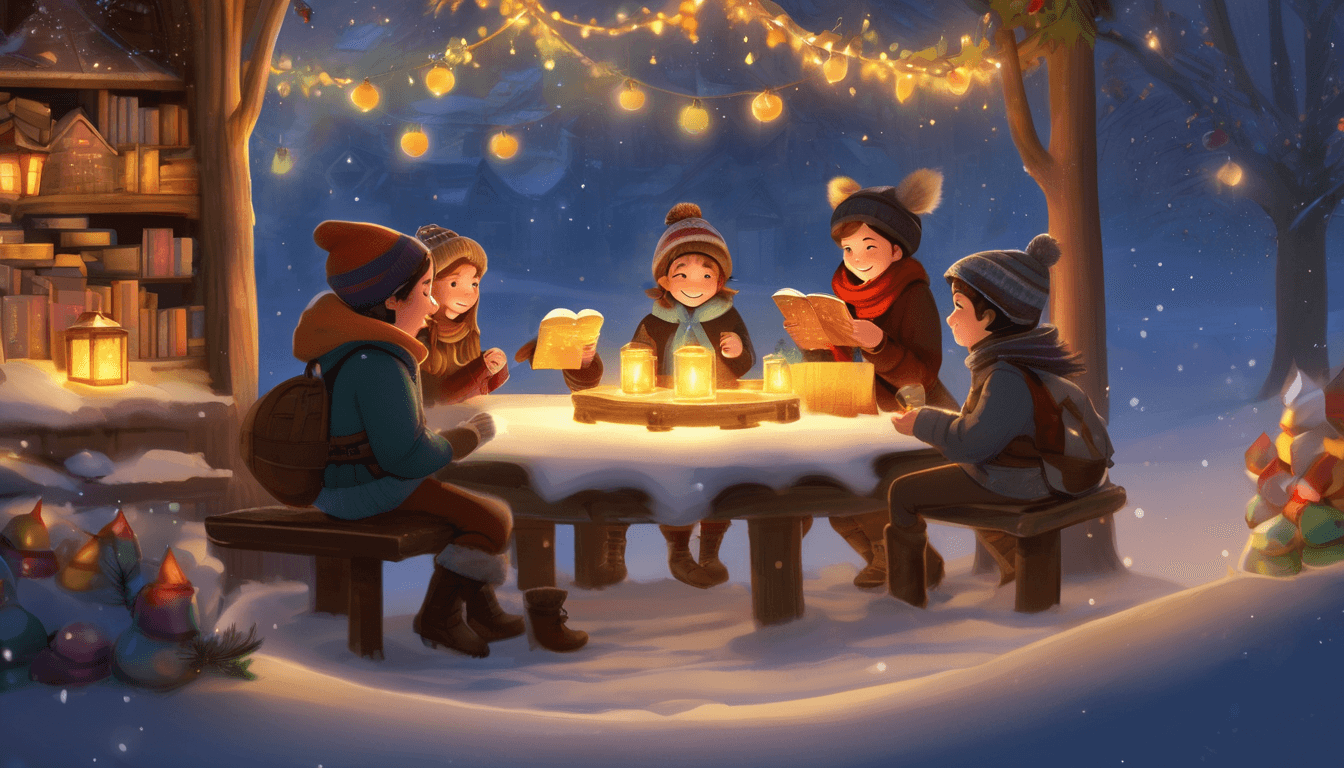
On a warm Wednesday afternoon, four children were sitting on the library steps.
There was Niko, who liked taking things apart to see how they worked.
There was Amara, who filled sketchbooks with pictures of everything from sparrows to soup spoons.
There was Sunil, who could remember songs after hearing them only once.
And there was Maren, who asked so many questions that grown-ups sometimes had to sit down before answering.
They had been trying to decide what to do with the last weeks of summer.
“We could build a raft,” said Niko.
“In the tiny fountain?” asked Maren.
“It would be a very tiny raft,” Niko admitted.
“We could make a parade,” said Sunil.
“Who would be in it?” asked Amara.
“Our friends,” said Sunil. “And possibly the cats.”
Just then, the library door creaked open.
Out came Mrs. Odette, the librarian. Her silver hair was tied in a bun with a pencil stuck through it. She carried a cardboard box that said PLEASE DO NOT SNEEZE ON THE HISTORY.
“What is in there?” Maren asked.
“Forgotten things,” said Mrs. Odette.
The children gathered around.
Inside were an old bus ticket, a bent spoon, a photograph of a girl holding a prize pumpkin, a faded menu from the Moonfish Café, and a small cassette tape with a label that read: MR. FARID DESCRIBES THE GREAT WIND OF 1987.
“Why are these in a box?” asked Amara.
“Because the official town archive is full,” Mrs. Odette said. “It has records of important things. Town meetings. Bridge openings. Mayor’s speeches. But little things get left behind.”
“Little things are important,” said Sunil.
Mrs. Odette smiled. “I agree. A town is not only made of buildings and dates. It is made of the sound of rain on the market awnings. It is made of the way someone folds bread dough. It is made of jokes, songs, lost mittens, and the names people give to alley cats.”
Maren’s eyes widened. “We should make an archive for all of that.”
“A neighborhood archive,” said Amara.
“With recordings,” said Sunil.
“And drawings,” said Amara.
“And recipes,” said Niko.
“And stories,” said Maren.
Mrs. Odette looked at the four children carefully, as if she were checking whether they were sturdy enough for a big idea.
Then she handed them the cardboard box.
“Start with this,” she said.
So they did.
They took over a small empty room at the back of the library. It had one round window, a wobbly table, and shelves that leaned slightly to the left. Above the door, Amara painted a sign in curling letters:
THE BELLWETHER EVERYDAY ARCHIVE
THINGS WORTH REMEMBERING
Niko found an old recording machine in the library basement. It was square and gray and had two giant buttons, one red and one black.
“Red means record,” he said.
“Are you sure?” asked Maren.
“No,” said Niko. “But it feels correct.”
It was correct.
Their first recording was of Mrs. Imani from Number 7 sweeping her front steps.
“What should I say?” Mrs. Imani asked, holding the microphone.
“Anything you want people to remember,” said Sunil.
Mrs. Imani thought for a moment.
“Every spring,” she said, “a pair of swallows builds a nest under my porch roof. They arrive before the apple trees blossom. I call them Buttons and Buttons, because I cannot tell them apart.”
The children listened to the soft scrape-scrape-scrape of her broom, the chirp of the swallows, and Mrs. Imani’s gentle laugh.
They recorded Mr. Takeshi, the gardener, explaining how to save tomato seeds.
They copied Auntie Celeste’s recipe for moon-shaped dumplings filled with potato, chives, and a pinch of nutmeg.
They drew the old yellow bus that came every morning at seven fourteen.
They wrote down the game the twins from Willow Lane played with bottle caps and chalk.
They collected a story from Mr. Farid about the Great Wind of 1987, when hats flew into trees, laundry sailed down the street like flags, and one entire picnic table landed in a pond.
For every story, Mrs. Odette gave them a card to fill in.
WHO SHARED THIS?
WHEN DID THEY SHARE IT?
WHERE DID IT HAPPEN?
WHY MIGHT SOMEONE WANT TO KNOW?
At first, the last question was hard.
Why might someone want to know that Mrs. Imani called two swallows Buttons and Buttons?
Why might someone care that the Moonfish Café served strawberry soup one summer long ago?
Why save a drawing of the crack in the pavement that looked exactly like a leaping rabbit?
But the more they collected, the more the children understood.
These things made Bellwether feel like Bellwether.
Then, near the end of summer, something odd began to happen.
It began with the new playground.
For years, the town had been planning one beside the river, with a climbing net, a wide slide, and a little wooden boat for children to pretend they were sailors.
But one morning, workers arrived with shovels and boards.
They built a very nice playground.
It had swings, a roundabout, and a tall red slide.
But there was no climbing net.
No wooden boat.
No river-shaped path painted on the ground.
“It is lovely,” said Maren, “but it is not the playground they planned.”
The next day, the Moonfish Café took down its painted sign.
In its place was a plain white sign that said CAFÉ.
“Where is the moonfish?” Amara asked the owner.
The owner blinked. “Moonfish?”
“The blue fish with silver spots,” said Amara. “It has been above your door forever.”
The owner frowned. “I do not remember that.”
Soon, more things began to slip away.
The town council forgot why the clock in the square rang thirteen times on the first day of autumn.
Nobody remembered the plan to plant cherry trees along the river.
The post office forgot it had promised to put a bench outside for people waiting in the rain.
Worst of all, the schoolchildren were supposed to have a yearly Lantern Night, when they carried paper lanterns through the streets and hung wishes in the old elm tree.
When Sunil asked his teacher about it, she looked puzzled.
“Lantern Night?” she said. “That sounds nice. Perhaps someone should invent it.”
“But it already happened,” Sunil whispered.
That evening, the four friends met in the archive room.
The round window showed a pale moon floating above the rooftops.
On the table were piles of cards, drawings, recipes, and tapes.
“It is like the town is forgetting,” said Amara.
“Not the past exactly,” said Maren. “It is forgetting things that have not happened yet.”
Niko sat very still.
“The playground was planned,” he said. “The cherry trees were planned. The bench was promised. Lantern Night was meant to come back.”
“The town is forgetting its future,” said Sunil.
Nobody spoke for a moment.
Outside, the library bell gave a small clink, though no one had returned a book.
Then Mrs. Odette appeared in the doorway, wearing slippers with tiny embroidered foxes.
“I thought you might notice,” she said.
“You knew?” asked Maren.
“I suspected.” Mrs. Odette went to the highest shelf and took down a long, thin book covered in blue cloth.
Its pages were empty.
“This is Bellwether’s Book of Tomorrows,” she said. “Every town has one, though most people do not know it. It holds plans, promises, hopes, and good ideas. Not just grand things. The idea to teach a child to bake bread. The promise to visit an old friend. The plan to save a patch of wildflowers.”
“Why is it empty?” asked Amara.
“Because a future cannot stay alive if no one remembers why it matters,” said Mrs. Odette. “Bellwether has become too busy. People write plans, then rush away. They make promises, then lose the stories behind them.”
Niko looked at the archive shelves.
“We have stories behind things.”
“Yes,” said Mrs. Odette. “You have been gathering the roots.”
The children understood at once.
The town’s future was not a list of jobs on a clipboard. It was connected to its people.
The climbing net was for children who loved pretending to be spiders.
The wooden boat was for the river stories Mr. Farid told.
The cherry trees were for the spring picnic Mrs. Imani remembered from childhood.
The bench outside the post office was for Mr. Takeshi, whose knees hurt when he waited for letters from his granddaughter.
Lantern Night was for everyone who had wishes too shy to say out loud.
They worked late into the night.
Amara drew pictures of the missing playground boat and the cherry trees in bloom.
Sunil recorded everyone humming the Lantern Night song, even those who only remembered one small part.
Niko fixed the old town projector.
Maren wrote each promise onto a fresh page in the Book of Tomorrows.
Not just what would happen.
Why it should happen.
The next evening, they invited the whole neighborhood to the square.
People came slowly at first, carrying folding chairs, mugs of tea, babies, umbrellas, and curious expressions.
Niko set up the projector against the blank wall of the town hall.
Amara hung drawings on a clothesline.
Sunil placed the recording machine on a stool.
Maren stood beside the Book of Tomorrows.
Then they began.
They played Mrs. Imani’s voice talking about the swallows.
They showed Mr. Farid’s photograph of the river, with a little boy in a paper captain’s hat.
They read Auntie Celeste’s dumpling recipe.
They displayed the old sketch of Lantern Night, with glowing lanterns tucked among elm branches.
At first, people simply watched.
Then someone said, “I remember that!”
Another person said, “My father built the first wooden boat for the playground.”
“The cherry trees,” cried an old woman in a yellow coat. “We wanted them because my sister loved cherry blossoms.”
“I promised that bench,” said the postmaster, suddenly looking very embarrassed. “I wrote it down, but I never wrote down who it was for.”
Mr. Takeshi lifted his hand from the back of the crowd.
“It was for me,” he said. Then he smiled. “But perhaps also for everyone.”
The square grew warm with talking.
Memories passed from person to person like candles being lit.
The next morning, the town was different.
The café owner painted a blue moonfish back onto his sign, giving it extra silver spots.
The workers returned to the playground with ropes for the climbing net and lumber for a splendid wooden boat.
The town council ordered young cherry trees.
The post office got its bench, painted green.
And on the first day of autumn, the clock in the square rang thirteen times.
One ring for every month people wished they had.
And one ring for all the tomorrows still waiting.
As for the neighborhood archive, it grew and grew.
There were shelves for recordings, drawers for recipes, tubes for rolled-up drawings, boxes for small objects, and a special golden folder called PROMISES WE WANT TO KEEP.
Children came after school to add things.
A recipe for rainy-day noodles.
A recording of a baby’s first laugh.
A map of the best puddles for jumping.
A story about a dog who delivered a mitten to the wrong house.
And each new card still asked:
WHY MIGHT SOMEONE WANT TO KNOW?
The children had learned the answer.
Someone might want to know because someday, when the world was rushing too fast, they would need to remember what mattered.
A bench.
A tree.
A song.
A boat beside a river.
A wish glowing softly in a lantern.
And every night, before Mrs. Odette locked the library, she opened the Book of Tomorrows.
Its pages were no longer empty.
They shimmered with plans and promises, written in many hands.
Outside, beneath the green roof and the book-shaped weather vane, Bellwether slept peacefully.
It remembered yesterday.
It noticed today.
And it held tomorrow gently, like a small bright lantern in both hands.


Leave a Reply