
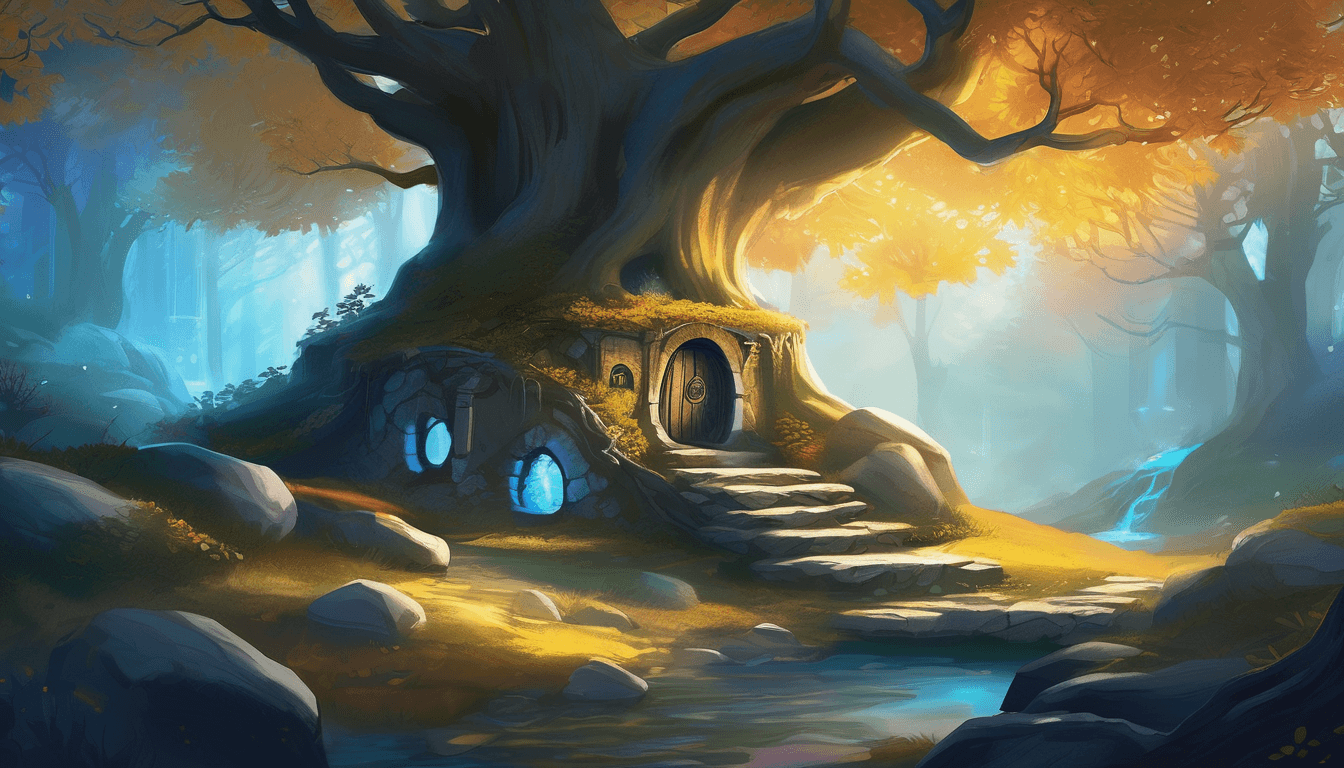
In the middle of a misty valley, where blue foxgloves nodded in the morning dew and silver streams curled between the hills, stood the oldest tree in the world.
It was called Grandmother Oaken.
No one knew exactly how old she was. Some said she had been a seed when the moon was still learning how to shine. Some said her first leaves had opened before people knew how to bake bread. Her trunk was so wide that twelve grown-ups holding hands could not reach all the way around it.
And Grandmother Oaken was hollow.
Not empty hollow, not dark and lonely hollow.
Inside her enormous trunk was a whole village.
The village was called Nemu, after the soft sound the tree made when the wind traveled through her highest branches.
“Neeee-muuuu,” Grandmother Oaken would hum on breezy days.
The people of Nemu had rounded doorways tucked into the wood, glowing windows made from polished amber, and little staircases that curved along the inside walls of the trunk. There were mossy rooms for sleeping, a bakery where warm acorn bread puffed in stone ovens, a schoolroom built inside an old knot, and a tiny library where books rested in shelves shaped like curled leaves.
At the very center of the village was a bright open space called the Heart Hall. It was not a hall made by hands. Long ago, Grandmother Oaken’s heartwood had formed a warm, round chamber with walls striped in honey-gold and deep brown. A pool of clear water bubbled there from somewhere beneath the roots.
The children of Nemu loved the Heart Hall best of all.
They played pebble-skipping games beside the pool. They whispered wishes into acorn caps and floated them on the water. They listened to the soft thumping sound that came from deep inside the tree.
Thum.
Thum.
Thum.
That was Grandmother Oaken sleeping.
Every summer, when the valley was green and warm, Grandmother Oaken slept deeply. Her branches stretched high above the hills, full of broad coppery leaves. Birds nested in her boughs. Squirrels raced along her limbs. Bees made honey in a crack on her western side.
But each year, as autumn came to an end, the village had an important job.
They had to wake Grandmother Oaken’s roots.
Not wake the whole tree. Oh no. Grandmother Oaken needed her winter sleep. She had earned it after standing through a thousand storms.
But beneath the soil, far below the village, her roots had to stir before the first hard frost. If they did not, the underground springs could freeze. The warm water in the Heart Hall might stop bubbling. The roots would become stiff and cold, and the village of Nemu would shiver through winter.
Usually, the grown-ups led the Root-Waking Ceremony.
They carried lanterns down the winding root passages. They sang old songs. They sprinkled sweet sap in the root wells and tapped gentle rhythms on the rootwood with willow sticks.
But this year, a strange thing happened.
Autumn arrived early.
One morning, the children woke to find the valley covered in pale white frost. The foxgloves had folded their blue heads. The stream wore a thin glassy skin around its edges. And above the village, the leaves of Grandmother Oaken had changed overnight from copper to deep red, as if the whole tree had been painted by the sunset.
In the Heart Hall, the warm spring water made only a tiny bubble.
Plop.
Then nothing.
The grown-ups hurried about with worried faces.
“The roots are sleeping too deeply,” said Auntie Maren, the village baker.
“The first snow clouds are already gathering beyond the northern hills,” said Tomas, who watched the weather from the highest window.
“We must begin the Root-Waking Ceremony tonight,” said Elder Sada, whose hair was white as thistledown.
But there was a problem.
The grown-ups had all gone that morning to gather the last of the winter food from the valley. They had expected several more days before the frost came. Now they were far away, collecting apples, chestnuts, dried berries, and bundles of firewood before the snow arrived.
Only the children remained in Nemu.
There was Jun, who was careful and quiet and could tie any knot. There was Amara, who had curly black hair and a laugh that made other people laugh too. There was little Soren, who was small enough to squeeze through the narrowest root tunnels. There was Mei, who knew the names of every bird in the valley. And there was Farid, who always carried a pocketful of interesting things, such as shiny pebbles, a button, half a feather, and once, a very sleepy beetle.
Elder Sada looked at them all.
“The ceremony is gentle,” she said. “That is important. Roots do not like shouting or stomping. They must be reminded, not startled.”
“We can do it,” said Amara.
Jun looked toward the dark doorway that led down into the roots. “Have any children ever done it before?”
“Long ago,” said Elder Sada. “In the Winter of Blue Stars.”
“What happened then?” asked Soren.
“Everyone was snowed inside the tree for twelve days,” said Elder Sada. “And the children woke the roots by singing a song so softly that even the snow listened.”
Farid swallowed. “Do we know that song?”
Elder Sada gave a small smile. “You will.”
She brought them to a wall in the Heart Hall where five small lanterns hung from hooks. Their glass was colored green, gold, blue, pink, and purple.
“These are root-lanterns,” she said. “They shine only when carried with kindness. If you become too frightened, too cross, or too rough, the lights will dim.”
Then she gave them a small silver bell.
“You must ring this only once, when you reach the oldest root. It is called the Listening Root. Its tip rests near the underground spring.”
Jun took the bell carefully. It was cold and smooth in his palm.
At the entrance to the root passages, Elder Sada placed her hand against the bark.
“Remember,” she told them. “Grandmother Oaken loves you. Her roots know your footsteps.”
The children lit their lanterns.
Then, one by one, they went down.
The root passages were nothing like the bright rooms of Nemu. They curled beneath the village in thick wooden tunnels, sometimes wide enough for everyone to walk side by side, sometimes so low they had to duck. The walls were ridged and twisting, like the backs of sleeping dragons, though no dragons had ever lived there.
Drops of water clung to the ceiling and fell with tiny plinks.
Plink.
Plink.
Plink.
At first, the children could hear the familiar sounds above them. A door closing. Someone moving a chair. The distant whistle of wind.
Then the sounds faded.
Soon, all they could hear was the creaking hush of the roots.
Soren held Mei’s hand.
“Do you think it’s darker because the roots are dreaming?” he whispered.
“I think it’s darker because we are underground,” said Farid.
But then he added, “Though dreaming roots might make it extra dark.”
They came to the first root well, a shallow bowl in the wood where clear sap usually gathered.
It was dry.
Jun knelt beside it. “We need sweet sap.”
“I have some,” said Farid.
From his many-pocketed coat, he pulled out a little corked bottle.
“You have sap in your pocket?” asked Amara.
“It is maple sap,” said Farid proudly. “I was saving it for porridge.”
“That was a very good thing to save,” said Mei.
Farid poured one shining drop into the dry well.
For a moment, nothing happened.
Then the wood around the bowl gave a quiet sigh.
A soft golden thread appeared along the root passage floor. It glowed for three steps, then five, then curled onward into the dark.
“The roots are listening,” whispered Jun.
They followed the golden thread.
The second root well was blocked by a tumble of stones. They were not ordinary stones. Each one was covered in pale fuzzy moss, and when Soren touched one, it yawned.
“Excuse me,” said the stone in a sleepy voice.
Soren jumped back.
“Sorry,” he said.
The mossy stones had rolled down from a crack in the earth and lodged in the well. The children tried to move them, but they were heavy.
“Could we ask?” Mei suggested.
So the children asked politely.
“Dear stones,” said Amara, “Grandmother Oaken’s roots need to wake before winter. Would you kindly roll a little to the side?”
The largest stone yawned again.
“We were having such a nice rest,” it mumbled.
“We understand,” said Jun. “But if the roots stay asleep, the village will get very cold.”
The stones were quiet.
Then, with many tiny grunts and rumbles, they rolled aside one by one.
Underneath them, the root well was full of silvery water.
The water began to swirl. It spun faster and faster, making a sound like someone humming with their lips closed.
“Mmmmmm.”
The golden thread on the floor grew brighter.
The children went deeper.
Soon they came to a place where the passage split into three tunnels.
The left tunnel smelled like cinnamon.
The middle tunnel smelled like rain.
The right tunnel smelled like something very old, like wet stones and hidden caves.
“Which way?” asked Soren.
Jun looked at the floor. The golden thread had disappeared.
Mei closed her eyes.
“Listen,” she said.
Everyone stood very still.
From the left tunnel came a scratch-scratch sound.
From the middle tunnel came dripping water.
From the right tunnel came the faintest sound of all.
Thum.
A long pause.
Thum.
“Grandmother Oaken’s heartbeat,” Mei said.
They took the right tunnel.
It was the narrowest passage yet. In places, Soren crawled ahead and called back directions. The walls trembled now and then, as though something huge beneath them was turning over in sleep.
At last, the children reached a cavern so large their lanterns could not show all of it.
A single root filled the center.
It was thicker than a house.
It curled from the ceiling down into the earth, its bark dark and ridged. Fine pale roots spread from it like the roots of a river, disappearing into black soil. At its base sat a small pool, but the pool was still.
This was the Listening Root.
Jun held up the silver bell.
“I’m nervous,” he admitted.
“So am I,” said Amara.
“That means we should be gentle,” said Mei.
Soren stepped close to the great root and placed his small hand against the bark.
“It feels cold,” he said.
Farid took out the half feather from his pocket. It was gray and white, soft as a cloud.
“My grandmother says feathers can tickle a sleepy nose,” he said.
“There is no nose,” said Jun.
“But perhaps there is a root-nose,” Farid replied.
Amara giggled, and the sound skipped around the cavern.
Then she stopped. “Wait. Maybe that is it. Not the root-nose part. The song.”
She began to hum.
It was not a grand song. It was not loud. It was a tune made of warm little notes, like candlelight shining through amber windows.
Mei joined in.
Then Soren.
Then Jun, even though he was not sure he knew how to sing softly.
Farid hummed too, holding his feather beside the bark.
Their voices wound together in the dark:
“Roots below, roots deep and kind,
Dream of water, wake in time.
Not to wander, not to rise,
Only stretch beneath the skies.
Drink the stream and hold it near,
Keep our little village clear.
Sleepy roots, we softly say,
Winter comes, please wake today.”
When they finished, the cavern was silent.
Jun lifted the silver bell.
He rang it once.
Ting.
The sound was very small.
But it traveled everywhere.
It slipped into the cracks in the earth. It ran along the finest root hairs. It flew beneath stones and through underground water. It climbed up the great root, through the trunk, past the Heart Hall, past the bakery, past the windows and rooms and winding stairs, all the way to Grandmother Oaken’s highest branches.
For one long moment, nothing happened.
Then the Listening Root moved.
Not much.
Just a tiny shiver.
The pool at its base trembled.
A bubble rose from the bottom.
Plop.
Another bubble.
Plop.
Then the water began to glow blue-green. It swirled around the root, spilling into thin channels in the earth. The channels lit up one after another, rushing away like lines of stars.
The great root gave a deep, slow stretch.
The children felt it through their feet.
Thum.
Above them, somewhere far away, the whole tree answered.
Thum.
Thum.
Thum.
“Run!” cried Amara, but she was laughing.
They hurried back through the tunnels as the roots gently woke around them. The mossy stones rolled themselves into neat little piles. Sap gleamed in the root wells. The golden thread became a golden river of light beneath their shoes.
When the children reached the Heart Hall, the warm pool at its center was bubbling merrily.
Plop-plop-plop!
Steam curled above the water, carrying the sweet smell of oak leaves after rain.
Outside, snow began to fall.
It drifted through the branches in fat, quiet flakes. It covered the valley, the stream, the foxgloves, and the far-away hills.
But inside Grandmother Oaken, Nemu was warm.
The grown-ups returned just as the children were sitting in the Heart Hall with mugs of cinnamon milk. They were surprised to find the village glowing, the ovens warm, and the roots humming beneath the floor.
Elder Sada listened to the children’s story without interrupting.
When they had finished, she nodded slowly.
“You did exactly what was needed,” she said. “You remembered that waking something ancient is not about being loud. It is about being patient enough to be heard.”
That night, the children slept in their round rooms inside the great hollow tree.
Jun dreamed of golden paths under the earth.
Amara dreamed that snowflakes were tiny white birds.
Soren dreamed of friendly mossy stones who invited him to tea.
Mei dreamed of Grandmother Oaken’s branches reaching across the winter sky.
And Farid dreamed that he discovered a real root-nose, though in the morning he decided not to mention it.
All through the snowy winter, Grandmother Oaken rested deeply.
Her roots drank from the underground springs.
Her heartwood stayed warm.
And sometimes, on the coldest nights, if the people of Nemu pressed an ear to the walls of their homes, they could hear a gentle sound rising from below.
Thum.
Thum.
Thum.
It was Grandmother Oaken sleeping safely, with her roots awake beneath the frost.



Leave a Reply