
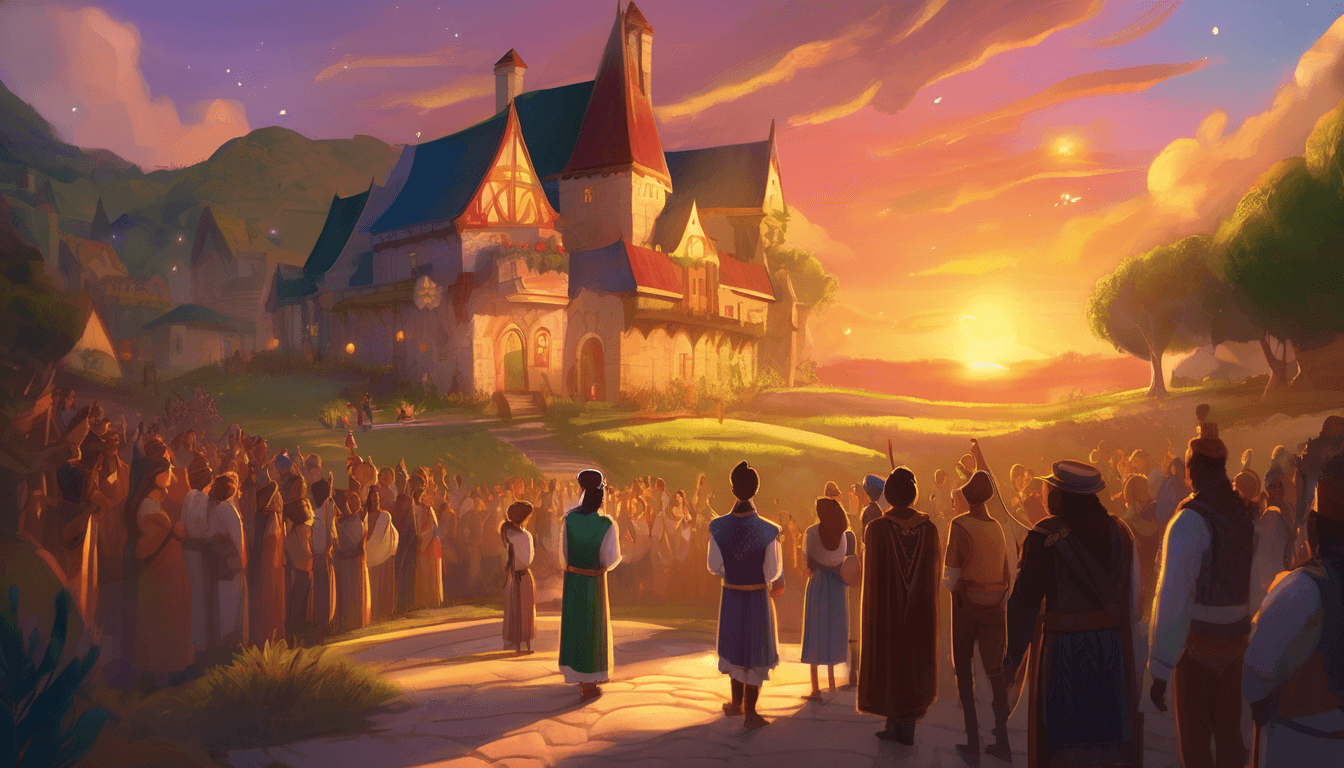
In the valley of Evermere, where the mountains wore silver snowcaps and the rivers curled like blue ribbons through green fields, there stood a kingdom called Bellaflor.
Bellaflor was famous for many things. Its bread smelled of honey and rosemary. Its castle had seven round towers, each painted a different color. Its people could grow roses that glimmered softly in moonlight.
But Bellaflor was most famous for its Dreamspeaker.
Every night, when the stars appeared over the castle, one person from the kingdom was chosen to sleep in the Moon Chamber. The Moon Chamber was a quiet round room at the very top of the tallest tower. Its ceiling was made of glass, so the stars shone down upon the sleeper. A bed of soft white feathers stood beneath the open sky.
Whoever slept there would dream of Bellaflor’s future.
Then, in the morning, they would tell everyone what they had seen.
The people of Bellaflor believed the dreams completely.
If the Dreamspeaker dreamed of a bridge across the Willow River, the builders began laying stones before lunch. If they dreamed of apple orchards on the eastern hill, gardeners carried baskets of tiny trees there the next day. If they dreamed of a festival with golden lanterns, every family began folding paper and polishing lamps.
For many years, the dreams had led Bellaflor safely.
One night, a baker dreamed that the village of Mossybrook would need extra bread after a winter storm. So every oven in Bellaflor baked through the night. Three days later, snow covered the roads, and the hungry people of Mossybrook were saved by warm loaves carried on sleds.
Another night, a shepherd dreamed of wolves near the northern fields. The villagers built bright watchfires, rang little bells on their sheep, and kept the wolves away.
The kingdom grew rich and peaceful.
Yet, as time went by, people began waiting for dreams before doing almost anything.
“What should we plant this spring?” they would ask.
“Let us wait for the Dreamspeaker,” someone would reply.
“Should we fix the old school roof?” they would wonder.
“Perhaps the dream will tell us.”
“Should we visit Grandmother Anya? She has been lonely.”
“Let us see what tomorrow brings.”
Even the king, King Orun, who had a kind face and a beard as white as cloud foam, began to wait for each morning’s dream before making decisions.
At first, this seemed sensible.
But little by little, Bellaflor became a kingdom that paused.
The old school roof leaked whenever it rained.
The road to Mossybrook became bumpy and full of puddles.
Grandmother Anya sat by her window with her knitting, wishing someone would come for tea.
And still, everyone waited.
One spring evening, when the air smelled of wet earth and lilacs, the royal bell rang through the kingdom.
Dong. Dong. Dong.
It was time to choose the next Dreamspeaker.
People gathered in the castle square, looking up at the moon, which hung round and pale above the towers. Beside the fountain stood the royal Dream Bowl, a silver bowl filled with smooth blue stones. Each stone had a person’s name written on it in tiny gold letters.
Queen Samira, who wore a cloak stitched with little stars, reached into the bowl.
The crowd grew quiet.
She drew out one blue stone and read the name.
“Marcel the cobbler.”
Marcel blinked in surprise. He was a cheerful man with round glasses and ink stains on his fingers from writing shoe orders.
That night, Marcel climbed the winding stairs to the Moon Chamber. He lay beneath the stars and soon fell asleep.
In the morning, a trumpet sounded.
Everyone hurried to the castle square.
Marcel stood on the balcony, still wearing his nightcap.
“I dreamed,” he announced, “that the old school roof was covered in red tiles. Children were singing beneath it, and not a single raindrop fell inside.”
The crowd clapped.
“At last!” cried the schoolteacher.
The builders hurried away to fetch ladders and tiles.
Then the queen reached into the Dream Bowl again.
“Tonight’s Dreamspeaker will be…” She paused. “Noura Vale.”
A hush swept through the square.
Noura Vale was only seven years old.
She lived above her parents’ little clock shop near the market. She had dark curls that sprang in every direction, green boots with scuffed toes, and a habit of asking questions at very inconvenient times.
“Why do fish not get thirsty?”
“Do clouds ever miss the rain?”
“Who teaches baby spiders to make webs?”
Noura’s parents stared at one another.
Noura stared at the blue stone in the queen’s hand.
“Me?” she whispered.
“Yes,” said Queen Samira gently. “The Dream Bowl has chosen.”
That evening, Noura climbed the castle stairs with her mother and father. The stairs curled and curled, past windows showing the rooftops of Bellaflor, past sleepy guards in polished helmets, past paintings of old Dreamspeakers.
There was a knight who had dreamed of a hidden spring.
There was a farmer who had dreamed of windmills.
There was a queen who had dreamed of peace after a long-ago quarrel.
Noura stopped in front of each painting.
“Did they really see the future?” she asked.
“They did,” said her father.
“Every bit of it?”
Her mother smiled. “Dreams can be strange, little seed.”
At last, they reached the Moon Chamber.
Noura climbed into the feather bed. The queen tucked the blanket beneath her chin.
“Sleep well,” Queen Samira said. “In the morning, tell us what Bellaflor will become.”
Noura looked up through the glass ceiling. Thousands of stars trembled in the dark sky.
“What if I don’t dream anything?” she asked.
“Everyone dreams,” said the queen.
But Noura did not feel sleepy.
The room was so quiet that she could hear the tiny ticking of the clock tower below. Tick. Tick. Tick.
She thought about the leaking school roof.
She thought about the bumpy road.
She thought about Grandmother Anya, who had given her a cinnamon biscuit last week and said, “Come again soon,” in a soft voice.
Then Noura thought of all the people waiting below.
The builders waiting for a dream.
The gardeners waiting for a dream.
The king and queen waiting for a dream.
It felt like holding a huge basket full of eggs.
“I don’t know what the future is,” Noura whispered to the stars.
At last, her eyes closed.
And she dreamed.
She dreamed of Bellaflor many years from now.
At first, she saw the castle towers shining in the sun. She saw fields of wheat waving gold. She saw children racing along the riverbank.
But then the dream changed.
The school roof had holes again, though nobody knew why, because no one had checked it for years.
The road to Mossybrook was covered in weeds.
Grandmother Anya’s house stood empty, with her knitting still on the chair.
In the market square, people sat with folded hands.
“What shall we do?” they asked.
“Wait for the Dreamspeaker,” said everyone.
Then Noura saw the Moon Chamber. A grown-up man slept in the feather bed. Above him, the stars swirled like silver fish.
He woke and came to the balcony.
“I dreamed of a blue door,” he said.
So all the people painted blue doors.
The next night, a woman dreamed of bells.
So all the people hung bells.
The next night, someone dreamed of purple cakes.
So all the people baked purple cakes.
But nobody asked why.
Nobody helped unless a dream told them to.
The kingdom grew quieter. Its gardens became tangled. Its bridges creaked. Its people forgot that their own hands could mend, plant, carry, build, and comfort.
Noura felt sad in her dream.
Then, far away, she heard a small sound.
Tap, tap, tap.
It was the sound of a hammer.
She followed it through the dream and found a little girl sitting beside a broken birdhouse. The girl had a hammer in one hand and three crooked nails in the other.
“What are you doing?” Noura asked.
“Fixing this house for the wrens,” said the girl.
“But did the Dreamspeaker tell you to?”
The girl looked surprised.
“No. The wrens need a house.”
As soon as she said those words, the dream brightened.
A gardener saw drooping flowers and carried them water.
A boy noticed the old road was muddy and began placing stones in the puddles.
A family brought tea and soup to a lonely neighbor.
A group of children helped patch the school roof before the rain came.
Soon, people all across Bellaflor were looking carefully at one another, at their homes, at the fields and rivers and roads.
“What is needed?” they asked.
“What can I do?”
The kingdom began to shine again, not because one person had dreamed it, but because everyone had noticed it.
Then the stars above the dream became bright as lanterns.
Noura woke.
Morning had come.
Below the tower, trumpets called.
The whole kingdom had gathered in the square.
Noura dressed quickly in her green boots and walked to the balcony with Queen Samira. King Orun stood nearby, looking very serious. The crowd filled the square all the way to the market stalls.
“What did you see?” called the baker.
“What must we build?” asked the captain of the guards.
“What shall we plant?” asked the gardeners.
Noura looked at all their faces.
For a moment, her knees wobbled.
Then she remembered the little girl with the hammer.
“I dreamed of Bellaflor,” Noura said.
The square grew silent.
“I dreamed it was beautiful. Then I dreamed it was not beautiful anymore, because everyone waited too long for someone else to tell them what to do.”
People shifted uneasily.
Noura took a breath.
“In my dream, the future did not come from one person sleeping in a tower. It came from everyone looking around and helping.”
The king’s white eyebrows rose.
Noura pointed toward the school, where a new red roof gleamed in the sun.
“The builders fixed the roof because the children needed it. That was good.”
Then she pointed toward the road leading out of town.
“But the road to Mossybrook still has puddles. We do not need a dream to know that people need a safe road.”
She looked toward the little house with the yellow curtains at the edge of the square.
“And Grandmother Anya would like visitors. We do not need a dream to know that lonely people need friends.”
No one spoke for several heartbeats.
Then Marcel the cobbler raised his hand.
“I could mend the road,” he said. “Well, not all of it alone. But I have a strong cart.”
“I have stones,” called a mason.
“I can bring soup for the workers,” said the baker.
The schoolteacher smiled. “My children can help clear the weeds.”
From the edge of the crowd, a tiny voice called, “I can visit Grandmother Anya!”
It was Noura’s friend, Kenji.
“I can too!” said another child.
Soon, the square filled with voices.
“I can carry water!”
“I can fix fences!”
“I can plant beans!”
“I can check on my neighbor!”
King Orun looked at Queen Samira. Queen Samira looked at Noura.
Then the king began to laugh, not a loud laugh, but a warm, surprised laugh that made his shoulders shake.
“All these years,” he said, “we thought the future was something we had to be told.”
He took the silver Dream Bowl from its stand.
“But perhaps the future is something we make together.”
That night, the Moon Chamber was empty for the first time in hundreds of years.
No one slept beneath the glass ceiling to dream for the kingdom.
Instead, all across Bellaflor, people dreamed in their own homes.
They dreamed of gardens, bridges, songs, warm bread, and bright roads.
And in the morning, they did something wonderful.
They woke up.
Noura woke in the room above the clock shop, with sunlight on her blanket and the smell of cinnamon porridge drifting up the stairs.
She hurried to the window.
Below, Bellaflor was busy.
The mason rolled stones toward Mossybrook.
The baker handed out soup.
Children carried buckets of paint to freshen the old market benches.
King Orun himself, wearing a very ordinary hat, was helping repair a fence near the palace garden.
And at Grandmother Anya’s house, Noura could see five children sitting by the window, listening while the old woman showed them how to knit little red birds.
Noura smiled.
The future was not a secret hidden in the stars.
It was in a hammer lifted kindly.
A loaf shared warmly.
A hand held out.
A question asked.
A small thing noticed before it became a big thing.
And every night after that, when the moon rose over the seven colorful towers of Bellaflor, its silver light fell upon a kingdom full of people who still dreamed.
But now, when morning came, they did not wait.
They opened their doors, looked around with caring eyes, and helped build the bright tomorrow they had imagined together.
Leave a Reply