
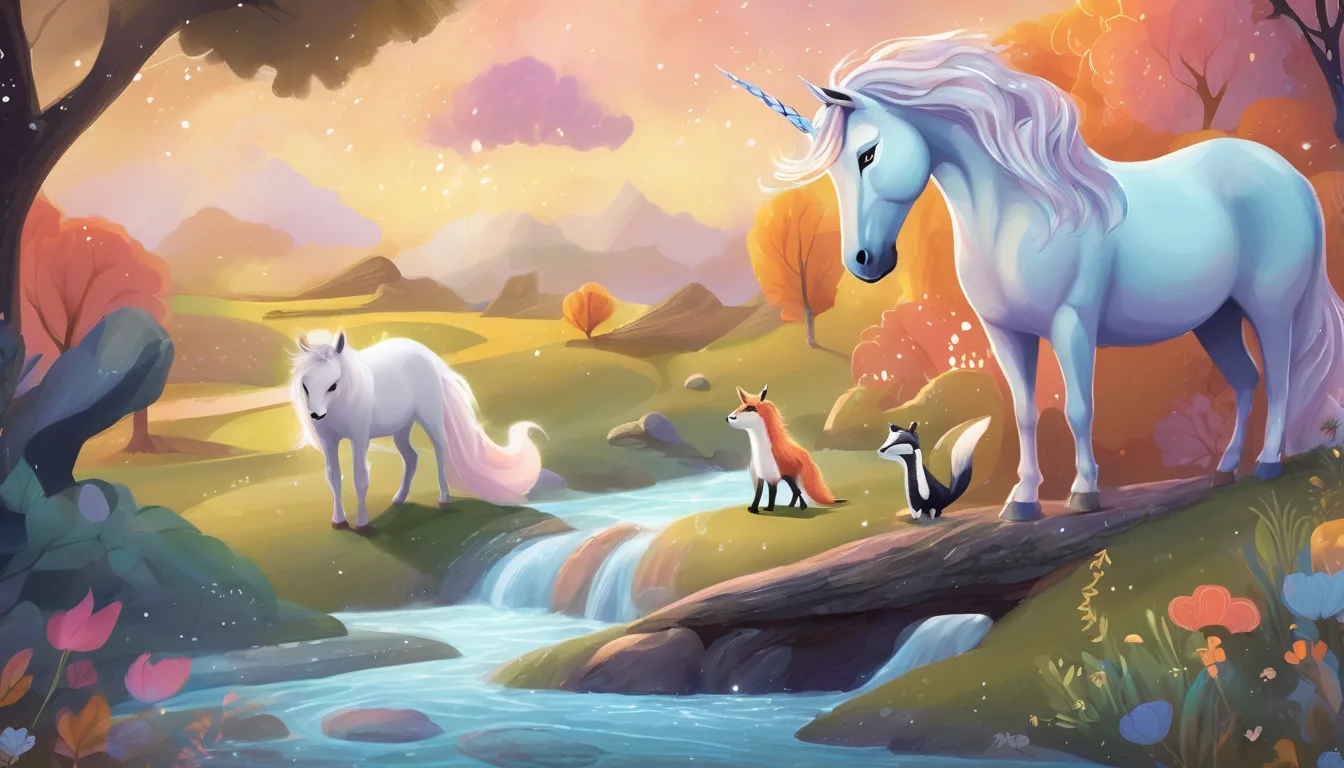
In a valley hidden between blue-green hills, where the clouds often rested low enough to tickle the treetops, there lived a young unicorn named Maris.
Maris had a silver-white coat that shimmered like moonlit snow, a mane the color of soft apricots, and a small spiral horn that glowed lavender whenever she was excited.
She lived in the Orchard of Wonder, a place where apples grew in the shapes of hearts, plums hummed tiny songs in the breeze, and mushrooms opened their umbrellas whenever it rained.
Maris was very proud of her magic.
With a swish of her tail and a little tap of her hoof, she could make a tired flower lift its head. She could send warm sparks dancing through cold puddles. She could turn a pile of fallen leaves into a flock of bright paper birds.
At least, that was what she hoped she could do.
One morning, Maris trotted to the edge of the orchard, where her friends were gathered beside a dry little stream.
There was Toma the fox, with copper fur and clever eyes.
There was Nuru the badger, who was excellent at digging tunnels and finding lost buttons.
There was Saki the tiny dragon, whose flame was no bigger than a candle but smelled pleasantly of cinnamon.
And there was Yara, a young giant who lived in the hills and wore a scarf woven from mist.
“The stream has stopped flowing,” said Toma. He pointed with one black paw.
The little stream usually ran through the valley, bubbling past the orchard and winding all the way to the village of round-door cottages. But now its bed was cracked and dry. The reeds were drooping. A family of water beetles sat sadly on a smooth stone, wearing expressions almost too serious for beetles.
“We need water,” said Nuru.
Maris lifted her chin. “Do not worry. I have magic.”
Her friends brightened.
Maris closed her eyes. She planted her hooves firmly on the ground. She thought of rivers, rain, silver fish, and cool water splashing over stones.
Her horn began to glow.
Lavender light swirled around it.
“Stream, stream, come and play,” Maris whispered. “Wake up and run this way.”
A tiny puff of purple smoke floated out from her horn.
Then, plink.
One drop of water fell into the streambed.
Plink.
Another drop.
Then nothing.
Maris opened one eye.
The stream was still dry.
Toma politely cleared his throat. “That was a very nice pair of drops.”
Maris’s ears drooped. “My magic is not working.”
Saki flapped her little wings. “Maybe it needs a snack?”
“That is not how magic works,” said Nuru.
“Sometimes it is,” Saki replied. “I work much better after toast.”
Maris tried again. She stood taller and gave her horn a determined wiggle.
“Water, please!”
Her horn gave a weak sparkle.
A single wet sock appeared on a reed.
No one knew where it had come from.
Yara held it gently between two fingers. “Well,” she said, “it is damp.”
Maris wanted to gallop away and hide beneath the biggest apple tree in the orchard. She had thought unicorn magic was supposed to be grand and easy. It was supposed to sparkle whenever one needed it.
But now the little stream needed help, and Maris had made only two drops and one mysterious sock.
“I am sorry,” she said quietly.
The friends sat together beside the dry stream.
After a while, Saki nudged a pebble with her nose. “What if we all try?”
Maris looked up. “All of us?”
“Yes,” said Saki. “Your magic may be shy.”
“Or picky,” said Toma.
“Or perhaps,” said Yara, smiling, “it likes company.”
Maris had never thought of that.
She had always tried to do everything herself. When someone had a problem, she rushed in with her horn shining. When someone needed a flowerbed watered, she offered magic. When someone wanted a kite untangled from a tree, she offered magic.
She liked being helpful.
But perhaps helpful did not always mean doing all the helping.
“All right,” said Maris. “Let us try together.”
Nuru began to dig small channels in the earth with his strong paws. “If water comes, it will need somewhere to go,” he said.
Toma raced to the willow trees and gathered long, bendy branches. He laid them across the narrowest part of the streambed to make a little bridge for the beetles.
Yara climbed halfway up the hill and rolled several smooth boulders down, very carefully, until they made a curve across the valley.
“What are those for?” asked Maris.
“To guide rainwater,” said Yara. “When the next cloud comes, it will know where to travel.”
Saki flew from flower to flower, asking the bees if they had seen any rain clouds nearby.
The bees buzzed in a serious circle.
“At the top of Mount Mallow,” Saki reported. “A rain cloud is stuck behind a grumpy wind.”
Maris looked toward the mountain. Its peak rose beyond the hills, wearing a cap of gray cloud.
“A grumpy wind?” asked Toma.
Saki nodded. “The bees say it is called Bront. It blows the wrong way on purpose.”
Toma’s tail flicked. “That does sound grumpy.”
Maris felt the lavender glow stirring faintly in her horn. Not enough to make a stream, but enough to make an idea.
“What if we make a game?” she said.
“A game?” Nuru asked.
“Yes! A game to invite the rain cloud down. Everyone can do one part.”
Toma grinned. “Now that sounds interesting.”
Maris began pacing in a circle as she thought. “We will call it Cloud Catch.”
“How do we play?” asked Yara.
“First, someone must make a path,” said Maris.
“That is me,” said Nuru.
“Then someone must make something that flutters and flaps, so the cloud notices us.”
“That is definitely me,” said Saki, puffing out her chest.
“Someone must call out a rhyme loud enough to reach Mount Mallow.”
Yara raised one enormous hand. “I can do that.”
“And someone must be sneaky enough to distract Bront the wind.”
Toma bowed so low his whiskers nearly touched the ground. “At your service.”
“And what will you do?” Saki asked Maris.
Maris looked at her dimly glowing horn.
“I will not do it alone,” she said. “I will keep the game going.”
So they began.
Nuru dug a twisting path in the soft earth, from the foot of Mount Mallow all the way down toward the dry stream. It curled around stones, slipped beneath roots, and made a neat little turn around a patch of bluebells.
Saki gathered willow fluff, bright feathers, and long grass. She tied them together with threads of spider silk, making fluttery flags that danced in the air.
Yara stood on the highest hill, lifted her misty scarf, and called:
“Cloud so round and cloud so gray,
Follow the winding, wiggling way!
Skip past the stones, come down with cheer,
The thirsty valley needs you here!”
Her voice rolled over the hills like a friendly drum.
Far away, the rain cloud trembled.
But Bront the wind puffed himself up and blew it back.
“No,” boomed Bront. “This cloud stays on Mount Mallow. I like it there. It keeps the mountain cool.”
Toma had been waiting behind a bush. He slipped quietly up the mountain path, his paws light as falling leaves.
When he reached Bront, he saw that the wind was not a creature with feet or fur. Bront was a swirling shape of gray-blue air, with a long cloudy nose and eyebrows made of twigs.
Toma did not say, “You are being mean.”
Instead, he said, “Excuse me, Mr. Bront. I have heard that you are the strongest wind in all the hills.”
Bront whirled proudly. “Of course I am.”
“I wonder,” said Toma, “if you are strong enough to play a game.”
Bront narrowed his windy eyes. “What game?”
“Cloud Catch,” said Toma. “You must blow the cloud down the winding path without letting it touch a single hilltop. Only the strongest wind could manage it.”
Bront puffed larger. “Easy.”
Below, Maris saw Toma wave his tail.
“It is time!” she called.
Saki leaped into the air, flapping her wings as hard as she could. Her tiny cinnamon flame lit the fluttering flags, not burning them, but making their colors glow gold and green and rose.
Nuru tapped the ground beside his winding channel.
Yara lifted both arms.
Maris stepped into the middle of her friends.
“Everybody ready?” she asked.
“Ready!” they called.
Her horn glowed.
Not lavender this time.
It glowed lavender, gold, cinnamon-red, fox-orange, deep badger-brown, and misty blue all together. The light streamed out in ribbons, joining each friend to the next.
Maris felt something wonderful.
Her magic was not a bucket of water that she could pour out by herself.
It was more like a lantern.
When everyone brought their own small light, her lantern made them shine brighter.
“Cloud Catch!” cried Maris.
Bront blew.
The rain cloud rolled off Mount Mallow with a soft rumble.
It floated down the first curve of Nuru’s path.
Saki’s glowing flags fluttered, showing it which way to go.
Yara called the rhyme again.
Toma raced ahead, pointing his tail first left, then right.
Bront blew harder, trying to prove how strong he was.
The cloud skipped over a hilltop.
It swooped around a boulder.
It dipped through the willow branches.
Then it reached the valley.
For one quiet moment, the whole orchard held its breath.
The cloud looked down at the dry stream, the drooping reeds, the waiting beetles, and the little bridge made of willow branches.
Then it began to rain.
Not a wild, splashy rain.
It was a gentle rain, warm and silvery. It fell into the streambed. It filled Nuru’s little channels. It rolled around Yara’s boulders. It gathered beneath the bridge and made the water beetles cheer in their tiny beetle voices.
Soon, the stream began to gurgle.
Then bubble.
Then sing.
Water rushed over the stones, clear and bright.
The orchard drank happily. Leaves lifted. Flowers opened. The heart-shaped apples gleamed red in the rain.
Maris laughed so hard she nearly slipped in the mud.
Her friends gathered around her.
“You did it!” said Saki.
“We did it,” Maris said.
Just then, Bront the wind came floating down from the mountain. He looked smaller now, and a little embarrassed.
“I did not know the valley needed the rain,” he murmured.
“We could have told you,” said Nuru.
“I suppose you could have,” Bront said.
Maris looked at him kindly. “Would you like to play another round tomorrow? We could make a game where you help blow seeds into empty fields.”
Bront’s twiggy eyebrows rose. “Would I get to be the strongest wind?”
“Certainly,” said Toma. “As long as you blow in the helpful direction.”
Bront made a sound that might have been a chuckle.
From that day on, Maris invented all kinds of games.
There was Moonbeam Relay, where everyone carried a little mirror to guide lost fireflies home.
There was Berry Basket Orchestra, where tapping different berry baskets made music that helped sleepy hedgehogs find their burrows.
There was the Great Acorn Roll, where squirrels, rabbits, moles, and even Yara the young giant worked together to roll giant acorns into place before winter.
And whenever Maris’s horn glowed, it did not shine in only one color.
It shone with the colors of everyone who joined in.
At bedtime, after a day of games and laughter and shared magic, Maris would stand beside the softly flowing stream.
The stars would appear above the orchard.
Bront would gently sweep the last clouds aside.
Saki would curl up beneath a mushroom umbrella.
Toma would tuck his nose beneath his tail.
Nuru would yawn from inside his cozy burrow.
Yara would lie on the hillside, with her mist scarf pulled up to her chin.
And Maris would look at her horn, glowing faintly in the dark.
She no longer wished for magic that made her the most important one.
She had discovered something better.
Magic that was shared could make streams sing, clouds dance, fields bloom, and friends feel brave.
Then Maris would close her eyes.
The orchard would sigh.
The stream would whisper over its stones.
And all through the hidden valley, dreams would begin to glow.
Leave a Reply