
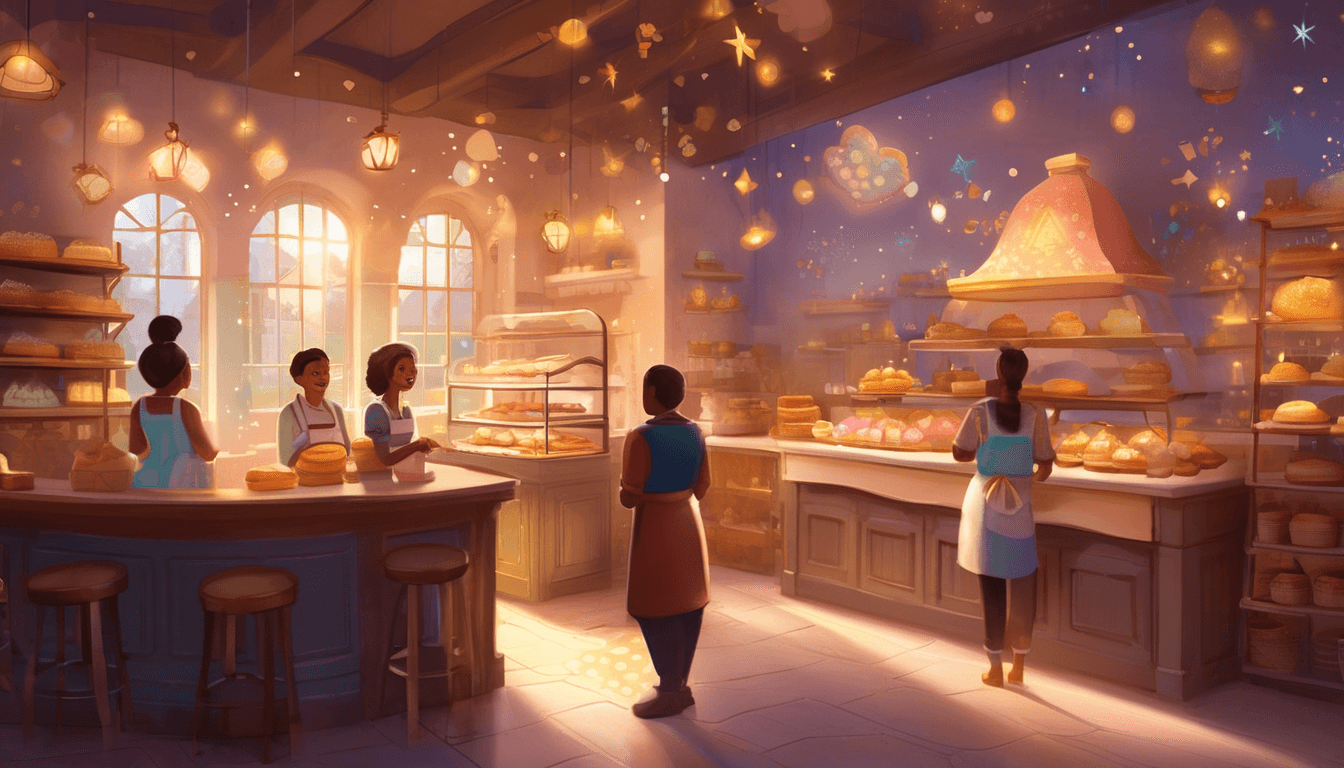
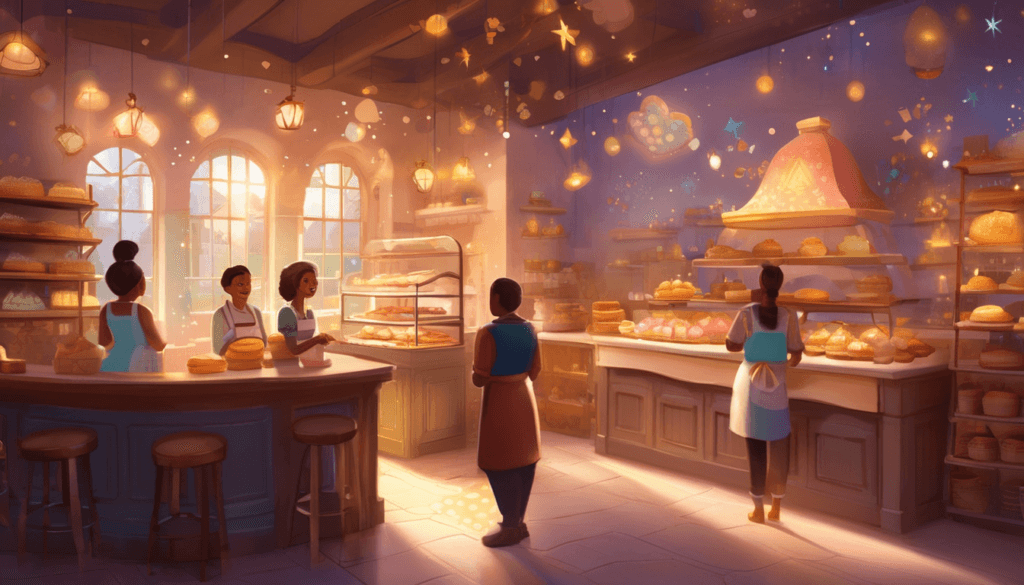
In a little town called Bellwether, where the rooftops leaned together as if they were whispering secrets, there was a bakery with a blue door and a round window shaped like a moon.
The bakery belonged to a baker named Amara.
Amara made warm things.
She made bread with crackly golden tops. She made little cakes with berry jam hiding in the middle. She made cinnamon twists that curled like sleepy kittens. Every morning, the street filled with the smell of butter, honey, and toasted flour, and the people of Bellwether woke up feeling that perhaps the day might be all right after all.
But Amara had one problem.
She worried.
She worried about her sourdough starter getting too bubbly.
She worried about the rain leaking through the roof above the flour shelf.
She worried that Mr. Niko, who lived in the yellow house at the end of the lane, had looked sad when he bought only one bun instead of his usual two.
Amara tried to tuck her worries away. She put them in the pockets of her apron. She stirred them into soup. She hummed at them while she kneaded dough.
Still, they followed her.
Especially at night.
One Tuesday evening, after the last customer had gone home and the moon was as round as a silver plate, Amara closed the blue door, swept the flour from the floor, and blew out all but one candle.
“Enough worrying,” she told herself firmly. “Tomorrow is for tomorrow.”
Then she went upstairs to bed.
Down below, the bakery became quiet.
The ovens cooled.
The wooden spoons rested in their jar.
The big copper mixing bowl gave one tiny, sleepy clink.
And on the bakery wall, Amara’s shadow stretched long and dark beneath the candlelight.
It lifted one hand.
Then the other.
The shadow looked around.
It slipped off the wall.
Now, a shadow is usually flat and silent and content to follow people about. But Amara’s shadow had spent years listening to all the worries Amara carried home in her apron pockets.
It had heard every sigh.
It had watched every frown.
And it had decided that worries ought not to be kept in pockets at all.
So the shadow tiptoed to the flour shelf.
It scooped flour into the copper bowl.
It cracked eggs with a soft, clever tap.
It poured milk, sprinkled sugar, and stirred everything with a spoon that moved all by itself.
Then it began to shape pastries.
The first pastry was a small, round bun with two worried little eyes made of raisins. Its doughy mouth was squeezed into a tight line.
The shadow baked it until it puffed up beautifully.
Then it made another.
This one was shaped like a tiny gray cloud, with almond flakes that looked like raindrops.
Then it made a third pastry, shaped like a crooked little boat with a jam sail.
By morning, the bakery shelves were full.
Amara came downstairs, tied on her apron, and stopped so suddenly that her slipper came halfway off.
“Oh,” she whispered.
There were pastries everywhere.
Not her pastries.
These were strange, lovely things. A tart shaped like a tangled knot. A biscuit shaped like a very large ear. A bun shaped like a tiny house with a crooked chimney. A pie shaped like a pair of shoes, one pointing this way and one pointing that way.
Amara stared at them.
Then the bell above the blue door jingled.
It was Mr. Niko from the yellow house.
He came in slowly, with his wool hat pulled low over his ears.
“Good morning,” said Amara. “Would you like your usual?”
Mr. Niko looked at the shelves and blinked.
“Oh,” he said. “That little cloud pastry.”
The cloud was the size of a teacup saucer. It had almond raindrops and a little stripe of lemon icing.
“I’ll take that, please.”
Amara handed it to him.
Mr. Niko held it in both hands.
For a moment, he only looked at it.
Then he gave a soft sigh.
“My sister is coming to visit today,” he said. “I have not seen her in fourteen years.”
Amara leaned on the counter.
“That is a long time.”
“Yes,” said Mr. Niko. “I keep thinking, what if she is angry with me? What if I have forgotten how to talk to her? What if it rains the whole time and we have nothing to say?”
He looked down at the cloud pastry.
“I suppose I have been carrying a storm around.”
Amara nodded.
“A storm is heavy to carry alone.”
Mr. Niko took a bite of the cloud.
Lemon and honey filled the bakery with a bright, sunny smell.
Mr. Niko’s shoulders lowered.
“Perhaps,” he said, “I shall tell her I was nervous.”
“That sounds like a good beginning,” said Amara.
After he left, Amara looked back at the pastry shelf.
The cloud pastry was gone.
In its place, there was only a little dusting of sugar.
That evening, Amara stayed awake as long as she could.
She sat at the top of the stairs with a blanket around her shoulders and watched the bakery below.
When the clock struck midnight, the candle flame trembled.
Amara’s shadow stretched across the wall.
And once again, it lifted its hands.
“Oh,” breathed Amara.
Her shadow stepped out of the wall and began to bake.
It worked all night.
It made a crescent-shaped pastry with a tiny bite missing from it.
It made a cake that looked like a very tall stack of books, wobbly but still standing.
It made a tart shaped like a mouse wearing a red scarf.
It made a little pastry bridge, with two halves that almost touched in the middle.
Amara did not interrupt.
She only watched.
The next morning, a girl named Zora came in with her grandfather.
Zora was usually the loudest child in Bellwether. She could whistle through a daisy stem and climb the old pear tree faster than anyone.
But that morning she held her grandfather’s hand very tightly.
Her eyes went straight to the little pastry bridge.
“May I have that one?” she asked.
“Of course,” said Amara.
Zora carried it to a table, but she did not eat it.
Her grandfather sat beside her.
“What is it, sparrow?” he asked.
Zora looked at the bridge.
“I’m scared of starting school next week,” she said in a very small voice.
Her grandfather was quiet.
“I thought everyone else would be excited,” Zora went on. “But what if no one wants to sit with me? What if I forget where the bathroom is? What if the teacher thinks I am too noisy?”
Her grandfather squeezed her hand.
“Oh, Zora,” he said. “I was scared on my first day too.”
“You were?”
“I wore my shirt inside out.”
Zora looked up.
“You did not.”
“I certainly did. And I cried because my pencil was too pointy.”
Zora began to giggle.
Then she broke the pastry bridge in half.
One half had raspberry filling. The other had cream.
She gave the cream half to her grandfather.
“Maybe,” she said, chewing thoughtfully, “being scared is easier if you tell somebody.”
“I think so too,” said Amara.
That night, Amara did not go upstairs.
She made herself a nest behind the counter with two cushions, a blanket, and a cup of peppermint tea.
At midnight, her shadow slipped from the wall.
This time, Amara spoke.
“Excuse me,” she said.
The shadow froze, one hand deep in the flour bin.
Amara expected it to run away.
But it did not.
It turned toward her.
Though it had no face, Amara could somehow tell it was embarrassed.
“You have been making all these pastries,” Amara said.
The shadow nodded.
“Why?”
The shadow pointed toward Amara’s apron.
Amara looked down.
In one pocket was a list of things she needed to remember. In another was a loose button. In the deepest pocket was a pebble she had picked up when she was worried about Mr. Niko.
And there, tucked behind the pebble, was a worry.
Not a real thing exactly. More like a little crumpled feeling.
Amara pulled it out.
It was about her bakery.
What if people stopped coming?
What if she made something wrong?
What if everyone liked the pastries better when her shadow made them?
Amara’s eyes grew wide.
The shadow gently took the worry from her hand.
It rolled it into dough.
It folded it once.
Twice.
Then it made a pastry shaped like a tiny lantern.
The shadow baked it until the lantern glowed with apricot jam.
Amara sat very still.
“I am worried that I might not be good enough,” she said aloud.
The bakery seemed to grow warmer.
The shadow placed the lantern pastry in front of her.
Amara took a bite.
It tasted like peaches, brown sugar, and the first warm light in a window when you have been walking home in the dark.
A small tear rolled down her cheek.
Then she smiled.
The next morning, Amara put a little sign in the window.
It said:
WORRY PASTRIES.
TAKE ONE IF YOU NEED IT.
TELL SOMEONE IF YOU CAN.
At first, people were shy.
They came in and looked at the pastries without speaking.
There was a pastry shaped like a tangled ball of yarn.
A boy named Tomas chose it and admitted he was worried his best friend had stopped liking him.
There was a pastry shaped like a tiny locked box.
Mrs. Siti chose it and told Amara she was worried about being lonely since her cat had gone to stay with her daughter.
There was a pastry shaped like a giant question mark with blueberry dots.
A delivery rider named Kenji chose it and said he did not know what he wanted to be when he grew up, even though he was already grown up.
Amara listened.
Sometimes she offered a cup of tea.
Sometimes she offered a chair by the window.
Sometimes she offered no advice at all, just a warm napkin and a nod.
And something wonderful began to happen.
When people shared their worries, the pastries became lighter.
A knot tart loosened into a swirl.
A cloud bun became a sun bun.
A little locked-box biscuit opened at the top and showed a sweet fig center.
Soon, people began sharing worries with one another.
Mr. Niko’s sister came to the bakery with him. They sat by the window for three hours, talking and crying and laughing so loudly that Amara had to bring them extra tea.
Zora started school and discovered that three other children were worried too. On the second day, she led them all to the bathroom, even though she had only just learned the way herself.
And Kenji, who did not know what he wanted to be, decided it was all right not to know yet. He started painting small pictures of bicycles on the sides of his delivery boxes.
As for Amara, she still worried sometimes.
Of course she did.
Worries are sneaky little things. They can slip under doors and hide in teacups and sit quietly at the end of the bed.
But now, whenever Amara felt one growing heavy in her pocket, she would not keep it there for long.
She would tell someone.
Or write it down.
Or knead it into bread dough.
And every night, after the town had gone quiet and the moon shone through the round window, her shadow would climb from the wall.
Together, baker and shadow would mix, roll, fold, and bake.
They made pastries shaped like worries.
They made pastries shaped like hope.
And before dawn, they always saved one small, warm bun for anyone who might need to hear the gentlest truth of all:
You do not have to carry everything alone.
Outside, Bellwether slept beneath its leaning rooftops.
Inside the bakery, the last oven gave a soft, happy sigh.
Amara blew out the candle.
Her shadow returned to the wall.
And in the blue-doored bakery, among the sugar and flour and moonlight, everything became quiet, warm, and wonderfully still.


Leave a Reply