
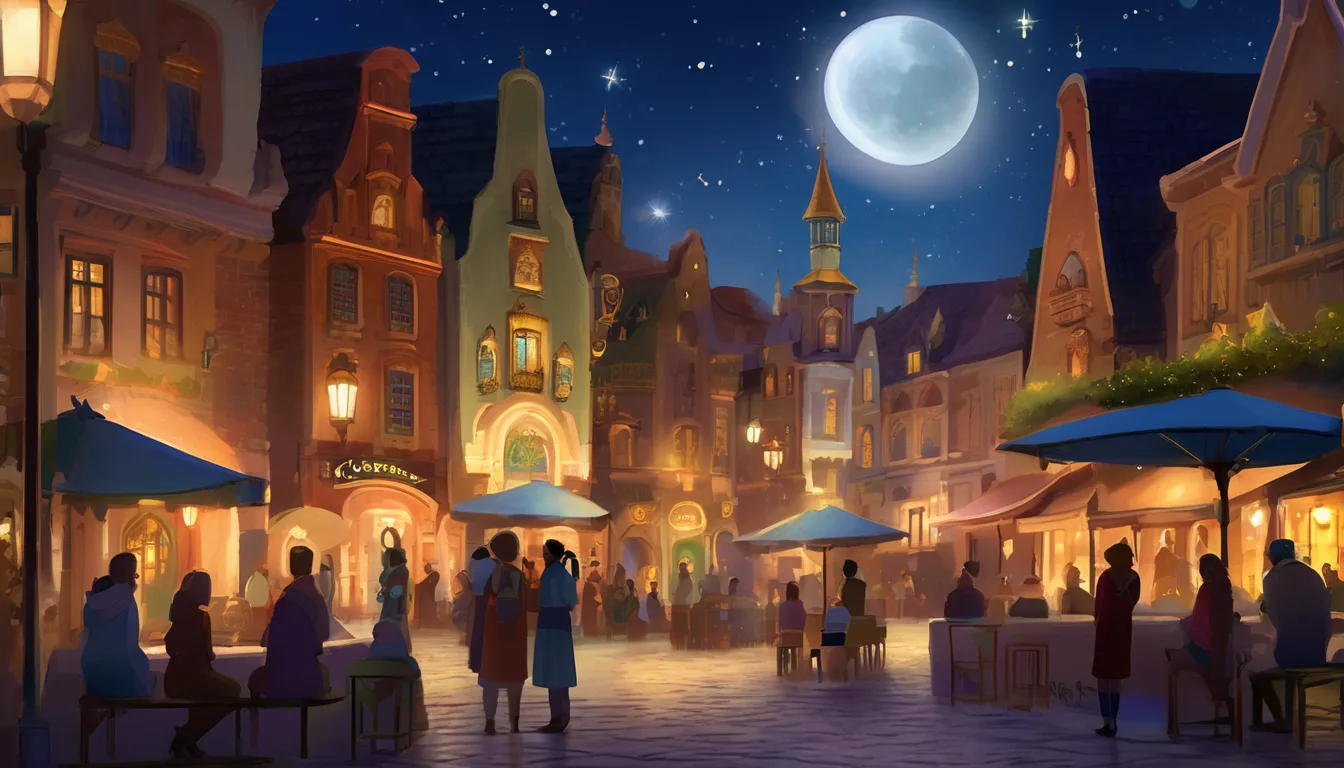
In the little town of Bellweather, the streets curved like ribbons, the rooftops wore red tiles like hats, and every window box overflowed with daisies, mint, and tiny yellow flowers that smelled like lemon cake after rain. Bellweather had a clock tower, a bakery with a blue door, a pond full of patient ducks, and a very unusual town square. In the square stood seven statues, each on a smooth round stone pedestal. By day, everyone knew them well. There was Amina the Brave, holding a lantern high. There was Tomas the Listener, with one hand cupped behind his ear. There was Mei the Maker, carrying a little hammer and a shining silver nail. There was Bako the Gentle Giant, bending down to offer a tiny bird a crumb. There was Suri the Seeker, pointing toward the sky with a telescope under her arm. There was Niko the Jester, balancing a pear on his nose. And there was Grandmother Orla, seated in a stone chair with an open book on her lap.
Visitors came from other towns to see the statues. They took pictures. They ate buns from the bakery and said, “How lovely!” Children liked to climb the low steps around the pedestals, though the grown-ups always reminded them not to climb too high. Pigeons sat on Amina’s lantern and sometimes on Niko’s pear. In winter, snow collected in Tomas’s cupped hand. In summer, bees rested in the folds of Orla’s stone shawl. The statues never moved, not while the sun was up. They stayed perfectly still through market days, parades, school mornings, and rainy afternoons.
But the people of Bellweather had a secret. Or, at least, some of them did.
Every night, when the last bakery lamp was turned low and the moon rose over the clock tower, the statues stepped down from their pedestals.
They did not make a clattering sound, as you might expect from stone feet. No. Their feet made a soft sound like two pebbles being tucked into a velvet pocket. Their joints stretched with little sighs. Amina’s lantern filled with golden fire. Tomas’s stone ears warmed to a rosy pink. Mei brushed dust from her sleeves. Bako blinked his kind, mossy-green eyes. Suri’s telescope twinkled. Niko’s pear gave a polite little hiccup. And Grandmother Orla closed her stone book with a whisper.
Then the seven statues looked all around Bellweather.
They did not go visiting just for fun, though Niko did enjoy fun very much. They went because each statue had a special kind of encouragement to give. Whenever someone in town needed courage, or a listening ear, or help beginning a hard task, or gentleness, or wonder, or laughter, or a warm story before sleep, the statues somehow knew.
Only one child had ever seen them go.
His name was Ren.
Ren lived above the bakery with his father, who made buns shaped like moons, ladybugs, shells, and once, by mistake, a very handsome boot. Ren’s bedroom was in the round corner of the building, where he could see the town square from his window. He had a patchwork quilt with eight different kinds of blue on it. He had a small wooden boat on his shelf. He had three socks under his bed, though no one knew where their partners had gone. And Ren had a habit of waking up in the middle of the night.
Sometimes he woke because of a dream. Sometimes because a cat sang outside his window. Sometimes because his mind was full of questions, such as whether fish got thirsty, or whether clouds ever bumped into one another and said sorry.
One silver-blue night, Ren woke just as the clock tower chimed twelve gentle bells.
Dong.
Dong.
Dong.
He rubbed his eyes and climbed onto the window seat. The town square was bright with moonlight. He expected to see seven statues standing on their pedestals as always.
Instead, he saw Amina stepping carefully down from hers.
Ren pressed both hands to the glass.
Tomas climbed down next, then Mei, Bako, Suri, Niko, and Grandmother Orla. They gathered beneath the clock tower. Niko gave the pear on his nose a tiny spin. Bako caught a sleepy pigeon that had slid from his shoulder and placed it on the fountain rim. Grandmother Orla looked up toward Ren’s window.
Ren froze.
Then she smiled and put one finger to her lips.
Ren nodded so quickly that his hair fell into his eyes.
Amina lifted her lantern. The light inside it swirled in small gold curls, and suddenly a thin bright path appeared on the cobblestones. It led away from the square, past the bakery, past the post office, and toward Willow Lane.
The statues followed the path.
Ren did not even stop to put on matching slippers. He wore one green slipper and one with a red fox on it. He pulled on his cardigan, tiptoed downstairs, and slipped out through the bakery’s side door. The air smelled like cinnamon, wet leaves, and the last warm bread of the day. Ahead of him, the statues moved through the moonlit town.
They were not scary at all.
Amina walked with a steady, brave step. Tomas tilted his head at every small nighttime sound. Mei carried a bag of stone tools that made no noise. Bako had to duck under the laundry lines. Suri gazed up at the stars, whispering their names. Niko walked sideways for a while, just because he liked how it felt. Grandmother Orla moved slowly, her stone shawl rippling as though it were made of soft wool instead of marble.
Their first stop was the yellow house at the end of Willow Lane.
There lived a girl named Marisol, who was meant to begin at the new school in the morning. Her family had moved to Bellweather only four days before. Her bedroom was filled with unopened boxes. One box said BOOKS. One said SPOONS. One said IMPORTANT THINGS, though Marisol could not remember what important things were inside it. She sat awake under her blanket, staring at the dark shape of her school shoes.
“I do not know anyone,” she whispered. “What if I say the wrong thing? What if I cannot find the classroom? What if everyone already has a friend?”
Amina stood outside the window and raised her lantern.
The golden light slipped through the curtains, soft as honey.
Marisol looked up.
Amina did not speak. She simply opened the lantern’s little door. Out flew a flock of glowing paper moths. Each moth had a tiny word written on its wings.
HELLO.
MAY I SIT HERE?
WHAT DO YOU LIKE?
THAT SOUNDS NICE.
The moths fluttered around Marisol’s room, landing on her pillow, her school bag, and the tip of her nose. Marisol giggled.
Then Amina held one hand over her heart and nodded.
Marisol placed her own hand over her heart.
“I can say hello,” she whispered.
Amina’s lantern glowed brighter for one moment, and then the paper moths folded themselves into a small golden square. It landed on Marisol’s bedside table. By morning it would look like an ordinary piece of paper, but when Marisol unfolded it, she would remember all the words she needed.
Ren watched from behind the hedge. His chest felt warm. He had thought courage was something loud, like climbing a mountain or roaring at a dragon. But maybe courage could be as small as saying hello with a shaky voice.
The bright path curled away from Willow Lane and led toward the pond.
At the edge of the water sat Mr. Haruto, the town gardener. He was not usually awake at night. In the daytime, he wore a straw hat and talked to roses while he trimmed their stems. He could make pumpkin vines grow around any fence without letting them get too bossy. But that night he sat on a wooden bench with his hands hanging between his knees.
Beside him was a little wheelbarrow. Inside it was a rosebush that had drooped almost flat.
“I have tried everything,” Mr. Haruto murmured. “Water, shade, fresh soil, songs, kind words. I do not know what else to do.”
Tomas walked quietly to the bench and sat beside him.
For a long time, he said nothing.
Mr. Haruto looked at the pond. A duck snoozed with its beak tucked under one wing. The moon made a long silver road on the water.
“The rosebush belonged to my sister,” Mr. Haruto said at last. “She gave it to me when we were children. She said it would grow big enough for fairies to hold dances beneath. I promised I would take care of it.”
Tomas nodded.
Mr. Haruto’s voice wobbled. “But I cannot fix everything.”
Tomas nodded again, more slowly this time.
Then he cupped one hand behind his ear and leaned closer, not because he had missed a word, but because he wanted Mr. Haruto to know that every word mattered.
Mr. Haruto talked for a long while. He spoke of his sister, who lived far away. He spoke of being tired. He spoke of feeling foolish for worrying over one small plant. The statues sat nearby and listened too. Even Niko did not make a joke. Even the pear was quiet.
When Mr. Haruto had said all there was to say, Tomas placed one stone finger gently on the wheelbarrow handle.
The rosebush gave the tiniest rustle.
A green bud, no bigger than a pea, lifted its head.
Mr. Haruto did not smile because the bush was suddenly perfect. It was not. Its leaves were still droopy, and it still needed care. He smiled because he no longer had to carry his worry all alone.
“Thank you,” he said.
Tomas bowed.
Ren swallowed a lump in his throat. He understood that encouragement was not always telling someone what to do. Sometimes it was sitting close enough to hear the quiet things.
The path continued through the market square, where striped awnings flapped in the breeze. It led to the narrow little house of Oksana, who made umbrellas.
Oksana had made every umbrella in Bellweather. There were yellow umbrellas with duck handles, purple umbrellas with silver stars, enormous green umbrellas for families, and one famous umbrella shaped like a cabbage. But lately, Oksana had stopped making them. Her workshop was full of half-finished handles, bent wires, scraps of silk, and a large sign that read: CLOSED UNTIL I CAN THINK OF SOMETHING GOOD.
Oksana sat at her table with her head in her hands.
“The Rainy Day Parade is tomorrow,” she said to nobody. “Everyone expects something splendid. But every idea I have feels lumpy, or silly, or not nearly wonderful enough.”
Mei the Maker stepped through the open workshop door.
She examined the room. She picked up a crooked umbrella rib. She tapped it with her little hammer. Ting. She held up a scrap of orange silk. She turned it this way and that. She found a button shaped like a snail, a spool of blue thread, a bent teaspoon, and three feathers that had somehow gotten stuck in a pot of glue.
Mei laid all the bits on the table.
Oksana blinked. “Those are only leftovers.”
Mei tapped her hammer once more.
Ting.
Then she began to work.
She did not make the whole umbrella for Oksana. That would not have been true encouragement. Instead, Mei bent one wire into a curling handle. She showed Oksana how the teaspoon could become a tiny scoop for rainwater. She sewed the snail button to the silk and pointed at the three feathers.
Oksana stared.
“A cloud umbrella,” she breathed. “A cloud umbrella that catches rain and sprinkles it out as sparkles!”
Mei grinned.
Soon Oksana was cutting, stitching, twisting, and humming. Her tired eyes began to shine. Ren watched the workshop fill with umbrellas shaped like clouds, raindrops, mushrooms, teacups, and one that looked exactly like a sleepy whale.
Mei tucked her hammer away and gave Oksana a little bow.
“Starting is the hardest part,” Oksana said. “Thank you for helping me find the first piece.”
The next bright path went uphill, past the sleepy library, past the school garden, and up to the old windmill where a boy named Dev lived with his grandmother.
Dev had a very big laugh, very fast feet, and a very small new baby sister named Anu. Since Anu had arrived, Dev’s grandmother was often busy rocking her, feeding her, or humming slow songs. Dev knew babies needed care. He truly did. But that night, he sat outside the windmill with his knees tucked under his chin.
“I used to be the little one,” he told the grass. “Now everybody says, ‘Be gentle, Dev. Be quiet, Dev. Help with this, Dev.’ I do not feel like helping. I feel like stomping.”
Bako the Gentle Giant came up the hill.
He was enormous beside Dev, though not so enormous that he could not sit carefully on the ground. He folded his long stone legs and rested his hands on his knees.
Dev looked at Bako. “Are you going to tell me not to stomp?”
Bako thought for a moment.
Then he reached into the little satchel tied around his waist and took out a smooth, round stone. It was dark blue and fit exactly in Dev’s palm.
Bako placed it there.
Dev squeezed it.
“It is soft,” Dev said in surprise.
The stone was not really soft, not like bread or a pillow. But it was smooth and warm, and somehow squeezing it made Dev’s hands feel less stormy.
Bako pointed toward the windmill window, where baby Anu slept in a basket. Then he pointed to Dev’s chest. Then he held up two fingers.
“Two?” Dev asked.
Bako nodded.
“Two little ones?”
Bako nodded again.
Dev looked through the window. Anu’s tiny hand opened and closed in her sleep.
“I can be upset and still be her big brother,” Dev said slowly.
Bako’s face softened. He leaned down and gave Dev a hug so careful that it felt like being wrapped in a blanket made of sunshine and tree bark.
Dev did stomp once before going inside, but it was a gentle stomp. Then he put the blue stone beside Anu’s basket and whispered, “When you are bigger, I will show you where the best puddles are.”
Suri’s telescope began to sparkle next. It pointed not down into town, but up, up, up toward the hill beyond Bellweather, where the observatory stood.
The observatory belonged to Mrs. Zhen, who had once traveled on ships to study stars from the middle of the ocean. She knew about moon craters, comet tails, and why the night sky looked different in each season. But lately, Mrs. Zhen had not used her big telescope. She had covered it with a sheet.
“I am too old for new questions,” she had told people. “I have seen plenty of stars.”
That night, she sat at her desk, sorting old maps.
Suri peered through the observatory window and knocked gently with the tip of her telescope.
Mrs. Zhen looked up. “Oh,” she said. “It is you.”
Suri nodded and pointed outside.
The two of them climbed to the observatory roof. Ren followed at a distance, hiding behind a tall pot of lavender. Above them, the sky was clear and enormous. Stars shone like pinpricks in a navy curtain. A few thin clouds floated by, pale as milk.
Suri aimed her telescope at a patch of darkness between two familiar stars.
Mrs. Zhen looked through.
At first, she saw nothing.
Then she gasped.
There, very faintly, was a small smudge of light. Not a star exactly. Not a cloud. Something new, or nearly new, or perhaps something that had always been there but had never been noticed before.
Mrs. Zhen looked again. Her eyes widened.
“What are you?” she whispered to the little smudge.
Suri clasped her hands.
Mrs. Zhen laughed, a bright young laugh that bounced over the roof tiles. “Well,” she said, pulling the sheet off her great telescope, “I suppose I have one more question after all.”
Suri smiled at Ren as she passed. Ren looked up at the sky. He decided that questions did not have to keep anyone awake forever. Some questions could be tucked into a pocket for tomorrow.
Near the town square, the statues stopped outside the bakery.
Ren nearly bumped into Bako’s knee.
“Oh!” he whispered.
All seven statues turned toward him.
Niko’s pear rolled down his nose and stopped on his chin. “Aha!” he said. “The fox-slipper spy.”
Ren looked at his feet. He had forgotten about the mismatched slippers.
“I am sorry,” he said. “I did not mean to follow you. I only wanted to see.”
Grandmother Orla came closer. In the moonlight, her face looked wise and gentle, with little lines around her eyes like the paths on a leaf.
“There is nothing wrong with wanting to see,” she said.
Ren looked at the empty pedestals in the square. “Do you do this every night?”
“Every night someone needs us,” said Amina.
“Which is nearly every night,” said Tomas.
“Sometimes people need only a little nudge,” said Mei.
“Sometimes they need someone to sit beside them,” said Bako.
“Sometimes they need a new thing to wonder about,” said Suri.
“And sometimes,” said Niko, balancing the pear on top of his head, “they need to remember that a serious face can still enjoy a raspberry noise.”
He made one.
The pear made one too.
Ren laughed so hard that he had to sit down on the bakery step.
But then Grandmother Orla noticed that his laugh had a small worried sound underneath it.
“What is it, Ren?” she asked.
Ren looked at the dark bakery window. “My father has been tired,” he said. “The bakery is busy, and he says he is fine. But sometimes he sits at the table after I am supposed to be asleep. He looks at all the flour bills and makes a face like he has swallowed a thistle. I want to help him. But I am only Ren.”
Grandmother Orla sat beside him.
“Only Ren?” she said. “That is a very important person to be.”
Ren’s cheeks warmed.
“What kind of encouragement does he need?” he asked.
The statues looked at one another.
Tomas listened to the quiet bakery walls. Mei inspected the floury doorstep. Amina held up her lantern. Bako looked at Ren with kind eyes. Suri gazed at the stars. Niko tapped his pear thoughtfully.
Then Grandmother Orla said, “Perhaps your father needs to remember that love can be useful in surprising ways.”
The statues entered the bakery.
Ren unlocked the side door with the little key his father kept hidden behind a flowerpot. Inside, the bakery was warm and dim. Rows of buns rested under cloths. The big mixing bowl shone on the counter. Ren’s father, Mateo, sat at the kitchen table with his head resting on one arm. He had fallen asleep beside a pile of papers.
Niko climbed onto the table and gently moved a pencil so that it drew a curly moustache on one of the flour bills. Mateo stirred but did not wake.
Mei gathered scraps of dough from a bowl and shaped them into tiny stars. Bako carried sacks of flour from the floor to a neat shelf. Tomas folded the papers into piles, one pile for tomorrow, one pile for later, and one pile that simply said BREATHE. Suri opened the skylight so a square of starlight fell on the mixing bowl. Amina placed her lantern beside Mateo’s hand.
Grandmother Orla opened her stone book.
From between its pages fluttered a soft little story, not written in letters, but made of pictures. It showed a baker waking before dawn. It showed children choosing moon buns. It showed old Mrs. Zhen buying cinnamon rolls after watching the stars. It showed Mr. Haruto trading roses for bread. It showed Marisol sharing a ladybug bun with a new friend at school. It showed Dev saving the fox-shaped bun for his baby sister’s future birthday.
Mateo opened his eyes.
He blinked at the glowing pictures.
Then he saw Ren standing in the doorway.
“Ren?” Mateo whispered.
“I know you are tired,” Ren said. “I cannot make all the buns. But I can help with some things. I can put the napkins out. I can draw signs. I can tell people which bun is shaped like a boot.”
Mateo smiled, first with his mouth, then with his whole face.
“You are not only Ren,” he said. “You are my helper, my taste-tester, my best good-morning person, and the finder of lost socks.”
Ren leaned against him.
The statues quietly began to leave. Before they went, Mateo looked at the glowing lantern, the starry dough, the tidy papers, and the pear now wearing a floury cap.
“Did I dream all that?” he asked.
Niko winked.
“Probably,” said the pear.
Just before dawn, the statues returned to the square. The bright path faded behind them. They climbed onto their pedestals one by one. Amina lifted her lantern. Tomas cupped his hand to his ear. Mei held her hammer. Bako offered his crumb to the bird. Suri pointed toward the sky. Niko balanced his pear. Grandmother Orla opened her book.
By the time the first pink light touched Bellweather’s rooftops, they were stone again.
Ren stood in the square wearing his mismatched slippers. He looked at them for a long moment.
In the morning, people noticed little things.
Marisol went to school with a folded golden square in her pocket and said hello to a girl who liked purple crayons. Mr. Haruto found a new rosebud in his wheelbarrow and decided to call the rose Moon Listener. Oksana led the Rainy Day Parade beneath a cloud umbrella that sprinkled silver sparkles. Dev carried baby Anu’s blanket without being asked, although he still stomped when he needed to. Mrs. Zhen invited the whole town to look through her telescope. And Mateo hung a new sign in the bakery window.
It said:
BUNS MADE WITH FLOUR, BUTTER, AND HELP FROM REN.
That night, Ren went to bed very tired in the nicest way. He put both slippers neatly beside his bed, though they still did not match. His father tucked the blue patchwork quilt around him.
“Will the statues go out again tonight?” Ren asked sleepily.
“Perhaps,” Mateo said.
Ren looked through the round window at the town square. The seven statues stood silent beneath the moon. A pigeon slept on Amina’s lantern. The fountain made a small splashing sound. Somewhere, a cat sang one wobbly note.
Ren smiled.
He knew that if someone in Bellweather felt scared, or lonely, or stuck, or cross, or tired, or full of questions, the statues would know. When the clock struck twelve, they would step down softly from their pedestals. They would walk the moonlit streets with their lantern, telescope, hammer, book, pear, gentle hands, and listening ears.
And if they ever passed the bakery, perhaps they would find a little boy waiting by the window, ready to help them notice who needed encouragement next.
Then Ren closed his eyes.
The town grew quiet.
The moon kept watch.
And somewhere in the square, very softly, a stone pear gave a tiny bedtime hiccup.



Leave a Reply