
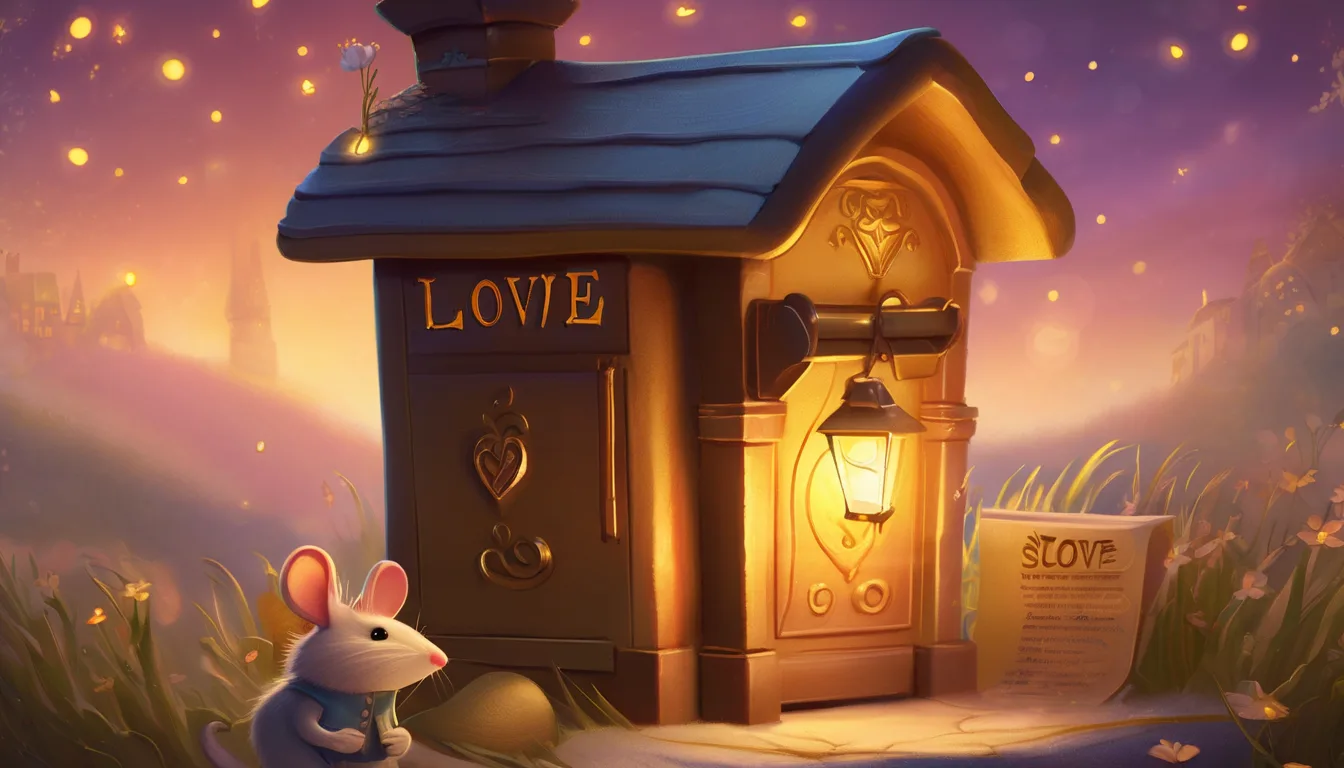
In the little town of Bellwether, where chimneys wore curly caps of smoke and every doorstep had a pot of mint growing beside it, there stood a mailbox unlike any other.
It was painted a glossy blue-green, like a beetle’s wing after rain. It had a brass flag shaped like a feather, a tiny round window in its door, and three pearly buttons along the side.
Nobody remembered who had put it there.
It stood at the end of a cobbled lane beside the house of a child named Miro.
Miro was seven years old and liked to collect small, important things: smooth stones with white stripes, buttons that looked like moons, feathers with bent tips, and secrets that had been accidentally spoken by grown-ups.
For many years, Miro had believed the strange mailbox was ordinary.
The postman never used it. Letters placed inside it never seemed to go anywhere. And every morning, it was empty except for a dry leaf, a ladybird, or once, a polite snail who had fallen asleep on the warm metal floor.
Then, one windy autumn evening, just as the sky turned the color of plum jam, the mailbox’s brass feather began to twitch.
Tap.
Tap-tap.
Tap-tap-tap!
Miro, who was sitting on the front step tying string around a pinecone, stared at it.
The little round window glowed from inside.
Then the mailbox door sprang open with a bright, cheerful ding!
Out slid a creamy envelope.
On the front, in curling blue ink, were written the words:
FOR MIRO, IN REPLY
Miro looked over both shoulders.
The lane was empty. Mrs. Baladi’s cat was asleep in a flowerpot. A bicycle leaned against a fence. Far away, someone was playing a wobbly tune on a flute.
“In reply to what?” Miro whispered.
The envelope smelled faintly of cinnamon and rain.
Miro opened it carefully.
Inside was a single sheet of paper.
Dear Miro,
I forgive you.
I had not realized you were scared too.
I am glad you will tell me.
Your friend,
Sana
Miro’s heart gave a surprised little bump.
Sana lived two houses away. She had thick dark hair that she wore in two bouncing braids, and she could whistle through an acorn cap. Miro and Sana had been best friends all summer. They built a castle from sticks in the willow woods. They made a soup of rose petals and grass, which tasted terrible but looked beautiful. They taught Mrs. Baladi’s cat to jump over a teaspoon.
But three days ago, something sad had happened.
They had found a very old, very small door at the bottom of a hill behind the bakery. The door had a silver handle and no house around it.
“I think it goes to a secret place,” Sana had said.
“I think we should open it,” Miro had said.
But when the handle gave a tiny click, and a puff of cold, blue-smelling air came out from the crack beneath the door, Miro had become frightened.
Miro had shouted, “Don’t!”
Sana had jumped back.
Then Miro had said something worse.
“You always ruin things by rushing!”
Sana’s face had become still. Not angry-still. Hurt-still.
She had gone home without a word.
For three days, Miro had wanted to say sorry. But each time Miro saw Sana’s yellow gate, all the words hid behind Miro’s teeth.
Now here was a reply from Sana.
I forgive you.
Before Miro had even written.
The mailbox made a soft humming sound.
Another envelope slid out.
FOR MIRO, IN REPLY
This one was addressed in green ink.
Dear Miro,
Yes, you may come with us.
There will be room by the window.
Bring your red scarf because the mountain wind is very chilly.
Love,
Grandmother Yelena
Miro blinked.
Grandmother Yelena lived far away in a village where the roofs were red and goats wore bells around their necks. She had written last month to say she might take a train trip through the mountains in spring.
Miro had wanted very much to ask, May I come?
But Miro had not asked.
Miro had worried Grandmother Yelena would say no.
Miro held the letter against a chest that suddenly felt warm and fizzy.
Then the mailbox gave another ding.
A third envelope appeared.
FOR MIRO, IN REPLY
This envelope was gray, and the writing on it was neat and serious.
Dear Miro,
Of course I am not disappointed.
You do not have to be perfect to be loved.
Tomorrow is another chance.
Love,
Papa
Miro did not open that one right away.
The wind had started to swish the branches overhead. A few leaves danced along the lane, round and round Miro’s boots. Through the kitchen window, Miro could see Papa washing dishes, his elbows foamy with soap.
That afternoon, Miro had knocked over a bowl of flour while trying to help make bread. Flour had gone everywhere. On the floor. On the chairs. In Papa’s hair. Miro had run away before Papa could say anything.
All evening, Miro had carried a heavy little stone inside.
Now the letter waited in Miro’s hand.
You do not have to be perfect to be loved.
The mailbox’s pearly buttons began to glow one by one.
Pink.
Gold.
Blue.
Then a tiny voice came from inside.
“Before-writing replies are very delicate things,” it said.
Miro crouched beside the mailbox. “Who said that?”
A pair of round spectacles rose slowly behind the tiny window. Underneath them was a small face covered in soft gray fur.
“Good evening,” said the creature. “I am Toma, Keeper of the Almost-Said.”
“Are you a mouse?” Miro asked.
“I am a mail-mouse,” said Toma. “A distant cousin of ordinary mice, but with better handwriting and stronger opinions about stamps.”
Miro peered through the window. Toma sat at a desk no bigger than a shoe box. There were shelves behind him stuffed with envelopes. Some fluttered their corners anxiously. Some snored. One wore a ribbon.
“Did you send these?” Miro asked.
“The mailbox did,” said Toma. “It delivers replies before letters are written. But only once in a while. Only when somebody’s heart has a knot that needs loosening.”
Miro looked at the three envelopes.
“So Sana will forgive me? Grandmother Yelena will take me on the train? Papa won’t be disappointed?”
“Those are possible replies,” said Toma. “They are not promises. They are echoes from the kindest paths ahead.”
Miro frowned. “What does that mean?”
Toma adjusted his spectacles.
“It means a reply may arrive before a letter, but it is still your job to write truthfully. You have one evening. By moonrise, you must decide what you truly want to say. Not what makes you look clever. Not what keeps everyone from feeling cross. The true thing.”
“And if I don’t?”
“The letters will become ordinary paper,” said Toma. “Very good for wrapping sandwiches, but not much else.”
Miro looked toward the kitchen window again.
“What if I write the wrong thing?”
“Then you can write another thing tomorrow,” Toma said gently. “Most people think words are doors that lock behind them. But good words are more like garden gates. They can open again.”
With that, Toma tipped his little cap.
The mailbox door shut.
Ding.
Miro hurried into the house.
At the kitchen table, Papa had finished washing up. There was flour still dusted along one eyebrow, which made Miro almost laugh, but the heavy little stone was still there.
Miro took a piece of paper from the drawer. The first words were easy.
Dear Papa,
Then Miro stopped.
Miro wrote:
I am sorry about the flour.
That was true.
But it was not all of the true thing.
Miro chewed the pencil end and listened to the clock tick. In the next room, the kettle began to sing.
At last Miro wrote:
I am sorry about the flour, and for running away. I thought you would be angry because I made such a big mess. I want to help clean it tomorrow. I also want to learn how to make bread, even if it gets flour in your eyebrows again.
Miro read it aloud in a quiet voice.
Papa, who had been pouring tea, turned around.
“That sounds like a very interesting letter,” he said.
Miro’s cheeks turned pink. “I haven’t given it to you yet.”
“I can wait,” said Papa, smiling.
The stone in Miro’s chest became smaller.
Next, Miro wrote to Grandmother Yelena.
At first, Miro wrote:
May I come on your train trip?
But then Miro thought about mountains, and cold blue mornings, and sitting by the window while valleys rolled past. Miro thought about how much Grandmother Yelena loved quiet moments, and how Miro sometimes forgot to be quiet when excited.
So Miro wrote:
Dear Grandmother Yelena,
May I come on your train trip if you still have room? I would like to see the mountains with you. I will bring my red scarf, and I will try to sit quietly when the view is beautiful, so we can look at it together.
Love,
Miro
That one made Miro feel bright, like a lantern had been lit behind the ribs.
But Sana’s letter was hardest.
Miro carried a blank paper upstairs. The room was dark except for moonlight, pale as milk, on the floorboards. Miro sat on the bed with knees tucked under the chin.
Dear Sana,
Miro wrote.
Then came a long, long pause.
Outside, the willow trees whispered. Somewhere in the town, a dog barked twice and decided that was enough.
Miro remembered Sana’s face by the little silver door.
I was scared, Miro wrote.
Then:
I said you ruin things, but that wasn’t true. I was scared of what might be behind the door, and I wanted you to be scared too, so I wouldn’t feel alone. That was unkind. I am sorry. I miss you. Tomorrow, if you want, we can go back to the little door, but we do not have to open it. We can just sit beside it and eat apple slices.
Your friend,
Miro
Miro looked at the words for a long time.
They did not make Miro feel clever.
They did not make Miro feel safe from everything.
But they felt true.
Downstairs, the clock began to chime.
One.
Two.
Three.
Miro raced out into the lane in slippers, holding the three letters.
The moon had climbed above the rooftops. It looked round and yellow, as though it had been painted on the sky with honey. The strange mailbox shone blue-green in the moonlight.
Its brass feather lifted.
Miro placed the letter to Papa inside.
Then the one for Grandmother Yelena.
Then Sana’s letter.
For one breath, nothing happened.
Miro’s stomach wobbled.
Then the mailbox gave a deep, happy hum.
Its three pearly buttons glowed pink, gold, and blue. The little round window filled with stars, though Miro knew there were no stars inside a mailbox.
Toma the mail-mouse appeared behind the glass.
“Well posted,” he said.
“Will the replies come true?” Miro asked.
Toma smiled kindly.
“Some replies do. Some change. Some take longer than expected. But you have done the important part.”
“What part?”
“You have sent your true words out into the world,” said Toma. “Now they know where to go.”
The mailbox door clicked shut.
The wind softened.
Miro stood for a moment beneath the moon, no longer holding any letters. The lane seemed brighter than before. Even Mrs. Baladi’s cat, awake now, blinked slowly from the flowerpot as if it understood something very wise.
The next morning, Papa found Miro’s letter beside the teapot. He read it, hugged Miro, and said, “We shall make bread this afternoon. Aprons on. Flour in bowls, if possible.”
Three days later, a letter arrived from Grandmother Yelena. It said there was indeed room by the window, and perhaps Miro could help count the goat bells at the mountain station.
And the very next afternoon, Sana came to Miro’s gate.
She held the letter in one hand and a small paper bag in the other.
“I brought apple slices,” she said.
Miro swallowed. “I’m sorry.”
Sana nodded. “I was scared too. But I didn’t want to say it.”
They walked together toward the hill behind the bakery, where the tiny old door waited beneath its blanket of moss.
The silver handle still gleamed.
They sat beside it without opening it.
They ate apple slices in the soft afternoon sun.
And after a while, Sana put her hand beside Miro’s on the grass, close enough that their little fingers touched.
Neither of them said anything for a moment.
They did not need to.
Above them, in the willow branches, a breeze moved through the leaves like the rustle of many tiny envelopes, carrying all the almost-said things gently home.
Leave a Reply