
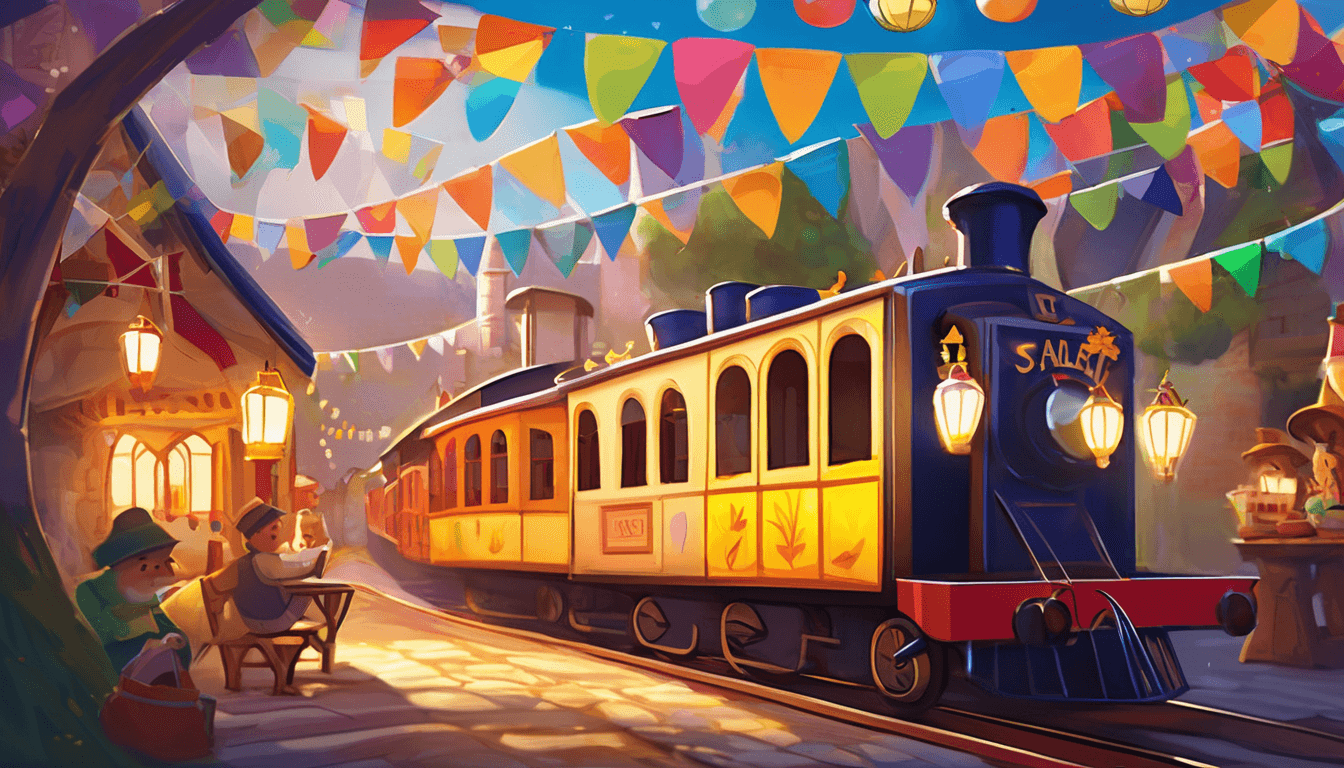
In the little town of Bellwether, the days of the week arrived by train.
Sunday came in a sleepy blue carriage with velvet curtains. Tuesday wore a cap with a brass whistle and brought baskets of useful ideas. Thursday usually stepped off with a pocket full of buttons, because Thursday liked things to be fastened properly.
But Monday was the grandest arrival of all.
Every Monday morning, at exactly seven chimes past the first toast popping, a silver train rolled into Bellwether Station. Its engine puffed clouds shaped like briefcases, loaves of bread, pencils, and sensible shoes. Monday himself, a tall fellow in a gray coat with bright yellow socks, would climb down from the train and call, “Good morning! Time to begin!”
Then the baker began baking, the teacher began teaching, the postmistress began posting, and everyone remembered where they had put their hats.
But one bright Saturday, something went wrong.
It began with a duck.
Not an ordinary duck, of course. Bellwether had plenty of ordinary ducks, and they were all very busy being ducks near the fountain. This was a station duck named Mallow, who believed that train tickets were a sort of delicious paper cracker.
Mallow waddled into the ticket office, saw a stack of shiny schedules, and gobbled the corner off every single one.
The station clock tried to help.
“Saturday!” it chimed.
But Mallow had swallowed the bit that said Saturday.
“Monday!” the clock chimed instead.
Far away, in the Day Depot beyond the hills, Monday heard the call.
“Monday to platform one!” cried the conductor.
Monday looked at the calendar. “But it is Saturday.”
The conductor pointed at the schedule. “The clock has spoken.”
Monday was very serious about clocks. So he buttoned his gray coat, straightened his yellow socks, climbed aboard his silver train, and hurried toward Bellwether.
At seven chimes past the first toast popping, the silver train burst into Bellwether Station.
The engine puffed clouds shaped like briefcases, bread, pencils, and sensible shoes.
Monday stepped down.
“Good morning!” he called. “Time to begin!”
All across town, people stopped in the middle of their Saturday.
Mrs. Kazumi, the baker, was wearing floury slippers and making cinnamon cloud buns for no reason at all. She blinked at Monday through a curtain of flour.
“But I was planning to begin nothing today,” she said.
At the town pond, Mr. Bako had one foot in a fishing boat and one foot on the dock. “I was going to finish sitting quietly,” he said.
In the market square, little Ansel and his grandmother, Oma Sabine, were halfway through building a kite shaped like a pear.
“It needs a tail,” Ansel said.
“It needs six tails,” said Oma Sabine.
“Actually,” said Monday, pulling out a list as long as a scarf, “there are many things in Bellwether that need finishing.”
Everyone gathered around.
Monday cleared his throat.
“Three letters have been started but not written. One fence has been painted up to the goat’s nose. Seven socks have no partners. The town band has rehearsed a song but not chosen an ending. A birthday cake has icing on only one side. A row of carrots has been planted in the shape of a question mark. And someone has begun teaching a goat to play the tuba.”
A soft tuba note floated down the street.
Bwoooomp.
From the window of the music shop, a goat named Nuri looked out with a tuba around her middle.
“That is my project,” said Mr. Ivo, the music teacher. “Nuri has shown promise.”
Monday looked kindly at the goat. “I am sure she has.”
Then he unrolled more of the list.
“There are forty-two unfinished drawings, nine half-knitted mittens, a mystery pie with no filling, and a small bridge over the stream which has been built from both sides but does not meet in the middle.”
“Oh dear,” said the mayor, Mrs. Odelia, who had been trying to spend Saturday polishing the town’s ceremonial spoon.
“Monday,” she said, “you have arrived early.”
Monday’s yellow socks drooped.
“I have?”
“By two days,” said Oma Sabine.
There was a silence.
Even Mallow the duck, who had just waddled into the square with a bit of timetable stuck to his beak, went quiet.
Monday sat down on a bench.
“I am sorry,” he said. “I did not mean to rush anyone. I simply thought it was time for beginnings.”
Ansel looked at the long list. Then he looked at the town, where half-finished things seemed to peek from every doorstep and window.
There was a wooden toy horse with only one ear.
There was a mural of a moon with no stars around it.
There was a jam jar labeled PLUM? with a question mark painted in purple.
Ansel’s eyes grew round.
“What if,” he said slowly, “Monday can be here, but we do not have to do Monday things?”
The grown-ups looked at him.
“What would we do instead?” asked Mayor Odelia.
Ansel pointed at the list.
“We could have a festival for everything we forgot to finish!”
Now, Bellwether was a town that could turn almost anything into a festival. They had held the Festival of Lost Buttons, the Parade of Extremely Small Hats, and once, during a very rainy spring, the Puddle Appreciation Week.
So the people began to nod.
Mrs. Kazumi clapped her floury hands. “We shall call it the Almost-Done Festival!”
“The Nearly-There Jubilee!” cried Mr. Bako.
“The Not-Quite-Yet Fair!” called Mr. Ivo, while Nuri played a proud, wobbly tuba note.
Mayor Odelia lifted the ceremonial spoon.
“Let all three names be used,” she declared. “That way, nobody has to finish deciding.”
And so, on a Saturday that had accidentally become Monday, Bellwether held the Almost-Done Festival, the Nearly-There Jubilee, and the Not-Quite-Yet Fair.
First, everyone brought their unfinished things to the market square.
Mrs. Kazumi carried the one-sided birthday cake. People took turns decorating the bare side with strawberry stars, lemon moons, and tiny sugar umbrellas.
Mr. Bako brought his half-carved wooden boat. Children painted little windows on it, and a toddler named Nessa put a blue dot near the front.
“What is that?” Mr. Bako asked.
“A porthole for a fish,” said Nessa.
Nobody knew why a fish would need a porthole, but it seemed important, so they kept it.
Oma Sabine hung the pear kite from the fountain. Everyone added a ribbon tail. Soon it had six tails, then twelve, then so many tails that the kite looked like a pear-shaped jellyfish dancing in the breeze.
At the bridge by the stream, people carried planks, ropes, and sandwiches. The two half-bridges had been built very carefully, but between them was a gap exactly as wide as one sleeping badger.
No one had noticed the badger sleeping there.
His name was Toma, and he was curled up on a mossy stone with his nose tucked under his paw.
“We cannot build over him,” whispered Ansel.
“He looks too comfortable,” whispered Monday.
So the townspeople laid a little blanket over Toma and waited.
While they waited, they began finishing other things.
The postmistress, Farah, set up a Letter Tent. Everyone could complete a letter they had meant to write.
One letter began, Dear Cousin, I saw a very strange turnip.
Another began, Thank you for the scarf, though the left sleeve is mysterious.
Ansel wrote to his uncle in the city.
Dear Uncle Ren,
Today Monday came on Saturday. There is a goat playing tuba. I think you should visit soon.
From Ansel.
He held the letter up. “Is it finished?”
Farah read it and smiled. “It is finished enough to travel.”
That made Ansel feel warm inside.
Nearby, the town band gathered beneath the clock tower. They had been practicing a song called “The March of the Magnificent Turnips,” but could never decide how it ended.
“It should end loudly!” said the drummer.
“It should end softly,” said the flute player.
“It should end with a turnip-shaped dance,” said Mr. Ivo.
Nuri the goat gave a thoughtful bwoooomp.
Monday, who had been standing quietly nearby, said, “What if it ends in all three ways?”
So the band played loudly, then softly, and finally everyone danced like turnips rolling down a hill.
It was the silliest ending anyone had ever heard, which meant it was perfect.
By afternoon, the square was bright with completed things. The fence had fresh paint all the way past the goat’s nose. The question-mark carrots had been gently moved into a neat row, though one carrot was left crooked because it looked cheerful that way. The mystery pie was filled with apples, blackberries, and one tiny spoonful of plum jam.
The lonely socks were given names and made into puppets, because nobody could find their partners.
But then the sky began to turn peach and lavender, and a worried whisper moved through the crowd.
“What about Sunday?” someone asked.
Everyone looked toward the station.
If Monday was here on Saturday, where was Sunday?
Monday’s face went pale beneath his gray hat.
“Oh,” he said. “Sunday must be waiting at the Day Depot. And if I do not return soon, Tuesday will not know where to go. Then Wednesday may arrive on Thursday, and Thursday might bring buttons on Friday, and everything will become terribly tangled.”
The festival suddenly seemed smaller.
Ansel looked at the silver train. “Can’t you go back?”
“I can,” Monday said. “But only if the station clock sends the right call.”
They all turned toward the clock tower.
The clock’s hands pointed firmly to MONDAY.
And beneath it, Mallow the duck hiccuped.
A tiny strip of shiny paper fluttered from his beak.
Oma Sabine bent down and read it.
“SATUR…”
Mallow hiccuped again.
“…DAY.”
“The missing schedule!” cried Mayor Odelia.
Mallow waddled away quickly, but not quickly enough. He had very short legs and a very round tummy. Ansel followed him through the square, past the cake, under the pear kite, around Nuri’s tuba, and straight into the Letter Tent.
Mallow climbed onto Farah’s desk and stared at a bowl of water.
“Perhaps he is thirsty,” Ansel said.
Farah brought him a fresh dish of water with three peas floating in it.
Mallow drank. He swallowed. He hiccuped.
And out popped the last crumbly piece of the timetable.
Mayor Odelia carefully pressed all the pieces together.
The station clock gave a shiver.
Its minute hand spun backward. Its hour hand spun forward. A tiny door in its face opened, and a clockwork bird popped out.
“Saturday!” it sang.
Then it sang, “Saturday! Saturday! Saturday!”
Monday sighed with relief.
The silver train gave a gentle puff.
“I must go,” he said.
“But you helped us finish everything,” Ansel told him.
Monday shook his head. “No. You did that yourselves. I only arrived with a list.”
Before he boarded, he reached into his coat pocket and took out a small silver bell.
“For Bellwether,” he said. “Ring it whenever you have too many unfinished things. Not because you must hurry. Only because sometimes it helps to gather together, share what is left undone, and make a little room for one another.”
The mayor accepted the bell.
Then Monday climbed aboard his train. It rolled away into the evening, puffing clouds shaped like pillows, sleepy cats, and tomorrow’s toast.
A few minutes later, Sunday arrived on schedule, wearing a blue coat and carrying a basket of slow, quiet hours.
Sunday stepped onto the platform and looked around Bellwether.
The town square was covered in ribbons, paint pots, letters, pie crumbs, and happy people. A goat was asleep inside a tuba. A badger was snoring beneath a new bridge. And the pear kite, with all its many tails, floated over the fountain like a friendly moon.
“What happened here?” Sunday asked.
Ansel smiled.
“We almost finished a festival,” he said.
Sunday nodded thoughtfully.
“That sounds like the best kind.”
That night, Bellwether went to bed tired in the soft, satisfied way that comes after laughing, helping, painting, writing, dancing, and eating a slice of pie with a very mysterious crust.
And just before Ansel fell asleep, he heard the little silver bell ring once in the mayor’s house.
Not loudly.
Not urgently.
Just enough to remind the town that unfinished things could wait sometimes.
And when they could not wait, they might become something wonderful.

Leave a Reply