
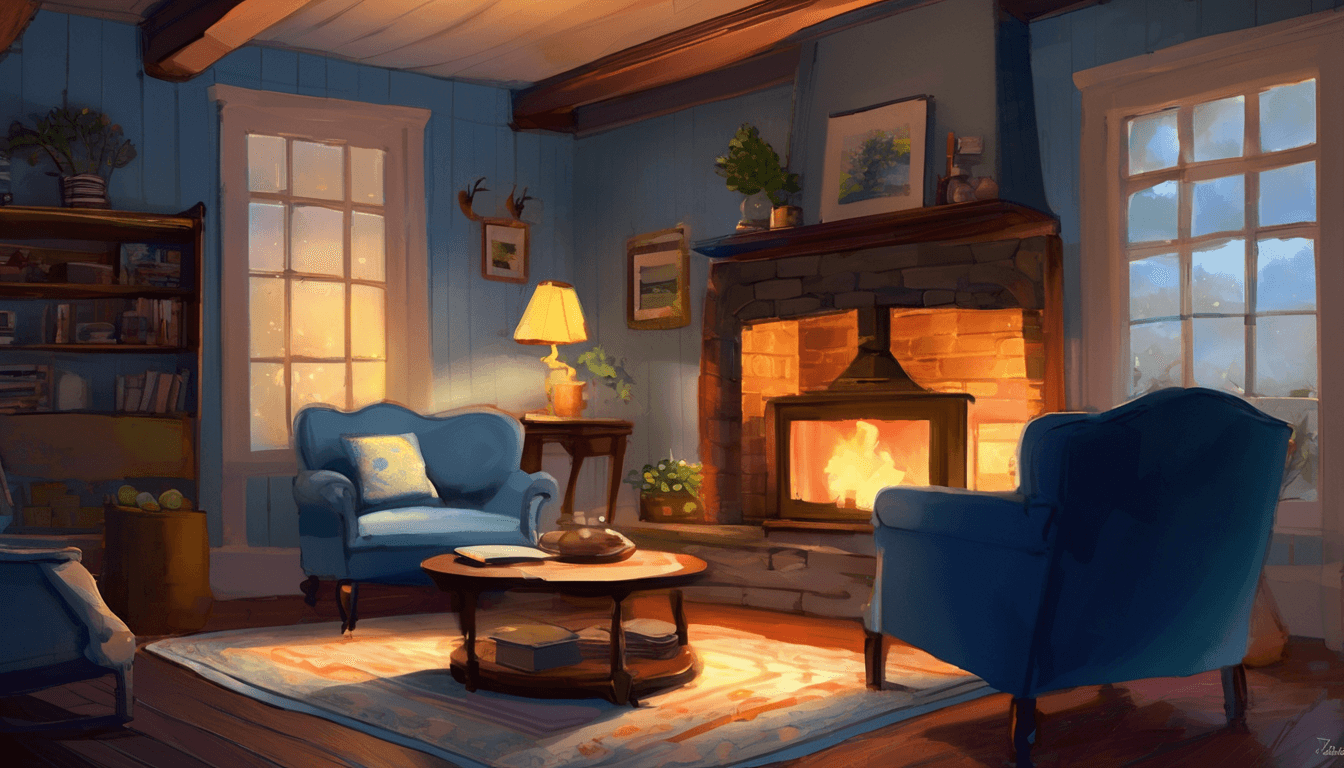
In a blue house at the end of a lane where foxgloves nodded over the fences, there lived the Ibarra family.
There was Mamá Rosa, who made soup that smelled of carrots and rain. There was Papa Luis, who could fix nearly anything except a sock with a hole in the toe. There was Grandmother Anouk, who wore shiny slippers and kept peppermints in her pockets. And there were the children, Tomi and Suki, who shared a room beneath the round attic window.
The blue house had six rooms, not counting the little cupboard under the stairs.
There was the kitchen, warm and busy, with yellow curtains and a breadboard shaped like a fish.
There was the sitting room, with a soft green rug, a fireplace, and a large blue sofa that had lost one button long ago.
There was the dining room, where everyone gathered for birthdays, rainy Sundays, and any occasion Grandmother Anouk felt needed a pie.
There was the hallway, narrow but important, with an umbrella stand that looked like a brass trumpet.
There was Tomi and Suki’s attic bedroom, full of blankets, paper stars, a toy train, and the sound of pigeons walking on the roof.
And there was the grown-ups’ room, peaceful and pale, where moonlight lay across the floor each night like a silver scarf.
The Ibarra family thought their furniture was ordinary.
They were very wrong.
Each evening, after the children had brushed their teeth, after the lamps had been switched off, after Papa Luis had said, “Good night, little comets,” and Mamá Rosa had said, “Dream of something kind,” the house became quietly busy.
At precisely twelve minutes past midnight, the grandfather clock in the hallway gave one very polite cough.
“Ahem,” said the clock.
The blue sofa stretched its cushions.
The dining chairs shuffled closer together.
The little kitchen stool hopped once, twice, and then hid behind the flour tin because it was shy.
The furniture was gathering for its nightly meeting.
It had begun three weeks earlier, on the first cold night of autumn.
Nobody knew exactly why.
Perhaps it was because the wind had blown a leaf straight down the chimney and into the fireplace.
Perhaps it was because Grandmother Anouk had dropped a peppermint behind the sideboard, where it had rolled beneath the floorboards and made the house smell sweet.
Or perhaps it was because every piece of furniture had suddenly begun wondering the very same thing.
Which room felt most like home?
“I say it is clearly the sitting room,” announced the blue sofa on the first night. Her name was Zora, and she was rather proud of her wide arms and springy cushions. “People sit on me when they are tired. They curl up on me when it rains. They whisper secrets into my pillows. Home is where people rest.”
“Rest is very nice,” said the dining table.
The dining table was called Haruto. He was round, polished, and wore a white lace cloth only on special days.
“But home is where people come together,” he continued. “In my room, they share breakfast. They tell stories over supper. They clap when someone has good news. Last week, Suki lost a tooth, and everyone gathered around me to admire the tiny gap in her smile. Surely that is home.”
The kitchen stool peeked out from behind the flour tin.
“My room smells the best,” it squeaked.
All the furniture paused.
This was difficult to argue with.
The kitchen cupboard doors nodded. The kettle puffed a little cloud of steam, though it had not been put on the stove.
“The kitchen has toast,” said the stool bravely. “And cinnamon. And soup. When Tomi has a cold, Mamá Rosa sits him at the table and gives him honey in warm milk. That is very home-like.”
From the hallway came a scrape, scrape, scrape.
It was the old coat stand, dragging one wooden foot along the floor. His name was Bemba, and he was tall, thin, and always wore at least two scarves, three hats, and Papa Luis’s raincoat.
“You are all forgetting the hallway,” Bemba said.
“The hallway?” said Zora the sofa.
“The hallway?” said Haruto the dining table.
“The hallway,” repeated Bemba. “Everyone passes through it. It welcomes them when they come in wet from the rain. It holds their boots, their gloves, their umbrellas, their schoolbags. It is the first place that says, ‘Here you are.’ And it is the last place that says, ‘Come back soon.’”
This made the furniture think.
Then, from far above, came a little thump.
The furniture looked up.
Tomi and Suki’s wooden toy chest had sent a message down through the heating pipes.
“THE ATTIC ROOM!” boomed the toy chest, whose name was Omid and whose voice was much larger than his hinges. “The attic room is where dreams live. I hold dragons made from socks, paper crowns, a one-eyed rabbit, and seven marbles that belong nowhere. The children laugh there. They sing there. They make shadow puppets on the wall. How could any room feel more like home?”
For a whole minute, nobody spoke.
The furniture had all made excellent points.
So they decided to vote.
Zora the sofa voted for the sitting room.
Haruto the table voted for the dining room.
The kitchen stool voted for the kitchen.
Bemba the coat stand voted for the hallway.
Omid the toy chest voted for the attic room.
Then all eyes turned toward the old walnut bed in the grown-ups’ room.
Her name was Mireya. She had curved posts, a quilt covered in faded red flowers, and a calm, creaky voice.
“Well?” asked the blue sofa. “Which room feels most like home?”
Mireya did not answer right away.
At last she said, “I think we need more meetings.”
So every night, after the moon rose above the foxgloves, the furniture held a meeting.
They spoke of what they had seen that day.
The sofa told them about Papa Luis falling asleep with a newspaper on his face.
The dining table described Grandmother Anouk teaching Suki how to fold napkins into swans.
The kitchen stool reported that Tomi had eaten only the raisins from his oatmeal and claimed the rest had “disappeared by magic.”
The hallway coat stand spoke fondly of the family’s muddy boots all lined up together.
And Omid the toy chest told tales of pillow forts, bedtime giggles, and a mysterious crayon drawing of a purple elephant wearing boots.
Still, the furniture could not agree.
Each room seemed full of something precious.
Then, one windy evening, something happened.
It began with a storm.
The rain tapped and tapped and tapped against the windows. Branches brushed the roof. The old blue house made small settling sounds, as if it were pulling its blanket closer.
Tomi woke first.
“I heard a growl,” he whispered.
Suki sat up in bed. “That was thunder.”
“It sounded like a giant hungry bear.”
“It was a thunder bear, then.”
Another rumble rolled across the sky.
Tomi slipped from bed, carrying his blanket. Suki followed with her one-eyed rabbit tucked under her arm.
They went down the attic stairs to the hallway.
But the hallway was dark, and the coat stand looked very tall in the flashing lightning.
“I do not like the thunder bear,” Tomi said.
Suki held his hand.
They went into the sitting room.
The blue sofa waited in the dark, big and soft. The children climbed onto her and tucked themselves under a knitted blanket.
“Home,” whispered Zora to herself.
But the storm rattled the windows, and Suki began to sniffle.
“I want Mamá,” she said.
At once, the two children hurried through the hallway, past Bemba the coat stand, and into the grown-ups’ room.
Mamá Rosa woke up just enough to lift the quilt.
“In you come,” she murmured.
Papa Luis moved over. Grandmother Anouk appeared at the doorway in her shiny slippers, carrying an extra blanket and somehow, even at midnight, a peppermint.
Soon everyone was gathered on Mireya the bed.
Tomi was pressed against Mamá Rosa’s warm shoulder. Suki had her rabbit. Papa Luis had placed a hand on each child’s back. Grandmother Anouk sat at the end of the bed and told them, in a soft voice, about a cloud that was afraid of the dark until it learned the stars were always waiting above it.
Outside, the storm continued.
Inside, the family breathed together.
The furniture watched from their rooms.
And then something strange happened.
The house itself gave a long, happy creak.
The blue sofa understood first.
“Oh,” she said.
Haruto the table gave a gentle tap of one wooden leg.
“Oh,” he said too.
The kitchen stool made a tiny hop.
“Oh.”
Bemba the coat stand sighed, and one of Papa Luis’s hats slipped over his face.
Even Omid the toy chest, high in the attic, went quiet.
They had been asking the wrong question.
It was not which room felt most like home.
It was not the room with the best smells, the biggest cushions, the finest meals, or the coziest bed.
Home was not hiding in one place at all.
Home moved.
It followed the family from room to room.
It sat at the dining table when hands reached for bread.
It curled on the sofa during rainy afternoons.
It waited in the hallway with a dry towel and a pair of slippers.
It lived in the kitchen beside a bubbling pot.
It hid in the attic among paper stars and toy rabbits.
And now, on this stormy night, it was gathered beneath a faded red quilt, breathing softly in the dark.
The next midnight, the grandfather clock gave his polite cough.
“Ahem. Shall we begin the meeting?”
But before anyone could speak, Mireya the bed said, “I believe we have reached a decision.”
The furniture waited.
“Every room feels most like home,” she said, “when the family is in it.”
There was a lovely silence.
Then Zora the sofa said, “I would like that written down.”
Haruto the table agreed. “In a very important book.”
The kitchen stool said, “With crumbs on the page.”
Bemba said, “And perhaps a hat.”
Omid boomed from the attic, “AND A DRAWING OF A PURPLE ELEPHANT IN BOOTS!”
So the furniture made a new rule.
They would still hold meetings every night.
But no more voting.
Instead, they would each share one small thing that had made the house feel like home that day.
A laugh.
A hug.
A soup smell.
A muddy boot.
A song sung badly and proudly.
A lost tooth.
A tear wiped away.
A blanket tucked under a chin.
And in the blue house at the end of the lane, where foxgloves nodded over the fences, every room became a little warmer.
Not because of the fireplace.
Not because of the kettle.
Not even because of Grandmother Anouk’s peppermints.
It was because home had never belonged to just one room.
It belonged to all the people who loved one another inside it.
And long after the storm had wandered away, Tomi and Suki slept safely beneath their attic window, while downstairs the sofa settled her cushions, the table stood tall and shining, the stool dreamed of cinnamon, and the coat stand held everybody’s hats.
The old blue house wrapped itself around them all.
Then it gave one final, contented creak.
And went to sleep.
Leave a Reply